

California income tax power of attorney form: Master 2025
Understanding the California Tax Power of Attorney
When dealing with California tax matters, the california income tax power of attorney form is your key to authorizing someone else to handle your tax affairs with the state. Here’s what you need to know:
Quick Answer: How to Get the California Income Tax Power of Attorney Form
- Primary Form: FTB 3520-PIT (Individual or Fiduciary Power of Attorney Declaration)
- Where to Get It: Download from ftb.ca.gov or file online through MyFTB
- Alternative Forms: Modified IRS Form 2848, IRS Form 8821, or handwritten documents
- Validity: Generally lasts 6 years from signature date
- Cost: Free from the California Franchise Tax Board
A Power of Attorney (POA) declaration gives another person the legal right to look at your account information, talk to the FTB on your behalf, send information, and represent you in tax matters. The California Franchise Tax Board requires specific forms and procedures that differ from federal requirements.
Whether you’re facing an audit, need ongoing tax representation, or simply want someone to handle routine communications with the FTB, understanding how to properly obtain and complete the california income tax power of attorney form is essential for California taxpayers.
I’m David Brillant, a Certified Specialist in Estate Planning, Trust and Probate Law with a Masters in Taxation. I regularly help clients steer complex tax matters, including properly executing the california income tax power of attorney form to ensure their representatives have the necessary authority to handle FTB matters effectively.
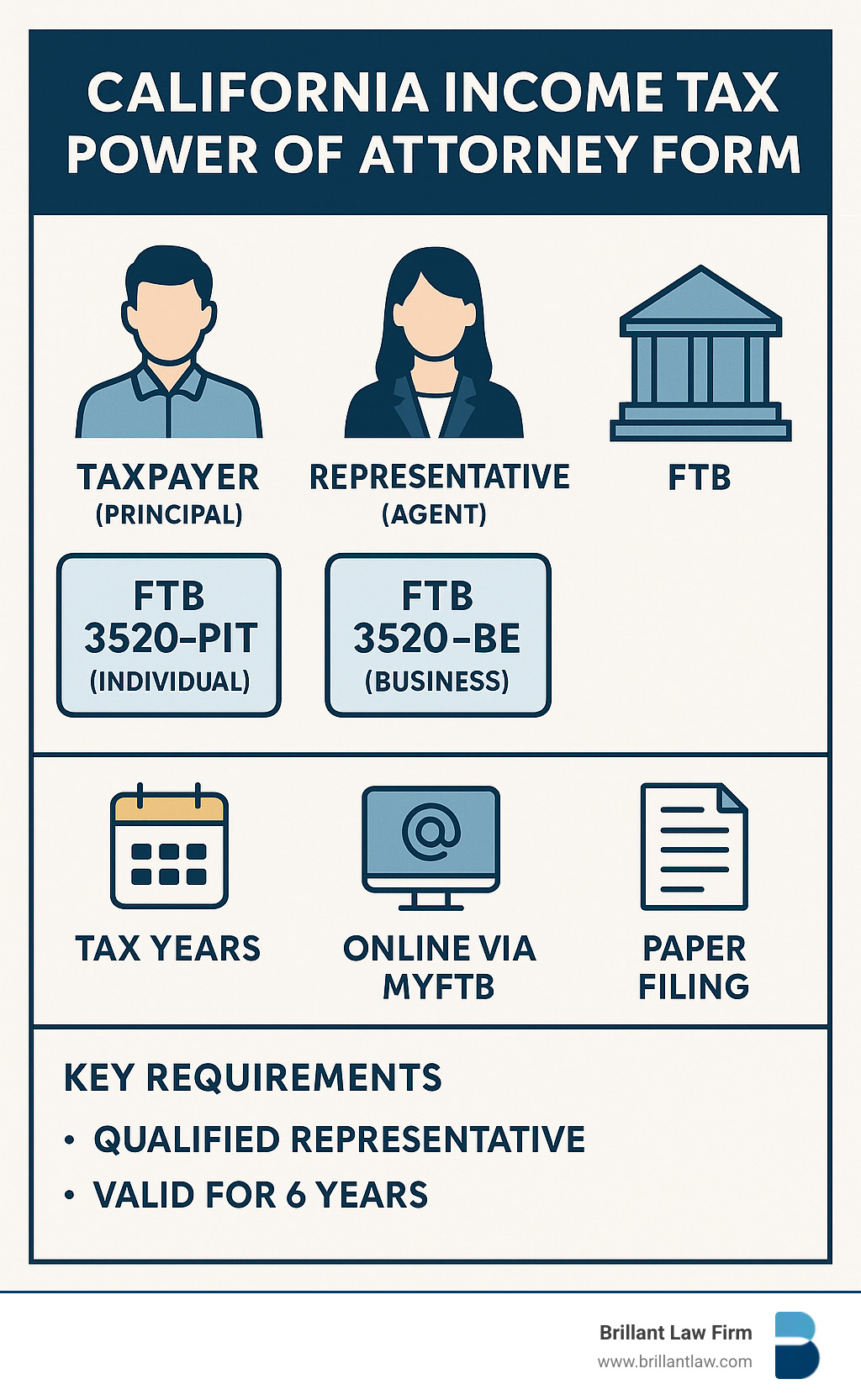
California income tax power of attorney form terms to remember:
What is a Power of Attorney for California Income Tax?
A Power of Attorney (POA) for California income tax is a legal document that lets you (the “principal”) authorize someone else (your “agent” or “representative”) to handle your tax matters with the Franchise Tax Board (FTB). This allows your representative to communicate with the FTB, access your confidential tax information, and represent you during audits, disputes, or other proceedings. A POA is essential if you are ill, traveling, or prefer a professional to manage your tax affairs. The authority you grant can be broad or limited to specific actions and tax years. Our tax lawyers are experts in ensuring your POA is structured to manage your tax affairs precisely as you intend. More info about what tax lawyers do.
Who Can You Appoint as a Representative?
When using the california income tax power of attorney form, you must appoint an individual, not a company or firm. While you can hire an accounting or law firm, the POA form must name a specific person from that firm.
The FTB recognizes several types of representatives:
- Attorneys: Licensed attorneys in California.
- Certified Public Accountants (CPAs): California-licensed CPAs.
- Enrolled Agents (EAs): Tax professionals authorized by the IRS.
- Family Members or Trusted Individuals: You can appoint a non-professional, like a spouse or friend, but ensure they understand the responsibility.
Choosing a representative is a critical decision, as they will have access to your sensitive financial data. Select someone trustworthy and knowledgeable about tax matters. Find a California Tax Advisor.
Power of Attorney vs. Tax Information Authorization (TIA)
It’s crucial to distinguish between a Power of Attorney (POA) and a Tax Information Authorization (TIA). While both grant a third party access to your tax information, their authority differs significantly.
Here’s a comparison:
| Feature | Power of Attorney (POA) | Tax Information Authorization (TIA) |
|---|---|---|
| Primary Purpose | To authorize a representative to act on your behalf and represent you in tax matters with the FTB. | To authorize a representative to receive and inspect your confidential tax information. |
| FTB Form Used | FTB 3520-PIT (Individual/Fiduciary) or FTB 3520-BE (Business Entity) | FTB 3534 (Tax Information Authorization) |
| Scope of Authority | Broad. Allows the representative to communicate, receive notices, sign waivers, execute agreements, resolve issues, and generally represent you. | Limited. Allows access to information, but does not grant the authority to act on your behalf or represent you in formal proceedings. |
| Ability to Act | Yes, can represent you, negotiate, and sign certain documents (with specific authorization). | No, cannot represent you, negotiate, or sign documents. Primarily for information gathering. |
| Confidential Info Access | Yes, full access to confidential tax information. | Yes, access to confidential tax information. |
| Online Account Access | Can request full or limited online account access for tax professionals via MyFTB. | Can request limited online account access for tax professionals via MyFTB. |
| Duration | Generally 6 years, or until revoked. | Generally 1 year, or until revoked. |
In short, a POA (FTB 3520) allows someone to act for you—negotiating with the FTB, responding to audits, and resolving issues. A TIA (FTB 3534) only allows them to view your records. If you need active representation, you need a california income tax power of attorney form.
The Official California Income Tax Power of Attorney Form: FTB 3520-PIT
The primary california income tax power of attorney form is the FTB 3520-PIT (Individual or Fiduciary Power of Attorney Declaration). This is the standard FTB form for individuals and fiduciaries (e.g., estate executors, trustees).
For businesses, the correct form is the FTB 3520-BE (Business Entity or Group Nonresident Power of Attorney Declaration). This serves the same purpose for corporations, partnerships, and other business entities.
Using these official forms ensures you provide all necessary information, which leads to faster processing. Tax professionals often submit them via the MyFTB online portal for the quickest turnaround. While alternatives exist, we recommend starting with the official FTB 3520 form.
Download the official FTB 3520-PIT form.
How to Obtain the Form
You can obtain the california income tax power of attorney form in several ways:
- MyFTB Online Portal: The fastest method is to file electronically through a MyFTB account. This provides immediate confirmation and the quickest processing.
- Download PDF: You can download the form from ftb.ca.gov, fill it out, and mail it.
While online submission is preferred, paper filing exceptions exist for situations like declared disasters, certain impairments, or appointing a family member without professional credentials. Other exceptions cover first-time filers, estates, and active-duty military in combat zones.
If mailing, send the form separately from tax returns to the following address to avoid delays:
POA UNIT
PO BOX 2828
RANCHO CORDOVA CA 95741-2828
Online submission via MyFTB is the most efficient option.
Alternative Accepted Forms
While the FTB 3520 forms are official, the FTB accepts several alternatives as a valid california income tax power of attorney form, provided they contain all required information.
- Modified IRS Form 2848: The federal POA form is acceptable if modified to state it applies to “Franchise Tax Board matters” and includes all necessary details like specific tax years. More about IRS Form 2848.
- Modified IRS Form 8821: Similar to Form 2848, this can be used for information authorization if modified for the FTB.
- Joint Form BOE-392: This multi-agency California form works if the FTB box is checked and all information is complete.
- Handwritten Documents: A letter can serve as a POA if it includes your and your representative’s full details, a clear statement of authority, specific tax years, and your dated signature.
- General or Durable Power of Attorney: A legal POA can be used if it specifies authority for FTB tax matters and includes all required details.
Despite this flexibility, using the official FTB forms is recommended to avoid errors and processing delays.
How to Correctly Complete the FTB 3520
Completing the california income tax power of attorney form (FTB 3520) correctly is crucial to avoid rejection. Pay close attention to these key sections:
- Taxpayer Information: Enter your full name, current address, phone number, and SSN or ITIN. For estates or trusts, use the FEIN. This information must exactly match FTB records.
- Representative Details: You can name up to three individuals. Provide their complete contact information. For tax professionals, include their PTIN, California CPA license number, State Bar number, or CTEC number.
- Authorization Scope: You must list specific tax years (e.g., “2021, 2022, 2023” or “2020-2024”). Do not write “all years.” You can include up to three future tax years.
- Additional Authorizations: This optional section lets you grant special powers, such as allowing your representative to receive (but not cash) your refund checks or, in rare cases, sign tax returns.
- MyFTB Online Account Access: Grant your tax professional digital access to your account information for more efficient service.
- Signature: The form is not valid without your original, handwritten signature and date. For paper forms, electronic signatures or stamps are not accepted.

Double-checking each section before submission can prevent significant delays. If you need assistance, consider professional guidance. Get help from an Income Tax Attorney.
Key Requirements for the California Income Tax Power of Attorney Form
To ensure your california income tax power of attorney form is processed without issues, remember these critical requirements:
- Use the Correct Form: FTB 3520-PIT for individuals/fiduciaries and FTB 3520-BE for businesses.
- Provide Exact ID Numbers: Your SSN, ITIN, or FEIN must match FTB records.
- List Specific Tax Years: Never write “all years.” List specific years or a range, including up to three future years.
- Appoint Individuals Only: You cannot name a firm or company as a representative.
- Sign and Date the Form: An original, handwritten signature is required for paper filings.
Following these rules is the best way to avoid rejection and delays. Read the official FTB instructions.
Powers and Limitations You Can Grant
The california income tax power of attorney form allows you to grant your representative a range of powers. You can customize the level of authority to fit your needs.
Common Powers You Can Grant:
- Receive and Inspect Information: Access confidential tax information, notices, and correspondence.
- Communicate with the FTB: Discuss your tax matters directly with FTB staff.
- Represent You: Act as your advocate during audits, collections, and appeals.
- Sign Waivers: Extend the statute of limitations for assessment, which can provide more time to resolve issues.
- Execute Agreements: Enter into settlements or closing agreements (with explicit authorization).
- Receive Refund Checks: Your representative can receive your refund check, but they cannot endorse or cash it.
- Sign Tax Returns: This is rarely granted and only allowed under specific circumstances, such as incapacitation or extended absence from the U.S.
Important Limitations:
- Authority must be for specific tax years, not “all years.”
- Online MyFTB account access requires separate authorization.
- A tax POA does not grant authority for representation in court.
Common Mistakes When Filing the California Income Tax Power of Attorney Form
Filing the california income tax power of attorney form correctly is essential to avoid rejection. Here are common, avoidable mistakes:
- Vague Tax Years: The most frequent error. You must list specific years (e.g., “2020-2024”), not “all years.”
- Mismatched Information: Your name, SSN, and address must exactly match FTB records. Update your information with the FTB before filing if it has changed.
- Listing a Company as Representative: Only individuals can be representatives. Name a specific person, not a firm.
- Missing or Invalid Signature: A paper form requires an original, handwritten signature and date. Stamps or electronic signatures are not allowed.
- Using Outdated Forms: Always download the latest version of the form from the FTB website.
- Confusing Disclosure with Representation: Be careful not to check a box that limits your representative to only receiving information if you need them to act on your behalf.
Taking time to double-check your form can prevent significant delays. If you face a rejection or complex issues, professional help is available. Avoid issues with a Tax Litigation Lawyer in California.
The Lifecycle of Your FTB Power of Attorney
Once you’ve successfully filed your california income tax power of attorney form, it enters its lifecycle with the FTB. Understanding how long it lasts, how to extend it, and how to revoke it is just as important as knowing how to fill it out. Think of it like a gym membership – you need to know when it expires and how to cancel it if your needs change!

How Long is a POA Valid and How is it Extended?
A california income tax power of attorney form (FTB 3520) is generally valid for 6 years from the signature date. This allows for continuity in handling long-term tax matters.
Any POA filed on or before January 1, 2018, expired on December 31, 2023. If your POA dates from that period, you must file a new one to maintain representation.
To extend a POA, you simply submit a new, completed FTB 3520 form. There is no separate renewal process. The new form will be valid for another 6 years. Filing a new POA before the old one expires ensures there is no gap in representation.
How to Revoke or End a Power of Attorney
You or your representative can revoke a california income tax power of attorney form at any time. The process is straightforward:
- Write “REVOKE” on a Copy: Write “REVOKE” in large letters across the top of a copy of the original POA, then sign, date, and mail it to the FTB.
- Submit a Signed Statement: If you don’t have a copy, mail a signed letter that includes your information, your representative’s information, and a clear statement that you are revoking the POA.
- File a New POA: Filing a new POA for the same tax years automatically revokes any prior POAs for those years. To keep a prior POA active for different tax years, you must attach a copy of it to the new form and state your intention to keep it.
Mail revocations to the POA Unit at PO BOX 2828, RANCHO CORDOVA CA 95741-2828. For faster processing, you can fax the request to 916.843.5440.
How the FTB Processes POAs and Grants Online Access
Once a california income tax power of attorney form is submitted, the FTB reviews it for accuracy. Approved POAs are recorded in their system. The process is fastest when filed online through the MyFTB portal.
Tax professionals (Attorneys, CPAs, EAs) can use a MyFTB account to manage client matters efficiently. Online submission of a POA leads to much faster authorization compared to mail.
MyFTB offers two levels of online access for professionals:
- Limited Access: View-only access to notices and correspondence from the last 12 months.
- Full Access: View tax returns, payments, balances, and correspondence, and take action on the account for authorized years.
An major benefit of online access is email notifications. The FTB sends electronic notices to representatives instead of paper copies, ensuring real-time updates. If a POA form is rejected, the request for online access is also denied, highlighting the need for accuracy. For complex situations like an audit, a representative with full online access is invaluable. Get help with an IRS Audit.
Frequently Asked Questions about the California Tax POA Form
When it comes to the california income tax power of attorney form, we’ve heard just about every question you can imagine over the years. While the process is straightforward once you understand it, there are always those specific situations that make you scratch your head and wonder, “Wait, what about this?” Let me address the most common questions that come up in our practice.
What happens if I file a joint return?
Even if you file a joint tax return, each spouse or Registered Domestic Partner (RDP) must file their own separate POA declaration. The FTB requires individual authorization from each taxpayer to access their confidential information. If you and your spouse want the same representative, you must each complete and sign a separate FTB 3520-PIT form. This ensures your representative has the proper legal authority to act for both of you.
Can I use the federal IRS Power of Attorney form for California?
Yes, but with modifications. You can use a federal IRS Form 2848 (Power of Attorney) or IRS Form 8821 (Tax Information Authorization) for California tax matters, but you must clearly write “Franchise Tax Board” or “FTB” on the form. The modified form must also include all information the FTB requires, such as your representative’s full contact details and the specific California tax years involved. While this is an option, using the official california income tax power of attorney form (FTB 3520) is recommended to prevent errors and ensure faster processing.
What if I make a mistake on the form?
If you make a mistake or omit information on your california income tax power of attorney form, the FTB will return the form to you unprocessed. This means your representative is not authorized, which can cause significant delays, especially during an audit. Common errors include missing signatures, not specifying tax years, or providing information (name, address, SSN) that doesn’t match FTB records. To avoid this, double-check all information against your most recent tax return before submitting. If your form is returned, correct the errors indicated in the FTB’s letter and resubmit it.
Need Help with Your California Tax Matters?
Navigating California tax issues, from completing a california income tax power of attorney form to facing an FTB audit, can be overwhelming. You don’t have to handle it alone.
At Brillant Law Firm, our team specializes in California’s unique tax landscape. We provide bespoke, ironclad strategies for complex tax issues, ensuring your representation is handled correctly. Whether you need help with a POA form, representation during audits and appeals, or long-term tax planning, we are here to guide you.
Our expertise goes beyond forms; we focus on ensuring compliance while protecting your interests and minimizing your tax burden. We act as your advocates, translating the FTB’s complexities into clear, actionable advice. Tax mistakes can be costly, but with experienced professionals on your side, you can have peace of mind.
Don’t let tax complexities overwhelm you. Let our knowledge and experience work for you. Contact a California Tax Attorney for a consultation.


