

Tax Reduction Strategy: Smart Savings 2025
Beyond Filing, Towards Financial Artistry
A tax reduction strategy involves legally lowering your taxable income and the amount of tax you owe. For high earners, this typically includes:
- Maximizing contributions to tax-advantaged retirement accounts like 401(k)s and IRAs.
- Leveraging all eligible deductions and credits specific to your financial situation.
- Strategically managing investments to minimize capital gains taxes.
- Optimizing business structures and related deductions if you own a company.
For high-net-worth individuals and business owners, managing taxes is about proactive planning and using the tax code to your advantage. In California, strategic tax reduction is key to protecting your wealth.
I’m David Brillant. My practice helps high-net-worth individuals and business owners in Walnut Creek, Saranap, San Miguel, and Castle Hill steer complex tax situations. We craft bespoke tax reduction strategy solutions to legally minimize your tax burden. This guide will walk you through advanced techniques to do just that.
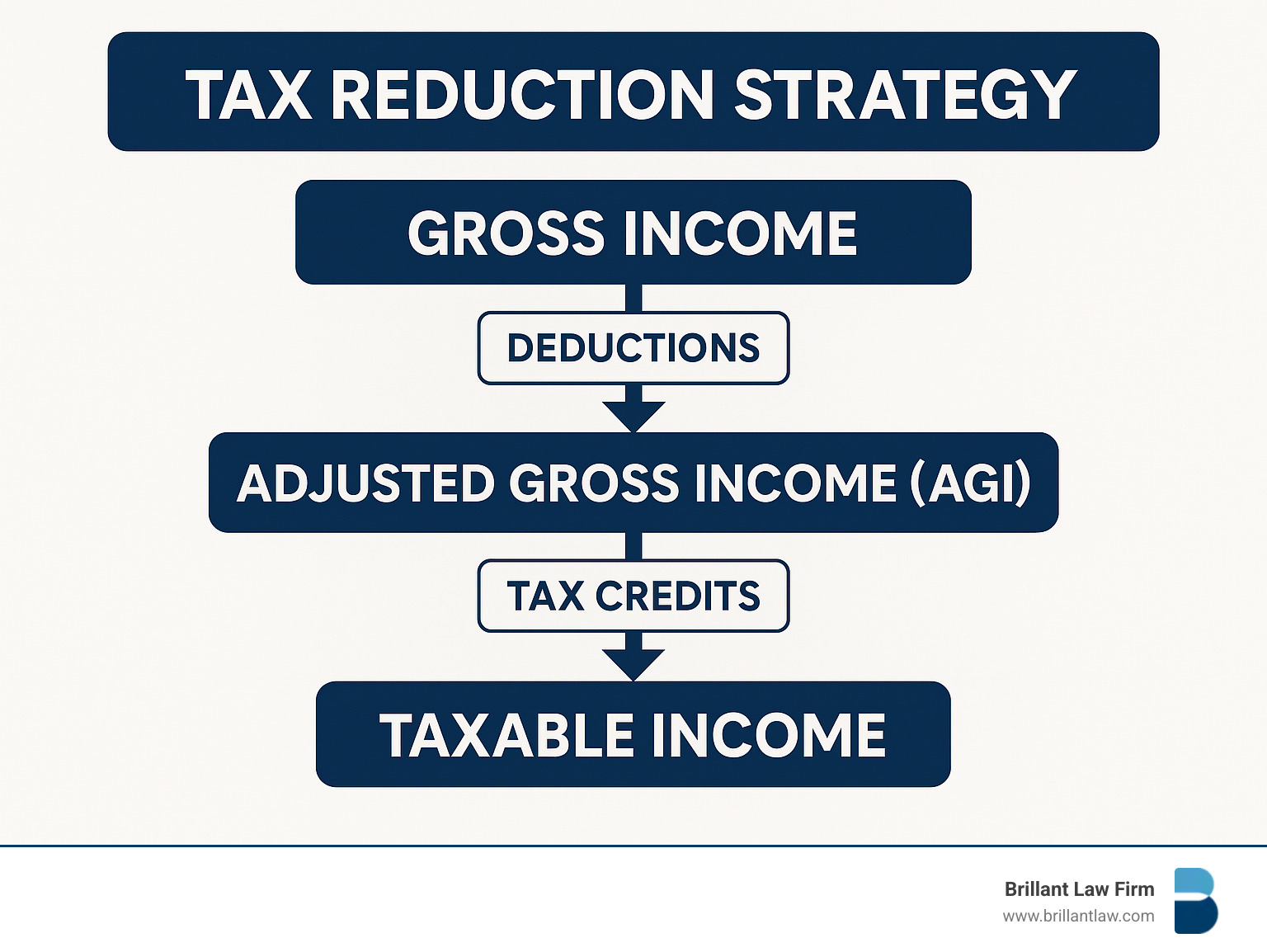
Tax reduction strategy terminology:
Foundational Pillars: Maximizing Deductions and Credits
Deductions and credits are the building blocks of any solid tax reduction strategy. For high earners in California, they are the first line of defense against a hefty tax bill.
Many people automatically take the standard deduction without doing the math. For high-income earners in California, itemizing often delivers much better results due to high real estate and state taxes.
Medical expenses are deductible if they exceed 7.5% of your Adjusted Gross Income. It’s worth calculating if you’ve had significant medical costs. State and local taxes (SALT) are capped at $10,000 federally, a frustrating limit for those paying California’s high income and property taxes. Still, you should claim every dollar of that $10,000.
The mortgage interest deduction is valuable in high-value real estate markets like Walnut Creek and San Miguel. Substantial mortgage interest translates to real tax savings.
For more detailed strategies, check out our guide on How to Reduce Taxable Income for High Earners.
A Strategic Approach to Charitable Giving
Charitable giving isn’t just about doing good—it’s about doing good strategically.
A powerful technique is donating appreciated stock instead of cash. If you bought stock for $10,000 that’s now worth $50,000, donating it directly lets you avoid capital gains tax on the $40,000 profit and deduct the full $50,000 value.
Donor-Advised Funds (DAFs) are another sophisticated tool, acting as a personal charitable savings account. You contribute in a high-income year for an immediate deduction, then recommend grants to charities over time. This “bunching” strategy maximizes deductions when your income spikes.
For those 70½ or older, Qualified Charitable Distributions (QCDs) from an IRA are invaluable. You can satisfy your Required Minimum Distributions with tax-free donations directly from your IRA to charity.
Navigating California’s Tax Environment

California’s tax environment can be overwhelming, with high state income and property tax rates. A thoughtful tax reduction strategy is essential for protecting your wealth in communities like Castle Hill and Saranap.
The SALT cap limitation hits California residents hard. While the $10,000 federal deduction is restrictive, understanding how different income types are treated at the state level can still inform your overall planning.
Property tax considerations are important if you own multiple properties. The timing of payments, understanding assessment cycles, and using available exemptions all play into your broader tax picture.
Our deep roots in Walnut Creek, Saranap, San Miguel, and Castle Hill provide insight into the specific challenges local high earners face. This local expertise allows us to craft strategies custom to your situation, considering California’s complex tax code and real estate market.
Advanced Investment and Retirement Tax Reduction Strategy
For those with substantial income, standard tax-saving approaches are insufficient. A well-crafted tax reduction strategy must leverage sophisticated tools within investment and retirement accounts, turning your portfolio into a tax-efficiency machine.
Maximizing 401(k) and IRA contributions is a start. For high earners in California who exceed Roth IRA income limits, the backdoor Roth IRA is a key strategy. It involves contributing to a non-deductible traditional IRA and immediately converting it to a Roth.
Health Savings Accounts (HSAs) offer a rare triple tax advantage: contributions are deductible, growth is tax-free, and qualified withdrawals are tax-free. For high earners who can pay medical costs out-of-pocket, an HSA becomes a powerful, tax-advantaged retirement account.

Tax-loss harvesting is another powerful tool. Selling investments at a loss can offset capital gains. If losses exceed gains, you can use up to $3,000 to reduce ordinary income annually, with leftover losses carrying forward indefinitely.
Strategic investors can also use tax-gain harvesting. In years when your income dips into the 0% long-term capital gains bracket, you can sell appreciated investments tax-free and immediately repurchase them. This provides a free “step-up in basis,” saving on future taxes.
| Feature | Traditional 401(k)/IRA | Roth 401(k)/IRA |
|---|---|---|
| Contributions | Pre-tax (tax-deductible) | After-tax (not deductible) |
| Growth | Tax-deferred | Tax-free |
| Withdrawals (Qualified) | Taxable in retirement | Tax-free in retirement |
The Art of the Roth Conversion
Roth conversions are about playing the long game. When you convert traditional IRA or 401(k) funds to a Roth account, you pay taxes now instead of later. This can save a fortune if you believe tax rates will be higher in the future. Plus, Roth accounts aren’t subject to Required Minimum Distributions during your lifetime, giving you more control over your wealth.
The trick is timing these conversions strategically to avoid pushing yourself into a higher tax bracket. Some of our clients in Walnut Creek and Castle Hill use sophisticated strategies to offset conversion income with other losses, essentially making the conversion tax-neutral.
This is complex territory that requires careful analysis. We help clients execute these conversions as part of their comprehensive Taxation and Tax Planning strategy.
Capital Gains: A High-Earner’s Tax Reduction Strategy
Capital gains taxes can feel like a penalty, but the right approach can minimize their impact. Understanding the difference between short-term and long-term gains is crucial for any tax reduction strategy.
Short-term gains are taxed at your ordinary income rate, which can be brutal for high earners in California. Long-term gains enjoy preferential federal rates of 0%, 15%, or 20%. While very high earners also face the 3.8% Net Investment Income Tax, long-term rates are generally more favorable.
The strategy is to manage when and how you realize gains. Harvest gains at the 0% rate in low-income years and harvest losses to offset gains in high-income years. This timing creates a more tax-efficient outcome. Unused losses can be carried forward indefinitely, per IRS information on carry-over investment losses.
Business and Entity Structuring for Optimal Tax Efficiency
Business ownership provides powerful tax reduction strategy tools. Your choice of business structure can save you thousands in taxes.

Whether you’re in Castle Hill or Walnut Creek, the entity you choose—S-Corporation, C-Corporation, or LLC—matters immensely.
For many business owners, an S-Corporation or an LLC taxed as an S-Corp is the sweet spot. You pay yourself a reasonable salary subject to payroll taxes, but additional profits taken as distributions escape self-employment taxes.
The Qualified Business Income (QBI) Deduction under Section 199A allows eligible pass-through entity owners to potentially deduct up to 20% of their qualified business income. Navigating the rules is complex but the savings can be substantial.
Depreciation offers significant tax advantages. Section 179 expensing lets you deduct the full purchase price of qualifying equipment in the year of purchase. Bonus depreciation allows for an immediate deduction of a large percentage of eligible property costs, providing a substantial write-off.
These strategies are particularly effective for California businesses as they help offset the state’s higher tax burden. For personalized guidance, consider working with our team as your Business Tax Lawyer Near Me.
Leveraging Your Business for Tax Savings
Your business is a sophisticated tax reduction strategy machine. The key is to think beyond basic structures to creative, legitimate ways to reduce your tax burden.
Hiring family members who perform legitimate services can be a smart tax move. Paying them a reasonable salary creates a business expense and can shift income to individuals in lower tax brackets. The IRS requires real work for real pay.
Accountable plans are a clean solution for expense reimbursement. Your business can reimburse you tax-free for expenses like travel, business meals, and home office costs.
Business ownership also provides access to superior retirement plans. SEP IRAs and Solo 401(k)s have contribution limits that dwarf traditional IRAs. A Solo 401(k) can accommodate up to $69,000 in contributions in 2024 ($76,500 if 50 or older).
For our clients in Saranap and San Miguel, maximizing these contributions is a cornerstone of their wealth-building and tax reduction strategy. You reduce current taxable income while building substantial retirement wealth. California also offers specific business credits that many owners overlook, providing further opportunities for savings.
Sophisticated Wealth Transfer and Estate Tax Planning
For high-net-worth individuals in communities like Walnut Creek and Castle Hill, a comprehensive tax reduction strategy must include wealth transfer and estate planning.
Estate planning is the ultimate long-term tax strategy. Proper planning minimizes estate taxes, preventing heirs from being forced to sell assets to pay the tax bill and ensuring your wealth passes efficiently.
Gifting strategies are foundational. The 2024 annual gift tax exclusion allows you to give $18,000 per recipient tax-free, without impacting your lifetime exemption. A married couple can give $36,000 per recipient, moving significant wealth out of your taxable estate over time.
For larger transfers, the 2024 lifetime gift and estate tax exemption is $13.61 million per individual. However, these amounts are scheduled to decrease significantly after 2025, making current planning critical.
Irrevocable Trusts are powerful tools. Once assets are transferred to an irrevocable trust, they are generally removed from your taxable estate, protecting them from creditors and providing tax advantages. Since the trust is irrevocable, expert guidance is essential.
An Irrevocable Life Insurance Trust (ILIT) owns a life insurance policy on your life. The death benefit passes to beneficiaries free of estate taxes, providing liquidity.
Family Limited Partnerships (FLPs) are popular with California business owners. You can transfer business or property interests to an FLP, then gift partnership interests to family. These interests often qualify for valuation discounts, allowing you to transfer more wealth with less of your lifetime exemption.
Tax-exempt life insurance allows cash value to grow tax-deferred. You can access this cash value through tax-free loans or withdrawals (up to your basis), and the death benefit is income tax-free to beneficiaries.
Charitable Remainder Trusts (CRTs) are for those who want to support charities while maintaining income. You transfer appreciated assets, get an immediate tax deduction, and receive income for a set term. The remainder goes to charity, and you avoid capital gains tax on the transfer.
These sophisticated strategies require expert implementation. The complexity of federal and California tax laws makes professional guidance essential, as each family’s situation is unique. At Brillant Law Firm, we understand your wealth represents your life’s work. Our expertise serving high-net-worth families in Walnut Creek, Saranap, San Miguel, and Castle Hill means we understand the unique challenges and opportunities for California residents.
These strategies are highly complex and require the expertise of an Estate Planning Tax Attorney to implement correctly.
Frequently Asked Questions about Tax Reduction
Here are answers to common tax reduction strategy questions from clients across Walnut Creek, Saranap, San Miguel, and Castle Hill.
What is the difference between legal tax avoidance and illegal tax evasion?
This is a critical distinction. The difference is clear, but the consequences of confusing them can be devastating.
Tax avoidance is legal and is what we practice at Brillant Law Firm. It involves using the tax code as intended—leveraging deductions, credits, and legal structures to minimize your tax liability. It’s smart, legal, and your right as a taxpayer.
Tax evasion is illegal and involves willful deceit, such as hiding income or fabricating deductions. The penalties are severe, including hefty fines, interest, and potential prison time.
If you face an audit or tax controversy, don’t go it alone. A qualified Tax Audit Lawyer Near Me can make all the difference.
How can I reduce my capital gains tax bill in California?
California presents unique capital gains challenges. Unlike the federal government, California taxes long-term gains as ordinary income. This means gains can face California’s top 13.3% rate plus federal rates up to 23.8% (including the Net Investment Income Tax).
However, powerful strategies can help:
- Holding assets for over a year is still crucial for saving on federal taxes.
- Tax-loss harvesting is valuable in California, as losses can offset gains taxed at high state rates.
- Gifting appreciated assets to charity allows you to avoid capital gains tax and get a deduction against high-rate California income.
- Investing within retirement accounts shields gains from both federal and California taxes until withdrawal.
- The primary residence exclusion can save married couples up to $500,000 in capital gains taxes when selling a home.
- Qualified Opportunity Zones offer a way to defer and potentially reduce capital gains taxes.
When is the best time to start year-end tax planning?
The biggest mistake high earners make is treating tax reduction strategy as a December activity. By then, most opportunities are gone.
The ideal time for year-end tax planning is Q3 or early Q4 (September or October). This timing is strategic, as it provides a clear picture of your annual income and investment performance.
Starting early allows for a full review of your financial picture. We can project income, analyze investments, and spot issues before they become expensive problems. This provides time to offset stock market gains with losses or accelerate business equipment purchases to leverage Section 179 expensing.
Strategic adjustments take time. Roth conversions and charitable contributions must be completed by December 31st. Consulting a professional early ensures deliberate, well-thought-out moves rather than hasty December decisions. The tax code rewards those who plan ahead.
Conclusion: Craft Your Masterpiece of Financial Efficiency
Tax reduction strategy is like creating a work of art. Building an effective strategy is a year-round discipline requiring patience, skill, and the right guidance.
The strategies we’ve explored—from maximizing deductions to sophisticated Roth conversions and business structuring—are the tools to create a comprehensive plan that protects and grows your wealth.
In California, with our unique tax landscape, this artistry is critical. The complexity of federal and state tax codes means a generic approach is insufficient. Local expertise makes all the difference.
At Brillant Law Firm, we see every client as unique. We don’t use cookie-cutter solutions; we craft bespoke, ironclad strategies custom to your individual and business needs.
Whether you’re in Walnut Creek, Saranap, San Miguel, or Castle Hill, we understand the local nuances that can make or break your tax strategy. Our expertise, dedication, and commitment to excellence ensure you receive the most effective tax planning solutions.
Taxes are a constant, but they shouldn’t control your financial future. With the right tax reduction strategy and professional guidance, you can take control and keep more of your hard-earned money.
Don’t let another year pass watching taxes erode your wealth. Let us help you craft your masterpiece of financial efficiency.
Explore our Advanced Tax Planning Techniques to begin your journey toward a more tax-efficient future.


