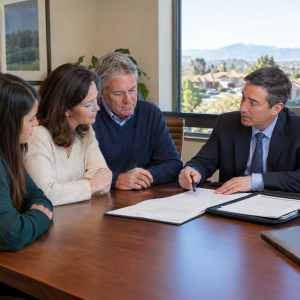
Online estate planning services make it possible to answer questions, organize information, and generate documents from home. For someone beginning to think about a will or trust, that convenience can be valuable. The harder question is whether the finished documents fit the person’s circumstances and whether the steps needed to make the plan effective have actually been completed.
For residents of Walnut Creek, Saranap, San Miguel, and Castle Hill, the choice is not necessarily between technology and an attorney. An online questionnaire can help you prepare for a legal conversation, and attorney-guided planning can begin with information you have gathered digitally. What matters is understanding the difference between producing documents and developing a California estate plan you can rely on.
What online estate planning services do—and what they do not
Most online services ask users a series of questions and generate documents from their answers. This process can help you identify potential beneficiaries, consider whom to appoint to important roles, and assemble a first draft. It can also reveal questions you have not yet resolved.
The resulting packet, however, reflects the information entered. If a question is misunderstood, an asset is omitted, or an option is selected without considering its consequences, a polished document may still miss an important objective. A service designed around common circumstances may not fully address a closely held business, complicated property ownership, changing family relationships, or a potential dispute.
It is also important to distinguish software assistance from legal advice. Before purchasing a service, find out whether a California attorney reviews your particular answers and documents, what that review covers, and whether anyone will help you complete the plan. General customer support may be useful for navigating a website without providing individualized guidance about your choices.
The California Courts’ estate-planning guidance notes that legal forms can be found online, while cautioning that living trusts are complicated and usually require a lawyer’s help. That distinction offers a practical standard: evaluate not only whether a service supplies a form, but whether you understand the decisions, formalities, and follow-through the form requires.
California signing rules deserve separate attention
Generating a document and signing it correctly are different tasks. For example, California Probate Code section 6110 generally requires a will to be in writing and signed by the person making it. It also specifies a process involving at least two witnesses who are present at the same time and sign during that person’s lifetime after witnessing the signing or an acknowledgment, and understanding that the document is the person’s will.
Certified Estate Law Specialist
Brillant Law Firm are Certified Specialist in Estate Planning, Trust and Probate Law
The statute provides a possible exception if clear and convincing evidence establishes the required intent. That is not a sensible execution strategy. Asking a court to resolve a signing defect later can create expense and uncertainty for the people the will was meant to help. Before signing an online will, verify the current California requirements and follow instructions that accurately reflect them.
Notarization presents a different issue. The California Secretary of State’s 2026 Notary Public Handbook states that a California notarial act requires the signer to appear personally before the notary. Although electronic notarization may be performed when the applicable requirements are met, the handbook says California notaries cannot currently perform remote online notarizations through audio-video communication. It describes the Online Notarization Act as not commencing before January 1, 2030, subject to the Secretary of State’s technology project. Because this guidance is time-sensitive, confirm the current rule when you are ready to sign.
Not every estate-planning document needs notarization, and witnessing and notarization are not interchangeable. The necessary steps depend on the document and applicable law. If an online service’s instructions about witnesses, signatures, or a video notary are unclear, pause rather than assume its digital workflow has satisfied California requirements.
A plan involves more than a will or trust
A will describes how property should be distributed after death and may nominate someone to administer the estate. A living trust can establish a framework for managing trust property and distributing it to beneficiaries. Depending on your circumstances, planning may also involve a financial power of attorney, an advance health care directive, and a review of beneficiary designations. These documents address different needs; one does not automatically replace the others.
Incapacity deserves particular attention. A financial power of attorney may authorize another person to handle specified financial matters, while an advance health care directive can record health care instructions and identify an agent for medical decisions. Naming an agent is not merely a data-entry step. Consider whom you trust, what authority the person should have, and who could serve if your first choice cannot.
The same care applies to choosing a trustee, successor trustee, executor, or beneficiary. What should happen if a beneficiary dies before you? Would an outright distribution reflect your wishes, or does a beneficiary need continuing support? Are names and instructions consistent across your documents? A questionnaire may ask for selections without helping you work through the reasons behind them.
Planning can also intersect with property ownership, tax questions, and future administration. Brillant Law Firm’s work spans trusts, estates, taxation, business matters, civil litigation, and appeals. Those areas can become relevant to an estate plan in different ways, particularly when a business interest must be addressed or a family wants to reduce the risk of confusion after a death. No single structure is right for every family; the purpose of individualized review is to determine what fits the facts.
The overlooked work after documents are generated
One of the most consequential questions to ask an online service is: What happens next? A completed download does not necessarily mean a trust holds the property intended for it. California Courts explains that assets need to be put into a living trust for the trust to pass them as intended. How property is titled and transferred therefore matters alongside the trust’s written terms.
Make an inventory of major assets and note how each is owned. Include real property, financial accounts, and business interests where applicable. Record existing beneficiary designations separately. Then identify which items you expect the trust to address and what action, if any, may be needed to coordinate them. Merely describing an asset in a planning document should not be assumed to change its title, account registration, or beneficiary form.
Different assets can require different procedures. A proposed transfer involving real property or a business may warrant review before paperwork is signed. The objective is not to transfer everything automatically; it is to understand how each asset relates to your goals and obtain guidance where the consequences are uncertain.
Execution, storage, and communication also belong on the follow-through list. Know where completed documents will be kept, how the people you appoint can locate them when needed, and which information should be shared now. Brillant Law Firm’s trust planning checklist offers a related framework for preparing a trustee and thinking ahead about beneficiary communication.
When a self-guided service may be a useful starting point
An online process may be useful when your circumstances are comparatively straightforward, the service is designed for California, and you understand both its questions and its limitations. It can help organize names, documents, assets, and goals before a consultation. A draft may make that meeting more productive, provided you treat it as material to evaluate rather than proof that every legal issue is settled.
Compare services by scope instead of price alone. Does the quoted fee include individualized attorney review, signing assistance, or guidance on coordinating assets with a trust? Are changes or corrections included? Can you download complete copies of your documents? Does the provider explain situations it cannot address? A low document-generation price may leave substantial work for you—or for someone who must later resolve an avoidable problem.
Check how the service handles updates, too. Relationships, assets, and priorities can change. A useful process should make it clear how to revisit the plan rather than treating the first set of answers as permanent.
When attorney-guided planning is worth considering
Individualized advice becomes especially important when you own real property or a business, have substantial or varied assets, are part of a blended family, anticipate family conflict, or want to provide structured support for a beneficiary. Prior wills or trusts can also raise coordination questions. None of these facts dictates a particular document; each is a reason to examine the choices more closely.
Consider a consultation if you are uncertain whom to appoint as a fiduciary, how your assets would pass under the proposed documents, whether tax issues merit attention, or what remains to be done after signing. If you have already purchased an online package, an attorney can review the documents and implementation questions without assuming the entire plan must be replaced.
An existing disagreement calls for a different kind of help. If the concern involves a trustee’s conduct, a beneficiary’s rights, or the validity of a will or trust, document-generation software cannot evaluate the dispute. A trust and estate litigation attorney can assess the facts and available options. Families considering a challenge to a trust can also review the firm’s California trust contest guide as background before seeking advice.
When selecting counsel, you can use the State Bar of California’s attorney directory to check an attorney’s profile and explore relevant credentials. The State Bar’s estate planning, trust, and probate law specialist brochure explains the examination, experience, education, and evaluations involved in specialist certification. A credential can inform your questions, but it does not guarantee an outcome or replace a discussion of your needs.
A practical comparison checklist
Before choosing an online service, ask:
- Are its documents and signing instructions intended for California?
- Does an attorney review my specific circumstances, or does the provider supply software and general information?
- What instructions cover witnesses, notarization, document storage, and trust funding?
- Which assets and family situations fall outside the service’s scope?
- What does the price include, and what work will remain after the documents are delivered?
- How can errors be corrected and the plan updated?
Then examine your own information. List existing planning documents, major assets, ownership details, and beneficiary designations. Identify preferred fiduciaries and alternates. Write down your wishes concerning incapacity as well as distribution after death. If you cannot explain how the proposed documents work together—or what you need to do after signing—seek clarification before relying on them.
Finally, set a review reminder. Marriage, separation, a birth or death, a significant asset change, or a business transition can affect your choices. Revisiting a plan means checking related documents and designations, not simply replacing a name on one page.
Planning in Walnut Creek, Saranap, San Miguel, and Castle Hill
For people in Walnut Creek, Saranap, San Miguel, and Castle Hill, an online service can make preliminary planning convenient. Local, attorney-guided review serves a different purpose: connecting California requirements to your property, family, and objectives. Two households in the same community may need very different approaches because their ownership arrangements, intended beneficiaries, and concerns differ.
Brillant Law Firm works with clients in these communities on trusts and estates alongside related tax, business, and litigation matters. If you are comparing a self-guided package with legal counsel, a conversation can help identify what the package covers, what remains unfinished, and whether a tailored plan is appropriate. Bring any online documents and signing instructions you already have, together with an asset list and your questions. If you have not started, a concise description of your goals is enough to begin the discussion.
Frequently asked questions
Are documents from online estate planning services valid in California?
An online service can generate documents, but whether a particular document is valid and effective depends on its terms, applicable California law, and how it is signed and implemented. A website’s general assurance does not resolve those individual questions.
Does a California will need witnesses?
California Probate Code section 6110 generally calls for two witnesses who are present at the same time and sign during the person’s lifetime after witnessing the signing or acknowledgment and understanding that the document is the person’s will. Follow current legal requirements rather than planning to rely on an exception for a defect.
Can I use a video notary for a California plan?
The California Secretary of State’s 2026 handbook says California notaries cannot currently perform remote online notarizations through audio-video communication and requires personal appearance for a California notarial act. Confirm current official guidance and whether your particular document requires notarization at all.
Is downloading a living trust the last step?
Usually not. Property intended to pass through a trust must be properly coordinated with it. Review ownership, beneficiary designations, any needed transfers, and the instructions for signing and storing the completed documents.
Should an attorney review documents I have already made online?
Review is worth considering if you have questions about signing, asset transfers, taxes, prior documents, or whether the plan reflects your circumstances. An attorney can identify remaining work without presuming that every online document is defective.
Make convenience part of a complete plan
Online estate planning services can help you get organized and begin making decisions. Their value depends on knowing where document generation ends and legal judgment, proper execution, and implementation begin. For residents of Walnut Creek, Saranap, San Miguel, and Castle Hill, Brillant Law Firm can discuss those questions in light of your California circumstances. Contact the firm if you would like to explore whether attorney-guided planning or a review of existing documents is appropriate. This article provides general information, not legal advice.