You get the call shortly after a parent dies or becomes incapacitated. Your name appears in the trust as successor trustee, and suddenly relatives want answers, banks need documents, property needs protection, and someone asks when distributions will be made. You may be grieving, but California law now expects you to operate as a fiduciary.
The job involves deadlines, records, asset control, beneficiary communication, tax coordination, and conflict management. If the settlor was serving as trustee of a revocable trust, the successor trustee should sign a written acceptance. When the settlor dies, the trust generally becomes irrevocable, and the trustee must provide required written notice to beneficiaries and heirs within 60 days under California law. The California courts' probate guidance describes this transition as the point at which the successor trustee takes responsibility for preserving and administering trust property.
Table of Contents
- What Taking Over a California Trust Actually Feels Like
- The Role of a Successor Trustee Under California Law
- Accepting, Resigning, or Stepping Aside From the Role
- Core Duties, Powers, and the 60-Day Notice Rule
- Compensation, Family Trustees, and Conflict Risk
- Walnut Creek Case Study of a Family Trust Administration
- Common Disputes and How Smart Recordkeeping Prevents Them
- Step-by-Step Checklist and When to Call a California Attorney
What Taking Over a California Trust Actually Feels Like
The first week rarely feels orderly. You're looking for the original trust and amendments, securing a residence, checking whether a safe deposit box exists, protecting vehicles and valuables, and trying to determine which accounts belong to the trust. At the same time, grieving relatives may call for personal belongings or immediate cash.
Your decisions are no longer ordinary family decisions. They're fiduciary decisions made for beneficiaries under the trust terms and California law. Moving money, selling a home, choosing an appraiser, paying a relative's bill, or allowing someone to use trust property can create questions about loyalty and impartiality.
Your first operating priorities
Start by establishing what activated the succession clause. Death, incapacity, resignation, or removal may have different documentary requirements under the trust. Gather the signed trust, every amendment, related estate documents, account statements, deeds, insurance information, and records showing debts or ongoing obligations.
Then protect the property. Change access arrangements where appropriate, preserve insurance, prevent unauthorized withdrawals, and keep trust funds separate from personal funds. Don't distribute property because a beneficiary is demanding it. You need to understand the trust, identify liabilities, and determine whether the requested distribution treats beneficiaries properly.
The calendar matters
California Probate Code § 16061.7 places the required notice responsibility on the continuing or successor trustee. The notice must generally be served within 60 days after the triggering event, and the statute also addresses recipients who become known later. The statutory text for California Probate Code § 16061.7 makes this a compliance deadline, not a courtesy call.
You'll also need a defensible asset inventory, including date-of-death values where applicable, a transaction ledger, beneficiary communications, and a plan for debts, taxes, accountings, and distribution. This guide focuses on the operating job: what authority you have, what you must document, how compensation creates conflict, and when California counsel should review your decisions.
The Role of a Successor Trustee Under California Law
A successor trustee is the person or institution named in the trust instrument to manage trust property after the current trustee can no longer serve. The trust may identify an individual, a bank, a trust company, or a sequence of replacement trustees. The successor doesn't inherit the trust property personally. The trustee holds and manages it for the beneficiaries.
The settlor creates the trust and transfers property into it. The original trustee manages that property while serving. In many revocable living trusts, the settlor begins as trustee, which means the successor's authority may remain inactive until the trust document's stated condition occurs.
What activates the appointment
Common activating events include the settlor's death, a certified incapacity determination, resignation, or court removal. California Probate Code § 15642 addresses court removal, while the trust itself usually supplies the procedure for proving incapacity, accepting resignation, or identifying the next trustee.
California law doesn't make the successor trustee's role a form of ownership. It's a fiduciary office. Once properly activated and accepted, the successor must follow the trust's instructions, protect trust property, treat beneficiaries fairly, keep records, and provide information required by law.
Practical rule: Read the complete trust and every amendment before making a major decision. A family summary isn't a substitute for the governing document.
The trustee doesn't have to be the settlor's child or closest relative. The trust may name a professional or corporate fiduciary instead. The practical choice depends on the document, the complexity of the assets, the family dynamic, and the person's ability to remain neutral when beneficiaries disagree.
Authority is limited by purpose
A trustee may have power to collect assets, open or manage accounts, hire professionals, sell property, pay proper expenses, and distribute assets. Those powers aren't personal discretion. Each action must serve the trust and remain consistent with fiduciary duties.
That distinction matters in Walnut Creek, Saranap, San Miguel, and Castle Hill, where a family home, business interest, investment account, or personal property may carry both financial and emotional significance. A successor trustee who treats the job as personal control can create avoidable exposure.
Accepting, Resigning, or Stepping Aside From the Role
You don't have to accept a successor trustee appointment reflexively. Before acting, decide whether you can manage the records, deadlines, family pressure, and potential conflicts. But don't assume silence keeps you outside the role. California Probate Code § 15600 provides that a named trustee may accept by signing the trust or a separate written acceptance, or by knowingly exercising trustee powers or performing trustee duties. The California statute governing trustee acceptance shows why conduct matters.
Signing for a trust account, making distributions, collecting trust income, or managing trust property can bind you to fiduciary responsibilities even if you never signed a formal acceptance. Get advice before taking operational steps if you're considering declining.
Choosing the right path
A written acceptance creates a clean record of when you assumed office. Review the trust's succession language, identify co-trustees, confirm the event that activated the appointment, and preserve proof of incapacity or death if the document requires it.
If you decline, follow the trust's procedure. The document may name an alternate successor or establish a method for filling the vacancy. If the trust is silent, the named person is unavailable, or the parties disagree, court involvement may be necessary. Corporate fiduciaries and professional trustees can serve where the trust permits and the institution agrees to accept the appointment.
Bond is another document-specific issue. California often waives a bond for a successor trustee, but the trust may require one, or a beneficiary may petition for bond under Probate Code § 15602. Don't promise beneficiaries that no bond can ever apply.
Resigning after acceptance
Resignation requires more than walking away. Review the trust, give the required written notice to qualified beneficiaries and co-trustees, identify the assets and records being transferred, and prepare a written acknowledgment of trust property. If litigation is pending or minor beneficiaries are involved, court approval may be appropriate before the resignation becomes effective.
A clean transition protects everyone. Hand over account statements, tax records, notices, contracts, appraisals, receipts, and the decision log. Leaving behind incomplete records can turn a resignation into a dispute about what happened during your tenure.
Core Duties, Powers, and the 60-Day Notice Rule
A successor trustee's duties and powers work together. The duty tells you what must be protected. The matching power gives you a lawful way to do it. Neither replaces the trust's instructions.
| Core Duty | Matching Power | Statute Anchor |
|---|---|---|
| Preserve trust property | Secure, collect, insure, and manage assets | California trust administration guidance |
| Follow the trust | Review and apply the governing terms | California fiduciary principles |
| Keep beneficiaries informed | Serve required notices and provide information | Probate Code § 16061.7 |
| Maintain accountability | Keep records and prepare accountings | California trust administration guidance |
| Avoid conflicted conduct | Decline or structure transactions requiring careful review | California fiduciary principles |
The California trust administration overview explains that trustees must account to beneficiaries at least annually, at trust termination, and on a change of trustee in many circumstances unless waived. That accountability continues throughout administration, not just at the end.
Turn the notice statute into calendar work
Under Probate Code § 16061.7, the continuing or successor trustee must serve the required notice within 60 days after the triggering event. The notice must identify the trust and trustee, state the principal place of administration, and explain where recipients can request the trust terms, as described in California trust administration notice materials.
Build a notice file immediately:
- Identify recipients: List beneficiaries and heirs who must receive notice, and document how you found their addresses.
- Prepare the notice: Use the required statutory content and verify the trustee's name, trust identity, and administration location.
- Record service: Keep copies, mailing evidence, returned mail, and follow-up efforts in the permanent trust file.
- Track later information: If you learn of an unknown entitled recipient, calendar the separate timing requirement tied to that discovery.
The notice can start a challenge period, so an incorrect or late notice can create procedural risk. Don't copy a casual family letter and assume it complies.
Keep the file operational
Maintain separate trust banking, an asset schedule, liability records, professional invoices, beneficiary communications, and written explanations for significant decisions. Coordinate tax identification and fiduciary filings with a qualified tax professional. If real estate is involved, confirm title before relying on a deed or assuming the trust controls the property. A practical explanation of trustee deed and warranty deed differences can help you identify when a real estate transfer requires closer review.
Compensation, Family Trustees, and Conflict Risk
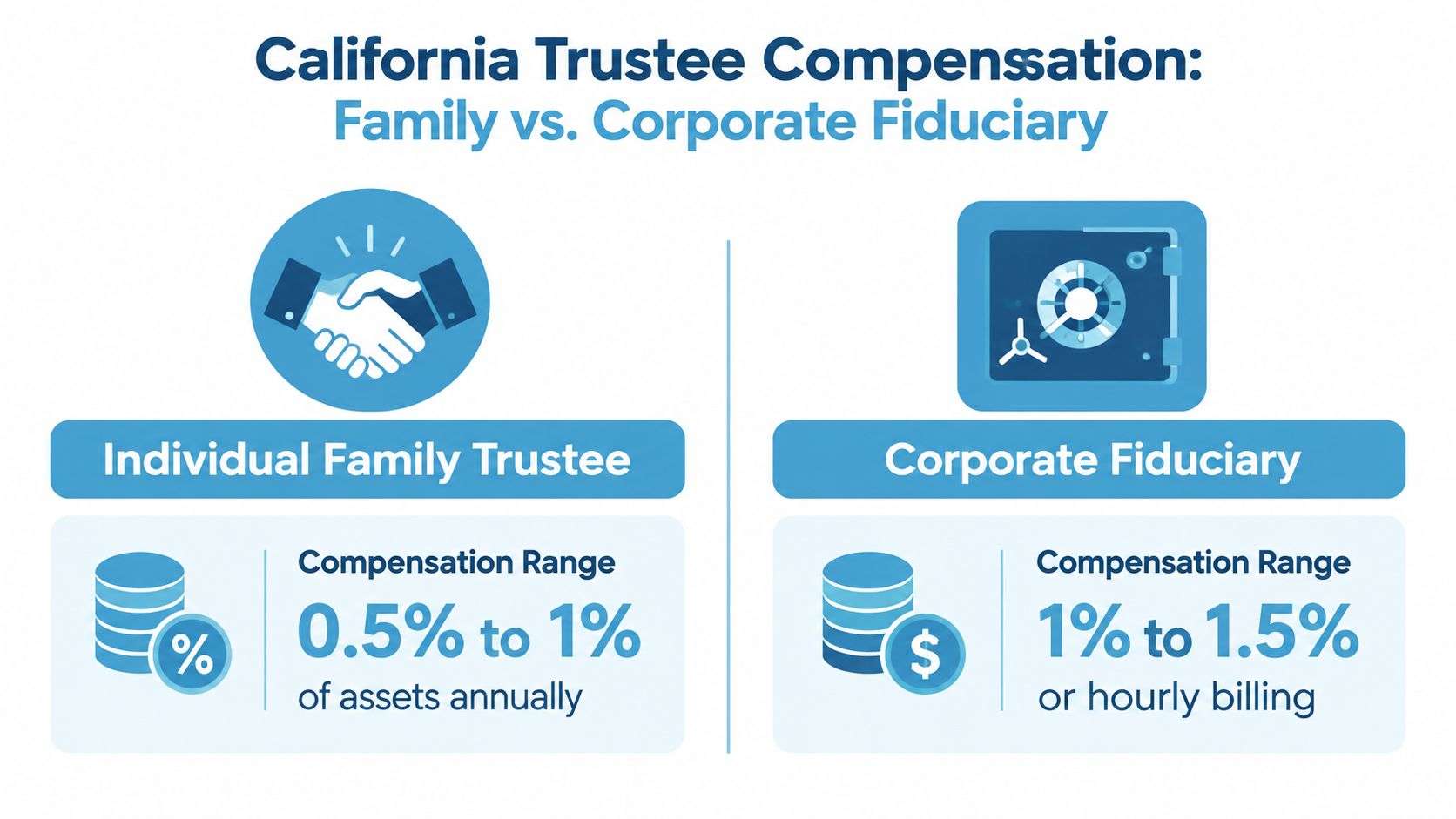
California trustees are generally entitled to reasonable compensation unless the trust provides otherwise. A family trustee may waive fees, charge for actual work, or seek compensation under the trust's terms. Corporate fiduciaries may use a percentage schedule or hourly billing.
Typical California ranges discussed in current California-focused guidance are 0.5% to 1% of assets annually for an individual family trustee, and 1% to 1.5% or hourly billing for a corporate fiduciary. Those ranges come from the California successor trustee compensation discussion. They're reference points, not automatic entitlements.
Why fees become a dispute
The question isn't only whether you can be paid. It's whether the amount, method, timing, and documentation are defensible. A trustee-beneficiary who takes a fee while also making discretionary distributions may face accusations that personal financial interests influenced trust decisions.
California Probate Code § 16004 addresses self-dealing and adverse interests. Don't set your own fee in a private conversation, deduct it without a ledger entry, or treat your beneficiary share as permission to favor yourself.
Use a written fee policy. Record dates, tasks, time spent, unusual complexity, and the trust provision supporting compensation. Give beneficiaries enough information to understand the charge, especially where siblings already disagree about distributions, loans, property use, or family history.
Fee advice: A modest, documented fee is easier to defend than a larger unexplained deduction, even when the trustee performed substantial work.
For blended families or high-value trusts, ask counsel to review compensation before taking it. Accounting and clear communication won't eliminate every disagreement, but they give beneficiaries a factual record instead of leaving them to infer motives.
Walnut Creek Case Study of a Family Trust Administration
Consider the fictional Martinez family in Walnut Creek. After their father dies, one adult child is named successor trustee, while three adult children are beneficiaries. The trustee's first task isn't dividing property. It's locating the signed trust and amendments, confirming the appointment, securing the residence and accounts, and identifying debts.
The trustee then prepares the required notices under Probate Code § 16061.7 and preserves proof of service. The estate includes a residence, investment accounts, personal property, and a vacation cabin. The family expects an immediate split, but the trustee first needs a complete inventory and reliable valuations.
Decisions that require process
The family residence may be sold, retained, or transferred according to the trust and the beneficiaries' agreement. One sibling wants the cabin. That request can't be approved merely because it feels fair. The trustee should obtain an independent appraisal, determine how the cabin's value compares with the other beneficiaries' shares, and document whether an equalizing payment or different allocation is authorized.
The trustee also needs to separate trust property from assets that passed by another method or remained outside the trust. An account statement, deed, and beneficiary designation may produce different results. The trustee should not assume every asset belongs in the distribution because the family remembers the deceased owning it.
A dated asset schedule and independent appraisal help establish the value used for administration. They also give the siblings a common reference point. Without that record, a later disagreement can become an argument about whether the trustee favored the child who wanted the cabin.
Moving toward distribution
The trustee pays proper expenses and addresses taxes and debts before final distribution. Each payment gets a supporting invoice, approval note, and transaction entry. Communications with the three beneficiaries should be consistent, factual, and preserved.
When the trust is ready to close, the trustee prepares a distribution plan that follows the trust. If the residence is sold, the net proceeds are allocated according to the governing terms. If property is distributed in kind, the file should show the valuation and each beneficiary's consent where consent is appropriate.
The lesson is simple. The trustee doesn't need to make every family member happy. The trustee needs to make decisions authorized by the trust, supported by reliable information, and documented well enough to explain later.
Common Disputes and How Smart Recordkeeping Prevents Them
Beneficiaries often frame a trust dispute as a personality problem. The legal issue usually begins with a missing record, an unexplained payment, or a decision that was never communicated. A successor trustee who keeps a working file can answer those questions before they become a petition.
Common flashpoints include unequal distributions, sibling objections, use of trust property, loans to beneficiaries, blended-family claims after a surviving spouse remarries, and alleged misconduct by a predecessor trustee. California guidance also recognizes that a successor may have responsibilities connected to predecessor misconduct in specified circumstances, which is why the incoming trustee must preserve records and investigate irregularities rather than continue business as usual.
| Dispute Trigger | Documentation That Prevents It |
|---|---|
| Unequal or disputed distributions | Trust clause, valuation, distribution calculation, and beneficiary communication |
| Alleged self-dealing | Conflict disclosure, written approval process, independent valuation, and transaction records |
| Missing or depleted assets | Opening inventory, account statements, transfer confirmations, and investigation notes |
| Fee objections | Written fee method, task log, invoices, and accounting entry |
| Predecessor misconduct | Condition-of-assets report, account review, correspondence, and preservation of original records |
Treat documentation as a defense
Write down why you selected an appraiser, why you sold or retained property, why you delayed a distribution, and how you handled a beneficiary request. Keep bank confirmations, receipts, invoices, signed acknowledgments, and copies of every notice.
A beneficiary doesn't have to agree with your choice for the choice to be proper. But if your file contains no explanation, a court may see only the result. California Probate Code § 16420 provides remedies for trustee misconduct, so a clean record is not clerical decoration. It's part of risk control.
Use the California guide to trust beneficiary rights when reviewing what information beneficiaries may request and how trustee communication can affect a developing dispute. Don't hide behind silence. Give accurate updates without promising outcomes you haven't verified.
Step-by-Step Checklist and When to Call a California Attorney
Start with control, then move to compliance. A new trustee should be able to show what happened, when it happened, and why each major action served the trust.
The working checklist
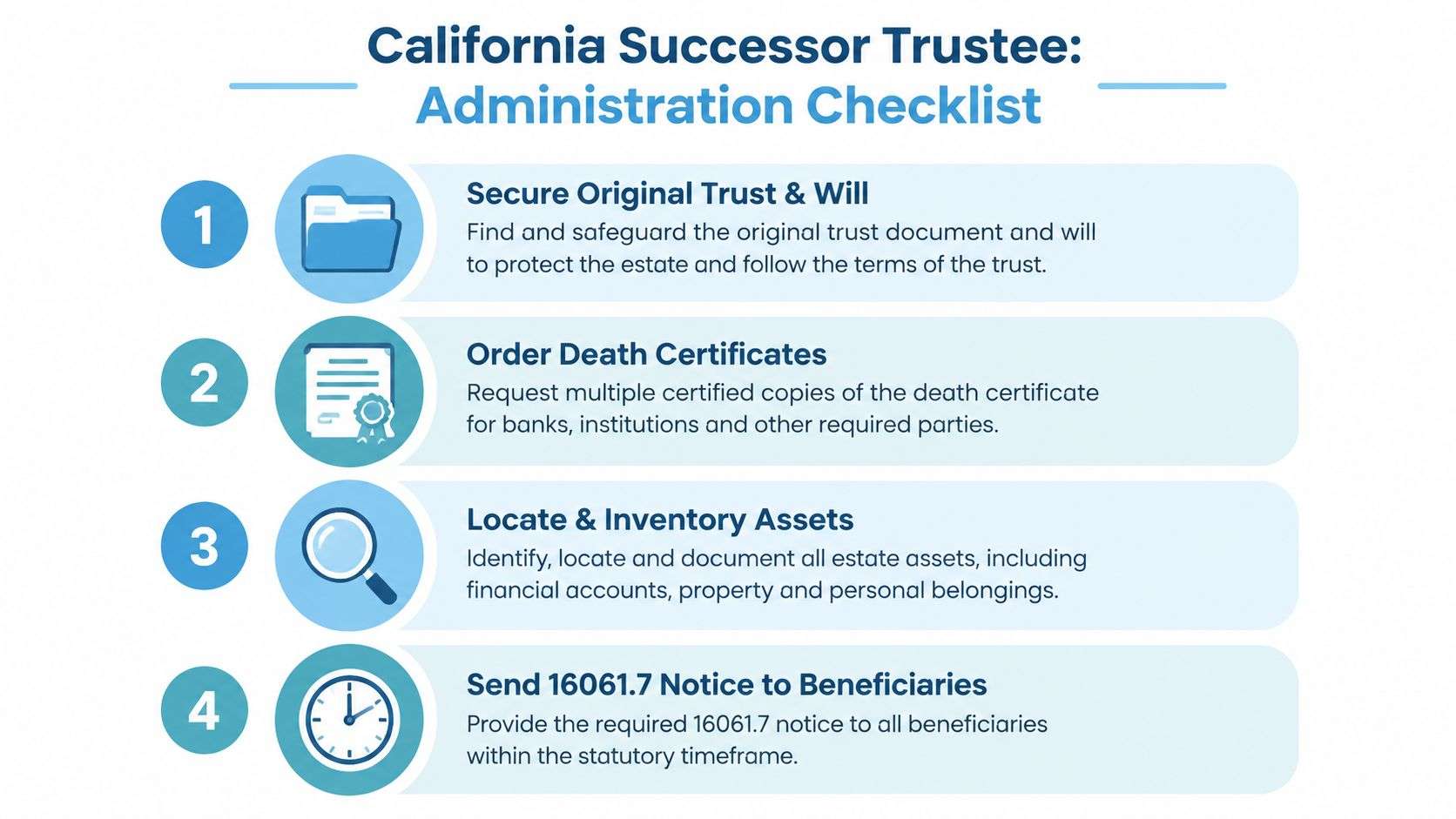
- Secure documents: Locate the original trust, amendments, and Will. Confirm who can act and what event activated succession.
- Order death records: Obtain the documentation needed by financial institutions, insurers, title offices, and other parties.
- Protect property: Secure real estate, valuables, accounts, mail, records, and insurance coverage.
- Inventory assets: List trust property, liabilities, account ownership, title, and available valuations.
- Calendar notice duties: Prepare and serve the required § 16061.7 notice within 60 days, then preserve proof of service.
- Separate finances: Use dedicated trust records and never mix trust money with personal funds.
- Review debts and taxes: Coordinate with tax and financial professionals before paying claims or distributing property.
- Account and communicate: Keep beneficiaries reasonably informed and prepare required accountings.
- Plan distribution: Confirm the governing terms, resolve valuation issues, obtain appropriate acknowledgments, and distribute only when the trust is ready to close.
Call a California trust attorney before acting if you face a Probate Code § 16064 accounting or liability question, suspect a breach, confront a contested interpretation, or are administering an estate above $5 million. Those circumstances justify a paid consultation before you sell property, take compensation, make a disputed distribution, or respond to a beneficiary demand.
A California trust administration lawyer can help you establish authority, organize the administration file, evaluate notices, address beneficiary conflict, and make decisions tied to the trust document and California law. Brillant Law serves clients connected to Walnut Creek, Saranap, San Miguel, and Castle Hill, with local familiarity that matters when trust administration involves family property, real estate, and community relationships.
The successor trustee is the administration's operational center of gravity. You don't need to handle every task personally, but you do need to control the process, meet deadlines, preserve assets, and know when a legal decision is too risky to make alone.
Brillant Law Firm advises California successor trustees on trust acceptance, statutory notices, asset administration, beneficiary disputes, fiduciary duties, and distribution decisions. If you're managing a trust connected to Walnut Creek, Saranap, San Miguel, or Castle Hill, visit Brillant Law Firm to request focused guidance before a missed deadline or undocumented decision becomes a dispute.