
Six months after their father's death, three siblings in Walnut Creek are still waiting for a distribution check. Their brother, the executor, sends calls to voicemail. No inventory has arrived. No one has seen an accounting, and every request for an explanation produces another promise to “handle it soon.”
That silence creates more than family tension. It can make it harder to trace estate funds, evaluate asset values, preserve objections, and recover losses if property has been sold or money has been spent improperly. California beneficiaries have enforceable rights, but those rights work best when used in a deliberate sequence rather than through repeated unanswered calls.
This guide explains beneficiary rights against an executor under California procedure, including fiduciary duties, information requests, accountings, demand letters, petitions to compel, removal, surcharge, evidence preservation, and the cost-versus-strategy decision families face in the Bay Area. It also addresses a practical reality: sometimes the least expensive way to protect an inheritance is to obtain advice before the estate becomes a full litigation dispute. For a related discussion of communication failures, see what beneficiaries can do when an executor is not communicating.
Table of Contents
- When an Executor Goes Quiet and What You Can Do
- The Fiduciary Duties an Executor Owes You
- Your Right to Information and an Accounting
- Common Breaches California Beneficiaries See
- Legal Remedies From Demand Letter to Court Order
- Evidence and Documentation to Build Your Case
- Cost Strategy and How Long This Takes
- When to Consult Counsel and What Comes Next
When an Executor Goes Quiet and What You Can Do
The Walnut Creek family described above may initially tell themselves that their brother is overwhelmed. Probate involves property, debts, tax matters, appraisals, and court filings. A period of limited communication doesn't automatically prove theft or misconduct.
But six months of silence, no meaningful financial information, and no clear explanation shouldn't be treated as ordinary family friction. An executor is a fiduciary, not the owner of the estate. The role carries duties to protect estate property, act in good faith, keep records, treat beneficiaries fairly, and administer the estate without unreasonable delay.
Silence is evidence of a process problem
The first useful step isn't an accusation. It's a written request that identifies the information sought, the estate involved, and the reason the request matters. Ask for the will and probate filings, the inventory and appraisals, estate account records, information about debts and expenses, and a description of the proposed distribution. Keep the request factual and preserve proof that it was delivered.
A beneficiary usually does better with a focused letter than with a long emotional message. A letter creates a record showing what the executor knew, what the beneficiary requested, and whether the executor responded. If the executor later claims that beneficiaries never asked for information, the written record answers that claim.
Practical rule: Don't wait indefinitely for a voluntary update when the estate's money, real property, or records may be at risk.
California law gives beneficiaries tools to demand information and seek court enforcement. Those tools include a formal accounting, a petition to compel compliance, a request for removal in appropriate circumstances, and a claim for financial recovery when the estate suffered a loss. The right remedy depends on what the documents reveal.
The key point is easy to miss. The executor's silence may not merely be poor manners. Refusing to provide required information, concealing material facts, favoring personal interests, or allowing estate property to deteriorate can breach fiduciary duties before anyone misses a distribution check.
The Fiduciary Duties an Executor Owes You
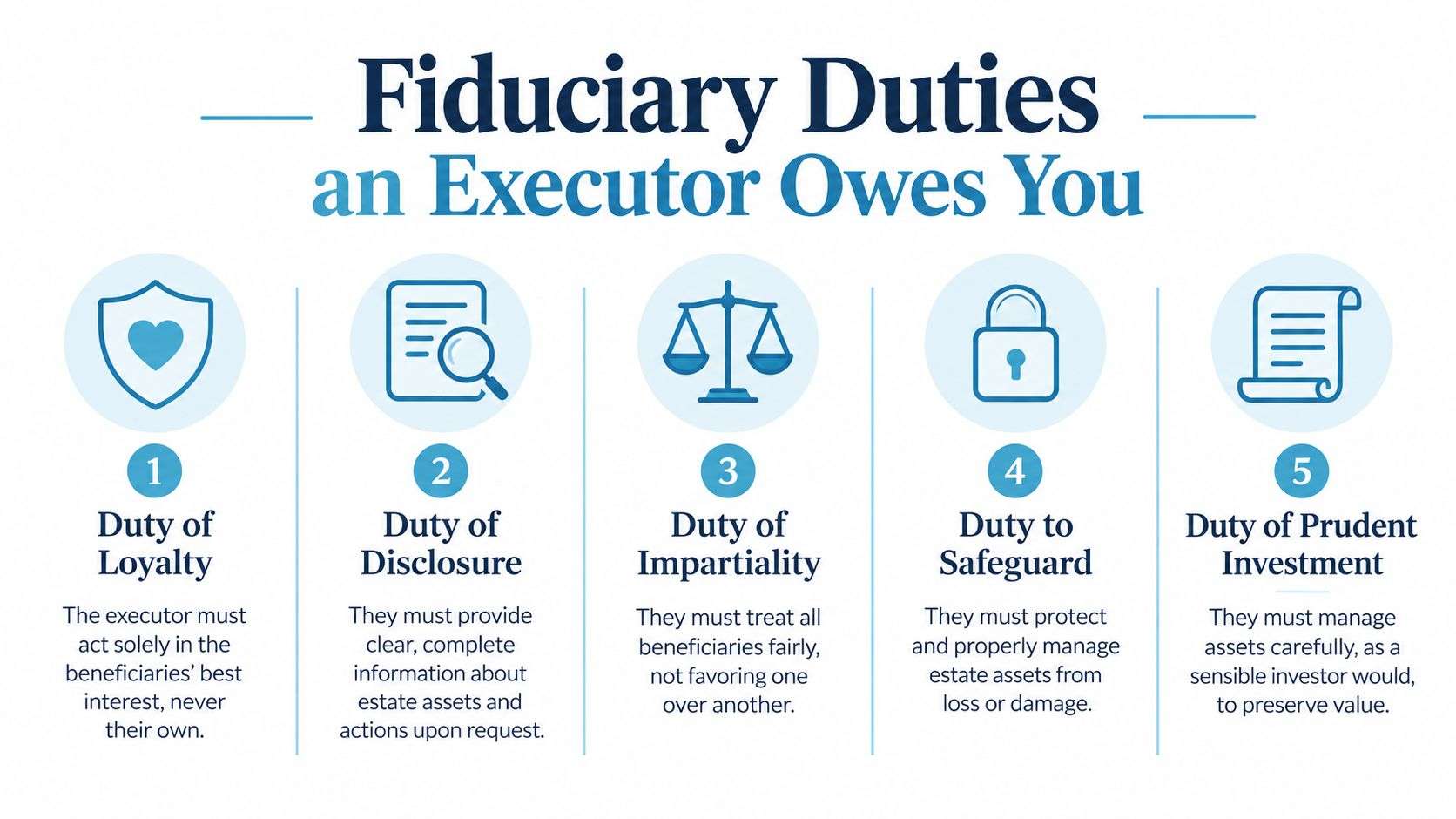
A California executor, formally called a personal representative, holds estate property for the benefit of the beneficiaries. The executor has authority to administer the estate, but that authority doesn't convert estate assets into personal property. California legal guidance describes the position as fiduciary, with duties of disclosure, honesty, fair dealing, and accountability to beneficiaries who have a legal interest under the will. California legal guidance on an executor's fiduciary obligations reflects that an executor can face removal or financial liability for failing to act for beneficiaries.
Loyalty and conflict avoidance
The duty of loyalty requires the executor to place the estate's interests ahead of personal gain. An executor shouldn't sell estate property to their own company, hire themselves at an inflated rate, or steer a sale to a relative without proper safeguards and disclosure.
For example, an executor buys a family cabin from the estate before beneficiaries see an appraisal or listing. The problem isn't only the sale. The undisclosed personal interest creates a conflict that can support an objection, a request for removal, or a claim that the estate suffered a financial loss.
Care and asset protection
An executor must manage estate assets prudently. That includes protecting real property, maintaining appropriate insurance, addressing valid debts, and avoiding careless decisions that expose the estate to preventable loss.
Suppose an executor leaves a Berkeley rental vacant and uninsured, then an incident damages the property. The executor may have failed to safeguard the asset, regardless of whether the original decision was intentional. Estate administration involves judgment, but it doesn't excuse neglect.
Disclosure and accounting
Beneficiaries need reliable information to evaluate administration. An executor who refuses to provide bank statements, receipts, inventory information, or an explanation of expenses can't replace accountability with “trust me.”
The duty to inform doesn't mean a beneficiary can direct every administrative choice. It does mean the executor must maintain records and provide information required by California law and the circumstances of the estate.
Impartiality and timely administration
An executor can't favor one beneficiary without a legitimate estate-related reason. Giving one sibling the first choice of valuable personal property, advancing money to a favored heir, or distributing assets selectively can violate the duty of impartiality.
The executor also must move the estate forward. A property sale, creditor issue, or tax question can justify delay. An estate that remains open because the executor is too busy, refuses to gather records, or ignores court requirements presents a different problem. The remedies discussed later all trace back to one of these duties.
Your Right to Information and an Accounting
An accounting is more than a casual list of expenses. It should allow beneficiaries and the probate court to understand what the estate owned, what it received, what it paid, what remains, and what the executor proposes to distribute.
California Probate Code section 8800 addresses the personal representative's inventory and appraisal obligations. Legal guidance for California beneficiaries explains that the inventory should identify estate property and that beneficiaries can request information needed to assess the administration. That information may include assets, debts, receipts, expenses, supporting records, and distributions. California guidance on inventory, appraisal, and beneficiary information rights provides the practical framework.
The accounting request
California Probate Code section 10900 is a central tool for beneficiaries seeking a formal accounting. A written demand should identify the estate, state that an accounting is requested, describe the records sought, and ask the executor to respond within the applicable period. Under the cited California guidance, failure to provide the accounting within 60 days can support a petition to compel, and the court may address the representative's compensation and the expense of preparing the accounting. California guidance on an executor's accounting duty explains why beneficiaries can move beyond informal requests when an executor delays.
An informal accounting may be appropriate when the estate is straightforward and all beneficiaries understand the records. The trade-off is significant. Signing a broad waiver or release before reviewing complete information can limit later objections, so beneficiaries should understand exactly what they are giving up before signing.
Final distribution and court enforcement
A petition for final distribution should provide the court with the information needed to determine what remains in the estate, including liabilities and the proposed distribution. A beneficiary who hasn't received adequate information can object or ask the court to require clarification before distribution.
California Probate Code section 10950 also gives an interested person a route to compel an accounting. California practice materials explain that a beneficiary may petition at any time, and that if more than one year has passed since the last accounting, or since appointment when no accounting has been filed, the court must grant the request. California accounting guidance on section 10950 describes why recurring accounting enforcement matters.
A written demand starts a practical clock even before a petition is filed. The response, incomplete production, or silence becomes part of the record. Once the accounting arrives, it often exposes the core dispute: unexplained transfers, missing assets, excessive fees, related-party transactions, or property decisions that don't match the estate's interests.
Common Breaches California Beneficiaries See
Many probate disputes don't begin with an obvious theft. They begin with a pattern that doesn't make sense. A property sale lacks a clear valuation. Estate funds appear in a personal account. One heir receives money while everyone else waits. The executor says records are unavailable, but never explains why.
The conduct should be evaluated against the fiduciary duties described above, not against family expectations alone. For a broader explanation of the legal concept, see breach of fiduciary duty in estate administration.
Patterns that deserve scrutiny
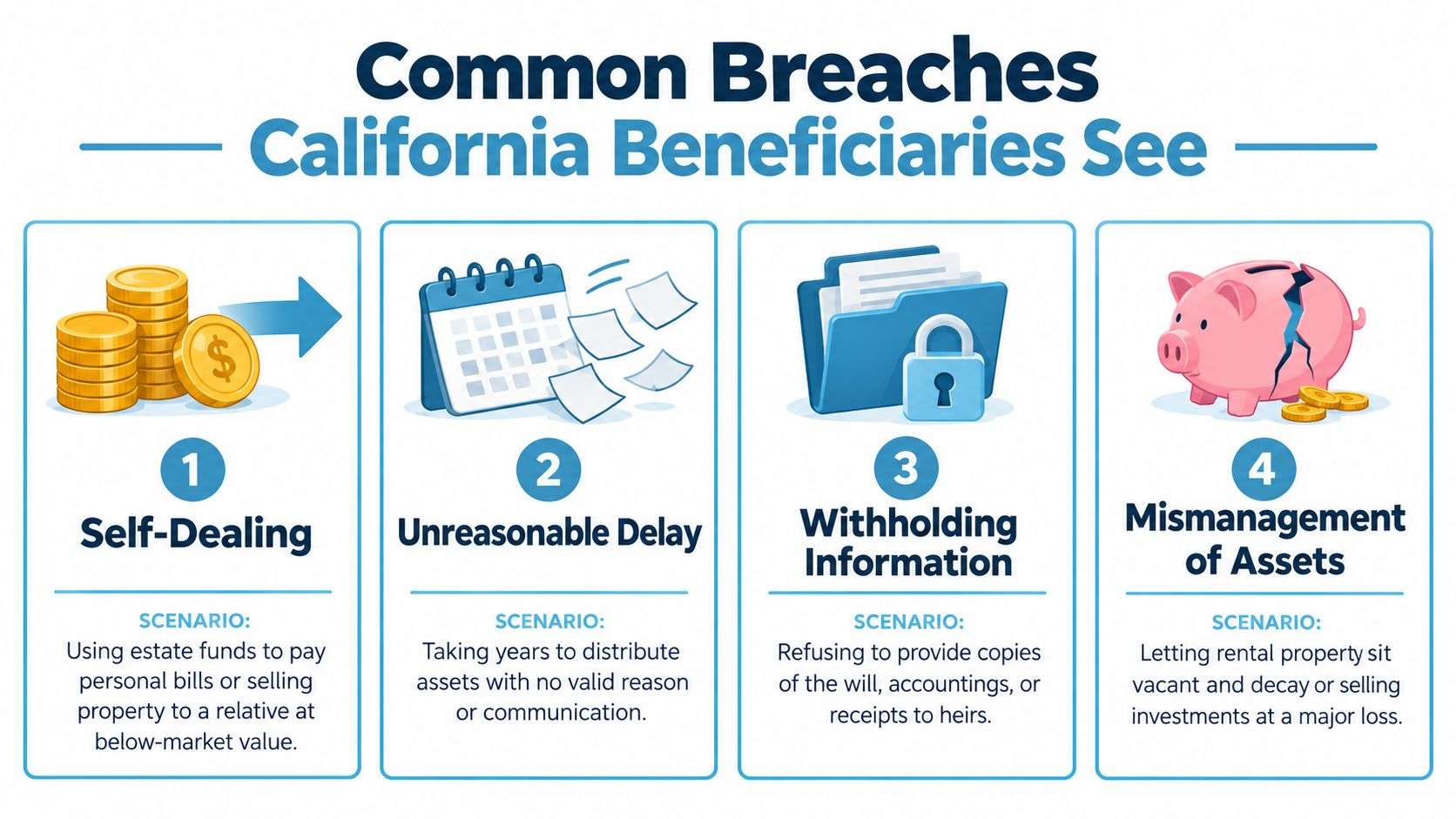
Self-dealing and conflicts: An executor sells estate property to a relative below a supported market value, directs work to a personally connected contractor, or uses estate funds for a personal obligation. These facts may support a loyalty and disclosure claim.
Unreasonable delay: The executor doesn't inventory assets, avoids necessary property decisions, or leaves the estate open without a concrete reason. Delay becomes more serious when beneficiaries receive no meaningful explanation and the estate loses value during the waiting period.
Commingling: Estate money appears in the executor's personal account, or personal bills are paid from an estate account. Bank statements, canceled checks, and transfer records can reveal whether the executor kept estate property separate.
Favoritism and neglected obligations
Preferential treatment: One heir receives a loan, early distribution, or valuable personal effects while other beneficiaries receive nothing and no explanation. Unequal treatment isn't automatically improper, but unexplained favoritism calls for records and a legal analysis.
Unpaid debts and filings: An executor fails to address valid debts or required tax filings, exposing the estate to penalties, creditor action, or avoidable expense. The executor's duty is to administer responsibly, not just distribute money quickly.
Neglected real property: A home remains vacant, uninsured, or poorly maintained. The estate may lose value through damage, missed rent, code issues, or an eventual distressed sale.
Digital assets left uncollected: Cryptocurrency, online financial accounts, stored records, or electronic business interests may sit unidentified while the executor focuses only on traditional bank accounts. The issue is usually one of diligence, preservation, and complete asset identification.
No single warning sign proves a breach. A court needs evidence connecting the conduct to a fiduciary duty and, for a surcharge, a loss or improper benefit. That is why records matter more than assumptions.
Legal Remedies From Demand Letter to Court Order
California beneficiaries usually should escalate in stages. A demand letter can resolve a communication failure without litigation. It can also preserve the record needed if the executor refuses to cooperate.
Start with a precise written demand
For a probate estate, a demand commonly identifies Probate Code section 10900 and requests an accounting, inventory information, receipts, account statements, and distribution details. Trust administration involves different provisions, including section 16061, so the governing document and legal structure must be confirmed before sending a letter.
The demand should avoid exaggerated accusations. It should state the facts known, identify missing information, request production, and reserve the beneficiary's rights. A California demand letter commonly costs $400 to $1,500, depending on the records, urgency, and attorney involvement. Those are practical Bay Area estimates, not statutory fees.
Petition to compel an accounting
If the executor doesn't provide a proper accounting, the beneficiary can petition the probate department of the superior court to compel one. Probate Code section 2620 may be relevant to the procedure, while section 10900 supports the accounting demand in the circumstances described above. The petition should attach the will or relevant probate documents, the written demand, proof of delivery, and evidence showing why the accounting is necessary.
A compel-accounting petition often falls in the range of $4,000 to $8,000 in Bay Area attorney fees, depending on opposition and the condition of the records. The purpose is to obtain information and court supervision, not to litigate every disputed transaction at the same time.
Removal and surcharge
Probate Code section 8502 provides a basis for seeking removal for cause, including serious mismanagement or conflicts of interest. Removal is a significant remedy because it changes who controls the estate. It shouldn't be pursued merely because the executor made a decision a beneficiary dislikes.
A removal petition may cost approximately $7,500 to $20,000 in Bay Area practice. A surcharge action seeks repayment for losses caused by breach. Probate Code sections 16401 and 9001 may be relevant depending on whether the dispute concerns a trust or probate administration. Full surcharge litigation commonly starts at $25,000 and upward, particularly when tracing, valuation, discovery, or contested hearings are required.
| California Beneficiary Remedies Compared | Probate Code Section | Typical Cost Range |
|---|---|---|
| Written demand for information or accounting | 10900, or 16061 for a trust | $400 to $1,500 |
| Petition to compel accounting | 10900, 2620 | $4,000 to $8,000 |
| Petition to remove fiduciary | 8502 | $7,500 to $20,000 |
| Surcharge litigation | 16401, 9001, as applicable | $25,000 and upward |
The cheapest remedy isn't always the right one. A demand may be enough when the executor is disorganized. It won't protect the estate if assets are being transferred or dissipated, and waiting can make recovery more difficult.
Evidence and Documentation to Build Your Case
A beneficiary should organize documents before making broad accusations or filing a petition. The objective is to create a timeline and connect each fact to a duty, an asset, or a requested remedy.
Start with the governing documents and court record:
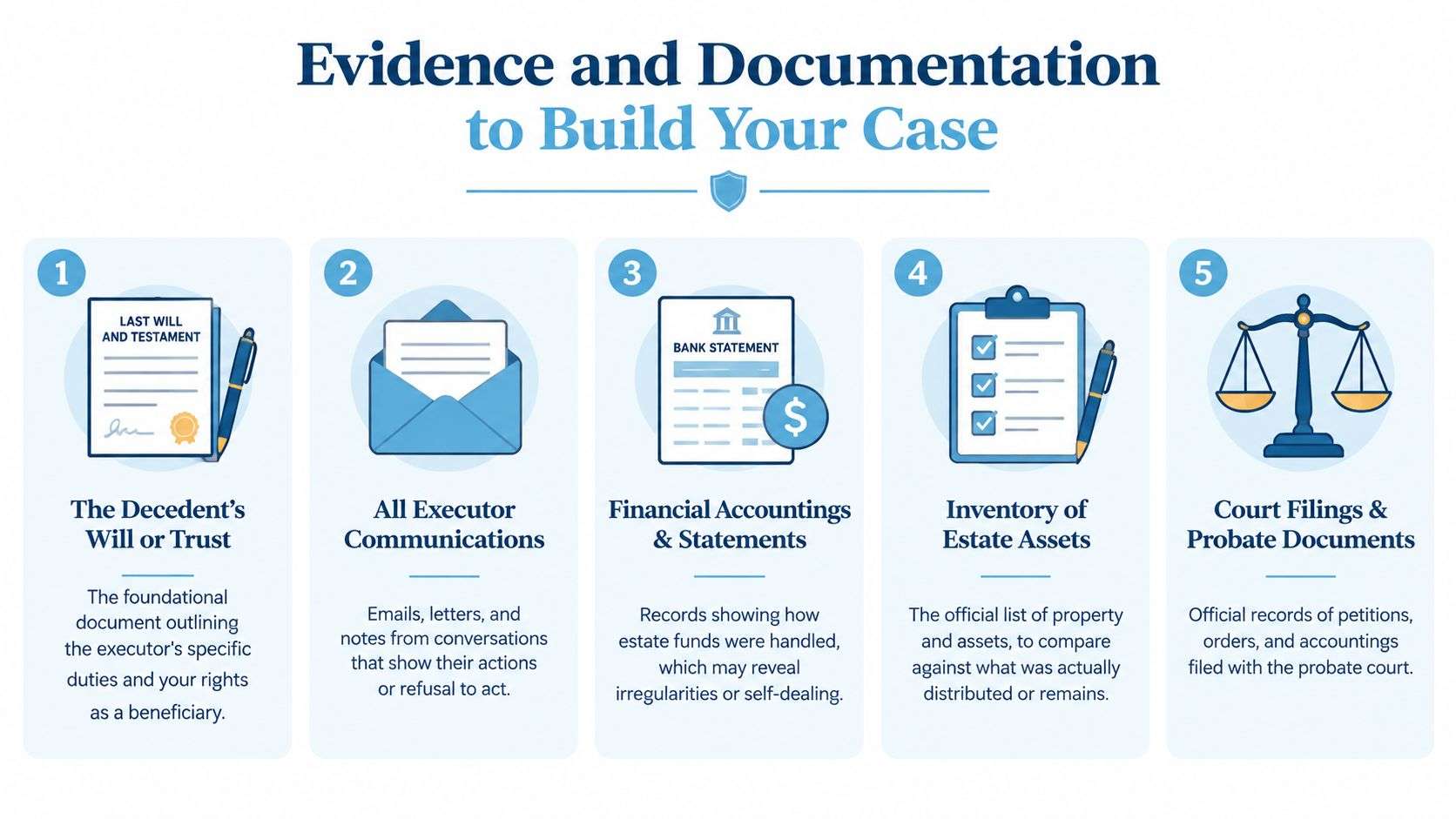
- Will or trust: Confirm the beneficiaries, fiduciary appointment, distribution terms, and any limits on the executor's authority.
- Letters and probate filings: Establish the appointment, court department, filed petitions, orders, and procedural history.
- Inventory and appraisals: Compare listed assets with property you know existed, and compare transaction prices with supported values.
- Bank and brokerage statements: Look for transfers, personal expenses, unexplained withdrawals, and missing income.
- Deeds and title records: Trace ownership, transfers, liens, and sales involving real property.
- Communications: Preserve emails, texts, letters, and voicemails showing requests, explanations, refusals, or notice of an objection.
- Loans and advances: Record money or property given to the executor or a favored heir, including the date and stated purpose.
A simple chronology often reveals more than a folder of unsorted documents. Note the date of each request, the response, the asset involved, and the harm suspected. Send important requests in writing so a nonresponse can support a later petition.
If electronic evidence may become disputed, a neutral chain-of-custody checklist can help you document how files were collected and preserved. The AI Video Detector template guide offers a general recordkeeping model that can be adapted to estate communications and digital files.
Don't edit screenshots, forward messages without retaining originals, or rely only on oral recollections. Preserve the original files and make working copies for review.
Cost Strategy and How Long This Takes
Beneficiaries usually have three practical paths: direct negotiation, mediation, or contested probate litigation. The right choice depends on the size and complexity of the estate, the quality of the records, the urgency of asset protection, and whether the executor is willing to engage.
Direct negotiation is appropriate when the executor is responsive but disorganized. An attorney can send a focused demand, review the production, and negotiate a distribution or accounting without immediately filing. Fees are commonly hourly, and the initial work may be limited to the records and issues that matter.
Mediation can help when siblings disagree but still want control over the result. It costs more than a letter because both sides must prepare, exchange information, and attend a structured settlement process. It can cost less than litigating every issue, especially when the dispute centers on communication, valuation, or an agreed accounting.
Litigation becomes more rational when the executor refuses to account, assets are at risk, a conflict affects control, or the parties can't agree on basic facts. Court proceedings create deadlines and enforceable orders, but discovery, hearings, valuation disputes, and opposition increase expense. County scheduling conditions, including congestion affecting Alameda, San Mateo, and Santa Clara probate matters, can also make court resolution less predictable.
| California Beneficiary Action Paths: Cost and Timeline | Typical Bay Area Cost Range | Realistic Timeline | Best For |
|---|---|---|---|
| Direct negotiation | Hourly fees, often limited to focused work | Depends on cooperation and record production | A responsive executor and a narrow information dispute |
| Structured mediation | Hourly fees plus mediator charges | Usually faster than fully contested litigation, but depends on preparation | Families seeking a controlled settlement |
| Contested probate litigation | Can reach $25,000 and upward in complex surcharge disputes | May extend through multiple hearings and discovery stages | Refusal to account, asset risk, removal, or substantial loss |
California fees are often hourly, although ordinary administration and extraordinary services can be handled differently depending on the engagement and court process. The discussion of executor fees and estate administration costs can help frame that distinction.
A hybrid strategy often makes economic sense for a moderate-estate beneficiary. Negotiate first, demand the accounting, and litigate only the accounting, removal, or specific loss that requires court intervention. The goal isn't to win every family argument. It's to protect the inheritance at a cost proportionate to the estate and the actual harm.
When to Consult Counsel and What Comes Next
Pick up the phone when a written demand goes unanswered for more than 30 days, the accounting is missing or suspicious, assets appear to be moving, or the executor hires litigation counsel. You don't need to wait until every document is available. A probate attorney can help preserve evidence, identify the correct petition, and prevent a beneficiary from signing a release without understanding its effect.
During the first 30 days:
- Preserve the will, trust, probate filings, account statements, communications, and property records.
- Build a timeline of requests, responses, transfers, distributions, and known asset changes.
- Send a focused written demand citing the applicable California Probate Code provisions.
- Calendar the 60-day response window tied to the accounting demand.
- Schedule a consultation before filing anything or accepting a broad waiver.
The right early intervention often prevents a removal fight rather than merely preparing for one. Brillant Law Firm serves clients in Walnut Creek, Saranap, San Miguel, and Castle Hill, with California-focused trust, estate, probate, and fiduciary dispute representation. Visit Brillant Law Firm to discuss the missing accounting, suspected breach, or executor communication problem with a team familiar with Northern California procedure.