
Taxation Strategies: 10 Powerful Ways to Keep More in 2025
Why Smart Tax Planning Can Save You Thousands Every Year
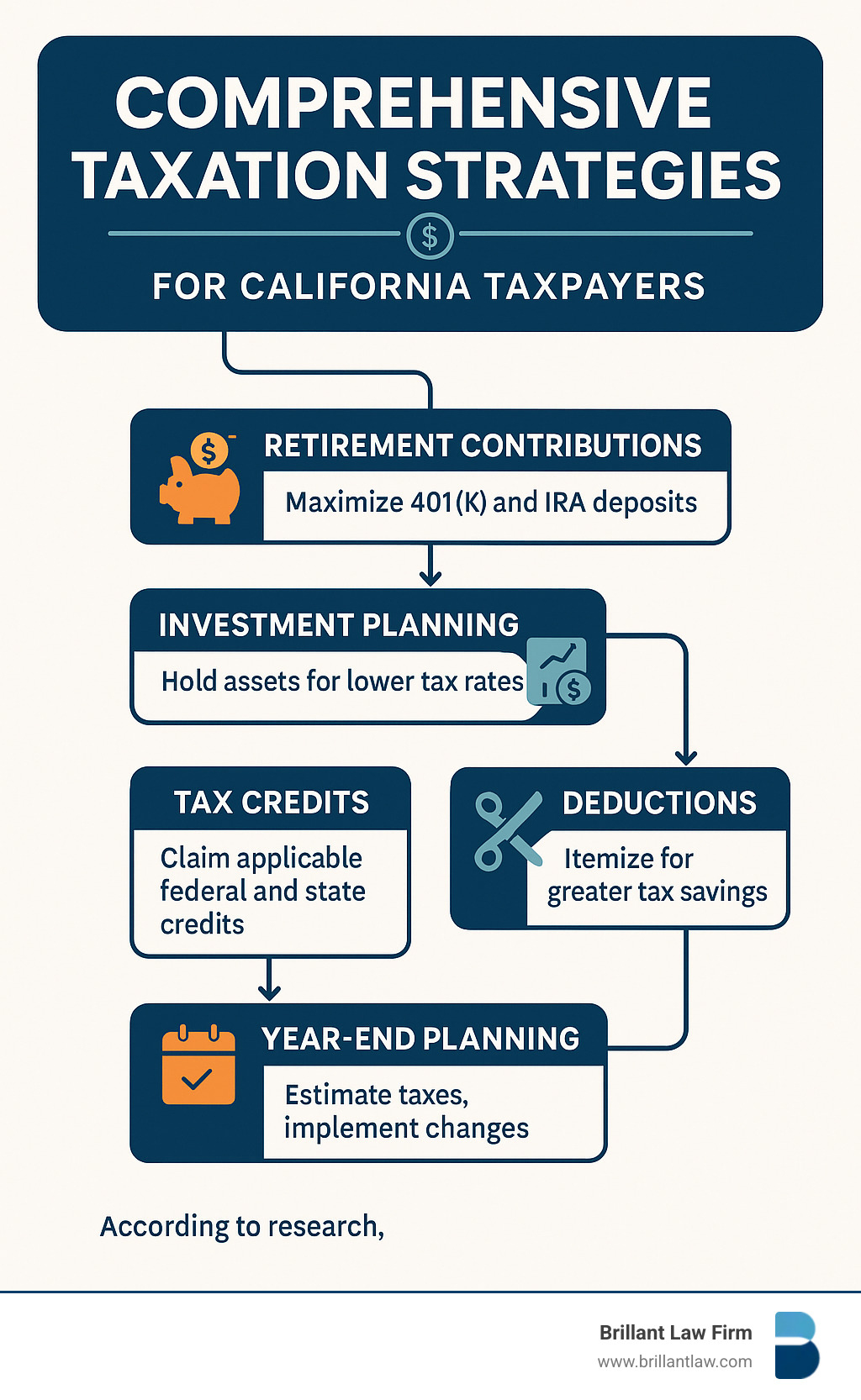
Taxation strategies are legal methods used to minimize your tax liability and maximize your after-tax income through careful planning and timing of financial decisions. The most effective approaches include maximizing retirement contributions, utilizing tax credits, implementing tax-loss harvesting, and structuring investments for optimal tax efficiency.
Quick Reference: Top Taxation Strategies
– Retirement Contributions: Max out 401(k) ($23,500 for 2025) and IRA ($7,000) contributions
– Tax Credits: Claim Child Tax Credit ($2,000 per child), Earned Income Credit (up to $7,830), and education credits
– Investment Planning: Hold assets over one year for long-term capital gains rates (0%, 15%, or 20%)
– Tax-Loss Harvesting: Offset gains with losses, deduct up to $3,000 against ordinary income
– Health Savings Accounts: Triple tax benefit with $4,300 individual/$8,550 family limits for 2025
According to research, U.S. families give over $1 billion to charity daily, often leveraging tax incentives. The standard deduction for 2024 is $29,200 for married couples and $14,600 for singles. Many taxpayers miss significant savings opportunities simply because they don’t understand which strategies apply to their situation.
Tax planning isn’t just for the wealthy – even middle-income earners can save thousands through proper planning. The key is understanding how different strategies work together and implementing them before the tax year ends.
I’m David Brillant, a Certified Specialist in Estate Planning, Trust and Probate Law with a Masters in Taxation. I’ve spent years helping California clients steer complex taxation strategies to minimize their tax burden while staying fully compliant with state and federal requirements.
Understanding U.S. Tax Fundamentals
Before diving into specific taxation strategies, let’s make sure you understand how the tax system actually works. Many people think they’re paying their highest tax rate on all their income – but that’s not how it works at all.
The U.S. uses what’s called a progressive tax system with seven brackets: 10%, 12%, 22%, 24%, 32%, 35%, and 37%. Think of it like climbing a staircase where each step gets a little steeper, but you only pay the higher rate on the income that reaches each new level.
Here’s a real example: Let’s say you’re single and earned $50,000 in taxable income. You don’t pay 22% on the entire $50,000. Instead, you pay 10% on your first $11,600, then 12% on everything from $11,601 to $47,150, and finally 22% on just that last $2,850. Your effective tax rate ends up being much lower than 22%.
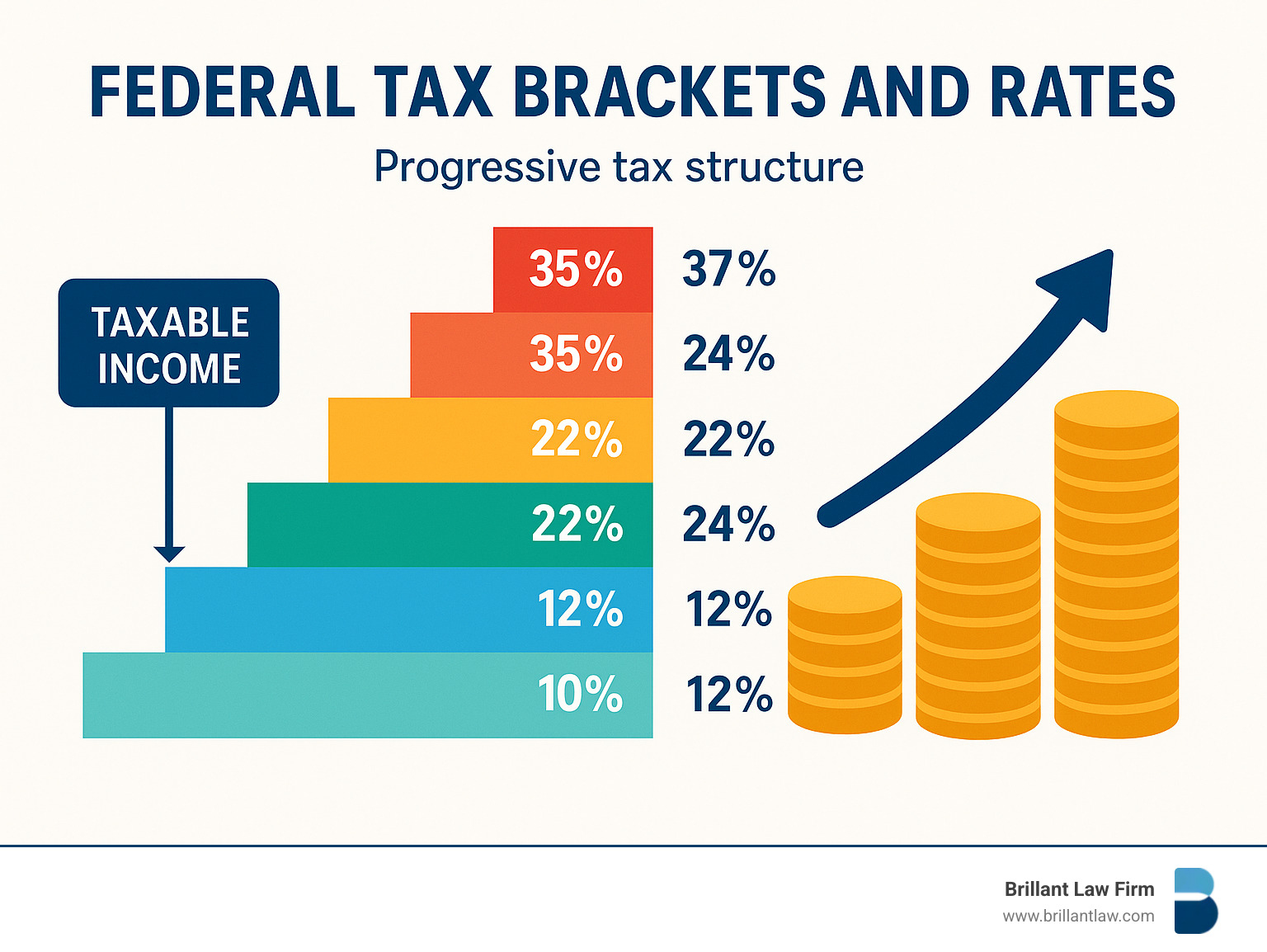
Understanding this progressive structure is crucial because it affects how different taxation strategies impact your bottom line. Moving income from one year to another or converting traditional retirement accounts to Roth accounts becomes much more strategic when you know exactly which tax bracket that income will hit.
The tax code treats different types of income very differently. Ordinary income from your job gets hit with those progressive rates. But long-term capital gains from investments you’ve held over a year get special treatment – they’re taxed at just 0%, 15%, or 20% depending on your total income level.
Don’t forget about the standard deduction – it’s like a freebie that reduces your taxable income before any calculations begin. For 2024, that’s $14,600 for single filers and $29,200 for married couples filing jointly. Tax credits are even better because they reduce your actual tax bill dollar-for-dollar.
Why Tax Planning Matters
Taxes are one of your largest lifetime expenses, often bigger than your mortgage or car payments. Yet most people spend more time planning their vacation than planning their tax strategy.
Smart tax planning improves your cash flow throughout the year. Instead of getting a huge refund (which is essentially an interest-free loan to the government), proper withholding adjustments put that money in your pocket when you can actually use it.
Wealth preservation is another huge benefit. Every dollar you save on taxes is a dollar that can stay invested and compound over time. Over decades, this can mean the difference between a comfortable retirement and struggling financially.
Types of Taxes Californians Face
Living in California means dealing with multiple layers of taxation. Understanding each layer helps you develop comprehensive taxation strategies that address your total tax picture.
Federal income tax hits everyone with those progressive rates from 10% to 37%. But California adds its own income tax ranging from 1% to 13.3% (including the mental health tax on high earners). California’s top rate is among the highest in the nation.
Payroll taxes take 7.65% right off the top of your paycheck (your employer matches this), covering Social Security and Medicare. Sales tax varies by location but averages 8.85% statewide. Property tax, while lower than many states as a percentage, can still be substantial given California’s high property values.
The key insight is that effective taxation strategies need to consider all these different tax types, not just focus on one area.
Core Taxation Strategies for Individuals

Getting your personal tax strategy right doesn’t require a finance degree – just understanding the basics and making smart choices. Most effective taxation strategies are surprisingly straightforward once you know what to look for.
The biggest decision you’ll face each year is whether to take the standard deduction or itemize. With 2024’s standard deduction at $14,600 for singles and $29,200 for married couples, about 90% of taxpayers now take the standard route. But if you’re a California homeowner with significant mortgage interest, state taxes, and charitable giving, itemizing might still save you money.
Taking the Standard Deduction vs. Itemizing
Here’s the simple math: add up your potential itemized deductions and compare them to the standard amount. If itemizing wins by a meaningful margin, go that route.
Mortgage interest remains one of the biggest itemized deductions, though it’s now capped at interest on $750,000 of debt for homes purchased after 2017.
The SALT cap – that’s state and local taxes – hits California residents particularly hard. You can only deduct $10,000 total in state income taxes and property taxes combined. Given California’s high tax rates, many residents max out this deduction quickly.
Charitable contributions offer some flexibility. You can generally deduct up to 60% of your adjusted gross income for cash donations to qualified charities. If you’re close to the itemizing threshold, consider “bunching” donations – giving two years’ worth of contributions in one tax year.
Key Tax Credits Every Californian Should Know
While deductions reduce your taxable income, tax credits cut your tax bill dollar-for-dollar. That makes credits incredibly powerful tools in your tax planning arsenal.
The Child Tax Credit gives you $2,000 for each qualifying child under 17. The Earned Income Tax Credit can put up to $7,830 back in your pocket for families with three or more children. Even better, it’s refundable, meaning you can get money back even if you owe no tax.
Education credits help offset college costs. The American Opportunity Credit provides up to $2,500 per student for the first four years of college, while the Lifetime Learning Credit offers up to $2,000 per tax return for continuing education expenses.
California’s push toward renewable energy makes energy credits particularly relevant. You can claim credits for solar panels, electric vehicles, and various energy-efficient home improvements.
Taxation Strategies for Reducing Taxable Income
The most powerful taxation strategies often involve reducing your taxable income before you even calculate your tax bill.
Retirement contributions top the list for good reason. Your 401(k) or 403(b) lets you defer $23,500 in 2025, plus an additional $7,500 if you’re 50 or older. Thanks to the SECURE 2.0 Act, workers aged 60-63 can contribute even more – up to $34,750 total.
Traditional IRAs add another $7,000 ($8,000 if 50+) in potential deductions, though income limits may reduce or eliminate the deduction if you have a workplace retirement plan.
Health Savings Accounts offer what I call the “triple crown” of tax benefits. Your contributions are deductible, the money grows tax-free, and withdrawals for medical expenses are tax-free. With 2025 limits of $4,300 for individuals and $8,550 for families, HSAs are among the best taxation strategies available.
Getting your withholding right prevents overpaying during the year or facing penalties. The IRS tax withholding estimator helps you find the sweet spot where you’re not giving the government an interest-free loan through excessive withholding.
Tax-Savvy Investing and Retirement Moves
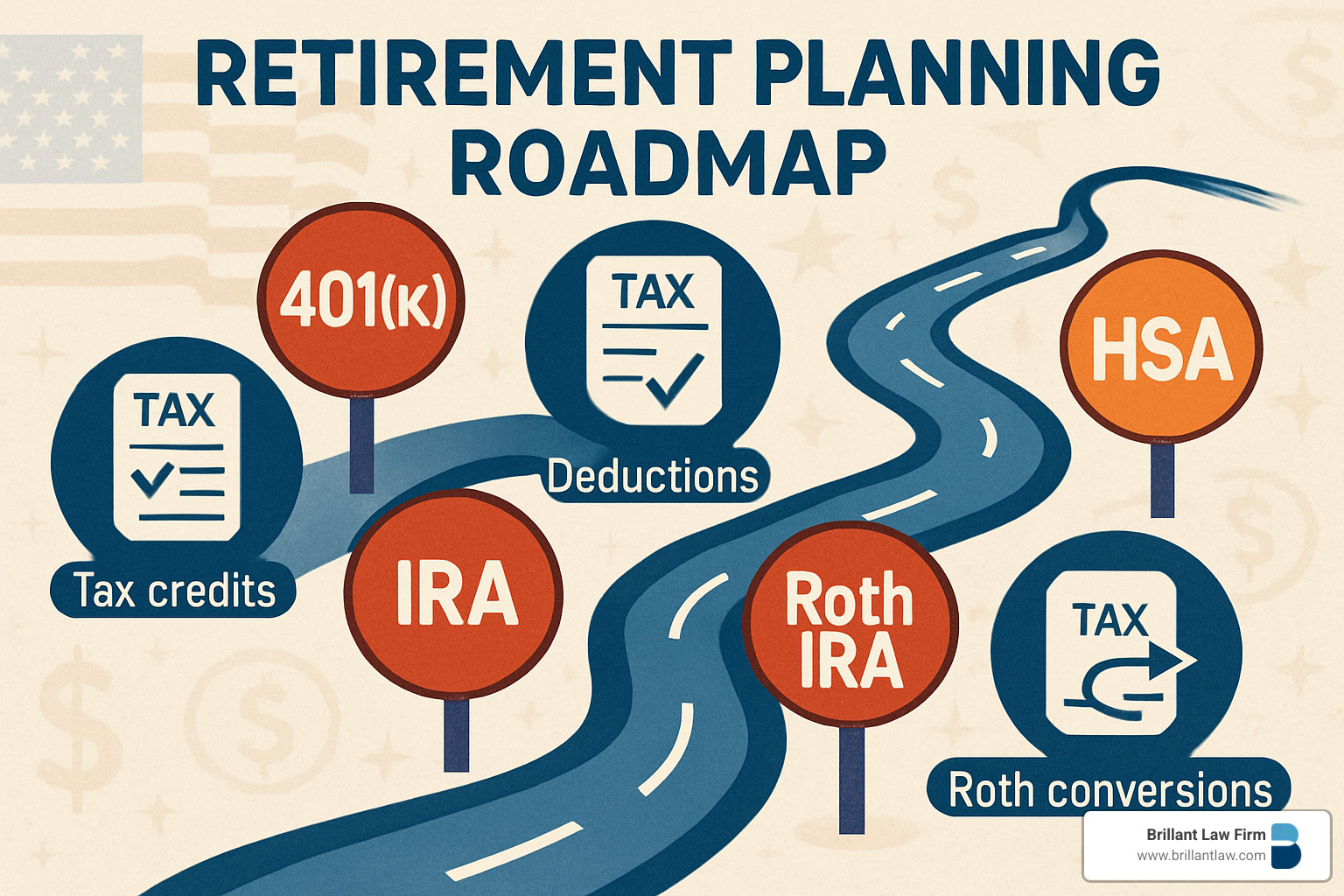
Smart investing isn’t just about picking winning stocks – it’s about keeping more of what you earn by minimizing Uncle Sam’s take. The most successful California investors understand that taxation strategies and investment planning work together.
Think of your investment accounts as different buckets, each with its own tax rules. Your taxable brokerage account gets hit with taxes every year on dividends and when you sell winners. Your 401(k) and traditional IRA let you skip taxes now but you’ll pay later. Your Roth IRA is the golden child – you pay taxes upfront, then everything grows tax-free forever.
Retirement-Focused Taxation Strategies
Roth IRA conversions are one of the most powerful moves in the tax playbook, but timing is everything. When you convert traditional IRA money to a Roth, you’re essentially prepaying taxes on that money. This makes sense when you’re in a lower tax bracket temporarily – maybe you’re between jobs, took a sabbatical, or had a down year in business.
Here’s the beautiful part: once money is in a Roth IRA, it grows tax-free forever. No required minimum distributions at 73. No taxes on withdrawals in retirement.
The traditional versus Roth decision often keeps people up at night, but it doesn’t have to be an either-or choice. Many smart California taxpayers hedge their bets with both. If you’re earning good money now and expect to live modestly in retirement, traditional accounts make sense. If you’re young or expect higher tax rates in the future, Roth accounts are your friend.
Required minimum distributions start at age 73, and they can create a tax bomb if you’re not prepared. Strategic Roth conversions in your 60s can reduce the size of those future RMDs.
Tax-Efficient Investment Portfolio Design
Asset location is like organizing your closet – everything should have its proper place. Your bond funds and REITs throw off lots of taxable income, so they belong in your tax-sheltered 401(k) or IRA. Your broad-market index funds are tax-efficient, so they’re fine in your regular brokerage account.
California residents have a secret weapon: municipal bonds. When you buy bonds issued by California cities, counties, or the state itself, the interest is typically free from both federal and California state taxes. That’s huge when you’re facing California’s top rate of 13.3%. Municipal bonds have historically been very safe – the default rate from 1970-2022 was only 0.08% compared to 6.9% for corporate bonds.
Low-turnover index funds and ETFs are your best friends for taxable accounts. They rarely make taxable distributions because they’re not constantly buying and selling stocks.
Capital Gains & “Harvesting” Taxation Strategies
Tax-loss harvesting is like finding money in your couch cushions, except it’s completely legal and the IRS approves. When some of your investments are down, you can sell them to “harvest” the losses and offset gains elsewhere in your portfolio. You can deduct up to $3,000 of net losses against your regular income each year, and any excess carries forward to future years.
The key is avoiding the wash sale rules – you can’t buy back the same investment within 30 days of selling it for a loss. But here’s a clever workaround: sell your S&P 500 index fund at a loss and immediately buy a total stock market index fund.
Tax-gain harvesting is the opposite strategy that works beautifully for lower-income years. If your total income puts you in the 0% long-term capital gains bracket ($47,025 for singles, $94,050 for married couples in 2024), you can sell winning investments and immediately buy them back.
The beauty of these taxation strategies is that they compound over time. Every dollar you save on taxes is a dollar that can keep growing in your portfolio.
Advanced & Aggressive Tactics: Proceed with Caution

Once you’ve mastered the basics, you might be tempted to explore more sophisticated taxation strategies. While these advanced techniques can provide significant savings, they also carry greater risk and scrutiny from tax authorities.
Think of aggressive tax planning like extreme sports – it can be thrilling and rewarding, but you better know what you’re doing before you jump.
When Aggressive Becomes Abusive
The S-Corporation salary strategy illustrates this perfectly. S-Corp owners can potentially save thousands on payroll taxes by taking a reasonable salary and additional distributions. The catch? That word “reasonable” is where many taxpayers get into trouble.
A California surgeon paying themselves $40,000 while taking $300,000 in distributions will face serious IRS scrutiny. The key is reasonable compensation based on your industry, experience, and actual responsibilities.
The Augusta Rule offers another example of how good strategies can go wrong. This rule allows you to rent your home to your business for up to 14 days annually without reporting the rental income. It’s perfectly legitimate when done correctly – charging market rates for genuine business meetings or conferences.
However, some taxpayers push the envelope by charging inflated rates or manufacturing questionable business purposes. Charging your business $5,000 per day to hold staff meetings in your living room will likely trigger an audit.
Section 179 vehicle deductions can provide massive tax benefits for vehicles over 6,000 pounds used primarily for business. The problem arises when taxpayers claim huge deductions for luxury SUVs used mainly for personal purposes.
Employing family members creates legitimate deductions when structured properly. Paying your teenager $15 per hour to handle filing and data entry is reasonable. Paying them $50,000 to occasionally answer phones raises red flags.
For sophisticated planning that stays within legal boundaries, consider consulting with professionals who specialize in advanced tax planning techniques.
High-Income Taxation Strategies
California’s high earners face unique challenges with combined federal and state rates potentially exceeding 50%. Fortunately, several advanced taxation strategies can help manage this burden.
The backdoor Roth IRA strategy works when your income exceeds direct Roth contribution limits. You contribute to a non-deductible traditional IRA, then immediately convert it to a Roth IRA.
The mega backdoor Roth takes this concept further for high earners with access to certain 401(k) plans. You can make after-tax contributions beyond the standard $23,500 limit, then convert these to Roth either within the plan or through rollovers.
Deferred compensation plans help high earners smooth income over multiple years, potentially reducing their overall tax burden. These plans work particularly well for California professionals expecting lower tax rates in retirement.
Net Investment Income Tax (NIIT) planning becomes crucial when your modified adjusted gross income exceeds $200,000 (single) or $250,000 (married). The additional 3.8% tax on investment income can be managed through strategic timing.
The key to successful high-income tax planning is coordination. These strategies work best when implemented as part of a comprehensive plan that considers your complete financial picture.
Documentation, Compliance & Year-End Checklist

Think of tax documentation like building a legal case – because that’s exactly what you might need to do if the IRS comes calling. Proper recordkeeping isn’t just about staying organized; it’s about protecting yourself and maximizing the effectiveness of your taxation strategies.
The IRS typically has three years to audit your return, but this window extends to six years if you’ve underreported income by more than 25%. This means some of your tax documents need to live in your files for years, not months.
Must-Keep Tax Documents
Your W-2s and 1099s form the backbone of your tax return, but don’t forget about K-1s from partnerships or S-Corps if you have business interests.
For deductions, you’ll need receipts for charitable contributions over $250, medical expense documentation if you itemize, and business expense records with clear business purposes noted. The IRS loves to see contemporaneous records – meaning you documented the business purpose when the expense occurred.
Investment records require special attention. Keep your brokerage statements and track cost basis information carefully. When you sell investments, Form 1099-B reports the proceeds but doesn’t always include your cost basis.
Home-related records deserve their own file. Keep purchase documents, improvement receipts, and refinancing costs for as long as you own the property, plus three years after you sell.
Year-End Taxation Strategies Review
December is crunch time for taxation strategies. Unlike retirement account contributions, which you can make until the tax filing deadline, most tax moves must happen before December 31st.
Accelerating deductions can make sense if you expect to be in a higher tax bracket next year. You might pay your January mortgage payment in December or prepay property taxes. Just remember that California’s SALT cap limits how much state and local tax deductions you can claim.
Deferring income works in reverse – push income into the following year if you expect lower tax rates. This might mean asking your employer to delay a year-end bonus or waiting until January to invoice clients if you’re self-employed.
Charitable bunching has become increasingly popular since the standard deduction increased. Instead of giving $5,000 to charity each year, you might give $15,000 one year and nothing the next two years. Donor-advised funds make this strategy simple.
Don’t forget about retirement contributions – your 401(k) contributions must come from payroll deductions before year-end. HSA funding also has a December 31st deadline for the current tax year.
Estimated payment planning becomes critical in California, where you need to make quarterly payments if you expect to owe more than $500. The safe harbor rule protects you from underpayment penalties if you pay 100% of last year’s tax liability (or 110% if your prior-year adjusted gross income exceeded $150,000).
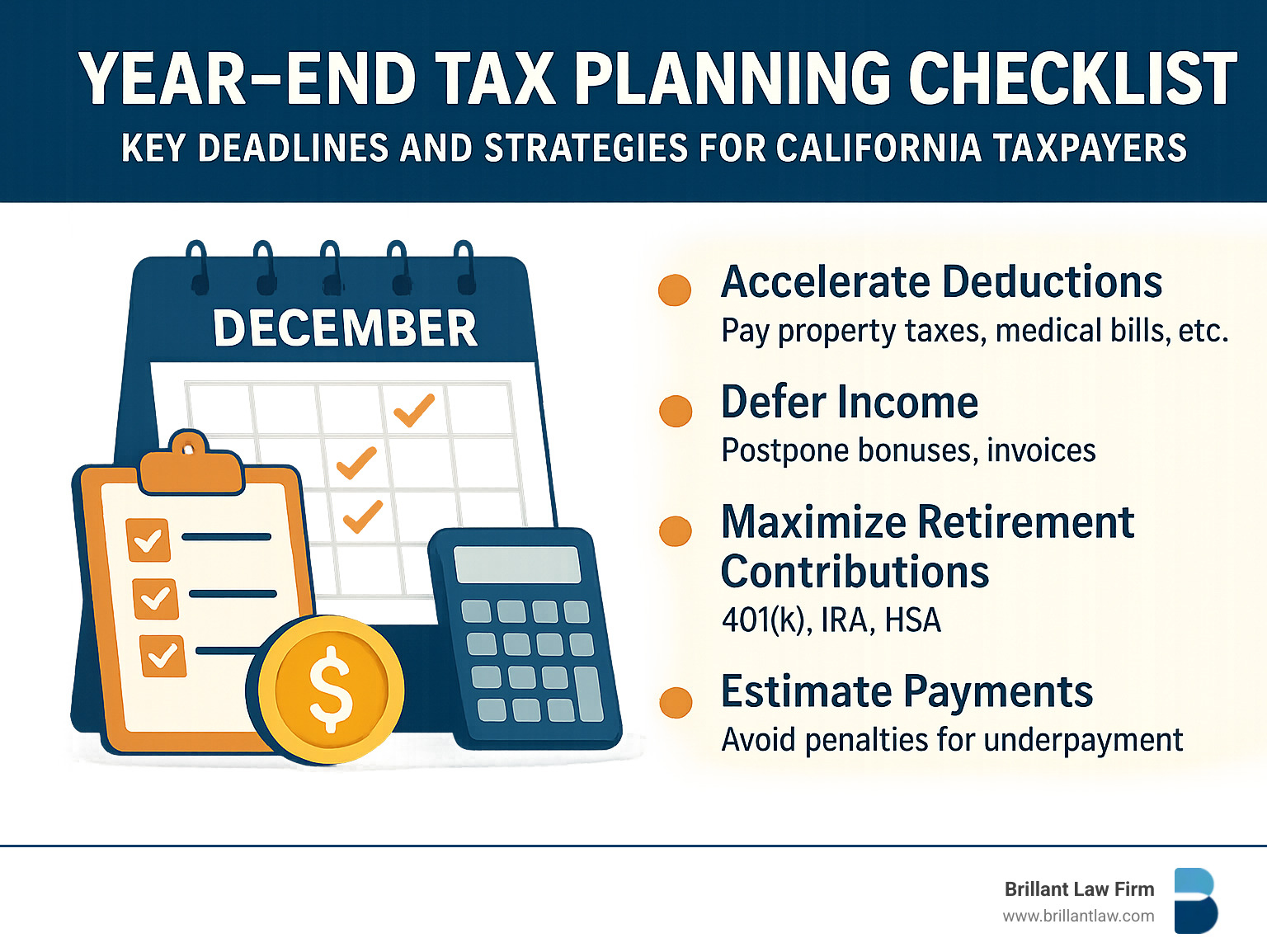
The key to successful year-end planning is starting early. By November, you should have a clear picture of your income and tax situation.
Frequently Asked Questions about California Taxation Strategies
When it comes to taxation strategies, I get the same questions from California clients again and again. Let me clear up the most common confusion points that trip people up during tax season.
What is the difference between a tax deduction and a tax credit?
This is probably the most misunderstood concept in tax planning. Think of it this way: a tax deduction is like a discount on what you’re buying, while a tax credit is like cash back.
A tax deduction reduces your taxable income first, then you calculate your tax on the lower amount. So if you’re in the 24% tax bracket and claim a $1,000 deduction, you save $240 in taxes (24% of $1,000).
A tax credit, on the other hand, reduces your actual tax bill dollar-for-dollar. That same $1,000 as a credit saves you the full $1,000, regardless of your tax bracket.
Here’s a real example: Let’s say you owe $5,000 in taxes. A $1,000 deduction might reduce that to $4,760, but a $1,000 credit drops it to $4,000. Big difference!
How can I avoid an underpayment penalty in California?
California doesn’t mess around with underpayment penalties, but the rules are actually pretty straightforward once you know them. You need to pay at least 90% of the current year’s tax or match what you paid last year through withholding and estimated payments.
There’s a catch though – if your prior-year adjusted gross income exceeded $150,000, you need to pay 110% of last year’s tax to stay in the safe harbor. This higher threshold often surprises high earners who get hit with penalties.
The smartest approach? Look at last year’s tax return and divide that amount by four for your quarterly estimated payments. This safe harbor strategy protects you even if your income jumps unexpectedly during the year.
When should I consult a tax attorney?
Here’s the honest truth: most people wait too long to get professional help. By the time they call me, they’re already in hot water with the IRS or have missed valuable planning opportunities.
You should consider consulting a tax attorney when you’re dealing with complex business structures, facing an IRS audit, or implementing aggressive taxation strategies that need bulletproof documentation.
If you’re thinking about advanced estate planning strategies or sophisticated business transactions, getting legal advice upfront can save you thousands later. I’ve seen too many DIY disasters where people tried to implement complex strategies they found online.
In California, expect to invest $600-$1,200 per hour for experienced tax attorneys, with most planning engagements requiring 10-20 hours of work. Yes, it’s a significant investment, but consider this: I recently saved a client $50,000 annually through proper business structure planning. That pays for a lot of attorney fees!
Conclusion
Smart taxation strategies can literally put thousands of dollars back in your pocket every year – but only if you approach them thoughtfully and consistently. Think of tax planning like tending a garden: a little attention throughout the year yields much better results than scrambling at the last minute.
The beauty of effective tax planning lies in how different strategies work together. When you maximize your 401(k) contributions while also implementing tax-loss harvesting and claiming every credit you’re entitled to, the savings compound. It’s not unusual for California residents to save $5,000 to $15,000 annually through proper planning.
Start with the basics – they’re called fundamentals for a reason. Max out those retirement contributions, grab every tax credit available, and keep meticulous records. These simple steps alone can dramatically reduce your tax burden. As your income grows and your financial situation becomes more complex, that’s when advanced strategies like Roth conversions and sophisticated investment planning really shine.
Here’s what I’ve learned after years of helping California clients: the biggest mistake is waiting. Tax laws change, opportunities expire, and procrastination costs money. The second biggest mistake? Trying to get too clever too quickly. Master the fundamentals first, then gradually add more sophisticated techniques as your situation warrants them.
California’s unique tax environment – with some of the highest state income tax rates in the nation – makes strategic planning even more crucial. Every dollar you can legally shift from taxable to tax-advantaged accounts has a bigger impact here than in most other states.
At Brillant Law Firm, we’ve seen how comprehensive taxation strategies can transform our clients’ financial futures. Our deep understanding of both federal and California tax law allows us to craft approaches that work specifically for California residents’ unique challenges and opportunities.
Ready to stop overpaying taxes and start keeping more of what you earn? Our advanced tax planning techniques can help you build a customized strategy that grows with your success. Because the best tax strategy isn’t the most complex one – it’s the one that fits your life and actually gets implemented.