

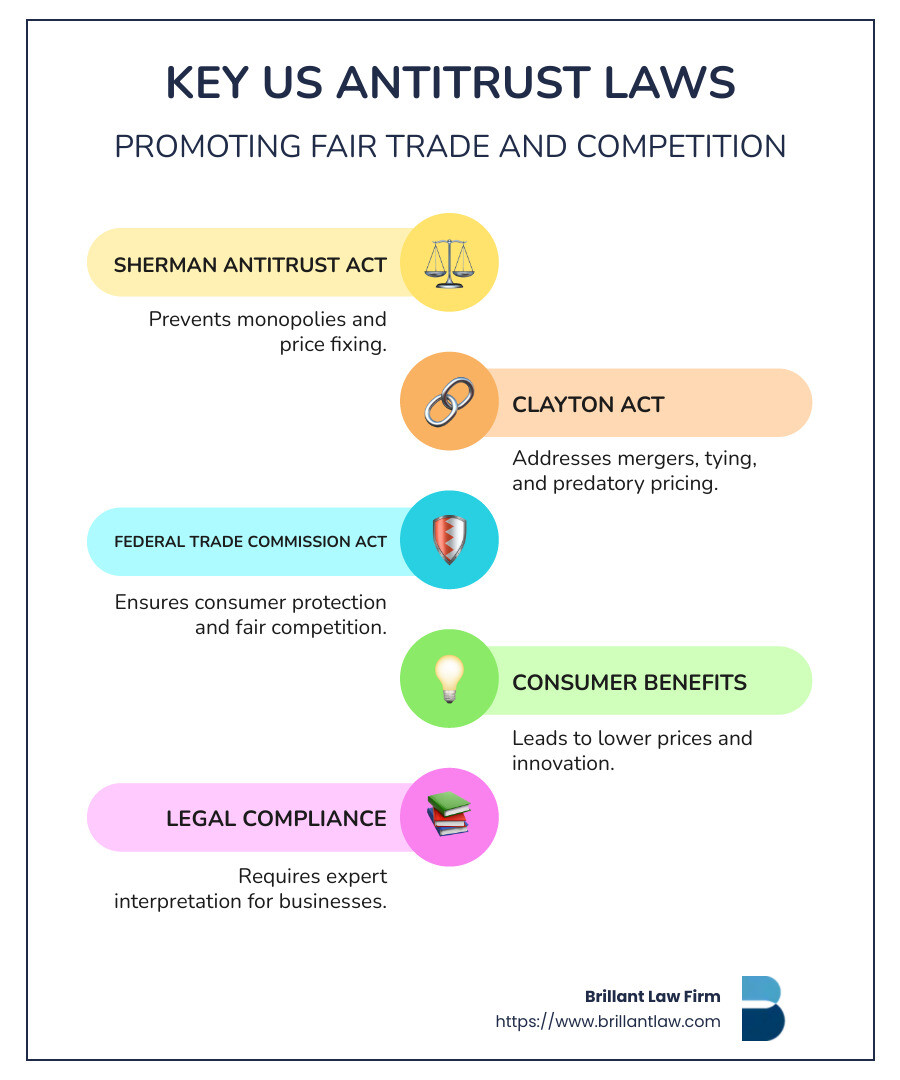
US laws that promote fair trade and competition among businesses are essential for ensuring a vibrant economic environment. These laws aim to protect consumers by fostering a marketplace where competition thrives, leading to lower prices, better quality, and more innovation. They’ve set the groundwork for businesses to compete fairly and for consumers to benefit from this competition. Key legislation includes:
- Sherman Antitrust Act
- Clayton Act
- Federal Trade Commission Act
These laws collectively prevent monopolistic practices, price fixing, and other unfair practices that could harm consumers or stifle competition.
Antitrust laws act as the guardians of our free market. By restricting anti-competitive behaviors like creating monopolies or engaging in price fixing, they ensure that competitive forces keep prices reasonable and innovation robust. Although they are crucial, antitrust laws can often seem complex and intricate, requiring expert interpretation and enforcement.
My name is David Brillant, and with a background in tax and estate law, I’ve encountered numerous cases where these laws intersect with commercial interests. My experience with US laws that promote fair trade and competition among businesses has equipped me to steer complex legal landscapes and ensure businesses operate within these important regulations.
Us laws that promote fair trade and competition among businesses terms at a glance:
– Appeals attorney near me
– us company law
Key US Laws Promoting Fair Trade and Competition
US laws that promote fair trade and competition among businesses are pivotal in maintaining a balanced and healthy marketplace. Let’s explore the three key laws that set the stage for fair competition: the Sherman Antitrust Act, the Clayton Act, and the Federal Trade Commission Act.
Sherman Antitrust Act
The Sherman Antitrust Act of 1890 was the first federal act that outlawed monopolistic business practices. It targets two main issues:
Price Fixing: Agreements between competitors to set prices at a certain level. This harms consumers by eliminating competition, which usually leads to higher prices.
Monopolization: The act makes it illegal for a company to dominate a market unfairly by suppressing competition. For instance, the famous case against Standard Oil in 1911 led to its breakup into 34 companies due to its monopoly in the oil industry.
The Sherman Act imposes criminal penalties for violations, underscoring the seriousness of anti-competitive behaviors.
Clayton Act
Passed in 1914, the Clayton Act builds on the foundation laid by the Sherman Act. It addresses specific practices not covered by its predecessor:
Mergers: The act scrutinizes mergers that could reduce competition or create a monopoly. For example, if two large companies in the same industry plan to merge, this act ensures the merger doesn’t harm consumers by reducing competition.
Tying Agreements: It prohibits companies from forcing consumers to buy a secondary product when purchasing a primary one, thus ensuring consumer choice.
Predatory Pricing: This is when a company sets prices extremely low to drive competitors out of the market, planning to raise prices once competition is eliminated.
Federal Trade Commission Act
The Federal Trade Commission Act of 1914 established the Federal Trade Commission (FTC), which is essential in promoting fair competition and protecting consumers from deceptive practices. The FTC can:
- Investigate and prevent unfair business practices.
- Take action against companies that engage in anticompetitive practices.
The FTC’s role is crucial in sectors where consumer spending is high, like healthcare and technology. By monitoring these areas, the FTC ensures businesses compete fairly, fostering an environment that benefits consumers through better prices and quality.

These laws work together to create a fair marketplace, ensuring businesses compete on merit and consumers receive the best possible outcomes. They are not just rules but the backbone of a thriving, competitive economy. As we explore these laws further, it’s clear they are indispensable in shaping a market where fair trade and competition are the norms.
The Role of the Sherman Antitrust Act
The Sherman Antitrust Act plays a vital role in ensuring fair trade and competition among businesses. Let’s break down how this law addresses major issues like price fixing, monopolization, and the enforcement of criminal penalties.
Price Fixing
Imagine walking into a store and finding that every brand of cereal costs exactly the same. If this happens, it’s likely due to price fixing, where competitors agree to set prices at a certain level. This practice is harmful because it eliminates the natural competition that keeps prices fair for consumers. The Sherman Antitrust Act makes such agreements illegal.
A notable example is the 1940 case, United States v. Socony-Vacuum Oil Co.. Here, oil companies agreed to buy surplus gasoline to keep prices high. The Supreme Court ruled this as illegal price fixing, reinforcing that such practices are against the law and harmful to consumers.
Monopolization
Monopolization occurs when a company dominates a market by unfair means, not by offering better products or services. The Sherman Act targets this by making it illegal to use anti-competitive practices to gain or maintain market power.
A classic example is the breakup of Standard Oil in 1911. The company controlled almost all oil production, refining, and marketing in the U.S. The government intervened, and the Supreme Court ordered Standard Oil to be divided into 34 independent companies. This action restored competition in the oil industry, ensuring better prices and options for consumers.
Criminal Penalties
The Sherman Antitrust Act doesn’t just set rules; it enforces them with criminal penalties. Companies and individuals found guilty of violating the act can face severe consequences, including heavy fines and imprisonment.
This underscores the seriousness of anti-competitive behaviors. It sends a clear message: businesses must compete fairly, or face significant legal repercussions. The potential for criminal charges acts as a strong deterrent against engaging in illegal practices like price fixing and monopolization.
The Sherman Antitrust Act is a cornerstone of U.S. antitrust law. It ensures that businesses compete on a level playing field, benefiting consumers with fair prices and choices. By tackling price fixing, monopolization, and imposing criminal penalties, the act creates a marketplace where competition thrives, and consumers win.
Next, we’ll explore the Clayton Act and its specific impact on mergers, tying agreements, and predatory pricing.
The Clayton Act and Its Impact
The Clayton Act builds on the foundation set by the Sherman Antitrust Act to further ensure fair trade and competition among businesses. It focuses on three main areas: mergers, tying agreements, and predatory pricing.
Mergers
Mergers can be beneficial, creating efficiencies and innovations. But when two companies merge and reduce competition, it can harm consumers. This is where the Clayton Act steps in.
Section 7 of the Clayton Act prohibits mergers and acquisitions that may substantially lessen competition or tend to create a monopoly. An example is the case of Malibu Rum and Captain Morgan’s proposed merger, which would have controlled over 95% of the premium rum market. The FTC challenged this merger to prevent potential price hikes and reduced consumer choices.
Tying Agreements
A tying agreement happens when a company requires customers to buy a secondary product along with a primary product. This can limit consumer choice and stifle competition.
The Clayton Act targets these agreements to ensure that businesses compete based on the quality and pricing of their products. A landmark case is International Business Machines Corp. v. United States, where IBM was found to have unlawfully tied the purchase of supplies to the lease of its machines. This decision reinforced that tying agreements are illegal when they restrict competition.
Predatory Pricing
Predatory pricing is when a company sets prices so low that competitors can’t compete and are driven out of the market. Once the competition is gone, the company can raise prices, harming consumers in the long run.
The Clayton Act addresses this by prohibiting pricing strategies that aim to eliminate competition unfairly. Critics argue that predatory pricing is more theory than practice, but the law remains a safeguard against potential abuse.
The Clayton Act strengthens U.S. antitrust laws by focusing on mergers, tying agreements, and predatory pricing. These provisions help maintain a competitive market, ensuring consumers benefit from fair prices and choices. Next, we’ll look at the Federal Trade Commission Act and how it helps ensure fair competition.
The Federal Trade Commission Act: Ensuring Fair Competition
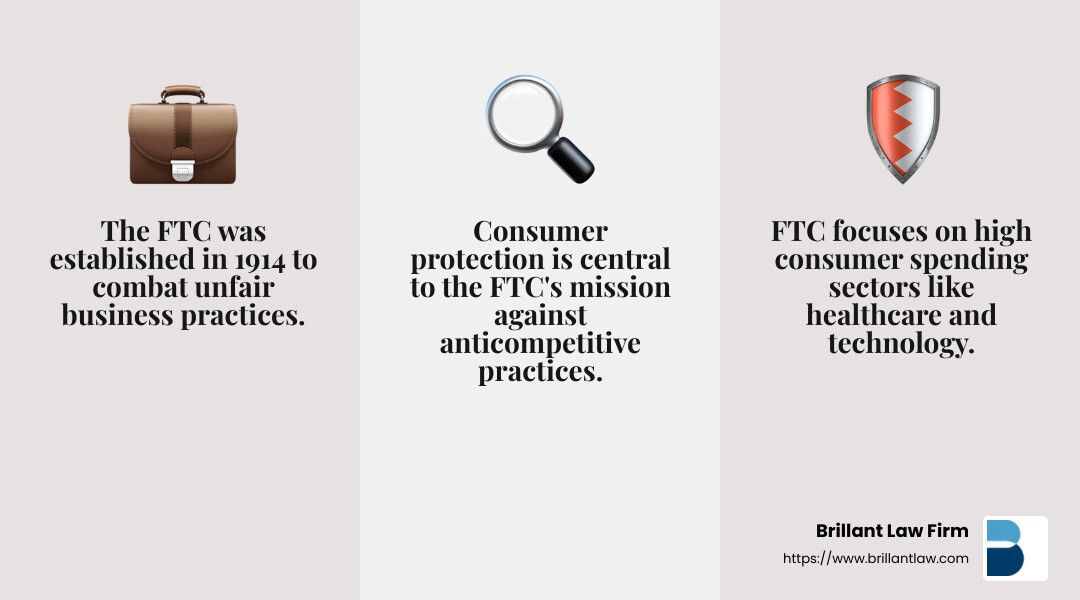
The Federal Trade Commission Act plays a crucial role in promoting fair trade and competition among businesses. It was established in 1914 to prevent unfair business practices and to protect consumers from deceptive acts.
The Role of the FTC
The Federal Trade Commission (FTC) is the main enforcer of the act. It focuses on preventing anticompetitive practices and ensuring consumer protection. The FTC targets industries where consumer spending is high, such as healthcare, technology, and food.
Consumer Protection
Consumer protection is at the heart of the FTC’s mission. The agency works to stop deceptive advertising, fraudulent business practices, and scams. For instance, in 2021, the FTC ordered Amazon to pay over $61 million for withholding tips from its Flex drivers. This action ensured that workers received their promised earnings and consumers’ trust was restored.
Anticompetitive Practices
The FTC also tackles anticompetitive practices that harm consumers. This includes actions like price fixing, monopolization, and unfair mergers. The FTC’s intervention in the proposed merger between Palmyra Medical Center and Putney Memorial Hospital is a prime example. The merger was blocked because it would have reduced competition and potentially increased healthcare costs for patients.
Enforcement and Cooperation
While the FTC doesn’t have the power to directly enforce its rulings, it can seek help from the courts to enforce decisions. The agency often collaborates with the Department of Justice to ensure that mergers and business practices align with public interest.
The Federal Trade Commission Act is vital for maintaining a fair and competitive market. By targeting deceptive practices and preventing unfair mergers, the FTC helps ensure that consumers enjoy fair prices and quality products. Next, we’ll dive into some Frequently Asked Questions about US Laws that Promote Fair Trade and Competition Among Businesses.
Frequently Asked Questions about US Laws that Promote Fair Trade and Competition Among Businesses
What laws promote fair trade and competition among businesses?
In the United States, two major laws ensure fair trade and competition among businesses: the Sherman Antitrust Act and the Clayton Act. These laws are designed to prevent activities that might harm competition, like monopolies, price fixing, or unfair mergers.
The Sherman Antitrust Act, passed in 1890, was the first federal action against monopolistic practices. It prohibits any agreement that restrains trade and targets monopolies that restrict competition. This act is crucial in maintaining a free market and ensuring consumers benefit from competitive prices and choices.
The Clayton Act, enacted in 1914, complements the Sherman Act by addressing specific practices that the Sherman Act does not explicitly cover. It targets activities like mergers that may lessen competition, tying agreements, and predatory pricing. Together, these laws form the backbone of U.S. antitrust regulation.
What is the fair trade law in the United States?
The concept of “fair trade law” in the U.S. initially emerged during the Great Depression. States enacted laws allowing manufacturers to set minimum prices to stabilize markets and protect brand value. However, these laws were eventually deemed inconsistent with the Sherman Antitrust Act. In 1975, Congress passed legislation making fair trade laws illegal under the Sherman Act, reinforcing the principle that competition should dictate prices, not artificial controls.
What are the penalties for violating antitrust laws?
Violating antitrust laws can lead to severe consequences. Under the Sherman Antitrust Act, penalties can be both criminal and civil. Individuals found guilty may face up to 10 years in prison and fines up to $1 million. Corporations can face fines up to $100 million. In some cases, fines may be even higher, calculated as twice the amount gained from illegal acts or twice the loss suffered by victims.
Civil enforcement allows for additional penalties, such as injunctions or court orders to cease anticompetitive practices. The Clayton Act also provides for civil remedies, including treble damages, which means affected parties can recover three times their actual damages, plus attorney fees.
Understanding these laws and their penalties is crucial for businesses operating in California. By adhering to these regulations, companies ensure they remain competitive while avoiding costly legal battles.
Next, we’ll explore how Brillant Law Firm’s expertise in California can help businesses steer these complex legal landscapes.
Conclusion
At Brillant Law Firm, we understand that navigating the complex world of antitrust laws can be challenging for businesses. Located in California, we specialize in providing custom legal strategies that help our clients comply with U.S. laws that promote fair trade and competition among businesses. Our expertise in the Sherman Antitrust Act, Clayton Act, and Federal Trade Commission Act ensures that our clients are well-equipped to operate within the legal framework that governs fair competition.
Our team is committed to excellence and offers bespoke solutions to meet the unique needs of each client. Whether you’re dealing with issues related to monopolization, mergers, or other anticompetitive practices, we have the knowledge and experience to guide you through. We pride ourselves on our unwavering dedication to protecting your business interests and ensuring compliance with California’s stringent antitrust regulations.
Operating in cities like Walnut Creek, Saranap, San Miguel, and Castle Hill, we are strategically positioned to serve businesses throughout California. Our legal services are not just about addressing current issues but also about foreseeing potential challenges and mitigating risks.
If you’re a business owner in California looking for expert legal guidance on antitrust matters, contact Brillant Law Firm. Let us help you steer the complexities of commercial litigation with confidence and clarity. Your success is our success, and we are dedicated to achieving the best possible outcomes for you.


