

In business, us company law is pivotal for anyone looking to steer the corporate maze successfully. But what exactly does it encompass? At its core, us company law regulates how companies are formed, operated, and dissolved in the United States, with a specific focus on corporate governance, business law, and company law. Here’s a quick breakdown:
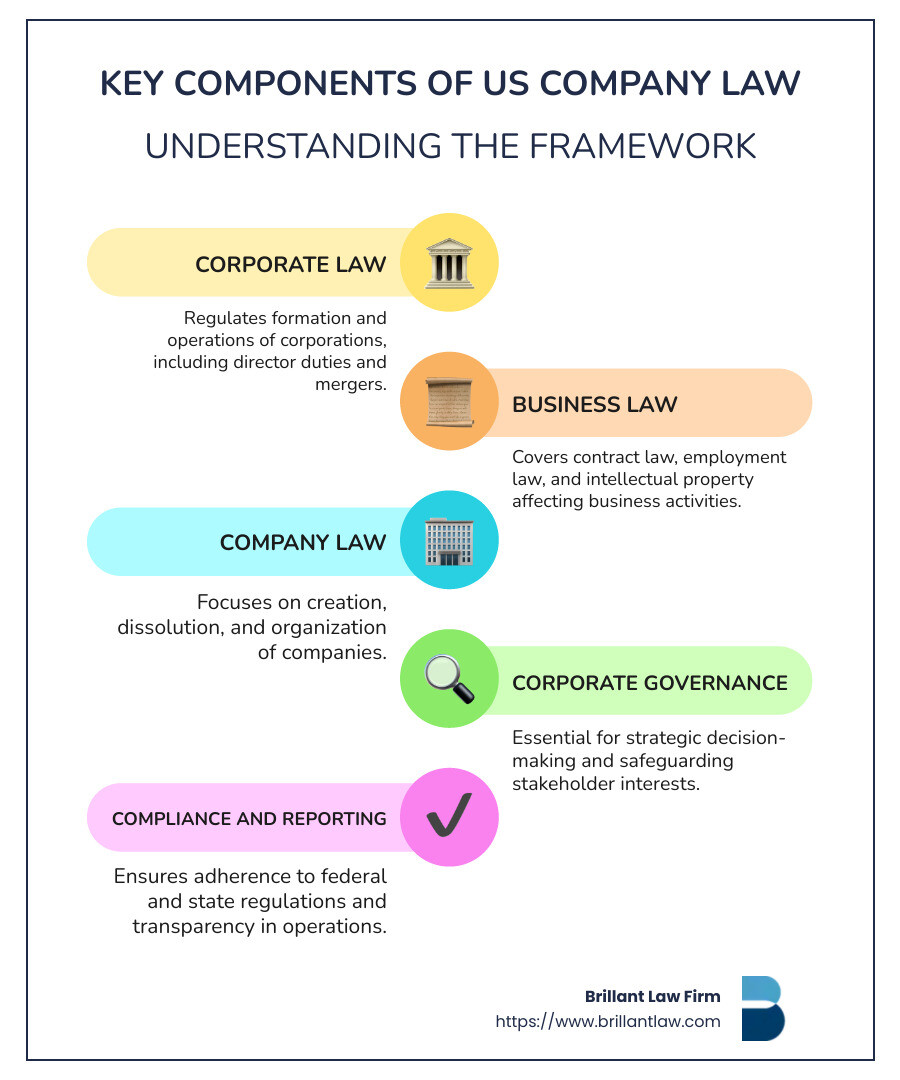
- Corporate Law: Governs the formation and operations of corporations, ensuring legal compliance in matters such as director duties, shareholder rights, and mergers.
- Business Law: Encompasses the broader spectrum of laws affecting business activities, including contract law, employment law, and intellectual property.
- Company Law: A subset of corporate law focused mainly on the creation, dissolution, and structural organization of companies.
Understanding these concepts is crucial for high-net-worth individuals and business owners who require bespoke strategies to safeguard their assets and interests.
Welcome, I’m David Brillant, a seasoned attorney specializing in us company law. With a wealth of experience in taxation and corporate governance, I enjoy tackling complex problems that others deem unsolvable. In California, where I practice, our firm dedicates itself to excellence, offering customized solutions custom to each client’s unique needs.
Understanding US Company Law
Let’s explore the heart of US company law—a complex yet fascinating world that focuses on how businesses are governed, both at the state and federal levels. This section will simplify the essentials of corporate governance, state corporate law, and federal securities law, particularly as they apply in California.
Corporate Governance
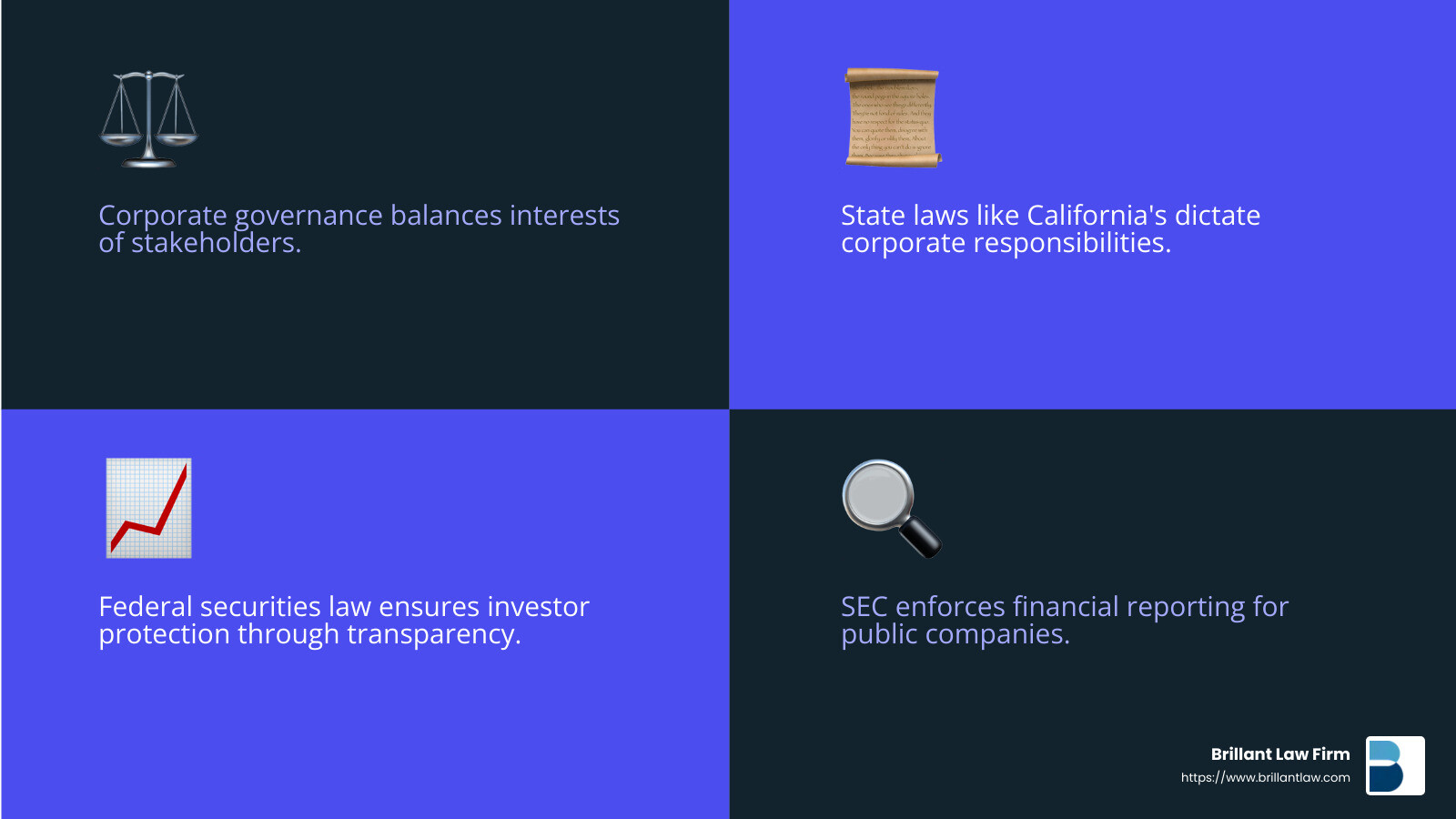
Corporate governance is all about the rules and practices that dictate how a company is controlled and directed. It’s a system that balances the interests of a company’s stakeholders, including shareholders, management, customers, suppliers, financiers, government, and the community.
In California, corporate governance is influenced by both state laws and federal regulations. The goal? To ensure transparency, accountability, and fairness in a company’s relationship with its stakeholders. A robust governance structure can help prevent corporate scandals and improve a company’s reputation and performance.
State Corporate Law
In the U.S., corporate law varies from state to state, but California has its own set of rules that companies must follow. These laws cover everything from the incorporation process to the responsibilities of directors and officers.
California’s corporate laws are designed to provide flexibility while maintaining a strong framework to protect shareholders and the public. Companies incorporated in California must adhere to the California Corporations Code, which outlines the necessary steps for corporate formation, the duties of corporate directors, and the rights of shareholders.
Federal Securities Law
Federal securities law, primarily governed by the Securities Act of 1933 and the Securities Exchange Act of 1934, plays a critical role in us company law. These laws are designed to protect investors by ensuring that public companies provide accurate and complete information about their financial health and business operations.
The Securities and Exchange Commission (SEC) enforces these laws, requiring companies to file periodic reports that provide transparency to investors. This includes annual reports (Form 10-K), quarterly reports (Form 10-Q), and current reports (Form 8-K) for significant events.
For businesses in California, understanding and complying with these federal securities laws is crucial to avoid penalties and maintain investor trust.
In summary, the intricate web of corporate governance, state corporate law, and federal securities law forms the backbone of us company law. This framework is essential for ensuring that companies operate fairly and transparently, protecting both the business and its stakeholders. Now, let’s explore the key components of US company law, including corporate formation and the importance of articles of incorporation and bylaws.
Key Components of US Company Law
When it comes to setting up a business in the United States, understanding us company law is crucial. Let’s explore three key components: corporate formation, articles of incorporation, and bylaws.
Corporate Formation
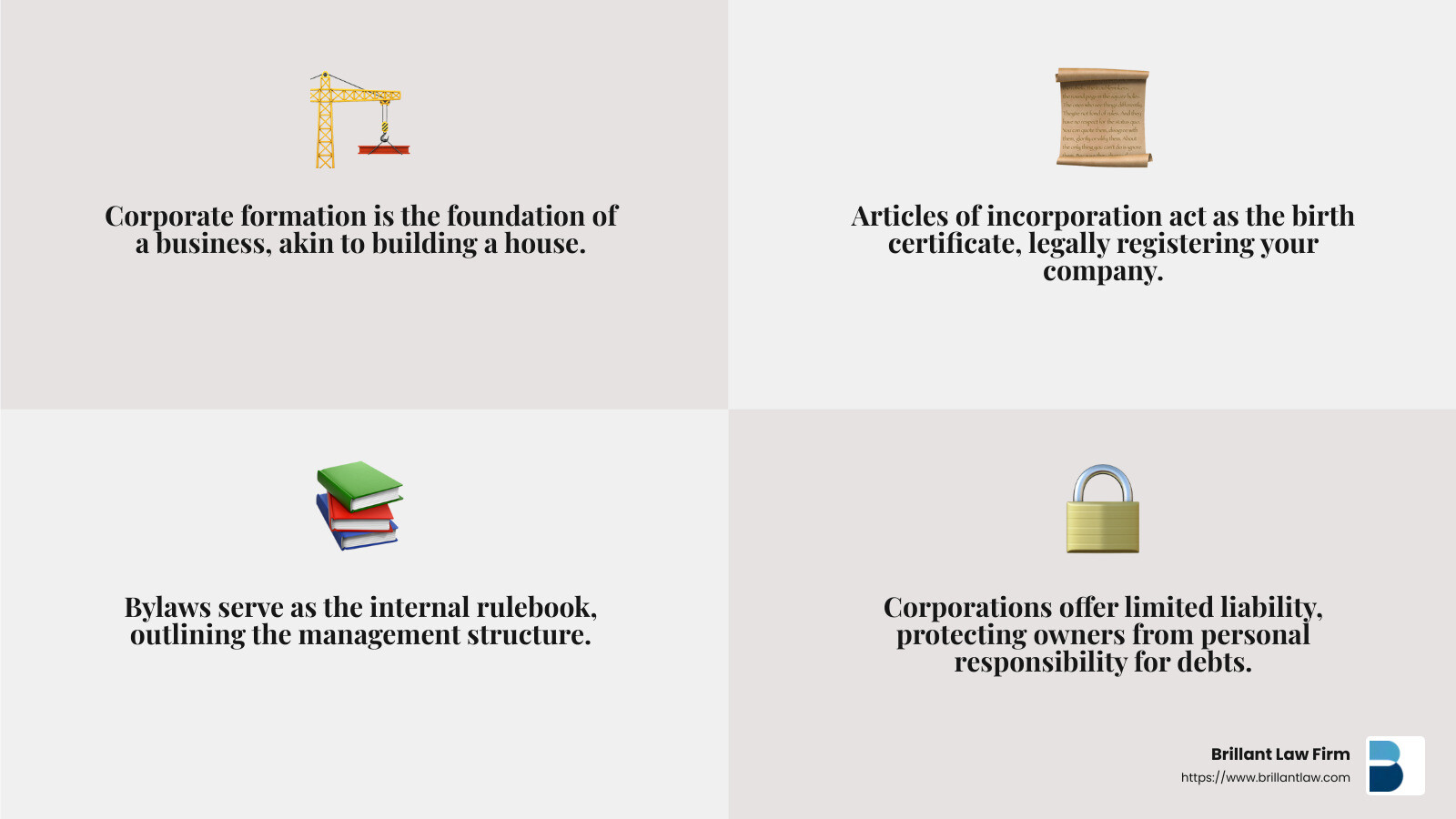
Starting a company is like building a house. You need a solid foundation. In California, this foundation begins with corporate formation.
Businesses can be structured in various ways, such as corporations, limited liability companies (LLCs), or partnerships. Each structure has its own set of rules and benefits. For example, corporations offer limited liability, meaning owners are not personally responsible for business debts. However, they may face double taxation—once on corporate income and again on dividends.
The process starts by choosing a unique name for your corporation. This name must include words like “corporation,” “incorporated,” or abbreviations like “corp.” or “inc.” to make it clear that it’s a corporate entity.
Articles of Incorporation
Think of the articles of incorporation as the birth certificate of your company. This document officially registers your corporation with the state of California.
The articles must include key information like the corporate name, the number of shares it can issue, and the address of its initial registered office. It also lists the name of the registered agent, who is responsible for receiving legal documents on behalf of the corporation.
Filing the articles of incorporation is a critical step. It brings the corporation into legal existence and provides a framework for its operations.
Bylaws
Bylaws are the rulebook for running your corporation. They outline the internal management structure and procedures, such as how meetings are conducted, how directors are elected, and how voting is handled.
Having clear and comprehensive bylaws is essential. They help prevent disputes among shareholders and directors by providing clear guidelines for decision-making processes.
Bylaws can be amended as the company grows and changes, allowing flexibility while maintaining order.
In California, understanding these components—corporate formation, articles of incorporation, and bylaws—is vital for anyone looking to start a business. They not only establish the legal identity of the corporation but also ensure smooth operations and compliance with us company law.
Next, we’ll dig into the role of federal and state laws in shaping the landscape of US company law.
The Role of Federal and State Laws
When it comes to us company law, both federal and state laws play crucial roles in shaping the landscape. Let’s break down how these laws work, focusing on the Securities Act of 1933, the Model Business Corporation Act, and California corporate law.
Securities Act of 1933
The Securities Act of 1933 is a federal law that regulates the offer and sale of securities. Think of it as a protective shield for investors. It requires companies to provide truthful information about their business, securities, and the risks involved. This transparency helps investors make informed decisions.
The Act mandates companies to register their securities with the U.S. Securities and Exchange Commission (SEC) before they can be sold to the public. This registration includes detailed financial statements and important disclosures. By ensuring transparency, the Act aims to prevent fraud and build trust in the financial markets.
Model Business Corporation Act
The Model Business Corporation Act (MBCA) serves as a blueprint for state corporate laws. While not a law itself, it provides a framework that many states use to draft their corporate statutes. It’s like a recipe book for creating corporate laws.
The MBCA covers various aspects of corporate governance, including the incorporation process, the roles of directors and officers, and shareholder rights. It gives states the flexibility to adopt and adapt its provisions to suit their specific needs.
California Corporate Law
In California, corporate law is guided by the California Corporations Code. This state-specific law governs how businesses are formed, operated, and dissolved within the state. It outlines the rights and responsibilities of corporate stakeholders and ensures compliance with both state and federal regulations.
California corporate law is known for its strong emphasis on shareholder rights and environmental considerations. It also supports progressive policies like board diversity and corporate social responsibility. Companies incorporated in California must adhere to these regulations, which reflect the state’s commitment to transparency and accountability.
Balancing Federal and State Laws
The interplay between federal and state laws creates a dynamic legal environment for businesses. Federal laws, like the Securities Act of 1933, provide a broad framework to protect investors across the country. Meanwhile, state laws, such as California’s Corporations Code, offer more specific guidance custom to local needs and priorities.
This dual system allows for innovation and flexibility in corporate governance. States can experiment with different regulations, creating a “laboratory” of ideas that can be adopted by others if successful. However, businesses must steer this complex landscape carefully to ensure compliance with all applicable laws.
In summary, understanding the role of federal and state laws is key for anyone involved in us company law. These laws not only shape the way businesses operate but also protect the interests of investors and other stakeholders.
Next, we’ll explore the benefits and challenges of incorporating a business in the United States.
Benefits and Challenges of Incorporating
Incorporating a business in the United States, particularly in California, comes with its own set of advantages and problems. Let’s explore the key aspects: limited liability, double taxation, and piercing the corporate veil.
Limited Liability
One of the biggest benefits of incorporating is limited liability. This means that as a shareholder in a corporation, your personal assets are generally protected from the company’s debts and liabilities. If the corporation faces financial trouble, the most you can lose is the amount you invested. This protection encourages entrepreneurship by reducing personal risk.
However, not all liabilities are off the table. Creditors often require personal guarantees from directors or major shareholders. This can blur the lines of protection, making it important to carefully assess any personal commitments.
Double Taxation
A notable challenge for corporations is double taxation. This occurs because a corporation is taxed as a separate legal entity. First, the corporation pays taxes on its profits. Then, if it distributes dividends to shareholders, those dividends are taxed again on the individual’s tax return.
To mitigate this, some business owners opt for an S-Corporation status, which allows profits to pass directly to shareholders without being taxed at the corporate level. However, this option comes with its own set of eligibility requirements and limitations, particularly in California where state-specific rules apply.
Piercing the Corporate Veil
The concept of piercing the corporate veil is an exception to limited liability. This legal action can hold shareholders personally liable if the corporation is found to be a sham or is used for fraudulent purposes. Courts can decide to pierce the veil if:
- The corporation was inadequately capitalized.
- Corporate formalities were ignored.
- The corporation was used to benefit another entity improperly.
For instance, in Kinney Shoe Corp v Polan, the court pierced the veil because the corporation was undercapitalized and failed to observe corporate formalities. This serves as a warning to maintain proper records and adequate capitalization to uphold the corporate shield.
In summary, incorporating offers significant protections and benefits, but it also comes with responsibilities and potential pitfalls. Understanding these elements is crucial for anyone considering incorporation under us company law.
Next, we’ll take a closer look at the Corporate Transparency Act and what it means for your business.
The Corporate Transparency Act (CTA)
The Corporate Transparency Act (CTA) is a game-changer in the field of US company law, particularly for small businesses in California. This federal law aims to combat illegal activities like money laundering and tax fraud by requiring businesses to disclose detailed information about their ownership.
Ownership Disclosure
Under the CTA, businesses must report information about their beneficial owners. A beneficial owner is anyone who owns or controls at least 25% of the company or exercises significant control over it. This means if you have a significant stake in a business, your information needs to be on file with the U.S. Department of the Treasury.
The goal is to prevent bad actors from hiding behind anonymous shell companies. By knowing who owns what, authorities can better track and prevent illegal activities.
Compliance Requirements
Compliance with the CTA is mandatory for many businesses, especially those with $5 million or less in annual U.S. revenues or 20 or fewer full-time employees. If your business fits this description, you need to prepare for the new filing requirements that kick in on January 1, 2024.
Key compliance steps include:
Filing Initial Reports: If your business existed before 2024, you have until January 1, 2025, to file your first report. For businesses formed after 2023, the deadline is 30 days post-formation, but if formed in 2024, you get a 90-day window.
Updating Information Promptly: Any changes in beneficial ownership or other relevant details must be reported within 30 days. This requires businesses to closely monitor and update their records to stay compliant.
Reporting Obligations
The CTA mandates that businesses report specific identifying information about each beneficial owner and, in some cases, company applicants. This includes:
- Full legal name
- Date of birth
- Current residential or business address
- Unique identifying number from an acceptable identification document (like a passport or driver’s license)
Failure to comply with these reporting obligations can result in penalties. Therefore, it’s crucial for businesses to implement internal systems to track and report any changes swiftly.
The CTA adds a layer of transparency to US company law, aiming to create a more secure and fair business environment. While it may seem like an extra administrative burden, it plays a vital role in curbing illicit activities.
Next, let’s dive into some frequently asked questions about US company law to further clarify how these regulations impact your business.
Frequently Asked Questions about US Company Law
What is US corporate law?
US corporate law is a set of rules and regulations that govern how corporations operate in the United States. It encompasses various aspects like corporate governance, securities regulation, and mergers and acquisitions. Corporate governance involves the systems and processes by which companies are directed and controlled. This includes the roles of the board of directors, shareholders, and other stakeholders.
A significant feature of US corporate law is the emphasis on Delaware incorporation. Delaware is a popular state for incorporation due to its well-established legal framework and business-friendly court system. However, California also provides a robust legal structure for businesses, focusing on transparency and accountability.
What is the governing law for US companies?
The governing law for US companies is a mix of corporate law and company law. Corporate law typically refers to the body of laws, rules, and regulations that apply to corporations. On the other hand, company law can include laws that apply to other types of business entities, such as limited liability companies (LLCs) and partnerships.
In California, companies must comply with state-specific corporate laws, which dictate everything from how a company is formed to how it must operate. This includes filing articles of incorporation, maintaining a registered agent, and adhering to corporate governance standards.
What is the Corporate Transparency Act?
The Corporate Transparency Act (CTA) is a federal law designed to improve transparency in business operations by requiring companies to disclose information about their beneficial owners. This law aims to combat illegal activities like money laundering and tax evasion by making it harder for bad actors to hide behind anonymous business structures.
Under the CTA, companies must provide detailed ownership disclosure, including the names, addresses, and identification numbers of anyone who owns or controls at least 25% of the company. This information is reported to the U.S. Department of the Treasury and helps create a more transparent and accountable business environment.
In summary, understanding these aspects of US company law is crucial for businesses operating in California. By adhering to corporate governance standards, complying with state and federal laws, and fulfilling ownership disclosure requirements, companies can ensure they are operating within the legal framework while contributing to a fair and transparent business landscape.
Conclusion
Navigating the complexities of US company law can be daunting, but with the right legal guidance, it becomes manageable. At Brillant Law Firm, we pride ourselves on our deep understanding of California’s corporate landscape, offering custom strategies that align with your business needs.
Our expertise in California legal matters ensures that your business is not only compliant but also positioned for success. We specialize in Trusts, Estates, Taxation, Business, Civil Litigation, and Appeals, bringing a wealth of knowledge to every case. Our team is dedicated to providing bespoke, ironclad strategies that cater specifically to your unique circumstances.
In California, where business regulations are both stringent and dynamic, having a legal partner who understands the intricacies of state-specific corporate laws is invaluable. We focus on transparency and accountability, helping you steer everything from filing articles of incorporation to maintaining corporate governance standards.
Choosing Brillant Law Firm means choosing excellence. We stand ready to assist you with all your business law needs, ensuring that your company’s legal foundation is as strong as your business aspirations. Trust us to be your steadfast partner in the changing world of corporate law.
For more information on how we can help your business thrive, visit our Business Law Lawyers page.


