

Tax Strategy: Unlock 2025 Savings
Why Tax Strategy Is Your Financial Foundation
A tax strategy is a comprehensive plan to legally minimize your tax liability. At its core, it involves reducing taxable income, maximizing deductions and credits, and timing financial decisions to your advantage. Key elements include income management, deduction optimization, credit utilization, and planning for investments and your estate.
For California residents, the stakes are high. With combined state and federal tax rates that can exceed 50% for high earners, proper tax planning can save thousands of dollars annually. Many people mistakenly view tax planning as a once-a-year activity, but effective strategies require year-round attention. Every financial decision, from managing investments in Walnut Creek to planning retirement in Castle Hill, has tax implications.
As David Brillant, a Certified Specialist in Estate Planning, Trust and Probate Law with a Masters in Taxation, I help clients in Saranap, San Miguel, and surrounding communities develop comprehensive tax strategies that align with their long-term financial goals.
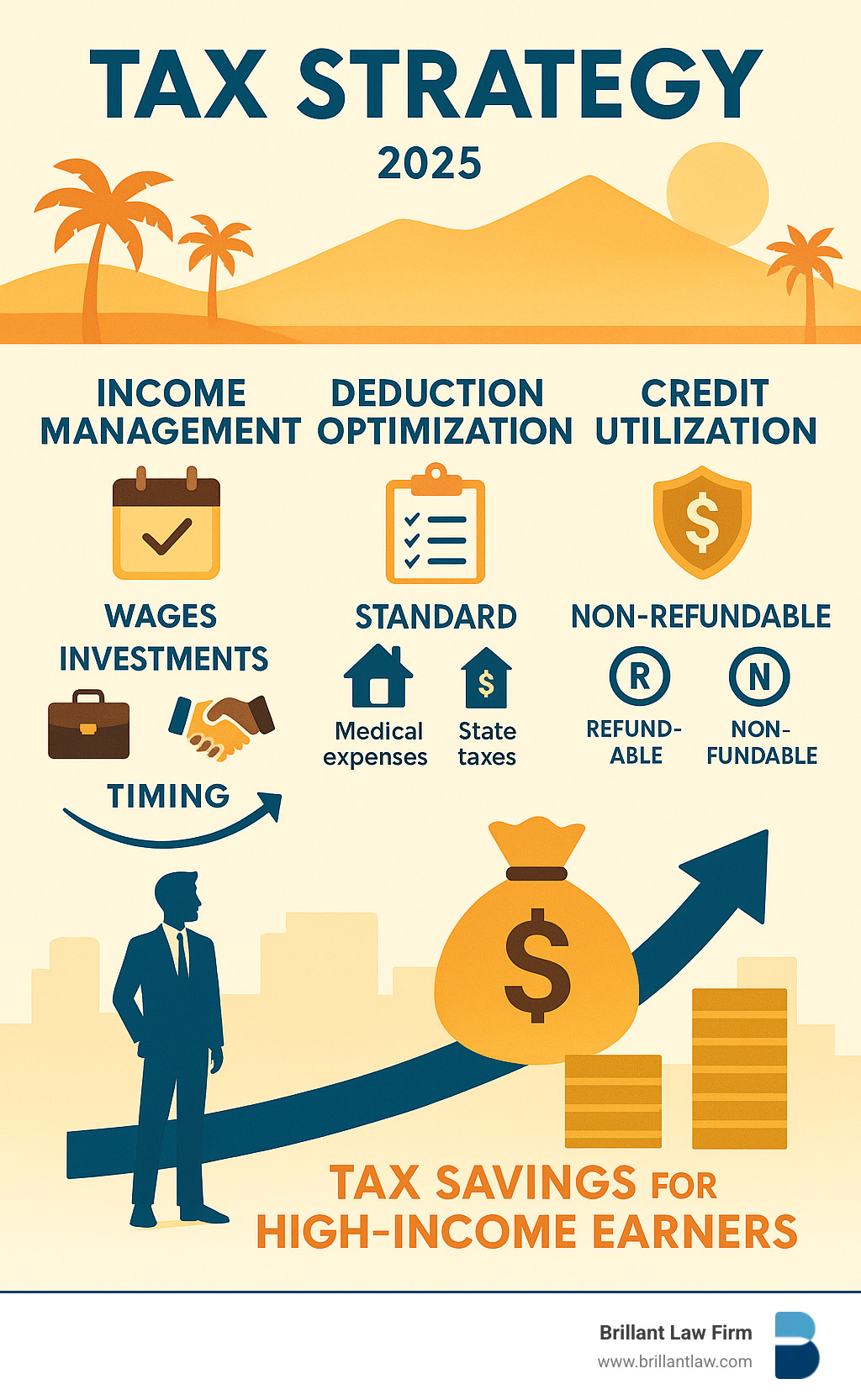
Handy tax strategy terms:
Foundations of an Effective Tax Strategy
Building a solid tax strategy means legally reducing your tax liability, deferring income when it makes sense, and accumulating wealth more efficiently. Every dollar you save in taxes is a dollar that can work for your financial future. At Brillant Law Firm, we create bespoke strategies for clients across Saranap, San Miguel, and Walnut Creek that align with long-term goals. For a deeper dive, explore our resources on Taxation and Tax Planning.
Strategic decisions about retirement contributions, investment timing, or business expenses have ripple effects that compound over time.

Understanding Tax Deductions vs. Tax Credits
The difference between tax deductions and tax credits is crucial. Tax deductions reduce your taxable income. If you earn $100,000 and have $15,000 in deductions, you’re taxed on the lower $85,000 amount. You can take the standard deduction or itemize specific expenses like mortgage interest if they total more.
Tax credits are more powerful, reducing your tax bill dollar-for-dollar. A $2,000 tax credit means you owe $2,000 less in taxes. Some are refundable (you can get money back even if you owe nothing), while others are non-refundable.
The Importance of Proactive Tax Planning
Tax planning in April is too late. An effective tax strategy is a year-round process that requires consistent record-keeping and alignment with your financial goals. Life events like a new job, a baby, or buying a home change your tax situation. Proactive planning means adapting as these events happen, not scrambling months later. For more, see our Advanced Tax Planning Strategies.
How Changes in Tax Law Impact Your Planning
Tax laws are constantly in flux. Capital gains rates, tax brackets, and available credits and deductions are regularly updated. Staying informed is critical to ensure your strategy remains compliant and optimized, especially after major legislation like the Tax Cuts & Jobs Act in 2017. Professional guidance is key to navigating these changes in California’s complex tax environment.
Core Tax Strategies for Individuals and Families in California
California families in Walnut Creek, Saranap, and Castle Hill face high state income tax rates on top of federal taxes. A personalized tax strategy is crucial for your family’s financial health. For those in California’s highest tax brackets, our guide on How to Reduce Taxable Income for High Earners offers detailed strategies.

Maximizing Tax-Advantaged Retirement Accounts
These accounts are the backbone of a strong tax strategy, offering tax relief while building wealth.
- Traditional 401(k)s and IRAs: You deduct contributions today, reducing current taxable income while investments grow tax-deferred.
- Roth IRAs: You pay taxes on contributions now, but your money grows and can be withdrawn completely tax-free in retirement.
- Health Savings Accounts (HSAs): These offer a triple tax advantage: contributions are deductible, growth is tax-free, and withdrawals for qualified medical expenses are also tax-free.
Be mindful of contribution limits and Required Minimum Distributions (RMDs) from traditional accounts after age 73.
A Personalized Tax Strategy for Life’s Milestones
Each major life event brings new tax planning opportunities.
- Medical Expenses: Track all eligible costs, as they can be deductible if they exceed a high threshold.
- Homeownership: Mortgage interest can be a substantial deduction, though it is capped by recent tax law changes.
- Education Planning: 529 plans offer tax-free growth for qualified education expenses.
- Caregiving: Various credits and deductions are available if you support elderly or disabled family members.
It’s essential to coordinate these events with your comprehensive Estate Planning.
Optimizing Charitable Giving for Tax Benefits
Strategic giving can maximize both your impact and your tax benefits.
- Donating Appreciated Securities: This is incredibly tax-efficient. You can avoid capital gains tax entirely while still claiming a deduction for the full fair market value.
- Qualified Charitable Distributions (QCDs): If you’re 70½ or older, you can donate up to $100,000 annually from your IRA to charity. This can satisfy your RMD without increasing your taxable income.
- Donor-Advised Funds: This strategy allows you to “bunch” donations by making a large contribution in one year for an immediate deduction, then recommending grants to charities over several years.
Advanced Investment and Asset Tax Strategy
For investors in Castle Hill or Walnut Creek, a sophisticated tax strategy is essential for managing a growing portfolio. California’s state taxes add complexity, making strategic planning critical. Our expertise in advanced tax planning strategies helps investors steer these challenges while keeping more of their returns.

Managing Taxes on Your Investments
- Tax-Loss Harvesting: Strategically sell losing investments to offset gains from your winners. You can use these losses to cancel out capital gains, and if you have more losses than gains, you can deduct up to $3,000 against ordinary income each year. Beware the wash sale rule, which disallows the loss if you buy a substantially identical security within 30 days.
- Asset Location: This strategy involves placing different types of investments in the most tax-efficient accounts. Tax-inefficient investments (like corporate bonds) belong in tax-deferred accounts (401(k)s/IRAs), while tax-efficient investments (like growth stocks) can thrive in taxable accounts.
Real Estate and Your Tax Strategy
- Principal Residence Exclusion: If you’ve lived in your home for at least two of the past five years, you can exclude up to $250,000 (single) or $500,000 (married) of capital gains from its sale.
- Investment Properties: When you sell a rental property, you face capital gains tax and depreciation recapture. A 1031 exchange offers a powerful way to defer these taxes by reinvesting the proceeds into another “like-kind” property.
Specialized Strategies for Equity Compensation
- Stock Options & RSUs: Incentive Stock Options (ISOs) and Non-qualified Stock Options (NSOs) have distinct tax treatments. Restricted Stock Units (RSUs) are taxed as ordinary income when they vest. The timing of when you exercise or sell is critical.
- 83(b) Election: A powerful but risky strategy where you elect to pay taxes on restricted stock at its current (hopefully low) value rather than waiting until it vests at a higher value.
- Net Unrealized Appreciation (NUA): This rule can benefit employees with highly appreciated company stock in their 401(k) plans, allowing the appreciation to be taxed at lower long-term capital gains rates.
These specialized strategies should be integrated with your broader estate planning to ensure your goals are aligned.
Strategic Tax Planning for California Businesses
For business owners in California, from Walnut Creek to Saranap, a robust tax strategy optimizes cash flow and fosters growth. Navigating the corporate tax landscape, including California’s franchise tax, requires expertise. Our Corporate Tax Attorney services can help. The choice of business structure is foundational, as each has distinct tax implications.
| Business Structure | Federal Tax Implications | California Tax Implications |
|---|---|---|
| Sole Proprietorship | Pass-through entity; income/losses on personal return (Schedule C); subject to self-employment tax. | Pass-through; generally no separate state income tax, but subject to self-employment tax and potential local business taxes. |
| Partnership | Pass-through entity; income/losses on partners’ personal returns (Schedule K-1); partners pay self-employment tax. | Pass-through; generally no separate state income tax, but partnerships may pay an annual LLC fee based on income. |
| LLC (Limited Liability Company) | Default pass-through (single-member taxed as sole prop, multi-member as partnership); can elect S-Corp or C-Corp taxation. | California LLCs pay an $800 annual minimum franchise tax plus an annual fee based on total income if over $250,000. |
| S-Corporation | Pass-through entity; income/losses on shareholder personal returns; avoids self-employment tax on distributions. | Pass-through, but subject to a 1.5% state corporate franchise tax (minimum $800). |
| C-Corporation | Taxed at the corporate level; shareholders taxed again on dividends (double taxation); can retain earnings. | Subject to an 8.84% state corporate income tax (minimum $800 franchise tax), plus federal corporate tax. |
Year-End Tax Planning for Your Business
Year-end is a critical time for strategic tax moves.
- Timing Income and Expenses: Accelerate expenses into the current year and defer income into the next to reduce current taxable income.
- Depreciable Asset Purchases (Section 179): Businesses can often deduct the full purchase price of qualifying equipment in the year it’s placed in service.
- Bonuses and Retirement Plans: Paying employee bonuses and maximizing contributions to retirement plans before year-end can create significant deductions.
Our team helps businesses in Castle Hill and beyond develop robust Business Litigation and Transactions strategies that include comprehensive year-end tax planning.
Structuring Family Involvement and Compensation
For family-owned businesses, paying reasonable salaries to family members (spouse, children) who genuinely work in the business can be a powerful tax strategy. This creates a business deduction and can shift income to a family member in a lower tax bracket. Hiring your children can also provide tax benefits and allow them to contribute to a Roth IRA from an early age. It’s crucial that all compensation is for actual work performed and is well-documented to withstand IRS scrutiny.
Compliance, Protection, and Professional Guidance
A robust tax strategy must be protected by meticulous compliance and professional guidance. Proper execution and documentation are essential to withstand IRS scrutiny and protect the financial benefits you’ve worked to achieve.

The Critical Role of Meticulous Record-Keeping
Your records are the backbone of your tax strategy. Without them, deductions can be disallowed. Use digital tools to capture and organize receipts for business, charitable, and medical expenses. The general rule is to keep records for three years, but some records (like for real estate purchases) should be kept indefinitely. To substantiate deductions, you need to document the amount, date, and business purpose. The goal is to audit-proof your return from the start.
Protecting Yourself from Fraudulent Tax Schemes
California’s high tax rates make residents targets for tax scams. Be wary of preparers who guarantee large refunds or encourage false claims. If a promise sounds “too good to be true,” it probably is. Always vet tax preparers and never sign a blank or incomprehensible return—you are ultimately responsible. The consequences of tax evasion include back taxes, penalties, interest, and even criminal prosecution.
When to Hire a Tax Attorney in California
While CPAs handle many tax matters, a tax attorney is crucial for certain situations:
- Complex investments or intricate business structures.
- High-net-worth individuals requiring sophisticated legal and strategic planning.
- Facing an IRS audit, collection action, or criminal investigation, where attorney-client privilege is vital.
- Estate planning with significant tax implications.
- Tax disputes with federal or state authorities, which require a Tax Litigation Attorney.
Our Corporate Tax Attorney and Los Angeles Tax Advisor services provide specialized guidance.
Attorney Fees and Rates in California
In California, tax attorney hourly rates typically range from $350 to $800, depending on experience, case complexity, and location. At Brillant Law Firm, we provide transparent fee structures for our clients in Walnut Creek, Saranap, and Castle Hill, ensuring you understand the investment in your tax strategy. The cost of quality legal representation is often far less than the cost of a mistake.
Frequently Asked Questions about Tax Strategy
What is the main goal of a tax strategy?
The primary goal is to legally minimize your tax liability over your lifetime. This allows you to retain more of your earnings to build wealth and achieve your financial goals, all while remaining fully compliant with federal and California tax laws. Every dollar saved is a dollar that can be reinvested in your business, saved for education, or used for retirement.
How often should I review my tax strategy?
Your tax strategy should be reviewed at least annually, and whenever you experience a significant life event, such as marriage, the birth of a child, a new job, starting a business, or receiving an inheritance. The plan that worked for you as a single renter in Saranap won’t be optimal after buying a home and starting a family. Proactive planning is key.
Can a good tax strategy really save me a lot of money?
Absolutely. For high-income earners and business owners, especially in a high-tax state like California, a well-designed tax strategy can result in substantial savings each year. Over a lifetime, the difference between a reactive approach—simply filing taxes each April—and proactive, expert-guided planning can amount to hundreds of thousands, if not millions, of dollars in preserved wealth.
Take Control of Your Financial Future
Financial security requires intentional planning. An effective tax strategy is one of the most powerful steps you can take to protect and grow your wealth, especially in high-tax California. Every dollar saved on taxes is a dollar that can fund your dreams. The difference between reactive tax filing and a proactive, year-round tax strategy can be worth hundreds of thousands of dollars over a lifetime.
Effective planning is about understanding how today’s decisions impact your future tax situation. It involves structuring your investments and business dealings to work in harmony with tax law.
At Brillant Law Firm, we believe proactive planning always beats reactive scrambling. We craft comprehensive strategies for clients in Walnut Creek, Saranap, and Castle Hill that align with your life goals. Our expertise in California’s complex tax landscape ensures your strategy is compliant and optimized.
Don’t let another year pass watching your hard-earned money go to unnecessary taxes. The best time to start was yesterday; the second-best time is now. Take control of your financial destiny. Explore Advanced Tax Planning Techniques with our experts and find how a well-crafted tax strategy can transform your financial future.


