

Small Business Tax Strategy: Master 2025 Savings
Why Smart Small Business Tax Strategy Matters More Than Ever
A small business tax strategy is the foundation that separates thriving businesses from those struggling with unnecessary tax burdens. With the right approach, California small business owners can significantly reduce their tax liability and build long-term wealth.
Essential Small Business Tax Strategies:
- Choose the optimal business structure (e.g., S-Corp vs. LLC) to save on self-employment taxes.
- Maximize deductions like home office, vehicle use, and equipment.
- Time income and expenses by deferring income or accelerating deductions.
- Leverage tax credits for R&D, employee benefits, and clean energy.
- Plan for succession with tax-efficient ownership transfers.
While the average small business pays an effective tax rate of 19.8%, proactive planning can significantly lower this for California businesses. The key is moving beyond basic compliance to a forward-thinking tax strategy.
Whether you’re in Walnut Creek or Castle Hill, California’s unique tax landscape—including the LLC fee and Franchise Tax Board requirements—demands specialized knowledge. Poor tax planning can derail your business’s future growth and succession plans.
I’m David Brillant, a Certified Specialist in Estate Planning, Trust and Probate Law with a Masters in Taxation. I help California business owners develop comprehensive small business tax strategy plans that protect wealth and fuel growth. My expertise ensures your tax strategies are both effective and defensible.
Simple small business tax strategy word guide:
Building a Rock-Solid Tax Foundation: Structure and Compliance
Every successful small business tax strategy begins with smart choices from day one. The two cornerstones of this foundation are choosing the right business structure and keeping impeccable records.
Choosing the Right Business Structure
Your legal structure is one of the most critical tax decisions you’ll make, affecting your tax bill and personal asset protection.
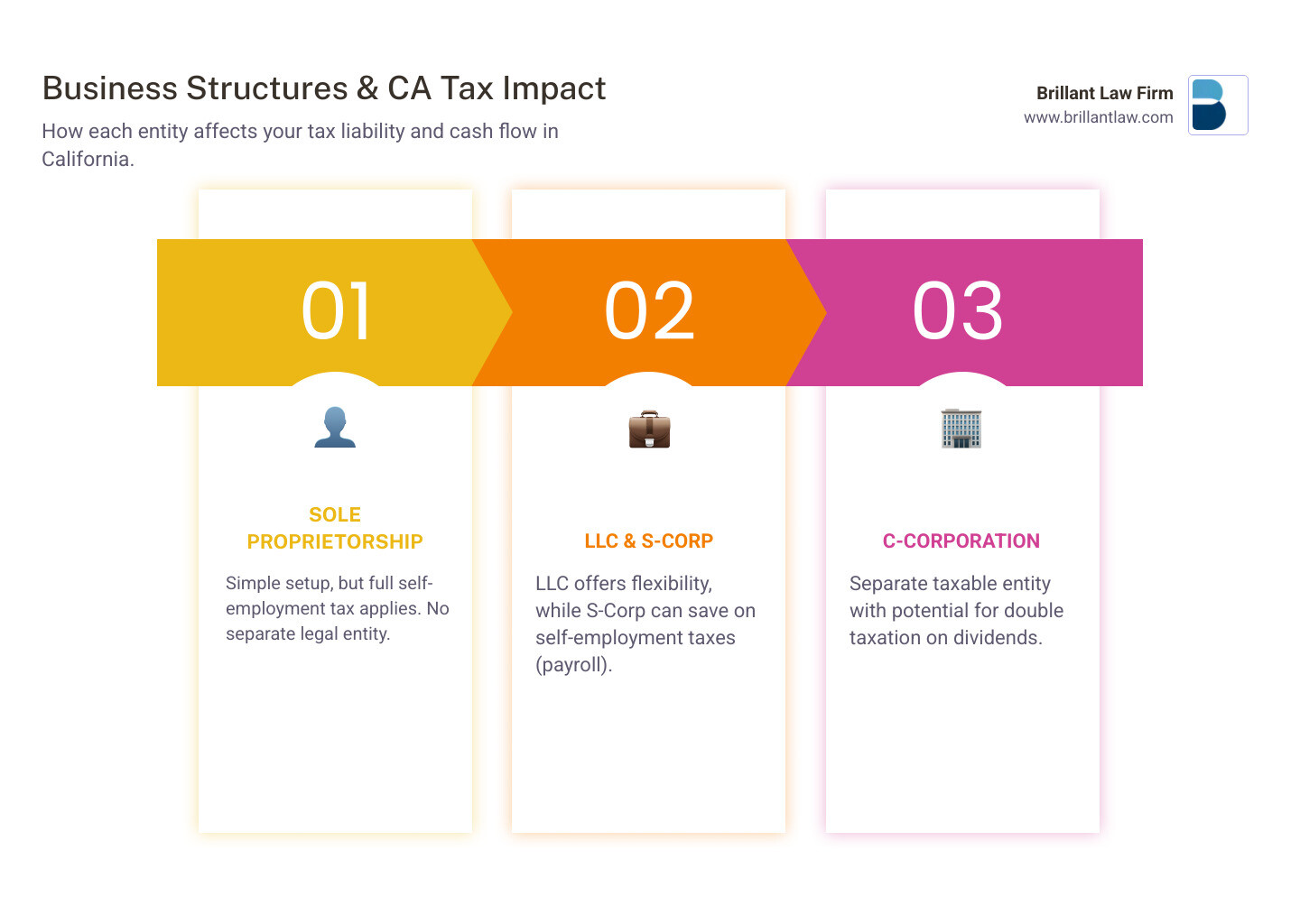
- Sole Proprietorship: The simplest path. Business income is reported on your personal tax return (Schedule C), but you pay self-employment taxes on all net business income.
- Partnership: Similar to a sole proprietorship for businesses with multiple owners. Income passes through to each partner, who then pays self-employment taxes.
- Limited Liability Company (LLC): Offers personal liability protection and tax flexibility. An LLC can be taxed like a sole proprietorship, partnership, S-Corp, or C-Corp. In California, LLCs also face an annual fee based on income, starting at $900, which we factor into our advice for clients in Walnut Creek, Saranap, and nearby areas.
- S Corporation: Provides liability protection while offering significant tax savings. Owners must take a “reasonable salary” subject to payroll taxes, but remaining profits can be distributed without self-employment taxes. This is a cornerstone of many effective tax strategies.
- C Corporation: A separate tax entity. The corporation pays its own taxes, and dividends are taxed again at the personal level (“double taxation”). However, C-Corps can offer other advantages, like easier access to capital. Our Corporate Tax Attorney services can help steer these complexities.
The choice dramatically impacts your personal taxes. Pass-through entities (Sole Proprietorship, Partnership, LLC, S-Corp) affect your personal return directly, while C-Corp profits are taxed separately before distributions add to your personal income.
| Business Structure | Liability Protection | Tax Treatment |
|---|---|---|
| Sole Proprietorship | None | Pass-through; self-employment tax on all income |
| Partnership | None | Pass-through; self-employment tax on distributive share |
| LLC | Yes | Flexible – can elect different tax treatments |
| S Corporation | Yes | Pass-through; payroll tax on salary, no SE tax on distributions |
| C Corporation | Yes | Double taxation; corporate tax plus personal tax on dividends |
Mastering Record-Keeping and Compliance
Organized records are your lifeline for maximizing tax savings. You can’t claim deductions you can’t document.
- Organize Your Records: Every documented business expense is money back in your pocket. The IRS requires keeping records for at least three years, but we advise holding them for at least six, as California’s Franchise Tax Board can be stringent.
- Separate Finances: Commingling personal and business expenses is a critical error. It jeopardizes deductions and can eliminate the liability protection of an LLC or corporation. Use dedicated business bank accounts and credit cards.
- Use Technology: Bookkeeping software like QuickBooks or Xero automates tracking and generates necessary reports.
- Meet Deadlines: Filing deadlines are firm requirements. Missing them results in penalties and interest. This applies to both annual returns and estimated taxes.
- Plan Year-Round: A proactive, year-round approach transforms basic compliance into a powerful small business tax strategy. Quarterly reviews allow for timely adjustments to save money.
Common pitfalls like poor records and missed deadlines can cost thousands. If you face an audit, our IRS Audit Attorney services can help, but prevention is always the best strategy.
Maximizing Deductions and Credits: Your Proactive Small Business Tax Strategy
Once your foundation is set, a robust small business tax strategy involves minimizing taxable income through deductions and credits. Every legitimate claim you miss is money left on the table.

It’s crucial to know the difference: Deductions reduce your taxable income, while credits reduce your tax bill dollar-for-dollar, making them more valuable.
Key Deductions to Lower Your Taxable Income
The IRS allows deductions for expenses that are both “ordinary” and “necessary” for your business.
- Qualified Business Income (QBI) Deduction: A powerful tool for pass-through entities (sole proprietorships, partnerships, LLCs, S-Corps). You may be able to deduct up to 20% of your qualified business income, subject to income limitations.
- Home Office: Deduct a portion of your home expenses based on the square footage used exclusively for business. You can use a simplified or regular method, but meticulous records are key.
- Vehicle Expenses: Track business mileage using the standard rate (70 cents per mile for 2025) or tally actual expenses like gas, repairs, and insurance. The IRS scrutinizes these deductions, so keep detailed logs.
- Equipment and Assets: The Section 179 Deduction allows you to deduct up to $1,250,000 of qualifying equipment costs in the year of purchase. Bonus depreciation offers an additional immediate deduction (40% in 2025) for eligible property.
- Business Meals: 50% of the cost of legitimate business meals is deductible, provided they are not lavish and are properly documented.
- Business Losses: Net operating losses can be carried forward to offset up to 80% of future taxable income. Similarly, tax-loss harvesting by selling losing investments can offset capital gains.
Our Business Tax Advisory Services help identify every deduction for your industry. For deductible expenses involving contracts, our Business Agreement Drafting services ensure compliance.
Leveraging Tax Credits for Dollar-for-Dollar Savings
Tax credits are the most valuable form of tax relief. A smart small business tax strategy must include a review of available credits.
- Work Opportunity Tax Credit (WOTC): Rewards businesses for hiring from certain disadvantaged groups, offering a credit of up to $9,600 per eligible new hire.
- Small Business Health Care Tax Credit: If you have fewer than 25 employees and pay at least half of their health insurance premiums, you may qualify for a credit to cover up to 50% of your contribution.
- Clean Technology Credits: Federal credits are available for California businesses investing in solar power, energy-efficient equipment, or clean vehicles.
- R&D Tax Credit: Valuable for innovative companies, this credit applies to expenses for developing new or improved products, processes, or software.
Advanced Income, Asset, and People Strategies
Beyond the basics, a sophisticated small business tax strategy involves proactive planning around income, assets, and compensation for your team and family.

These advanced strategies open up powerful tax-saving opportunities that can dramatically improve your bottom line.
A Strategic Small Business Tax Strategy for Income and Assets
The timing and management of your business’s income and assets can significantly impact your tax liability.
- Timing Income and Expenses: If you expect to be in a lower tax bracket next year, consider deferring income. Conversely, if you expect higher income next year, you might accelerate income. The same logic applies to expenses—accelerate them into a high-income year to maximize their value.
- Capital Gains Management: Strategically time the sale of assets to offset gains with losses from other investments (tax-loss harvesting). If your capital losses exceed gains, you can deduct up to $3,000 against ordinary income annually.
- Utilizing Business Losses (NOLs): Net operating losses can be carried forward indefinitely to offset up to 80% of taxable income in future profitable years.
- Depreciable Asset Timing: Purchasing qualifying assets before year-end can trigger immediate deductions through Section 179 or bonus depreciation, reducing your current tax bill.
For complex situations, our High Income Tax Planning services provide customized guidance.
Structuring Compensation and Benefits for Tax Efficiency
How you pay yourself and your employees is an often-overlooked area of small business tax strategy.
- Hiring Your Spouse or Children: Paying family members a reasonable wage for legitimate work creates a business deduction. Their wages are taxed at their (often lower) individual rates. For children under 18 in a sole proprietorship, wages may be exempt from Social Security and Medicare taxes.
- Reasonable Compensation: S-Corp owners must pay themselves a reasonable salary subject to payroll taxes before taking tax-advantaged distributions. This balance is key to saving on self-employment taxes without attracting IRS scrutiny.
- Tax-Advantaged Employee Benefits: Offering benefits like health insurance creates a business deduction while providing tax-free value to employees.
- Retirement Planning: Employer-sponsored plans offer powerful tax advantages.
- SEP IRAs are simple to administer and allow large, flexible contributions.
- SIMPLE IRAs allow employees to contribute, with a required employer match.
- Solo 401(k)s offer the highest contribution limits for self-employed individuals or business owners with no employees other than a spouse.
These benefits also help attract and retain talent in competitive markets like Walnut Creek and Saranap, which is essential for long-term stability and growth.
Frequently Asked Questions about Small Business Tax Planning
We frequently address the same key questions from small business owners in Walnut Creek, Saranap, and surrounding communities. Here are the answers to the most common concerns.
How much does professional tax planning cost for a small business in areas like Walnut Creek or Castle Hill?
The cost varies based on your business’s complexity. In California, you can expect to invest more than in other states, but the value often far exceeds the expense.
Attorney fees at Brillant Law Firm typically range from $350 to $800+ per hour for tax planning, reflecting the specialized expertise required for complex entity structuring and dispute resolution. For some projects, we may offer flat-fee arrangements.
While CPA costs for basic preparation may be lower, the real question is what not having expert legal advice costs. A skilled tax attorney can identify savings you’d miss and structure your business for long-term efficiency, making our fees a smart investment. Our Taxation and Tax Planning services are designed to deliver measurable value.
What is the single biggest tax mistake small business owners make?
The most costly error is mixing personal and business finances while keeping poor records. This simple mistake creates a cascade of problems.
When you commingle funds, you miss legitimate deductions, obscure your cash flow, and struggle to defend your position in an audit. For LLCs or corporations, it can even “pierce the corporate veil,” exposing your personal assets to business liabilities.
The solution is simple: maintain separate business accounts and keep meticulous records from day one. If you’re already facing issues, our IRS Tax Relief Attorneys can help, but prevention is always the best approach.
When should I hire a tax attorney instead of a CPA?
Both professionals are vital, but they serve different purposes. CPAs handle routine tax preparation and bookkeeping. Tax attorneys provide legal and strategic expertise for high-stakes situations.
You need a tax attorney for:
- Disputes or Audits: Only an attorney provides legal representation and attorney-client privilege when dealing with the IRS or California Franchise Tax Board. Our Business Tax Dispute Lawyer services are designed for this.
- Complex Transactions: Selling or acquiring a business requires a tax attorney to structure the deal for minimal tax impact and legal compliance.
- Estate and Succession Planning: An attorney can structure trusts and succession plans to minimize estate taxes and ensure a smooth wealth transfer.
- Entity Formation: While a CPA advises on tax implications, an attorney ensures your business entity is legally sound and compliant.
A collaborative approach is often best, with your CPA handling accounting and your tax attorney providing specialized legal counsel.
Secure Your Financial Future with Expert Tax Guidance
Your business deserves more than cookie-cutter tax advice. The right small business tax strategy can transform an enterprise, and we’ve seen it happen for clients across California.
The difference lies in having a partner who understands the unique challenges facing businesses in our communities. Whether you’re in Walnut Creek, Saranap, San Miguel, or Castle Hill, your tax strategy needs to be as unique as your business.

Proactive tax management isn’t about scrambling in April. It’s about building a financial foundation that supports your long-term goals. We look beyond this year’s return to where you want your business to be in five or ten years.
Many clients seek help choosing the right business structure, while others are ready for advanced strategies like family employment or retirement planning. All share a desire for long-term profitability and financial security. Our expertise in California tax law, including FTB requirements and LLC fees, makes the difference.
At Brillant Law Firm, we deliver bespoke strategies that work. Our local expertise in Walnut Creek and the surrounding communities means we understand the specific challenges and opportunities you face.
Don’t let another tax season pass without maximizing your opportunities. Your business’s financial future depends on the decisions you make today.
Explore Advanced Tax Planning Techniques with us and take the first step toward securing your business’s financial future. Let’s build a small business tax strategy that grows with your success.


