

Securing Your Family’s Financial Legacy
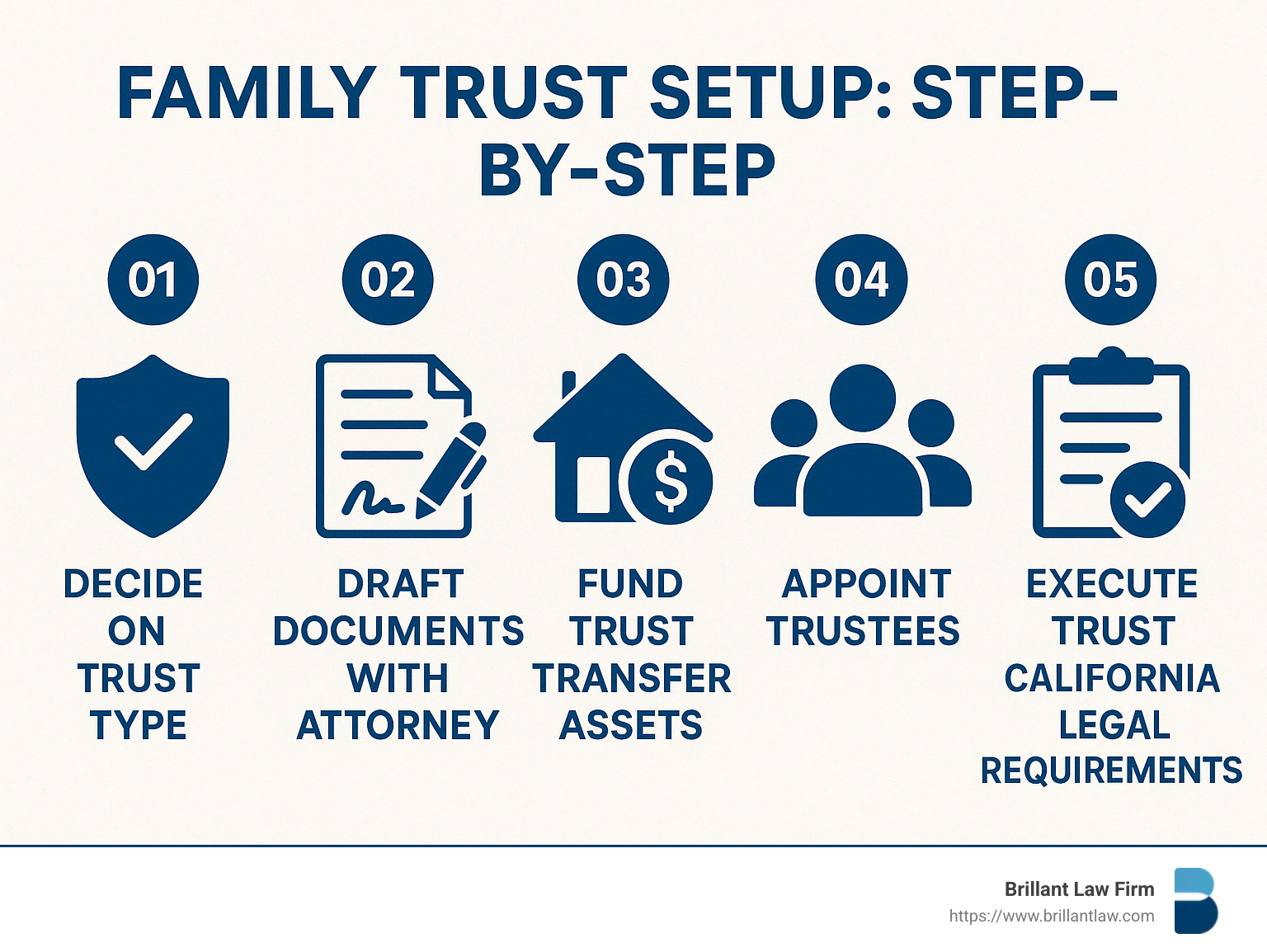
Setting up a family trust is a strategic estate planning tool that protects your assets and ensures they’re distributed according to your wishes. Here’s a quick overview of the process:
- Decide on trust type (revocable or irrevocable)
- Draft the trust document with an attorney
- Fund the trust by transferring assets
- Appoint trustees to manage the trust
- Execute the trust according to California legal requirements
A family trust offers significant benefits beyond a simple will. It helps you avoid the public and often costly probate process, maintain privacy for your beneficiaries, and potentially reduce estate taxes. For families with substantial assets or complex situations, setting up a family trust provides peace of mind that your legacy will be preserved exactly as you intend.
As the quote from a legal scholar reminds us: “The cost of probate expands to consume the money available.” A properly established family trust helps prevent this outcome.
I’m David Brillant, a Certified Specialist in Estate Planning, Trust and Probate Law by the State Bar of California with experience in setting up a family trust structures for high-net-worth individuals and business owners throughout California. My expertise in both taxation and estate planning allows me to create comprehensive trust solutions that protect your assets while optimizing tax benefits.
Setting up a family trust further reading:
– Estate planning guidance
– Trust planning services
Understanding Family Trusts
Before diving into the process of setting up a family trust, it’s important to understand what exactly a family trust is and how it functions within California’s legal framework. Many of our clients come to us with misconceptions about trusts, often confusing them with wills or believing they’re only for the ultra-wealthy. Let’s clear up what these powerful estate planning tools really are.
What Is a Family Trust?
A family trust is a legal arrangement where you (the grantor) transfer assets to a trustee who manages those assets for the benefit of your family members (the beneficiaries). Unlike a simple will, a family trust creates a continuing legal relationship that can extend beyond your lifetime.
Think of a family trust not as a single product, but rather as a customizable vehicle designed specifically to benefit your loved ones. At its heart, a family trust keeps assets within your family across generations while providing protection from various external factors.
As one client recently told me with a smile, “I always thought trusts were just for people with mansions and yachts. Learning that a family trust could protect our modest home and savings for our children was eye-opening.”
Family trusts serve multiple purposes, including providing for your spouse and children after your death, protecting assets from creditors, avoiding the public probate process, maintaining privacy, establishing provisions for minor children or family members with special needs, and creating conditions for how and when beneficiaries receive assets.
In California, family trusts operate under specific state laws that govern their creation, administration, and taxation. This makes working with a California-based attorney particularly important when setting up a family trust here.
Key Parties Involved in a Family Trust
Setting up a family trust involves three primary roles, each with distinct responsibilities:
The Grantor (also called Settlor or Trustor): This is you—the person creating the trust and transferring assets into it. As the grantor, you determine the trust’s terms, including who benefits, when they benefit, and under what conditions.
The Trustee: This person or entity manages the trust assets according to your instructions. The trustee has a fiduciary duty to act in the best interests of the beneficiaries. As the grantor of a revocable trust, you can serve as the initial trustee, maintaining control over your assets during your lifetime. You’ll also name successor trustees to take over when you’re no longer able to serve.
The Beneficiaries: These are the individuals (typically family members) who will receive benefits from the trust. Beneficiaries can be current (receiving benefits immediately) or remainder (receiving benefits at a future date or upon a specific event).
The trustee’s role carries significant responsibilities including managing trust assets prudently, making distributions according to trust terms, keeping accurate records, filing tax returns for the trust, communicating with beneficiaries, and following all legal requirements for trust administration.
One of my clients in San Francisco once compared a trustee to “the captain of a ship, responsible for safely delivering precious cargo to its destination.” It’s a fitting analogy for this important role.
Types of Family Trusts: Revocable vs. Irrevocable
When setting up a family trust, one of the most important decisions you’ll make is whether to create a revocable or irrevocable trust. Each has distinct advantages and potential drawbacks.
Revocable Family Trusts:
A revocable family trust, often called a living trust, gives you remarkable flexibility. You can modify or revoke the trust at any time during your lifetime, maintain control over assets placed in the trust, serve as the initial trustee in most cases, and change beneficiaries or distribution terms as your circumstances change.
This flexibility makes revocable trusts extremely popular for family estate planning in California. However, because you maintain control, these trusts don’t provide asset protection from creditors during your lifetime, and the assets remain part of your taxable estate.
Irrevocable Family Trusts:
Once established, an irrevocable family trust generally cannot be changed or revoked. This permanence creates both advantages and limitations. Assets transferred to an irrevocable trust are no longer considered part of your estate, which may provide protection from creditors and lawsuits, reduce estate tax liability for larger estates, and help beneficiaries qualify for government assistance by keeping assets off their personal balance sheets.
The trade-off is that you relinquish control over the assets placed in an irrevocable trust. As I often tell clients, “An irrevocable trust is like sending your assets on a one-way trip – they’re not coming back to you.”
Here’s a comparison of these two trust types:
| Feature | Revocable Family Trust | Irrevocable Family Trust |
|---|---|---|
| Ability to change terms | Yes, at any time | Generally no, except in limited circumstances |
| Control of assets | Grantor maintains control | Grantor relinquishes control |
| Asset protection | Limited during grantor’s lifetime | Stronger protection from creditors |
| Estate tax benefits | Assets remain in taxable estate | Assets removed from taxable estate |
| Privacy | Provides privacy from probate | Provides privacy from probate |
| Complexity | Less complex | More complex |
| Cost to establish | Moderate | Higher |
A client of ours in Walnut Creek recently shared: “When we first considered setting up a family trust, we were overwhelmed by the options. Working with Brillant Law Firm helped us understand that a revocable trust gave us the flexibility we needed while still protecting our assets for our children’s future.”
For more detailed information about how trusts fit into your broader estate planning strategy, visit our page on Estate Planning with Trusts.
Benefits of Setting Up a Family Trust

When clients walk into our office at Brillant Law Firm, they often have a simple goal: “I just want to make sure my family is taken care of.” What many don’t realize is how powerful setting up a family trust can be in achieving that peace of mind. Let’s explore the meaningful benefits that extend far beyond basic estate planning.
Asset Protection
Your assets represent a lifetime of hard work and careful decisions. Setting up a family trust creates a protective shield around what you’ve built.
“I spent thirty years building my business,” a client from San Francisco recently told me. “The thought of it being vulnerable to creditors or lawsuits kept me up at night until we established our trust.”
Depending on the trust structure—particularly with irrevocable trusts—your assets gain significant protection from creditors, potential lawsuits, and even claims from former spouses. For professionals in high-liability fields like medicine or construction in California, this protection is invaluable. The trust essentially creates a legal separation between you and your assets, making them much harder to reach through litigation.
Avoiding Probate
If you’ve ever known someone whose family went through probate in California, you’ve likely heard the horror stories. Probate here isn’t just public—it’s painfully slow and surprisingly expensive.
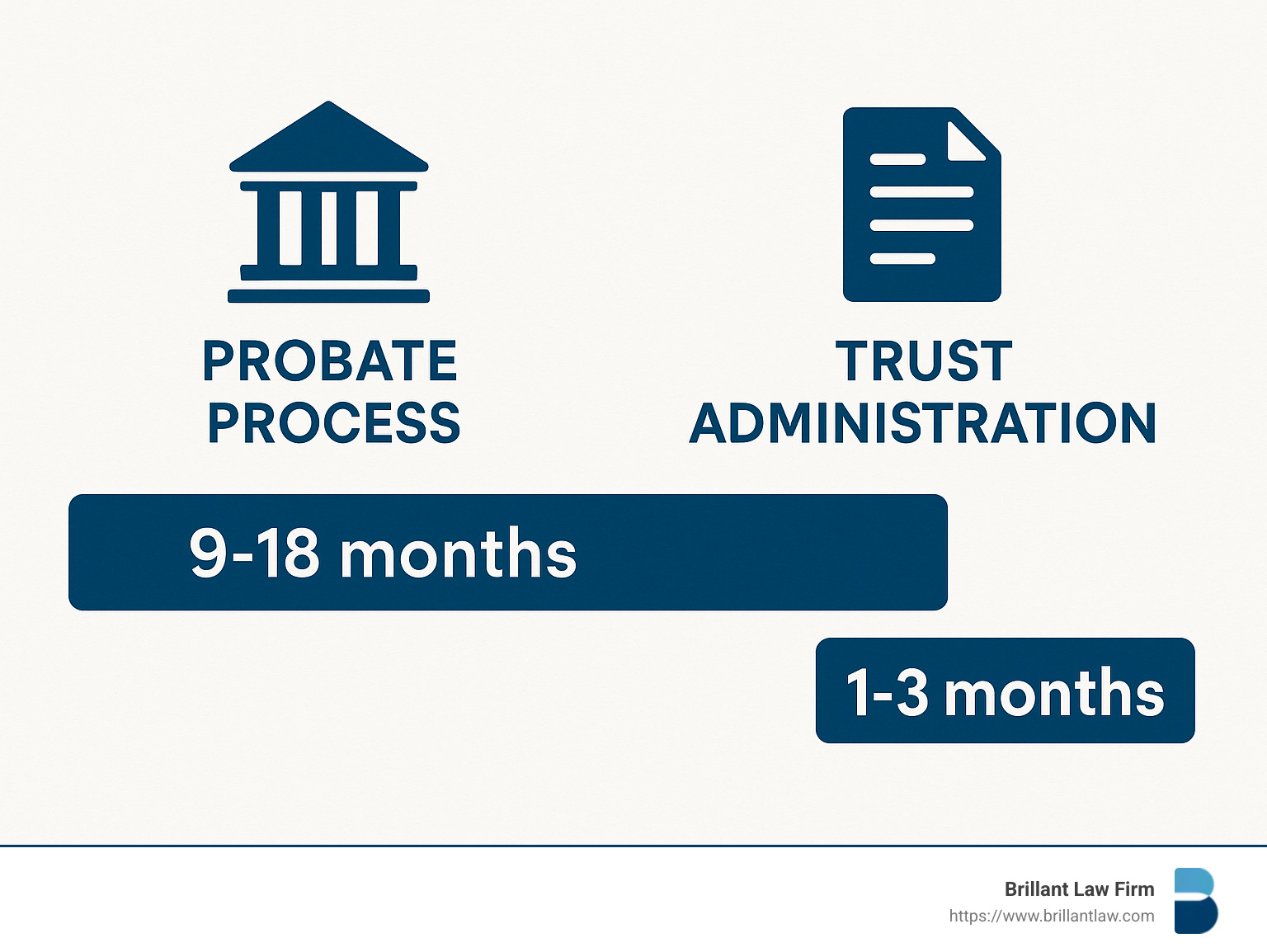
A modest $1 million estate in California (which, given property values here, isn’t uncommon) could face over $23,000 in statutory probate fees alone. More concerning is the timeline—typically 9-18 months where your assets sit frozen while the court process unfolds. Meanwhile, your loved ones wait, often facing financial uncertainty during an already difficult time.
Setting up a family trust allows your assets to pass directly to your beneficiaries, completely bypassing this cumbersome process. One client described it as “the difference between a direct flight and one with three lengthy layovers.”
Privacy Protection
In our digital age, privacy has become increasingly precious. When an estate goes through probate, it becomes part of the public record—your assets, debts, and beneficiaries become accessible to anyone curious enough to look.
A family trust keeps your financial affairs private. The assets you’ve accumulated, how you’ve chosen to distribute them, and who benefits remain confidential. This protection is particularly meaningful for families with substantial assets or public profiles in California communities where such information might attract unwanted attention.
Control Over Asset Distribution
Perhaps the most powerful benefit of setting up a family trust is the control it gives you. Unlike a will, which generally provides for outright distributions, a trust allows you to be thoughtful about how and when your assets transfer.
You can distribute assets in stages as beneficiaries reach certain ages. You might create incentives aligned with your values, like educational achievements. For beneficiaries who might struggle with financial management, you can provide structure and protection. As one client put it, “I’m not just leaving money to my grandchildren—I’m leaving them a pathway.”
This level of customization means your legacy truly reflects your wishes and values, even long after you’re gone.
Tax Planning Benefits
While the federal estate tax exemption is currently high ($13.61 million in 2024), California residents with substantial assets can still benefit from the tax advantages of certain trust structures. Irrevocable trusts, in particular, can be powerful tools for reducing the taxable estate.
Even for more modest estates, trusts offer income tax planning opportunities through strategic timing of distributions and deductions. In California, where state income tax rates rank among the nation’s highest, these strategies can result in meaningful savings over time.
Providing for Special Needs
For families with members who have disabilities, setting up a family trust can be truly life-changing. A properly structured special needs trust provides financial support without disqualifying the beneficiary from essential government benefits like Medi-Cal or Supplemental Security Income.
“We worried constantly about what would happen to our daughter after we were gone,” shared one family from Oakland. “Our special needs trust gave us the first real night’s sleep we’d had in years.”
These specialized trusts require careful drafting to comply with both federal and California regulations, making professional guidance essential. The peace of mind is immeasurable.
Continuity During Incapacity
Life is unpredictable. An often-overlooked benefit of family trusts is how they handle the unexpected. If you become incapacitated, your successor trustee can seamlessly step in to manage your affairs without court intervention.
This continuity avoids the costly and public conservatorship process that might otherwise be necessary in California. Your bills continue to be paid, investments managed, and family provided for—all according to your established wishes and without court supervision.
Setting up a family trust isn’t just about what happens after you’re gone—it’s about creating stability regardless of what life brings your way. As we often tell clients at Brillant Law Firm, “A good trust works for you in every season of life.”
Assets Suitable for Inclusion in a Family Trust
When setting up a family trust, clients often ask me, “David, what exactly should I put in my trust?” While every family’s situation is unique, I’ve found that certain assets consistently benefit from being included in your trust. Let’s walk through what you should consider transferring to protect your legacy.
Real Estate
Your home and other real property are typically the most valuable assets in your estate, making them perfect candidates for your family trust. This includes your primary residence in California, that vacation home in Lake Tahoe, rental properties in the Bay Area, and any undeveloped land you might be holding onto.
In a state like California, where the median home price in many communities exceeds $1 million, placing real estate in your trust is especially critical. Without a trust, your family home would need to go through probate—a process that could cost them over $28,000 in statutory fees on a modest $1.5 million property. That’s money that should stay in your family’s hands.
I recently helped a client in San Francisco transfer her home and two rental properties into her trust. She was relieved to know that when she passes, her children won’t face the headache and expense of probate for these valuable assets. The process was straightforward—we executed new deeds and recorded them with the county. And in California, this type of transfer is exempt from property tax reassessment when moving property into your revocable trust.
Financial Accounts
Your everyday financial accounts deserve protection too. Your checking and savings accounts at the local credit union, those CDs you’ve been holding onto, money market accounts, and non-retirement investment and brokerage accounts all benefit from trust ownership.
Transferring these accounts is usually as simple as visiting your bank or calling your financial advisor with your trust document in hand. Most institutions have straightforward processes for retitling accounts in your trust’s name.
One client told me that retitling her accounts felt like “finally putting a roof on the house”—the foundation was there with the trust document, but actually funding it with her accounts completed the protection.
Investment Assets
Beyond basic accounts, consider your broader investment portfolio. Those stocks and bonds not held in retirement accounts, your private equity investments, and especially any business interests you hold privately should all be considered for trust transfer.
If you’ve loaned money to others and hold promissory notes, those should go in too. The same applies to royalty interests from books, music, or patents, as well as valuable intellectual property rights.
These assets often represent significant value and can be complicated to transfer after death without a trust structure in place. I’ve seen families struggle for months trying to access investment accounts that could have been seamlessly transferred had they been properly titled in a trust.
Business Interests
For entrepreneurs and business owners, setting up a family trust can be crucial for ensuring business continuity. Your sole proprietorship assets, LLC membership interests, stock in your closely-held corporation, and partnership interests can all be transferred to your trust.
However, I always caution clients that business transfers require careful consideration. We need to review operating agreements, buy-sell provisions, and potential tax implications. I recommend consulting with both your estate planning attorney and business attorney before making these transfers to ensure you’re not inadvertently triggering any adverse consequences.
A restaurant owner in Oakland recently worked with me to transfer his business interests to his trust. His primary concern was ensuring the business could continue operating without interruption if something happened to him. By carefully structuring the trust provisions, we created a smooth transition plan that protected both his family and his employees.
Personal Property
While perhaps not as financially significant as your home or investments, personal property still deserves consideration:
- Vehicles, boats, and aircraft
- Valuable collections of art, antiques, or coins
- Jewelry and precious metals
- Household furnishings
- Other tangible items with significant monetary or sentimental value
For most personal property, we can use a general assignment document to transfer ownership to your trust without changing titles on individual items. For titled property like vehicles, specific transfers may be required, though many clients choose to leave lower-value vehicles outside the trust for simplicity.
As one client humorously noted, “I never thought my vintage record collection would need estate planning, but knowing it will go directly to my music-loving nephew gives me peace of mind.”
Assets to Consider Keeping Outside Your Trust
Not everything belongs in your family trust. Retirement accounts like IRAs, 401(k)s, and 403(b)s typically should remain outside your trust, as should life insurance policies, health savings accounts, and certain annuities.
These assets already have built-in beneficiary designations that allow them to pass outside of probate. However, we might consider naming your trust as a contingent beneficiary in some cases, particularly if your primary beneficiaries are minors or have special needs.
I recently reviewed a client’s portfolio and finded she had named her minor children as direct beneficiaries of her substantial IRA. We revised her plan to name her trust as contingent beneficiary with special provisions to manage these funds appropriately for her children until they reach adulthood.
Setting up a family trust requires thoughtful consideration of what assets to include. While this overview provides general guidance, your specific situation may call for different approaches. At Brillant Law Firm, we take the time to understand your unique assets and family dynamics to create a customized trust plan that truly protects what matters most to you.
Steps to Setting Up a Family Trust

The journey of setting up a family trust doesn’t have to be overwhelming. While the process involves several important steps, working with an experienced California trust attorney transforms what might seem complex into a straightforward path to securing your family’s future. Let me walk you through each step of creating your trust with clarity and confidence.
Step 1: Setting Up a Family Trust – Decide on the Type of Trust
The foundation of your trust begins with choosing the right type for your unique situation. This decision shapes everything that follows and should align perfectly with your family’s needs and your long-term goals.
Most families in California find themselves asking key questions that help determine their ideal trust structure:
“Do I want to maintain control over my assets while I’m alive?” If maintaining flexibility matters to you, a revocable trust likely makes the most sense.
“Is protecting assets from potential creditors my primary concern?” In this case, certain irrevocable trust structures might better serve your needs.
“Might my estate face significant tax burdens?” For larger estates approaching federal estate tax thresholds, specialized irrevocable trusts can offer meaningful tax advantages.
“Do I have family members with special needs?” This situation calls for carefully crafted supplemental needs trusts to protect both assets and benefit eligibility.
At Brillant Law Firm, we take the time to understand your unique circumstances before recommending a trust structure. Most California families benefit from a revocable living trust as their primary estate planning vehicle, sometimes complemented by specialized irrevocable trusts for specific purposes.

Step 2: Setting Up a Family Trust – Drafting the Trust Document
With your trust type determined, we move to creating the actual trust document – the heart of your estate plan. This isn’t simply filling in blanks on a template; it’s crafting a legal framework that will guide your family’s financial future.
A properly drafted trust document includes clear identification of all parties involved – you as the grantor, your chosen trustees, and your beneficiaries. It outlines specific instructions for asset distribution, trustee responsibilities, and provisions for special circumstances like disability or divorce.
The language must be precise and comply with California’s specific legal requirements. As one legal scholar perfectly noted, “Proper drafting is essential to reflect your wishes accurately.” Even small ambiguities can lead to family conflicts or unintended outcomes years later.
That’s why at Brillant Law Firm, we craft each trust document specifically for your unique situation rather than relying on generic templates. Your family deserves a trust that addresses your particular concerns, values, and vision for the future.
Step 3: Funding the Trust
Here’s a truth that many people find too late: a beautifully written trust document only protects assets that have been properly transferred into it. This critical step, called “funding” your trust, is where many DIY approaches unfortunately fall short.
Funding your trust involves transferring ownership of your assets from your individual name to your trust’s name. For your California home, this means preparing and recording new deeds with your county recorder’s office. For financial accounts, you’ll work with each institution to retitle accounts in your trust’s name. Business interests might require new stock certificates or amended operating agreements.
Even personal property like furniture, jewelry, and collectibles should be properly assigned to your trust through a general assignment document. Each asset type follows a different transfer procedure, and some assets (particularly retirement accounts) typically remain outside the trust with coordinated beneficiary designations.
Think of funding your trust as moving your valuables from an open uped drawer into a secure safe. The safe’s quality doesn’t matter if your valuables remain in the drawer. Similarly, setting up a family trust only protects assets you’ve properly placed inside it.
Step 4: Appointing Trustees
Selecting your trustee is perhaps the most personal decision in setting up a family trust. This person (or institution) will manage trust assets and make distributions according to your instructions, potentially for many years after you’re gone.
The ideal trustee combines financial responsibility with personal integrity. They should understand your values and be committed to honoring your wishes. They need both the willingness to serve and the emotional intelligence to handle family dynamics with sensitivity.
For revocable living trusts, many people serve as their own initial trustees, with a spouse or adult child as successor trustee. But not every family situation fits this model. When family dynamics are complex or your estate is substantial, a professional trustee like a trust company might provide valuable objectivity and expertise.
Remember to name at least one alternate successor trustee as a backup plan. Life circumstances change, and your primary choice might be unable or unwilling to serve when the time comes. Having alternates ensures your trust administration continues smoothly regardless of future developments.
For more guidance on this critical role, visit our detailed resource on Trust Administration.
Step 5: Finalizing and Executing the Trust
The final step in setting up a family trust is bringing your trust to life through proper execution. In California, this means signing your trust document, typically with notarization.
While California law doesn’t strictly require notarization for the trust itself to be valid, having your signature notarized helps prevent future challenges to its authenticity. It’s also necessary for recording deeds when transferring real property into your trust. Unlike wills, witnesses aren’t legally required for California trusts, though some attorneys recommend them as an additional safeguard.
Once executed, store your original trust document securely – a fireproof home safe or bank safe deposit box works well. Just ensure your successor trustee knows where to find it and can access it when needed. Providing copies to key parties like your successor trustee and attorney creates an additional layer of security.
Setting up a family trust isn’t a “set it and forget it” task. Life changes, and your trust should evolve with it. Major life events like marriages, divorces, births, deaths, or significant financial changes should trigger a review of your trust provisions.
For a helpful guide through this process, check out our Trust Creation Made Easy: A Comprehensive Checklist.
With these five steps completed, you’ve created a powerful tool for protecting your family’s future. Your properly established and funded trust will work silently in the background, giving you peace of mind that your wishes will be honored and your loved ones protected.
Tax Implications of a Family Trust
When setting up a family trust, understanding the tax consequences is crucial for making informed decisions. While trusts offer many benefits, their tax treatment varies significantly depending on the type you choose and how it’s structured. Let’s break down what you need to know about taxes and your family trust.
Income Tax Considerations
If you create a revocable living trust—the most common type for California families—you’ll experience virtually no change in your income taxes during your lifetime. Since you maintain control over the assets, the IRS simply views your trust as an extension of yourself. You’ll continue reporting all trust income on your personal tax return using your Social Security number, just as you did before the trust existed.
Everything changes, however, after you pass away. At that point, your revocable trust becomes irrevocable, and it transforms into a separate taxpaying entity with its own tax identification number. This is where careful planning becomes essential.
Trust tax rates reach the highest brackets much more quickly than individual rates. For 2025, trusts hit the highest federal income tax bracket (37%) at just $15,200 of income. Compare that to married couples filing jointly, who don’t reach that rate until their income exceeds $693,750. This compressed rate schedule can result in significantly higher taxes if you don’t plan carefully.
Many of our California clients use a strategy of distributing income to beneficiaries, who then pay taxes at their typically lower individual rates. This approach, known as the “distributable net income” (DNI) deduction, can result in substantial tax savings for the family as a whole.
Estate Tax Considerations
Estate tax planning is often a primary motivation for setting up a family trust, particularly for higher-net-worth California families. The good news is that the federal estate tax exemption remains substantial in 2025—approximately $14.1 million per individual. This means most families won’t face federal estate taxes at all.
However, there’s a critical timing issue to consider. The current high exemption amounts are scheduled to be reevaluated, and without congressional action, could potentially be reduced in the future. Additionally, while California currently has no state estate tax, there have been periodic legislative attempts to introduce one.
For estates that may exceed the exemption amount, certain specialized irrevocable trusts can help reduce your taxable estate:
Irrevocable Life Insurance Trusts (ILITs) remove life insurance proceeds from your taxable estate, potentially saving your heirs hundreds of thousands in estate taxes. Grantor Retained Annuity Trusts (GRATs) can transfer appreciation on assets with minimal gift tax implications, while Charitable Remainder Trusts (CRTs) provide income during your lifetime with the remainder going to charity. If your home represents a significant portion of your estate, a Qualified Personal Residence Trust (QPRT) can transfer it to your beneficiaries at a reduced gift tax value.
As one client recently told us after implementing these strategies: “I was amazed that we could reduce our potential estate tax burden so significantly while still ensuring our children receive exactly what we wanted them to have.”
Gift Tax Implications
Gift tax considerations are another important aspect of setting up a family trust. When you transfer assets to most irrevocable trusts, the IRS considers these completed gifts that may trigger gift tax if they exceed certain thresholds.
For 2025, you can give up to $19,000 per recipient annually without filing a gift tax return. Beyond that, gifts begin using your lifetime exemption amount (which is the same as the estate tax exemption). Only after exhausting that generous exemption would you actually owe gift taxes.
With revocable trusts, there are no gift tax consequences when funding the trust because you maintain control of the assets. The gift isn’t considered complete until your death or until the trust becomes irrevocable.
Property Tax Considerations in California
California property owners face unique considerations due to Proposition 13. The good news is that transfers to revocable living trusts are generally exempt from reassessment for property tax purposes. This means your property tax bill won’t increase just because you place your home in your revocable trust.
However, transfers to certain irrevocable trusts might trigger reassessment, potentially resulting in significantly higher property taxes. Given California’s high property values, especially in areas like the Bay Area and Southern California, an unexpected reassessment could increase your annual property tax bill by thousands of dollars.
The complex interplay between trust planning and various tax regimes makes professional guidance essential. At Brillant Law Firm, we bring expertise in both estate planning and taxation, allowing us to create comprehensive strategies that protect your assets while minimizing tax burdens.
A thoughtful approach to the tax implications of your family trust can save your family significant money while ensuring your wishes are carried out exactly as you intend. For more detailed information about how federal estate taxes might affect your planning, you can visit the IRS estate tax information page.
Avoiding Probate with a Family Trust
One of the primary reasons many California residents consider setting up a family trust is to avoid probate. Probate is the court-supervised process of validating a will, paying debts, and distributing assets after someone dies. In California, this process can be particularly burdensome and time-consuming for families already dealing with the loss of a loved one.
The Probate Process in California
When a loved one passes away in California without a trust, their estate often enters the probate process. This begins with filing a petition with the probate court and paying the required filing fee. Next comes the rather uncomfortable step of publishing a public notice to creditors in local newspapers, alerting anyone who might have claims against the estate to come forward.
Once that’s done, the personal representative must create a detailed inventory and appraisal of all assets – a process that can be emotionally draining as family members sort through possessions while still grieving. After the court approves this inventory, all legitimate debts, claims, and taxes must be paid before anyone receives their inheritance.
Finally, after the court gives its approval, assets can be distributed to heirs or beneficiaries. This entire journey typically takes between 9-18 months in California, even for straightforward estates. I’ve seen more complex situations or those involving family disputes drag on for years, with mounting legal fees and family tension.
As one client told me after going through probate for her father’s estate: “If I had known how long and painful this would be, I would have insisted my dad set up a trust years ago.”
How a Family Trust Bypasses Probate
When you’ve properly placed your assets in a family trust, you create a completely different experience for your loved ones. Assets titled in the name of your trust simply aren’t subject to probate. When you pass away, your successor trustee steps in seamlessly to manage and distribute those assets according to your instructions—without court involvement, public hearings, or statutory delays.
Think of it this way: probate is like traveling with multiple layovers and delayed flights, while a trust is like taking a direct flight to your destination. Both get you there, but one path is far more efficient and less stressful.
The advantages of setting up a family trust to avoid probate are substantial. Trust administration typically takes weeks or months rather than years. Your family saves significantly on costs by avoiding California’s statutory probate fees, which are calculated on the gross value of probate assets, not accounting for mortgages or other debts.
Perhaps just as important is the privacy a trust provides. While probate creates public records of your assets, debts, and beneficiaries—potentially exposing your family to solicitations or unwanted attention—trust administration happens privately, behind closed doors. This allows your loved ones to focus on healing rather than navigating complex court procedures while their personal financial matters become public record.
For Californians who own property in multiple states, a trust is particularly valuable as it helps avoid conducting separate probate proceedings in each state where property is owned—a truly nightmarish scenario I’ve seen families endure.
Statutory Probate Fees in California
California’s probate code sets statutory fees that might make your eyes water. Both attorneys and personal representatives are entitled to:
- 4% of the first $100,000
- 3% of the next $100,000
- 2% of the next $800,000
- 1% of the next $9 million
- 0.5% of the next $15 million
- A “reasonable amount” determined by the court for amounts above $25 million
These fees apply to both the attorney and the personal representative, effectively doubling the cost. To put this in perspective, for a modest $1 million estate in California (which might just be a family home with a mortgage), statutory fees would total $23,000 for the attorney and another $23,000 for the personal representative—a whopping $46,000 total.
By contrast, the cost of setting up a family trust typically ranges from $2,000 to $8,000 in California, depending on complexity. That’s a significant savings that keeps more money in your family’s hands, where it belongs.
What’s particularly painful about California’s probate fees is that they’re based on the gross value of assets—not the equity. This means if you own a $1 million home with an $800,000 mortgage, fees are still calculated on the full $1 million value, not your $200,000 of actual equity.
Pour-Over Wills and Probate Avoidance
Even with the most carefully drafted trust, we always recommend creating what’s called a “pour-over will” as a safety net. Think of this as your backup plan—it directs any assets not already in your trust to “pour over” into it at your death. However, it’s important to understand that assets that pass through a pour-over will still require probate if they exceed California’s small estate threshold (currently $166,250).
This is why proper trust funding—transferring assets to your trust during your lifetime—is absolutely essential for effective probate avoidance. I’ve seen too many families find too late that their loved one’s trust wasn’t properly funded, leaving them facing the probate process they thought they’d avoided.
At Brillant Law Firm, we don’t just help clients create trusts and then send them on their way. We provide comprehensive guidance on properly funding your trust, including assistance with deed preparation, account transfers, and other crucial steps to maximize probate avoidance. We want to ensure your family actually receives the benefits of the trust you’ve worked so hard to establish.
As one client recently shared after we helped her parents set up and fund their trust: “The peace of mind knowing that we won’t have to deal with probate when that difficult time comes is truly priceless.”
Providing for Family Members with Special Needs
Setting up a family trust takes on a whole new dimension of importance when you have family members with special needs. The planning process becomes not just about transferring assets, but about ensuring your loved one’s long-term care and quality of life while protecting essential benefits they may rely on.
Many of our California clients are surprised to learn that a well-intentioned inheritance could actually harm their loved one with special needs by disqualifying them from crucial government benefits like Medi-Cal (California’s Medicaid program) or Supplemental Security Income (SSI).
Special Needs Trusts: Preserving Benefits While Providing Support
A Special Needs Trust (SNT), sometimes called a Supplemental Needs Trust, is specifically designed to thread this needle – providing additional support for your loved one without jeopardizing their eligibility for government assistance programs.
Government benefit programs typically impose strict asset and income limitations. For instance, an individual with more than $2,000 in countable assets may be disqualified from SSI and Medi-Cal. Without proper planning, an inheritance or poorly structured trust could push them over this threshold, resulting in the loss of benefits that might be worth hundreds of thousands of dollars over their lifetime.
“I always thought leaving money to my son with autism was the right thing to do,” shared one of our Walnut Creek clients. “Learning that an outright inheritance could actually harm him by cutting off his benefits was eye-opening. The special needs trust we created gives us peace of mind that he’ll have both government support and the extras that make life enjoyable.”
A properly structured SNT allows you to improve your loved one’s life by providing supplemental support for things government benefits typically don’t cover, such as additional medical care, rehabilitation services, education and training, transportation, travel and entertainment, personal care attendants, and other quality of life improvements.
The key principle is that the trust supplements rather than replaces government benefits. The beneficiary never has direct access to or control over the trust assets, which prevents them from being counted as resources for benefit eligibility purposes.

Types of Special Needs Trusts
When setting up a family trust for a beneficiary with special needs, we typically discuss several options with our California clients:
Third-Party Special Needs Trust: This is the most common type we create for families planning ahead. It’s funded with assets that never belonged to the beneficiary – typically from parents, grandparents, or other family members. The major advantage is flexibility: you control the terms and can name remainder beneficiaries to receive any assets left after your loved one’s lifetime. There’s no requirement to reimburse the state for benefits provided.
First-Party Special Needs Trust: Sometimes we need to create this type when the person with special needs has already received assets – perhaps from a personal injury settlement or an inheritance received before proper planning was in place. These trusts come with an important limitation: they must include a “payback” provision that reimburses California’s Medi-Cal program for benefits provided upon the beneficiary’s death before any remaining assets can go to other beneficiaries.
Pooled Special Needs Trust: For some families, particularly those with more modest assets to set aside, a pooled trust can be an excellent option. These trusts are managed by nonprofit organizations that combine the assets of many beneficiaries for investment purposes while maintaining separate accounts for each person. The economies of scale often make this approach more cost-effective for smaller trusts.
Selecting Trustees for Special Needs Trusts
Choosing the right trustee becomes especially critical when setting up a family trust for someone with special needs. The trustee must steer complex benefit rules while making thoughtful decisions about how trust funds are used.
“The trustee of a special needs trust wears many hats,” as one of our clients aptly put it. They must understand government benefit programs and their intricate eligibility rules, make appropriate distribution decisions that won’t jeopardize benefits, advocate for the beneficiary when necessary, manage investments prudently, and maintain detailed records.
Many of our California families choose a combination approach – perhaps a family member who knows the beneficiary well, partnered with a professional trustee who understands the technical requirements. Some opt for a trust company with specific expertise in special needs trust administration, particularly for long-term planning.
Coordinating with Other Planning Tools
When setting up a family trust for special needs planning, we work with our clients to coordinate all aspects of their estate plan:
We review and update beneficiary designations on life insurance, retirement accounts, and other assets to ensure they don’t inadvertently leave assets directly to the special needs individual. One overlooked designation can undermine an otherwise solid plan.
Many families choose to fund the special needs trust with life insurance, providing substantial support without depleting resources intended for other family members. This can be particularly effective for families concerned about being “fair” to all children while providing extra support for a child with special needs.
We also encourage families to create a letter of intent – a detailed document that isn’t legally binding but provides invaluable guidance about the beneficiary’s needs, preferences, routines, and care requirements. This becomes a roadmap for future caregivers and trustees.
At Brillant Law Firm, we understand that planning for a loved one with special needs combines emotional and technical challenges. We take pride in creating comprehensive special needs planning solutions that protect vulnerable family members while preserving family resources. Our deep understanding of both California and federal benefit programs ensures that your loved one can maintain their eligibility while enjoying the improved quality of life you want to provide.
Costs of Setting Up and Maintaining a Family Trust
Let’s talk about something that’s on everyone’s mind when considering a family trust – the cost. It’s a bit like buying a good mattress: there’s an upfront investment, but the long-term benefits (like avoiding probate headaches and better sleep!) make it worthwhile.
Initial Setup Costs
The cost of setting up a family trust in California varies depending on your unique situation. Think of it like buying a suit – you can get one off the rack, or you can have one custom to fit you perfectly. The latter costs more but serves you better.
Several factors affect the price tag:
- How complex your family and financial situation is
- Whether you need a revocable or irrevocable trust
- What additional estate planning documents you’ll need
- The experience level of your attorney
- Whether you need specialized provisions (like for a family member with special needs)
Here in California, particularly in communities like Walnut Creek where our firm is located, you can expect to invest between $3,500 and $9,000 for an individual’s comprehensive estate plan with a revocable living trust in 2025. For married couples with standard planning needs, that range typically runs from $4,500 to $12,000.
If your situation is more complex – perhaps you have a blended family, substantial assets, business interests, or need specialized tax planning – the investment may range from $12,000 to $30,000 or more. This reflects the additional expertise and time required to create a plan that properly addresses all your needs.
The good news is that this investment typically covers not just the trust document itself, but a complete estate planning package including your pour-over will, powers of attorney, healthcare directives, and often assistance with funding your trust. It’s a comprehensive solution, not just a single document.
One of our clients recently shared: “I was initially concerned about the cost, but when I compared it to what my sister paid in probate fees after our parents passed without a trust, I realized it was actually a bargain.”
Ongoing Maintenance Costs
Setting up a family trust isn’t a one-and-done proposition – there are some ongoing considerations to keep in mind:
Regular Reviews and Updates: Life changes, and your trust should too. Major life events like marriages, divorces, births, or deaths often necessitate updates to your trust. At Brillant Law Firm, we offer maintenance programs that provide regular reviews at a reduced cost compared to creating an entirely new trust.
Trustee Fees: While you’re alive and serving as your own trustee, there are typically no trustee fees. However, when a successor trustee takes over, especially if it’s a professional trustee, fees will apply. Professional trustee fees in California generally range from 1% to 2% of trust assets annually, with the percentage often decreasing for larger trusts. Family members serving as trustees might waive fees or charge less, though they’re entitled to reasonable compensation.
Tax Preparation: After your trust becomes irrevocable (typically after your death), it will need its own tax returns. This can cost between $600 and $2,500 annually in 2025, depending on the complexity of the trust and its investments.
Asset Management Fees: If your trust includes investment assets, there may be investment management fees, typically ranging from 0.5% to 1.5% of managed assets annually.
Cost-Benefit Analysis
When weighing the cost of setting up a family trust, consider these important factors:
Probate Avoidance Savings: Remember those California statutory probate fees we discussed earlier? On a $1 million estate, they could total $46,000 or more. Suddenly, the cost of creating a trust seems quite reasonable in comparison.
Time Value: Beyond direct cost savings, there’s tremendous value in your beneficiaries receiving their inheritance months or years sooner than they would through probate. As one client put it, “My mother’s trust saved us not just money, but the emotional toll of waiting nearly two years for probate to conclude.”
Privacy Protection: While it’s harder to assign a dollar value to privacy, many families place significant value on keeping their financial affairs out of the public record.
Peace of Mind: Perhaps the most valuable benefit – though impossible to quantify – is the peace of mind that comes from knowing your affairs are in order and your loved ones won’t face unnecessary complications during an already difficult time.
At Brillant Law Firm, we believe in transparent pricing and will provide a clear fee quote after understanding your specific situation and needs. We see estate planning not as a transaction but as a relationship, and we’re committed to providing value that extends far beyond the initial documents.
For more information about our trust services and fees, visit our Attorneys for Living Trusts page.
Duration and Termination of a Family Trust
When setting up a family trust, clients often wonder about its lifespan. “How long will my trust last?” and “What happens after I’m gone?” are questions we hear frequently at Brillant Law Firm. Understanding your trust’s duration and eventual conclusion is a crucial piece of the estate planning puzzle.
Trust Duration Under California Law
California has modernized the traditional “Rule Against Perpetuities” that once strictly limited trust durations. Today, trusts created in California can last up to 90 years after creation or 21 years after the death of a beneficiary who was alive when the trust was established—whichever comes later.
For most family trusts, especially revocable living trusts, practical considerations matter more than these legal maximums. During your lifetime, your revocable trust continues as long as you wish since you maintain complete power to change or dissolve it. Many of our clients find comfort in this flexibility, knowing they can adapt their plan as life circumstances change.
After your passing, the trust typically continues until it fulfills its purpose—usually distributing assets to your beneficiaries according to your carefully crafted instructions. Some trusts complete this process within months, while others might continue for decades, depending on your goals and family situation.
As one client recently shared: “I was worried about setting up something I couldn’t change, but knowing I can adjust my trust as my grandchildren grow gives me peace of mind.”
What Happens After the Grantor’s Death
The death of a trust’s creator (grantor) triggers several significant changes:
First, your formerly revocable trust becomes irrevocable. The terms you’ve established become fixed and generally unchangeable, with limited exceptions under California law. This is why we emphasize the importance of regular trust reviews during your lifetime—to ensure your plan always reflects your current wishes.
Second, your chosen successor trustee steps into your shoes. This person or institution assumes responsibility for managing the trust according to its terms. Their duties begin immediately, which is why selecting the right successor trustee is so critical when setting up a family trust.
Third, the trust administration process begins. Your successor trustee will inventory all trust assets, pay any outstanding debts and taxes, and prepare for distributions. This process typically takes several months, even for straightforward estates.
Finally, the distribution timeline you’ve established begins to unfold. Depending on your instructions, this might include immediate distributions to certain beneficiaries, ongoing management for minor children, staged distributions at specified ages, or even the creation of subtrusts for specific purposes like education or special needs care.
Distribution of Assets
The distribution phase showcases the true flexibility that comes with setting up a family trust. Unlike a will, which typically provides straightforward, outright distributions, a trust can specify exactly how and when beneficiaries receive their inheritance.
Many of our clients in Walnut Creek choose outright distributions for mature, financially responsible beneficiaries. The trustee simply transfers assets directly to these beneficiaries, ending the trust’s involvement with those particular assets.
For younger beneficiaries, age-based distributions often make more sense. We frequently recommend staged distributions—perhaps one-third at age 25, another third at 30, and the final portion at 35—to prevent young adults from receiving large sums before they’re prepared to manage them wisely.
Some clients prefer milestone-based distributions tied to achievements like completing college, maintaining steady employment, or demonstrating financial responsibility. One client explained their reasoning: “I worked hard for this money, and I want it to encourage my grandchildren to work hard too.”
For beneficiaries who may need long-term protection, lifetime trusts keep assets secure for their entire lives, providing ongoing protection from creditors, divorce complications, or the beneficiary’s own financial inexperience.
Many trusts incorporate discretionary distribution provisions, giving the trustee authority to make distributions based on guidelines you establish. This approach allows flexibility to adapt to beneficiaries’ changing needs while still maintaining the protective structure of the trust.
Trust Termination
A family trust terminates when it fulfills its purpose—typically when all assets have been distributed according to its terms. However, some trusts continue for generations, particularly those designed for dynasty planning or long-term asset protection.
The termination process generally involves four key steps. First, the trustee distributes all remaining trust property to the final beneficiaries. Next, they provide a final accounting of all trust transactions to those beneficiaries—a critical step for transparency and closure.
Beneficiaries may then be asked to sign releases acknowledging receipt of their share and releasing the trustee from further liability. This step helps provide finality and protection for the trustee. Finally, the trustee must file final income tax returns for the trust to satisfy IRS requirements.
In California, trustees have specific legal duties during trust termination, including providing proper notice to beneficiaries and maintaining accurate records of all distributions. These requirements help ensure the process concludes properly and minimizes the risk of disputes.
At Brillant Law Firm, we understand that setting up a family trust is just the beginning of the journey. We provide guidance not only during the creation phase but also support successor trustees during administration and termination, ensuring your wishes are carried out exactly as you intended. Our clients often tell us this ongoing support provides immeasurable peace of mind during what can be a challenging time for families.
Common Misconceptions about Family Trusts

In my years of practice at Brillant Law Firm, I’ve noticed that many people hesitate to consider setting up a family trust because of misconceptions they’ve heard. These myths can prevent families from accessing valuable protection for their assets and loved ones. Let’s clear up some of these common misunderstandings.
Myth 1: Trusts Are Only for the Wealthy
“I don’t have enough money for a trust” is something I hear almost weekly in my practice. This belief that family trusts are exclusively for millionaires couldn’t be further from the truth.
The reality is that if you own a home in California—where property values are substantial even for modest homes—a trust likely makes financial sense for you. Trusts aren’t about how much you have; they’re about protecting what you have, regardless of the amount.
I remember one client, a retired teacher with a small pension and a paid-off home in Walnut Creek, who initially dismissed the idea of setting up a family trust. “I’m not rich,” she told me. After we discussed how a trust would save her children from the expensive California probate process and protect her home, she understood that trusts serve families across the economic spectrum.
Myth 2: Setting Up a Trust Is Too Expensive
The upfront cost of creating a trust makes some people hesitate. They wonder if the investment is worthwhile.
When you compare the cost of setting up a family trust (typically $3,000-$8,000 in California) to the potential probate fees on even a modest estate, the math becomes clear. On a $1 million home—not uncommon in many California communities—statutory probate fees could exceed $46,000.
Beyond the direct financial comparison, consider the non-monetary benefits: the privacy of your financial affairs, the control over how your assets are distributed, and the peace of mind knowing your loved ones won’t face the stress and delays of probate during their time of grief.
Myth 3: I’ll Lose Control of My Assets
Many people worry that placing assets in a trust means surrendering control over them during their lifetime.
With a revocable living trust—the most common type for family estate planning—you maintain complete control as the initial trustee. You can buy, sell, refinance, or gift your assets exactly as you did before. The trust is simply a legal structure that holds title to your assets while you retain the authority to manage them.
One client laughed with relief when I explained this. “So I’m giving my house to my trust, but I’m in charge of my trust, so I’m really just giving my house to myself?” Exactly right.
Myth 4: Trusts Completely Avoid Taxes
The belief that setting up a family trust will eliminate all tax obligations is unfortunately not accurate.
A revocable living trust doesn’t change your income tax situation during your lifetime—you’ll continue reporting trust income on your personal return. It also doesn’t automatically reduce estate taxes, though certain specialized irrevocable trusts can be used for tax planning when appropriate.
Trusts are primarily about control, probate avoidance, and privacy rather than tax avoidance. That said, the right trust structure, particularly for larger estates, can be part of a comprehensive tax planning strategy. This is where our dual expertise in both estate planning and taxation at Brillant Law Firm provides particular value.
Myth 5: Once I Create a Trust, I’m Done
Some clients believe that setting up a family trust is a one-time event requiring no further attention.
Creating the trust document is just the beginning. The critical next step is “funding” your trust by transferring assets into it—a step that’s often overlooked in do-it-yourself trust planning. Additionally, as your life changes through marriages, divorces, births, deaths, or significant changes in assets, your trust should be reviewed and potentially updated.
I often tell clients that their trust should grow and change with their family, just as a house needs maintenance to remain in good condition.
Myth 6: A Trust Is Too Complicated to Manage
The fear that managing a trust will be overly complex prevents some people from moving forward.
For most revocable living trusts, day-to-day management is virtually identical to how you managed your assets before. You’ll use the same bank accounts (now titled in the name of your trust) and make financial decisions just as you always have.
One client called me a month after setting up a family trust, surprised that nothing felt different in her daily financial life. “I thought I’d be doing extra paperwork or something,” she said. The reality is that while the legal structure provides important protections, it rarely changes your day-to-day financial activities.
Myth 7: I Have a Will, So I Don’t Need a Trust
Many people believe that having a will accomplishes the same goals as a trust.
While a will does direct who receives your assets, it does not avoid probate. In fact, a will guarantees probate for estates exceeding California’s small estate threshold (currently $166,250). A will also becomes public record, provides no incapacity planning, and offers limited control over how and when beneficiaries receive their inheritance.
I often explain it this way: a will is like leaving instructions for someone else to distribute your assets after a court process, while a trust is like hiring someone (your successor trustee) to carry out your instructions directly, without court involvement.
Myth 8: All Trusts Are the Same
The belief that all trusts are essentially identical leads some people to make decisions based on generic information or forms that don’t address their specific needs.
Trusts can be customized to address your unique goals and family situation. From basic revocable living trusts to specialized structures like special needs trusts for disabled beneficiaries, qualified domestic trusts for non-citizen spouses, or generation-skipping trusts for grandchildren, the options are varied and can be custom to your circumstances.
At Brillant Law Firm, we believe in taking the time to understand your specific situation before recommending any trust structure. Your family is unique—your estate plan should be too.
By clearing up these misconceptions, we hope to help more California families make informed decisions about whether setting up a family trust is right for their situation. A trust isn’t right for everyone, but it’s right for far more people than currently have one.
Frequently Asked Questions about Setting Up a Family Trust
Over our years of guiding California families through the estate planning process, we’ve noticed certain questions come up time and again. Let’s address the most common questions people have when considering setting up a family trust.
How Long Does It Take to Set Up a Family Trust?
People are often surprised to learn that setting up a family trust doesn’t happen overnight, but it also doesn’t need to be a drawn-out ordeal. The timeline varies based on your estate’s complexity, how quickly you make decisions, and how promptly you can gather necessary information.
At Brillant Law Firm, our typical process follows this path:
First, we start with an initial consultation lasting 1-2 hours where we discuss your goals, family situation, and gather essential information. This conversation helps us understand what matters most to you.
After our meeting, we need about 2-3 weeks to carefully draft your trust documents. We take this time to ensure everything is properly customized to your specific situation and California law requirements.
Once the documents are ready, we schedule a review meeting lasting 1-2 hours. During this important session, we walk through each document, explaining what it does and answering any questions you might have. We want you to fully understand your trust before signing.
The actual signing takes about an hour, as documents need to be properly signed and notarized according to California requirements.
The final phase—funding your trust by transferring assets into it—typically takes 1-3 months. This often takes the longest because it involves working with banks, investment companies, and county recorder’s offices. We provide detailed guidance during this crucial step since a trust without assets isn’t much help to your family.
From start to finish, most of our clients complete the entire process within 1-3 months. When urgent situations arise, we can expedite the process, while more complex estates might require additional time to ensure everything is properly structured.
As one client recently told us: “I was surprised at how smooth the process was. I’d been putting it off for years thinking it would be overwhelming, but with the right guidance, it was actually quite manageable.”
Can I Change My Family Trust After It’s Set Up?
This is one of the most common questions we hear, and the answer depends on which type of trust you establish.
For a revocable living trust—which is what most California families create—the answer is an emphatic yes. You can change or even completely revoke your trust at any time during your lifetime, as long as you’re mentally competent. We often help clients make changes when:
- They welcome new family members through birth, adoption, or marriage
- They want to adjust how assets will be distributed
- They need to name different successor trustees
- They acquire new assets that should be added to the trust
- Tax laws change in ways that affect their planning
Making changes typically involves creating an amendment to your trust document. For substantial changes, we might recommend a complete restatement that replaces the original document while maintaining the same trust entity—avoiding the need to retransfer assets.
For irrevocable trusts, as the name suggests, changes are more difficult but not always impossible. California law provides several potential pathways for modification in certain circumstances:
- If the trust document itself includes provisions allowing specific types of changes
- Through court approval if circumstances have changed in ways the grantor couldn’t have anticipated
- Through techniques like “decanting” (transferring assets from one irrevocable trust to another with different terms)
- With unanimous consent of all beneficiaries in some situations
California’s Uniform Trust Decanting Act continues to provide additional flexibility for modifying irrevocable trusts under certain circumstances in 2025.
At Brillant Law Firm, we build flexibility into the trusts we create whenever possible, recognizing that family circumstances, laws, and tax rules inevitably change over time.
Do I Still Need a Will If I Have a Family Trust?
Yes! Even after setting up a family trust, you should still have what we call a “pour-over will.” This special type of will works hand-in-hand with your trust and serves several crucial purposes.
First, it acts as a safety net for assets that might not make it into your trust. If you acquire new assets and don’t transfer them to your trust before your death (which happens more often than you might think), the pour-over will directs these assets to “pour over” into your trust. Just be aware that assets passing through a will still require probate if they exceed California’s small estate threshold (currently $184,500 in 2025).
Second—and this is particularly important for parents of minor children—only a will can legally name guardians for your children. While your trust can manage financial assets for your children’s benefit, it cannot designate who will raise them if both parents pass away. This reason alone makes a will essential for parents.
Third, your will can address specific personal property items that have sentimental rather than financial value. While your trust may contain general provisions for personal property, your will can include specific bequests of items like family heirlooms or mementos.
Finally, your pour-over will serves as a backup plan. In the unlikely event that your trust were found invalid for some reason, your pour-over will would provide instructions for distributing your assets.
At Brillant Law Firm, we include pour-over wills as standard components in our estate planning packages when setting up a family trust. We believe in creating comprehensive plans that address all aspects of your legacy, not just the financial elements.
As one client put it: “The peace of mind knowing that everything is covered—from my home to my investments to who would care for my children—that’s what made the whole process worthwhile.”
Conclusion

As we’ve explored throughout this guide, setting up a family trust isn’t just a legal formality—it’s one of the most meaningful steps you can take to protect what matters most. A well-crafted trust serves as the cornerstone of a comprehensive estate plan, offering protection and peace of mind that extends far beyond what a simple will can provide.
The journey of creating a family trust might seem daunting at first, but the benefits are substantial. Your family gains freedom from the stress, expense, and public scrutiny of probate. You maintain privacy around your financial affairs—something increasingly valuable in today’s world. Perhaps most importantly, you retain control over your legacy, ensuring your hard-earned assets benefit your loved ones exactly as you intend.
For parents of children with special needs, a properly structured trust can be truly life-changing. It creates a safety net that provides for their unique requirements without jeopardizing essential government benefits. For larger estates, strategic trust planning can significantly reduce tax burdens, preserving more of your wealth for future generations.
I’ve seen how families breathe easier once their trust is in place. As one client recently shared with me, “For years I worried about what would happen to my family if something happened to me. Now I know they’ll be taken care of, no matter what.”
That’s the true value of estate planning—not just organizing assets, but creating genuine security and continuity for the people you love.
At Brillant Law Firm, we understand that every family’s situation is unique. Whether you’re a young parent wanting to ensure your children are protected, a business owner with complex assets, or someone planning for retirement, we tailor our approach to your specific circumstances. Our combined expertise in estate planning and taxation allows us to create comprehensive strategies that address both the legal and financial aspects of your situation.
The documents we create aren’t just paperwork—they’re the embodiment of your wishes for your family’s future. That’s why we take the time to understand not just what you own, but what you value and what legacy you want to leave behind.
We invite you to take the first step toward securing your family’s future by scheduling a consultation with us. Together, we’ll create a trust solution that reflects your unique needs and goals, ensuring that your legacy remains protected for generations to come.
To learn more about family trusts and our approach to estate planning, explore our resources on what is a living trust or reach out to begin a conversation about setting up a family trust that secures your family’s tomorrow.


