
Qualified personal residence trust: 1 Wise Tax Savings
Why High-Net-Worth Californians Are Turning to QPRTs for Estate Planning
A Qualified personal residence trust (QPRT) is an irrevocable trust that allows you to transfer your primary or vacation home to your heirs at a significantly reduced gift tax value. This sophisticated tool can save hundreds of thousands in estate taxes while allowing you to live in the home rent-free for a specified period.
The core idea is that you, the grantor, make a gift of your residence to a trust for your beneficiaries. Because you retain the right to live in the home for a set term (e.g., 10-20 years), the taxable value of this gift is significantly discounted. This “freezes” the property’s value for tax purposes, meaning all future appreciation passes to your heirs tax-free—a major benefit in appreciating California markets like Walnut Creek, Saranap, San Miguel, and Castle Hill.
However, a QPRT involves a critical trade-off: you must outlive the trust term to secure the tax benefits. If you die before the term ends, the property returns to your estate, and the tax advantages are lost. This mortality risk, combined with the trust’s irrevocability, means a QPRT requires careful analysis of your health, finances, and family goals.
As David Brillant, a Certified Specialist in Estate Planning, Trust and Probate Law with a Masters in Taxation, I’ve helped numerous Bay Area clients steer the complexities of Qualified personal residence trusts. My approach focuses on creating ironclad, customized strategies that align with each client’s unique circumstances to protect their family homes from excessive estate taxation.
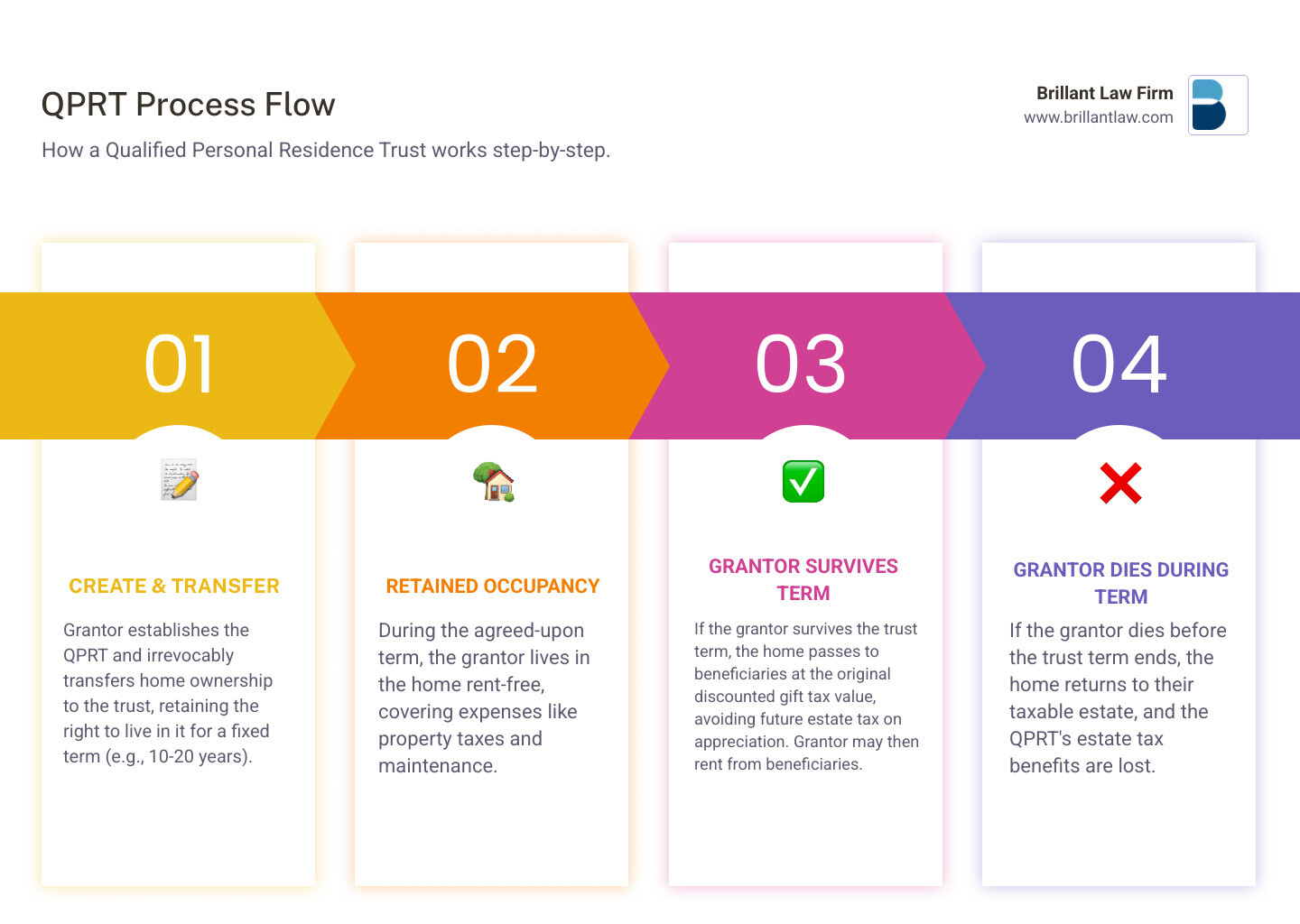
The Mechanics: How a QPRT Works Step-by-Step
Understanding how a Qualified personal residence trust works involves a few key stages.
Creating the Trust and Transferring Your Home
The process begins by drafting a trust document that adheres to IRS regulations under Section 2702. This document names the grantor (you), the trustee (often you, initially), the beneficiaries, and the length of your retained occupancy term. Once finalized, the property deed is irrevocably transferred to the QPRT. An experienced California estate planning attorney is crucial for navigating these initial steps, from property valuation to ensuring all legal formalities are met to create an effective trust.
Living in the Home During the Trust Term
A key feature of a Qualified personal residence trust is that you continue living in your home, rent-free, for the trust’s term. During this period, you remain responsible for all typical homeownership expenses, such as property taxes, insurance, and maintenance. For income tax purposes, the QPRT is a “grantor trust,” meaning you can still deduct property taxes and mortgage interest. This status also preserves your capital gains exclusion ($250,000 single/$500,000 married) if the home is sold during the term. However, QPRTs are most effective for homes without a mortgage, as mortgage payments can complicate the tax planning.
What Happens When the QPRT Term Ends?
If you outlive the trust term, ownership of the home officially transfers to your beneficiaries. You no longer legally own the property. If you wish to continue living there, you must lease the home from the beneficiaries at fair market rent. Paying anything less could cause the IRS to pull the home’s value back into your taxable estate, voiding the QPRT’s benefits. These rent payments can also serve as a tax-efficient way to transfer additional wealth to your beneficiaries, further reducing your taxable estate while providing them with income.
Weighing the Options: The Major Benefits and Risks
Deciding if a Qualified personal residence trust is right for you involves balancing significant tax advantages against notable risks.
Key Benefits of a QPRT
The primary appeal of a QPRT is its power to reduce your estate’s tax burden.
- Significant Gift Tax Discount: The value of the gift is not the home’s full market value. The IRS subtracts the value of your “retained interest” (your right to live there), resulting in a much lower “taxable gift” that counts against your lifetime exemption. For example, a $2 million home in a 15-year QPRT might only use $600,000 of your exemption, potentially saving your estate hundreds of thousands in taxes.
- Removing Future Appreciation: Once the home is in the QPRT, any future increase in its value occurs outside your taxable estate. In California’s appreciating real estate market, this “value freeze” can transfer millions in growth to your heirs, completely free of estate tax.
- Proactive Tax Planning: With the federal estate tax exemption scheduled to decrease after 2025, using a QPRT now allows you to “lock in” the benefits of the current high exemption. This is a valuable strategy for high-net-worth individuals in areas like Walnut Creek and Castle Hill.
Potential Downsides and Critical Risks
While compelling, a QPRT has risks that require careful consideration.
- The “Bet-to-Live” Mortality Risk: You must survive the entire trust term to get the tax benefits. If you die before the term ends, the home’s full value is pulled back into your taxable estate, and all potential savings are lost. This is why assessing health and life expectancy is a critical part of the planning process.
- Irrevocability: A QPRT cannot be easily changed or undone. You lose legal ownership and the flexibility to sell the home and use the proceeds for other needs.
- Loss of Stepped-Up Basis: Beneficiaries receive a “carryover basis,” meaning their cost basis is the same as yours. If they inherit through a will, they would get a “step-up in basis” to the market value at your death. The carryover basis can lead to a significant capital gains tax bill if your heirs sell the property, as they will be taxed on all appreciation since you originally bought it.
Navigating the Rules: IRS Requirements for a Qualified Personal Residence Trust
To ensure a Qualified personal residence trust delivers its intended tax benefits, it must comply with strict IRS rules under Internal Revenue Code Section 2702. Navigating these legal complexities is where an experienced estate planning attorney is essential.
Key Requirements for a Valid QPRT
For a trust to qualify, it must meet several conditions:
- Personal Residence: The property must be your principal residence or one other home you use as a residence (e.g., a vacation home). It cannot be primarily an investment or rental property.
- Limited Business Use: The residence cannot have more than incidental business use. A substantial home office or commercial activity would disqualify it.
- Limited Trust Assets: The QPRT can generally only hold the residence, insurance policies on it, and limited cash for specific purposes like improvements or expenses. You can establish up to two QPRTs, one for your primary home in Walnut Creek and another for a California vacation property.
How the Taxable Gift is Calculated
The taxable gift is the home’s fair market value minus the value of your “retained interest.” This remainder is the taxable gift. The calculation depends on three key factors:
- Trust Term Length: A longer term increases your retained interest, reducing the taxable gift.
- Your Age: This interacts with the term length to determine the actuarial value.
- The Section 7520 Interest Rate: A monthly IRS rate used to value partial interests. You can find more information on Section 7520 interest rates explained on the IRS website.
Filing a gift tax return (Form 709) is mandatory to report the gift and use your lifetime exemption.
The Impact of Interest Rates and Selling the Home
The prevailing Section 7520 rates significantly impact a QPRT’s effectiveness. A higher rate increases the value of your retained interest, which in turn reduces the value of the taxable gift to your beneficiaries. This makes a QPRT more tax-efficient in a higher interest rate environment. For example, with a $2 million home in a 15-year QPRT, a 5.0% interest rate might result in a taxable gift of around $500,000. If the rate were only 2.0%, the taxable gift could be closer to $950,000. This highlights why timing can be advantageous.
If you need to sell the home within the QPRT, the rules are strict. You generally have two years to reinvest the proceeds into a new personal residence. If you don’t, or if you buy a less expensive home, the remaining proceeds must typically be converted into a Grantor Retained Annuity Trust (GRAT) to maintain compliance.
Is a QPRT Right for Your California Estate?
Deciding if a Qualified personal residence trust fits your estate plan requires assessing your finances, family goals, and risk tolerance. For many high-net-worth Californians, especially in high-value property areas, it can be a powerful tool.
When to Consider a QPRT in Walnut Creek and Surrounding Areas
A QPRT is particularly appealing for residents in our service areas of Walnut Creek, Saranap, San Miguel, and Castle Hill. It might be an excellent fit if:
- Your primary or vacation home is a high-value asset.
- Your estate is likely to exceed the federal estate tax exemption, which is scheduled to decrease significantly after 2025.
- You want to pass your home to the next generation while minimizing their tax burden.
- You are in good health and can reasonably expect to outlive the trust term.
QPRT vs. Personal Residence Trust (PRT)
A close relative to the QPRT is the Personal Residence Trust (PRT). While similar, they have key differences:
| Feature | Qualified Personal Residence Trust (QPRT) | Personal Residence Trust (PRT) |
|---|---|---|
| Tax Savings | Maximum discount (30-60%) due to strict IRS rules. | Moderate discount (10-20%) with less favorable valuation. |
| Flexibility | Less Flexible: Rigid rules on assets, sales, and use. | More Flexible: Can hold adjacent land; less stringent rules on sales. |
| Risk | Higher Mortality Risk: If grantor dies during the term, benefits are lost. | Lower Mortality Risk: Can offer more adaptable provisions. |
| Cost | Higher setup costs due to complexity ($8,000-$20,000+ in California). | Generally lower setup costs ($5,000-$10,000). |
| Control | Grantor loses legal ownership and control over major decisions. | Grantor loses legal ownership but may retain slightly more control. |
We generally recommend a QPRT for maximum tax savings when health and long-term plans are stable. A PRT may be better if flexibility is a higher priority.
Integrating a QPRT with Your Overall Estate Plan
A QPRT should be part of a comprehensive estate plan. A common strategy is to pair it with an Irrevocable Life Insurance Trust (ILIT). The ILIT can hold a life insurance policy to provide liquidity or replace the home’s value for heirs if you don’t survive the QPRT term, effectively hedging the mortality risk. We also analyze other factors, like Generation-Skipping Transfer (GST) tax implications, to ensure your plan is efficient and achieves your long-term goals.
Frequently Asked Questions about QPRTs
Here are answers to common questions we receive from clients in Walnut Creek, Saranap, San Miguel, and Castle Hill about Qualified personal residence trusts.
How much does it cost to set up a QPRT in California?
Legal fees for drafting and implementing a Qualified personal residence trust in the Bay Area typically range from $8,000 to $20,000 or more, depending on complexity. This covers drafting the trust, transferring the deed, and ensuring IRS compliance. Additional costs include a professional property appraisal. Given the potential tax savings, these setup costs are often a worthwhile investment.
Can I be the trustee of my own QPRT?
Yes, you can act as the trustee of your own Qualified personal residence trust during the retained occupancy term. This allows you to manage the property and its expenses. However, you must name a successor trustee to take over when your term ends or if you become incapacitated. As trustee, you have a fiduciary duty to the trust’s beneficiaries.
What happens if my children (the beneficiaries) want to sell the house after the term ends?
Once the term ends, your beneficiaries gain full legal ownership and can sell the property. However, they will inherit your original “carryover basis” in the home. This means if they sell, they will owe capital gains tax on the difference between the sale price and your original purchase price. For example, if you bought a home for $500,000 and they sell it for $2,000,000, they could owe capital gains tax on $1,500,000. This potential tax liability makes family communication essential when establishing a QPRT.
Conclusion: Securing Your Legacy with a Bespoke Strategy
A Qualified personal residence trust is a powerful, yet complex, estate planning tool. For high-net-worth individuals in California’s vibrant communities like Walnut Creek, Saranap, San Miguel, and Castle Hill, it offers a unique opportunity to significantly reduce estate and gift taxes on your most valuable asset—your home—while preserving your right to enjoy it for years to come.
However, the irrevocability, the “bet-to-live” mortality risk, and the intricate IRS requirements mean that a QPRT is not a decision to be taken lightly. It demands careful consideration of your personal circumstances, a thorough understanding of the benefits and risks, and, most importantly, the guidance of experienced legal counsel.
At Brillant Law Firm, we pride ourselves on crafting bespoke, ironclad strategies custom specifically for our clients. Our unparalleled expertise, unwavering dedication, and commitment to excellence ensure that your Qualified personal residence trust is carefully designed to meet your unique goals and secure your legacy for future generations.
If you’re considering a QPRT or other advanced estate planning strategies, we invite you to connect with us. Learn more about our Trust and Estate Planning services and find how we can help you steer the complexities of wealth transfer with confidence and peace of mind.


