

Probate Legal Advice: Avoid Stress 2025
Understanding Probate Legal Services in California
Probate legal advice helps families steer California’s court-supervised process of validating a will and distributing a deceased person’s assets. When someone dies, their estate often must go through probate to transfer property, pay debts, and ensure beneficiaries receive their inheritance according to state law.
Key aspects of probate legal advice include:
- Estate administration guidance – Navigating complex legal requirements and court filings
- Personal Representative support – Assisting executors with their fiduciary duties
- Asset distribution planning – Ensuring the proper transfer of property and financial accounts
- Creditor notification – Meeting strict deadlines for notifying potential creditors
- Tax compliance – Managing estate and final income tax filings
- Dispute resolution – Handling conflicts between beneficiaries and will contests
The California probate process typically takes 9 months to 2 years, involving court appearances, asset inventories, and strict deadlines. Mistakes can result in personal liability for executors and costly delays for beneficiaries.
Many families in Walnut Creek, Saranap, San Miguel, and Castle Hill are overwhelmed by probate’s complexity. Professional guidance ensures compliance with California law while minimizing stress and protecting the estate’s value.
I’m David Brillant, a Certified Specialist in Estate Planning, Trust and Probate Law with a Masters in Taxation. My practice provides comprehensive probate legal advice to families throughout the East Bay, helping them steer even the most complex estate administration challenges with confidence.
Probate legal advice further reading:
What is Probate and When is it Necessary in California?
Probate is California’s court-supervised process for validating a will and authorizing a Personal Representative (executor) to manage a deceased person’s estate. Probate legal advice is essential for navigating this complex procedure. The court ensures debts and taxes are paid and that remaining assets are distributed correctly, either according to the will or state law if no will exists. This oversight protects all parties involved.
Probate is required for assets owned solely in the deceased’s name without a designated beneficiary. This commonly includes California real estate. If a loved one owned property in Walnut Creek or San Miguel solely in their name, probate is necessary to legally transfer the title. High-value bank accounts and investments held in the deceased’s name alone also require probate.
Fortunately, probate can often be avoided with proper estate planning, using tools like living trusts, joint tenancy, and payable-on-death accounts. Learn more in our guide on how to avoid probate.
Understanding California’s Small Estate Procedures
California offers a simplified process for smaller estates. If the total value of probate assets is $184,500 or less, you may be able to use a Small Estate Affidavit to bypass formal probate. This streamlined procedure saves time and money, allowing eligible estates to transfer assets with a simple affidavit instead of undergoing the full court process.

Who qualifies? Estates with limited assets, no real property over $61,500, and total probate assets under the current threshold. These amounts change, so verifying current limits is crucial. This procedure has limitations and is not suitable for complex or contested estates. However, for straightforward cases in communities like Castle Hill and Saranap, it is an excellent option.
The Role of the Personal Representative (Executor)
The Personal Representative is the estate’s legal manager, holding a fiduciary duty to act in the best interests of all beneficiaries. Key duties include: gathering assets, completing an inventory and appraisal with a California Probate Referee, notifying creditors within strict deadlines, paying bills and taxes, managing estate property (like a home in Walnut Creek), and distributing assets to beneficiaries.
The role requires detailed accounting to the court of all transactions. This is a significant responsibility, especially during a time of grief.
This is where our local expertise in Walnut Creek, San Miguel, and surrounding areas is invaluable. We guide Personal Representatives through local court procedures, helping them fulfill their duties without costly errors. With proper probate legal advice, the Personal Representative’s role becomes far more manageable.
The California Probate Process: A Step-by-Step Overview
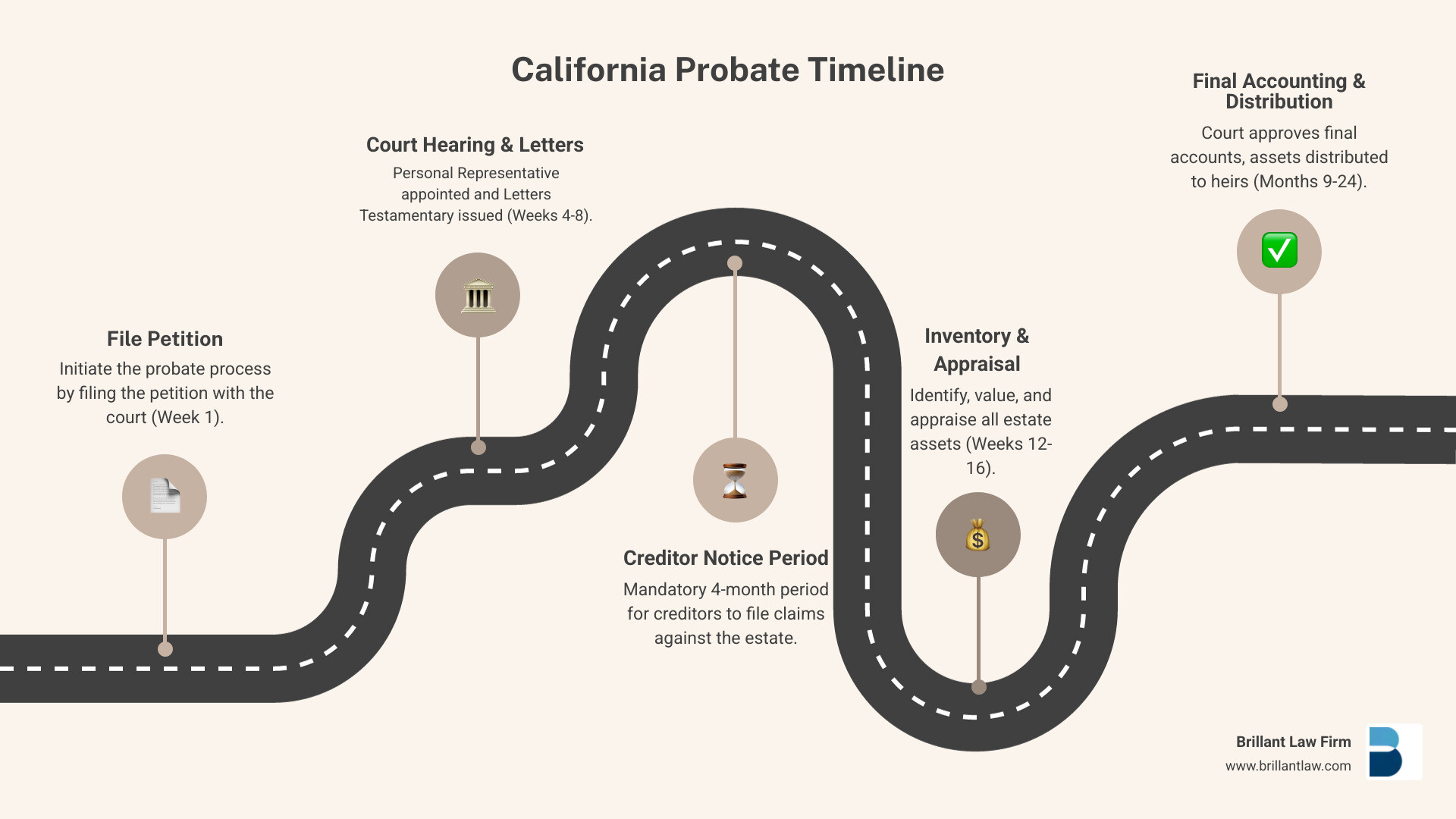
Understanding the probate legal advice you’ll need starts with knowing the steps of California’s probate process. While every estate is unique, the journey typically takes 9 months to 2 years.
1. Filing the Petition: The process starts by filing a Petition for Probate with the Superior Court in the county where the deceased lived, such as Contra Costa County for our local clients. This petition asks the court to validate the will and appoint a Personal Representative.
2. Appointing the Personal Representative: The court schedules a hearing and, if approved, issues “Letters Testamentary” (with a will) or “Letters of Administration” (without a will). These Letters grant official authority to manage the estate.
3. Notifying Heirs and Creditors: The Personal Representative must formally notify all potential heirs and known creditors. A notice must also be published in a local newspaper, giving unknown creditors four months to file claims.
4. Inventorying the Estate: All assets must be located and valued. Most assets require a formal appraisal by a court-appointed California Probate Referee to establish fair market value.
5. Paying Debts and Taxes: Valid creditor claims, funeral expenses, and administrative costs must be paid. The Personal Representative also handles final income tax returns and any applicable estate taxes.
6. Final Accounting: A complete financial report detailing all transactions must be submitted to the court for approval, ensuring the estate was managed responsibly.
7. Petition for Final Distribution: After the accounting is approved, this petition asks the court for permission to distribute the remaining assets to the beneficiaries.
8. Closing the Estate: The Personal Representative distributes the assets, collects receipts, and files a final declaration to officially close the probate case.
For official guidance, see California Courts Self-Help Probate and county-specific procedures from the Contra Costa County Superior Court Probate Division.
For more comprehensive information, visit our detailed guide on the probate process.
Key Documents Required for Probate
Probate involves significant paperwork. Key documents include:
- The original will (photocopies can cause legal issues).
- Certified death certificates for banks, insurance companies, and government agencies.
- The Petition for Probate (Form DE-111) to officially open the case.
- A comprehensive list of heirs and beneficiaries to ensure everyone is properly notified.
- The Inventory and Appraisal (Form DE-160) to document all assets and their court-appraised values.
- Notices to creditors and government agencies as proof of legal notification.

Working with local legal counsel in Walnut Creek, Saranap, San Miguel, and Castle Hill can make the document preparation process less stressful, as we understand Contra Costa County’s specific procedures.
The Role of Professional Probate Legal Advice
Navigating California’s probate system while grieving is a significant challenge. While handling probate without an attorney is possible, seeking professional probate legal advice is the wisest choice for most families in Walnut Creek, Saranap, San Miguel, and Castle Hill.
The risks of a DIY approach are substantial:
- Personal Liability: As a Personal Representative, you have a fiduciary duty. Mistakes in valuation, distribution, or deadlines can make you personally liable for financial losses.
- Missed Deadlines: California probate has strict statutory deadlines. Missing one can result in penalties or dismissal of your case.
- Incorrect Filings: Court forms are precise. A single error can lead to rejection and significant delays.
- Family Disputes: Inheritance can create tension. Without legal guidance, conflicts can escalate into costly litigation that destroys relationships.
- Emotional Strain: Managing complex legal matters while grieving is overwhelming. Professional help allows you to focus on healing.
The benefits of hiring an Estate Planning Attorney far outweigh the costs. We provide specialized expertise to steer California’s laws efficiently, minimize family conflict, and give you peace of mind.
The Pros and Cons of Forgoing Probate Legal Advice
Choosing between DIY probate and hiring an attorney involves clear trade-offs:
| Feature | DIY Probate in California | Hiring a Probate Lawyer |
|---|---|---|
| Cost | Lower upfront costs, but potential hidden expenses from errors, delays, or personal liability can be substantial | Higher initial investment, but predictable fees and protection from costly mistakes |
| Time Commitment | Requires significant personal time learning procedures, completing forms, and managing deadlines | Attorney handles most time-consuming tasks, allowing you to focus on family and healing |
| Legal Risk/Liability | High risk of personal liability for mistakes, missed deadlines, or improper distributions | Professional guidance significantly reduces risk of errors and personal liability |
| Complexity Handling | You’re responsible for understanding and navigating all legal requirements alone | Experienced attorney manages complex legal issues and court procedures |
| Emotional Stress | Added stress of legal responsibilities during an already difficult time | Reduced stress with professional support and guidance |
While DIY probate offers full control and potential upfront savings, it demands a significant time investment and carries a high risk of errors and lack of legal support when complications inevitably arise.
When is Seeking Probate Legal Advice Essential?
Some situations absolutely demand professional probate legal advice:
- Contested Wills: If the will’s validity is challenged for any reason (e.g., undue influence, lack of capacity), you need an experienced attorney immediately.
- Complex Assets: Business interests, multiple properties, or other sophisticated assets require specialized knowledge to value and distribute correctly.
- Significant Debts or Tax Issues: An insolvent estate or one with tax complications requires an expert to steer creditor claims and tax laws.
- Beneficiary Disputes: An attorney can mediate conflicts and resolve them before they escalate into litigation.
- Out-of-State Personal Representative: Managing a California estate from another state is logistically challenging. Our local expertise in Saranap and Castle Hill is invaluable in these cases.
For more information about comprehensive estate planning to avoid these issues, visit our page on What is Estate Planning?.
Understanding Probate Legal Services in California
Probate legal advice helps families steer California’s court-supervised process of validating a will and distributing a deceased person’s assets. When someone dies, their estate often must go through probate to transfer property, pay debts, and ensure beneficiaries receive their inheritance according to state law.
Key aspects of probate legal advice include:
- Estate administration guidance – Navigating complex legal requirements and court filings
- Personal Representative support – Assisting executors with their fiduciary duties
- Asset distribution planning – Ensuring the proper transfer of property and financial accounts
- Creditor notification – Meeting strict deadlines for notifying potential creditors
- Tax compliance – Managing estate and final income tax filings
- Dispute resolution – Handling conflicts between beneficiaries and will contests
The California probate process typically takes 9 months to 2 years, involving court appearances, asset inventories, and strict deadlines. Mistakes can result in personal liability for executors and costly delays for beneficiaries.
Many families in Walnut Creek, Saranap, San Miguel, and Castle Hill are overwhelmed by probate’s complexity. Professional guidance ensures compliance with California law while minimizing stress and protecting the estate’s value.
I’m David Brillant, a Certified Specialist in Estate Planning, Trust and Probate Law with a Masters in Taxation. My practice provides comprehensive probate legal advice to families throughout the East Bay, helping them steer even the most complex estate administration challenges with confidence.
Probate legal advice further reading:
What is Probate and When is it Necessary in California?
Probate is the formal legal process that validates a will and confirms the authority of the Personal Representative (executor) to manage an estate. Its purpose is to ensure assets are collected, debts and taxes are paid, and the remaining property is distributed to the rightful heirs according to the will or California’s intestate succession laws.
Probate is necessary when a person dies owning assets solely in their name without a designated beneficiary. This is especially true for real estate in California; if an individual owned property solely in their name, probate is almost always required to legally transfer the title. High-value bank or investment accounts held only in the deceased’s name also trigger probate.
We can often avoid probate if assets are structured properly. For instance, assets held in joint tenancy, where ownership automatically transfers to the surviving joint tenant, bypass probate. Similarly, assets held within a Living Trust or those with designated beneficiaries (like retirement accounts) pass directly to the named individual without court intervention. Learn more in our guide on How to Avoid Probate.
Understanding California’s Small Estate Procedures
California law provides simplified procedures for smaller estates. If the total value of the deceased’s probate assets is $184,500 or less, we may be able to avoid formal probate. This threshold changes, so it is vital to verify the current limit.
For these smaller estates, a “Small Estate Affidavit” can be used to transfer property more quickly and with less cost. However, this process has limitations and does not apply to real property valued over a certain amount (currently $61,500). This is a great option for many families, but it requires careful attention to ensure all qualifications are met.
The Role of the Personal Representative (Executor)
The Personal Representative is appointed by the court to manage the estate. This role carries a fiduciary duty to act in the best interests of the estate and its beneficiaries.
Key duties of a Personal Representative include:
- Gathering Assets: Identifying and taking control of all estate assets, from bank accounts to real estate.
- Inventory and Appraisal: Creating a detailed inventory of all assets and having them professionally appraised by a court-appointed California Probate Referee.
- Notifying Creditors: Notifying all known creditors and publishing a notice, which starts a strict four-month claim period.
- Paying Bills and Taxes: Paying legitimate debts, funeral expenses, and all applicable taxes.
- Managing Estate Property: Maintaining real estate, managing investments, or selling assets as needed.
- Distributing Assets to Heirs: After all obligations are met, distributing the remaining assets to beneficiaries.
- Accounting to the Court: Submitting a detailed financial accounting to the court for approval.
Our team routinely assists Personal Representatives in Walnut Creek, San Miguel, and surrounding areas, ensuring they fulfill these obligations accurately and efficiently.
The California Probate Process: A Step-by-Step Overview
The California probate process is a structured legal journey. While each estate is unique, the general steps remain consistent:
- Filing the Petition: The process begins by filing a “Petition for Probate” with the Superior Court in the county where the deceased resided (e.g., Contra Costa County for local clients).
- Appointing the Personal Representative: The court holds a hearing and, if approved, issues “Letters Testamentary” (with a will) or “Letters of Administration” (no will), granting legal authority to the Personal Representative.
- Notifying Heirs and Creditors: The Personal Representative must formally notify all heirs, beneficiaries, and known creditors. A notice is also published, starting a four-month window for creditor claims.
- Inventorying the Estate: All of the deceased’s assets must be identified, collected, and valued by a court-appointed California Probate Referee.
- Paying Debts and Taxes: Valid creditor claims, funeral expenses, and administrative costs are paid. The Personal Representative also handles final tax returns.
- Final Accounting: A detailed accounting of all estate transactions is prepared and submitted to the court for approval.
- Petition for Final Distribution: Once the accounting is approved, the Personal Representative asks the court for permission to distribute remaining assets to the heirs.
- Closing the Estate: After court approval, the Personal Representative distributes the assets, gets receipts, and files a final declaration to close the estate.
For more information about the probate process, please visit our page on More info about the Probate process.
Key Documents Required for Probate
Navigating probate involves significant paperwork. Essential documents include:
- Original Will: The original must be submitted to the court.
- Certified Death Certificate: Required to prove the death.
- Petition for Probate (Form DE-111): The initial form to open the case.
- List of Heirs and Beneficiaries: A complete list of all potential inheritors.
- Inventory and Appraisal (Form DE-160): Details all estate assets and their values.
- Notices to Creditors and Government Agencies: Proof that required notifications were sent.
The Role of Professional Probate Legal Advice
When a loved one passes, families must decide whether to handle probate themselves or seek professional help. While not legally required, probate legal advice is often the difference between a smooth process and a costly, stressful ordeal.
Probate is a complex legal process, not just paperwork, and mistakes have serious consequences. As a Personal Representative, you take on personal liability. If you miss a deadline, miscalculate asset values, or distribute funds incorrectly, you could be held personally responsible for the financial loss.
California’s probate courts enforce strict statutory deadlines. Missing the four-month creditor notification deadline could make you liable for otherwise barred claims. An incorrect filing can be rejected by the court, causing months of delay.
Furthermore, family disputes often surface over inheritance. Without professional mediation, these conflicts can escalate into bitter litigation that damages family relationships.
The benefits of hiring an experienced Estate Planning Attorney are clear. We provide unparalleled expertise in California probate law, ensuring efficiency while minimizing conflict. Our local knowledge of the courts in Walnut Creek, Saranap, San Miguel, and Castle Hill saves our clients time and money.
The Pros and Cons of Forgoing Probate Legal Advice
Consider the realities of handling probate yourself versus seeking professional probate legal advice:
| Feature | DIY Probate in California | Hiring a Probate Lawyer |
|---|---|---|
| Cost | Potentially lower upfront costs, but hidden expenses from mistakes, delays, and potential personal liability can far exceed attorney fees | Predictable legal fees ($300-$600/hour in California) plus statutory fees, but protection from costly errors and personal liability |
| Time Commitment | Hundreds of hours learning procedures, completing forms, attending court hearings, and managing estate administration | Minimal time investment – attorney handles complex tasks while you focus on family and healing |
| Legal Risk/Liability | High risk of personal liability for mistakes, missed deadlines, or improper distributions | Attorney carries professional liability insurance and expertise minimizes your personal risk |
| Complexity Handling | You’re responsible for learning and applying complex California probate law | Experienced attorney steers legal complexities and court requirements efficiently |
| Emotional Stress | High stress managing legal requirements while grieving, plus family conflicts without professional mediation | Significantly reduced stress with professional guidance and conflict resolution support |
The potential cost savings of DIY probate may seem appealing, but this comes with a significant time investment and a high risk of errors. The lack of legal support when problems arise can ultimately cost far more than professional fees.
When is Seeking Probate Legal Advice Essential?
Certain situations make professional probate legal advice absolutely critical:
- Contested Wills: If anyone challenges the will’s validity, claims undue influence, or questions the deceased’s capacity, you need an experienced attorney immediately.
- Complex Assets: Business interests, multiple properties, or significant investment portfolios require specialized knowledge for proper valuation and transfer.
- Significant Debts: If the estate has substantial debts or potential tax liabilities, an attorney’s expertise in managing claims and tax laws is invaluable.
- Beneficiary Disputes: Professional mediation can resolve conflicts before they escalate into expensive litigation that tears families apart.
- Out-of-State Personal Representative: Managing a California estate from afar is difficult. Our familiarity with Contra Costa County courts is essential for non-local representatives.
Learn more about comprehensive planning strategies in our guide What is Estate Planning?.


