

IRS installment agreement: 7 Powerful Ways to Win in 2025
Why an IRS Installment Agreement Can Save You From Financial Disaster
An IRS installment agreement is a payment plan that lets you pay your tax debt over time instead of in one lump sum. Here’s what you need to know:
Quick Facts:
– Individual taxpayers: Can owe up to $50,000 for long-term plans
– Business taxpayers: Can owe up to $25,000 for long-term plans
– Setup fees: Range from $0 to $225 depending on payment method
– Payment terms: Up to 72 months for individuals, 24 months for businesses
– Interest continues: Penalties and interest keep adding up until paid in full
According to the IRS, about 80-90% of individual taxpayers with a balance due qualify to use the online payment agreement application. The failure-to-pay penalty rate gets cut in half while you’re on an installment plan – from 0.5% per month to 0.25% per month.
When you can’t pay your full tax bill, don’t panic. The IRS offers several self-service options that are fast, easy, and secure. You can often get immediate approval through their online system.
But here’s the thing – one wrong move can trigger collection actions like liens and levies. The rules are complex, and the stakes are high for business owners and high-net-worth individuals.
I’m David Brillant, a Certified Specialist in Estate Planning, Trust and Probate Law with a Masters in Taxation. I’ve helped California clients steer complex IRS installment agreement negotiations and develop custom tax debt strategies that protect their assets while resolving their obligations. Let me walk you through exactly how these payment plans work and when you might need professional help.

IRS Installment Agreement Basics
When you’re staring at a tax bill you can’t afford, an IRS installment agreement becomes your financial lifeline. It’s essentially a contract between you and the IRS that says “I’ll pay what I owe, just give me time to do it in monthly chunks instead of one massive payment.”
Think of it as the IRS saying, “Okay, we’d rather get paid slowly than not at all.” And honestly, that’s exactly what it is.
The IRS made some pretty taxpayer-friendly changes back in 2018, streamlining the whole process. Now about 80-90% of individual taxpayers with a balance due can handle everything online without drowning in paperwork. It’s actually refreshing when government bureaucracy gets simpler instead of more complicated.
Here’s something that might surprise you: while you’re on an installment plan, the failure-to-pay penalty gets cut in half – from 0.5% per month down to 0.25% per month. That’s real money back in your pocket. The catch? Interest keeps ticking like a parking meter until you’ve paid every last penny.
The IRS has a 10-year collection window called the Collection Statute Expiration Date (CSED). Here’s where it gets interesting – requesting an installment agreement actually pauses that 10-year clock while your request is pending, plus another 30 days if they reject it. Sometimes buying time is half the battle.
| Short-Term Plans | Long-Term Plans |
|---|---|
| Up to 180 days | Up to 72 months (individuals) |
| No setup fee | $31-$225 setup fee |
| Balance under $100,000 | Balance under $50,000 (individuals) |
| Interest continues | Interest + penalties continue |
| No direct debit required | Direct debit often required |
Payment plans; installment agreements
Who Qualifies for an IRS Installment Agreement?
The qualification bar is actually pretty reasonable. Most taxpayers can clear it without breaking a sweat.
If you’re an individual taxpayer, you can owe up to $50,000 in combined tax, penalties, and interest for long-term plans. For short-term plans (180 days or less), that number jumps to $100,000. The main requirements are pretty straightforward: you need to have filed all your required returns and be able to make the monthly payments you’re proposing.
Business owners face tighter limits – you can owe up to $25,000 for an installment agreement. You’ll also need to have filed all required returns and demonstrate you can handle the monthly payments.
Here’s where the IRS gets a bit demanding: direct debit becomes mandatory at certain thresholds. If you’re an individual owing between $25,000 and $50,000, or a business owing between $10,000 and $25,000, you must set up automatic bank withdrawals. The IRS learned that people who pay automatically are far less likely to default.
Types of IRS Installment Agreements
The IRS offers several flavors of payment plans, each designed for different financial situations.
Short-term payment plans give you up to 180 days to pay without any setup fees. These work great if you owe less than $100,000 and can realistically pay it off quickly – maybe you’re waiting on a bonus or selling some assets.
Long-term installment agreements stretch your payments up to 72 months for individuals (24 months for businesses). You’ll pay a setup fee ranging from $31 to $225 depending on how you choose to pay, but sometimes spreading the pain over six years makes sense.
Streamlined installment agreements are the fast lane for taxpayers owing up to $50,000. No detailed financial statements required – just prove you can make the payments. The IRS often requires direct debit for higher balances in this category.
Guaranteed installment agreements are available if you owe $10,000 or less and can pay within three years. As the name suggests, if you meet the criteria, approval is essentially guaranteed.
Partial Payment Installment Agreements (PPIA) are for situations where you simply can’t pay the full amount before that 10-year collection window closes. You’ll need to bare your financial soul with detailed disclosure forms, but your monthly payments might not even cover the full balance – sometimes the IRS accepts that half a loaf is better than none.
Low-income taxpayers get some relief too. If your adjusted gross income sits at or below 250% of federal poverty guidelines, you might qualify for complete fee waivers on direct debit agreements, or even get reimbursed for fees once you complete a non-direct debit agreement.
Choosing the Right Tax Payment Plan

When it comes to picking the right payment plan, I always tell my California clients that one size definitely doesn’t fit all. Your financial situation is unique, and your IRS installment agreement should reflect that reality.
The most important thing to understand upfront is that interest keeps ticking no matter which plan you choose. Think of it like a parking meter that never stops running – the current underpayment interest rate fluctuates quarterly but typically hovers between 3-8% annually. Every month you’re making payments, your total debt is still growing from that interest.
Setup fees vary dramatically depending on how you apply and pay. The IRS really wants you to use direct debit, and they make it obvious through their fee structure. Online direct debit costs just $31, while a phone or mail application without direct debit will run you $225. That’s a $194 difference for essentially the same service.
Your payment method choices include direct debit from your bank account (which I strongly recommend), payroll deduction if your employer cooperates, EFTPS electronic payments, credit or debit cards (though you’ll pay processing fees), or old-fashioned checks that you mail with payment vouchers.
Here’s something that catches many people off guard: the IRS might still file a Notice of Federal Tax Lien even when you’re faithfully making installment payments, especially for larger balances. However, they’ve streamlined their process and often waive lien filings for assessed balances up to $25,000.
More info about IRS Tax Debt Resolution
Cost Breakdown & Fee Waivers
Let me break down the real costs because there’s more to consider than just the setup fees. The fee structure works like this: short-term payment plans cost nothing to set up, online direct debit long-term plans cost $31, online non-direct debit plans jump to $130, and phone or mail applications without direct debit hit $225.
Here in California, where the cost of living can be brutal, many of my clients are pleasantly surprised to learn they qualify for low-income fee waivers. The federal poverty guidelines are the same nationwide, but 250% of the poverty level might be more realistic for California residents than those in lower-cost areas.
If you qualify as low-income, you can get the setup fees completely waived for direct debit agreements or receive a refund when you complete a non-direct debit agreement. Given California’s housing costs and general expenses, it’s worth checking if you qualify even if you think your income is too high.
I always push my clients toward direct debit for several practical reasons. Beyond the lower fees, you eliminate the risk of missed payments due to mail delays, vacation travel, or simple forgetfulness. Plus, if you owe more than $25,000, direct debit becomes mandatory anyway.
Short-Term vs Long-Term Decision Factors
The choice between short-term and long-term plans often comes down to cash flow reality versus total cost. Short-term plans (up to 180 days) have no setup fees and get you out of debt faster, but require much higher monthly payments that might strain your budget.
Before committing to any plan, I walk my California clients through a thorough cash flow analysis. We look at monthly income after taxes, essential living expenses, business operating costs for entrepreneurs, seasonal income variations, and any major expenses on the horizon. California’s high cost of living means this analysis is especially critical here.
Sometimes the smartest move is actually using other credit sources to pay the IRS in full rather than entering a long-term installment agreement. We often explore home equity lines of credit, business lines of credit, or personal loans that might carry lower interest rates than the combination of IRS penalties and interest.
The 10-year collection statute can work in your favor if you understand how it operates. The IRS has 10 years from the assessment date to collect your debt, but certain actions can extend this period. Filing bankruptcy, submitting an Offer in Compromise, living outside the United States, or signing certain IRS forms can add time to that clock. This is where having experienced counsel becomes invaluable for developing the right strategy.
How to Apply for an IRS Installment Agreement
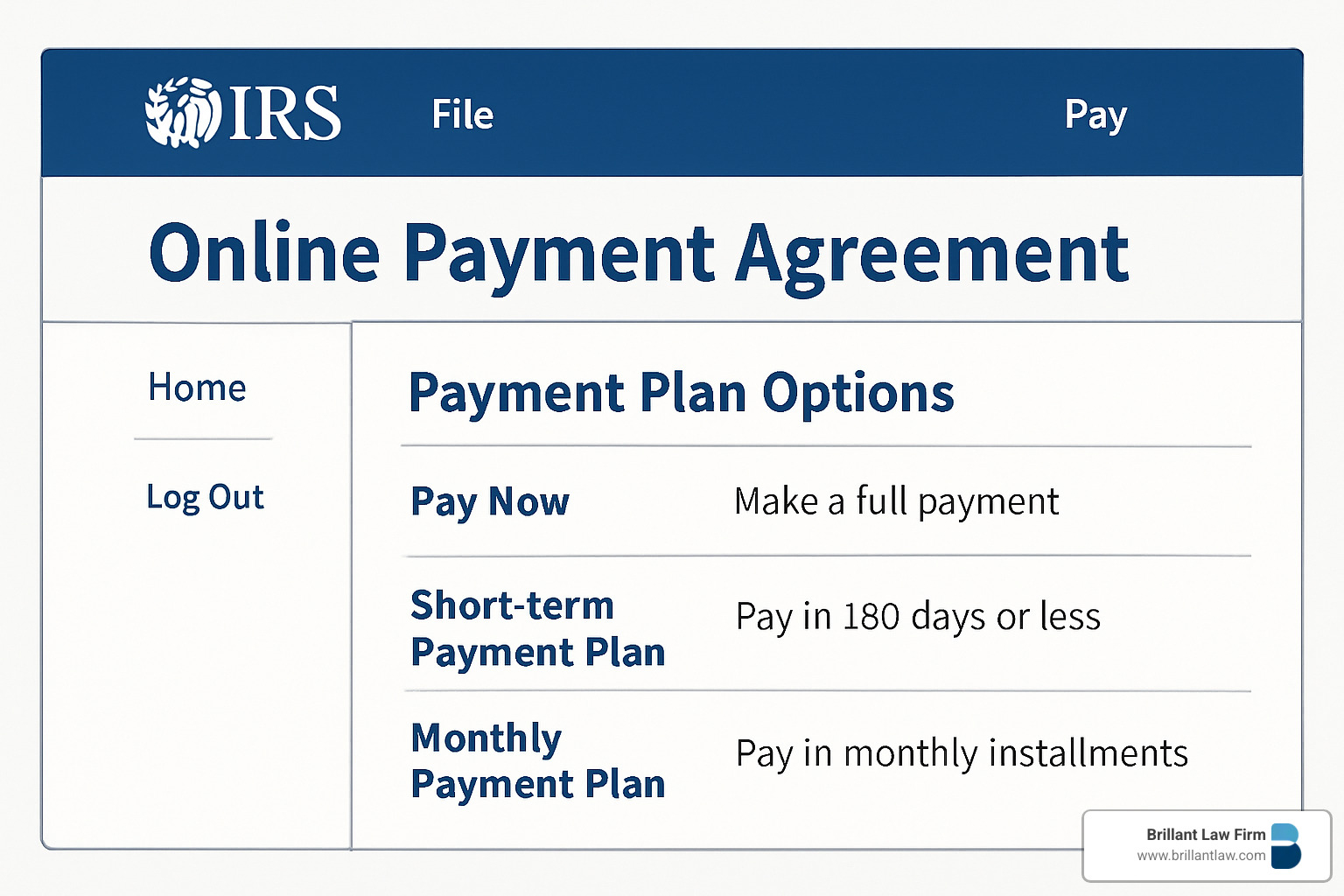
Applying for an IRS installment agreement has become surprisingly straightforward – a far cry from the bureaucratic maze it used to be. The IRS has invested heavily in their online systems, and it shows. Most of our California clients can get approved within minutes using the online application.
You have three ways to apply: online, by mail, or by phone. The online route is almost always your best bet – it’s faster, cheaper, and available 24/7. Plus, you’ll know immediately if you’re approved.
Before you start any application, take a few minutes to gather your paperwork. You’ll need your Social Security Number or Individual Taxpayer Identification Number, your bank routing and account numbers if you’re setting up direct debit, and the balance due from your tax return or IRS notice. If you have an IRS notice, look for the Caller ID number – it’s usually in the upper right corner and speeds up the process.
If you’re claiming low-income status for fee waivers, you’ll also need Form 13844. For paper applications, you’ll use Form 9465, the official installment agreement request form.
Online payment agreement application
Step-by-Step Online Application
The IRS Online Payment Agreement tool is honestly impressive for a government website. It walks you through everything step by step, and most people finish in about 15 minutes.
Creating your account is the first hurdle. You’ll need to set up an ID.me account with photo identification. If you have an old IRS username from years past, don’t worry – the system will help you migrate to the new ID.me system. It’s a bit of extra work upfront, but it makes future interactions with the IRS much smoother.
The identity verification process feels very modern. You’ll upload a photo of your driver’s license or state ID, then take a selfie for verification. The system also asks security questions based on your credit history – things like “Which of these addresses have you lived at?” It’s the same technology banks use, so it’s secure and reliable.
Choosing your plan type is where the system really shines. Based on your balance and situation, it automatically shows you which options you qualify for. You might see short-term payment plans up to 180 days or long-term installment agreements with monthly payments. The system does the math for you and won’t let you select options you don’t qualify for.
When you enter your banking information, double-check those routing and account numbers. A typo here can cause your first payment to fail, which could jeopardize your entire agreement. You’ll also choose your monthly payment date – pick something that works with your cash flow, like a few days after payday.
The review and submit step gives you one last chance to make sure everything’s correct. Read through the terms carefully, especially the part about what happens if you miss payments. Once you submit, you’ll typically get instant approval with a confirmation number and your first payment date.
Paper & Phone Applications
Sometimes the online system isn’t an option. Maybe your balance is too high, or you have a complex tax situation that requires human review. That’s when you’ll need to go old school with paper or phone applications.
Mail applications using Form 9465 still work perfectly fine, though they take longer to process. The form itself is straightforward – just follow the instructions and be thorough. Here’s a pro tip from our California practice: always include some payment with your application, even if it’s just $50. It shows good faith and can help tip the scales toward approval.
You’ll mail your completed form to the address shown on your tax return or IRS notice. Different types of taxes go to different processing centers, so don’t guess – use the specific address provided. Processing time is typically 30 days, though it can be longer during busy season.
Phone applications can be surprisingly efficient if you catch them at the right time. Call the number on your IRS notice with all your financial information ready. The representatives can often process your request during the call, though you’ll pay higher setup fees than the online option. Be prepared for potential wait times, especially during tax season.
Whether you apply by mail or phone, higher setup fees apply compared to the online application. But sometimes the personal touch is worth it, especially if you have questions about which payment plan makes the most sense for your situation.
Managing & Modifying Your IRS Installment Agreement
Getting your IRS installment agreement approved is just the beginning. Think of it like signing a lease – you’ve made a commitment that requires ongoing attention and careful management. The good news? With proper planning, most taxpayers successfully complete their payment plans without major issues.
Your monthly payment obligations are non-negotiable. The IRS expects your payment on the same date every month, and they’re not known for their flexibility when it comes to late payments. Even one missed payment can send you straight into default territory, which is a place you definitely don’t want to visit.
Here’s something that catches many people off guard: interest and penalties keep accumulating throughout your entire payment plan. Your debt is like a slowly inflating balloon – it keeps growing until you make that final payment. This means if you owe $30,000 today and set up a 60-month payment plan, you’ll end up paying significantly more than $30,000 by the time you’re done.
Default can happen faster than you think. Missing a payment is the obvious trigger, but there are other ways to accidentally torpedo your agreement. Failing to file your next year’s tax return on time will do it. So will owing additional taxes and not paying them by the deadline. The IRS views these as signs that you’re not holding up your end of the bargain.
During the COVID-19 relief period, the IRS offered some breathing room with suspension rules that allowed payments to be paused without triggering default. While that specific relief has ended, the IRS may still work with you if you’re experiencing genuine financial hardship – but you need to contact them proactively, not after you’ve already missed payments.
If you’re thinking about requesting a lien withdrawal, you’ll need to meet specific criteria and submit the proper paperwork. This is one area where having experienced legal counsel can make a significant difference in the outcome.
Can I Modify My IRS Installment Agreement?
Life changes, and fortunately, your IRS installment agreement can change with it. The modification process is actually more flexible than many taxpayers realize, especially if you use the online tools.
Changing your due date is probably the most common modification we help our California clients make. Maybe you initially chose the 5th of the month, but then realized your biggest client always pays you on the 15th. Moving your IRS payment to the 20th just makes more sense for your cash flow.
Adjusting your payment amount works both ways. If your business is doing better than expected, increasing your monthly payment can save you thousands in interest over the life of the agreement. On the flip side, if you’re facing genuine financial hardship, the IRS may allow you to reduce your payments – though you’ll need to provide documentation of your changed circumstances.
Converting to direct debit is almost always a smart move if you didn’t set it up initially. Not only do you get lower fees, but you eliminate the risk of forgetting to make a payment. In our experience, clients who use direct debit have far fewer problems with their agreements.
Adding new tax debt to an existing agreement is often possible and usually easier than juggling multiple payment plans. If you end up owing taxes for the current year while you’re still paying off prior years, the IRS can often combine everything into one manageable monthly payment.
Hardship revisions require more documentation, but they’re available if you truly need them. The key is being proactive and honest about your situation. The IRS would rather work with you than spend resources on collection actions.
What Happens If You Default?
Let’s be honest – defaulting on your IRS installment agreement is like poking a sleeping bear. Suddenly, all those collection tools the IRS had put away come roaring back to life, and they’re not in a patient mood anymore.
The immediate consequences hit fast. Your agreement gets terminated, which means the entire remaining balance becomes due right now. The IRS can file a Notice of Federal Tax Lien, which will show up on your credit report and make it nearly impossible to get financing for anything significant.
Levy risk becomes very real very quickly. The IRS can grab money directly from your bank accounts, garnish your wages, or seize business assets. We’ve seen clients lose significant portions of their paychecks – sometimes up to 70% or more, depending on their filing status and number of dependents.
But here’s what many people don’t know: you’re not necessarily sunk if you default. The IRS offers reinstatement options that can get you back on track. You can often reinstate your agreement by paying the missed amount plus a modest reinstatement fee. Sometimes you can negotiate a completely new agreement that better fits your current situation.
Appeal rights are your safety net. If you disagree with the IRS’s decision to terminate your agreement, or if you think they didn’t follow proper procedures, you can appeal. The appeals process gives you a chance to present your case to a different IRS employee who wasn’t involved in the original decision.
When things get really complicated, the Taxpayer Advocate Service can be a lifeline. They’re an independent organization within the IRS that helps taxpayers when the normal processes aren’t working. They’re particularly helpful if you’re experiencing significant financial hardship or if the IRS isn’t following their own rules.
The bottom line? Managing your IRS installment agreement successfully requires attention and planning, but it’s absolutely doable. Most of our California clients who stay proactive and communicate with the IRS when issues arise are able to complete their payment plans without major drama.
Alternatives & Professional Help

Sometimes an IRS installment agreement simply isn’t the right fit for your situation. Maybe your debt is too large, your financial circumstances are too complex, or you’re facing collection actions that require immediate attention. Let’s explore your other options and when it makes sense to bring in professional help.
Offer in Compromise is probably the most well-known alternative, though it’s not the magic bullet many people think it is. This program lets you settle your tax debt for pennies on the dollar – but only if you truly can’t pay the full amount. The IRS looks at your ability to pay, income potential, and asset equity using a strict formula. Here’s the reality: only about 25% of submitted offers get accepted. Most people who think they qualify actually don’t.
Currently Not Collectible status can be a lifesaver if you’re genuinely experiencing financial hardship. The IRS essentially puts your case on hold, stopping active collection while you get back on your feet. Your debt doesn’t disappear, but at least the collection pressure stops. This works well for people going through temporary crises like job loss or medical emergencies.
For shorter-term cash flow problems, an extension of time to pay might be all you need. This gives you an additional 30-120 days to pay your balance in full without the complexity of a formal installment agreement. It’s perfect when you’re waiting for a bonus, commission, or other expected income.
Bankruptcy can sometimes discharge tax debts, but the rules are incredibly complex. Generally, income taxes can be wiped out in bankruptcy if they meet specific timing and filing requirements. This is definitely not a DIY situation – you need professional guidance to understand if this makes sense for your circumstances.
Offer in Compromise Pre-Qualifier tool
In California, where we practice, experienced tax attorneys typically charge $400-$750 per hour depending on the complexity of your case. While that might seem expensive, it’s often a wise investment when you’re dealing with significant tax debt or facing potential asset seizure.
You should seriously consider professional help when you owe more than $25,000, especially if you own a business or have significant assets at risk. We also recommend getting counsel if you’ve previously defaulted on an installment agreement, if the IRS has already begun collection actions, or if you simply disagree with the amount the IRS says you owe.
Business owners face particularly complex challenges. Trust fund recovery penalties for unpaid payroll taxes can make business owners personally liable even if their company is incorporated. The stakes are simply too high to go it alone.
When the IRS Installment Agreement Isn’t Enough
Sometimes a standard IRS installment agreement won’t solve your problems. This happens more often than you might think, especially here in California where high asset values and complex financial situations are common.
Asset protection becomes crucial when you have significant wealth or business interests. Simply entering an installment agreement doesn’t shield your assets from future collection actions. We often help our California clients restructure their holdings before or during the installment agreement process to minimize exposure.
Partial Payment Installment Agreements (PPIA) offer a solution when you genuinely can’t pay your full debt before the 10-year collection statute expires. This isn’t just a reduced payment plan – it’s acknowledgment that you’ll never be able to pay the full amount. You’ll need to complete Form 433-F (for individuals) or Form 433-A (for wage earners and self-employed), providing detailed financial disclosure about every aspect of your financial life.
The financial statement process is thorough and somewhat invasive. The IRS wants to see all income sources, monthly living expenses, asset values, debts and liabilities, and bank account information. They use this data to calculate exactly what you can afford and whether alternative approaches make more sense.
Business owners face additional layers of complexity that make professional guidance almost essential. Beyond the obvious cash flow impacts, you’re dealing with potential trust fund recovery penalties, personal liability for certain business taxes, and the very real possibility that collection actions could disrupt your business operations. In some cases, the IRS can even pierce corporate protections, making business owners personally liable for company debts.
The key is understanding that tax debt resolution isn’t just about making payments – it’s about protecting your financial future while satisfying your obligations. That’s where experienced legal counsel makes all the difference.
Frequently Asked Questions about IRS Installment Agreements
How long does IRS approval take for an IRS installment agreement?
The approval time depends on how you apply:
- Online applications: You receive immediate notification of approval or denial
- Paper applications (Form 9465): Typically 30 days for a response
- Phone applications: Often processed during the call, but may take several days for confirmation
We always recommend the online application when possible because of the immediate response and lower fees.
Will an IRS installment agreement stop tax liens or levies?
An IRS installment agreement generally suspends collection actions while your application is pending and throughout the term of the agreement. However:
- Liens: The IRS may still file a Notice of Federal Tax Lien, especially for larger balances. However, they’ve streamlined criteria that waive lien determinations for balances up to $25,000.
- Levies: Active levy actions are typically suspended once you enter an installment agreement.
- Future collection: If you default on your agreement, collection actions can resume immediately.
The key is maintaining compliance with your agreement terms and staying current on future tax obligations.
What if I can’t afford the IRS installment agreement payment anymore?
If your financial situation changes and you can no longer afford your monthly payment, you have several options:
Contact the IRS immediately: Don’t wait until you miss a payment. Proactive communication often leads to better outcomes.
Request a modification: You can ask to reduce your monthly payment amount, though you’ll need to provide financial documentation justifying the change.
Hardship status: If you’re experiencing genuine financial hardship, you may qualify for temporary suspension of payments or currently not collectible status.
Professional help: This is often when we recommend consulting with a tax attorney to explore all available options and protect your interests.
Even if you can’t afford the current payment, defaulting without communication will trigger immediate collection actions.
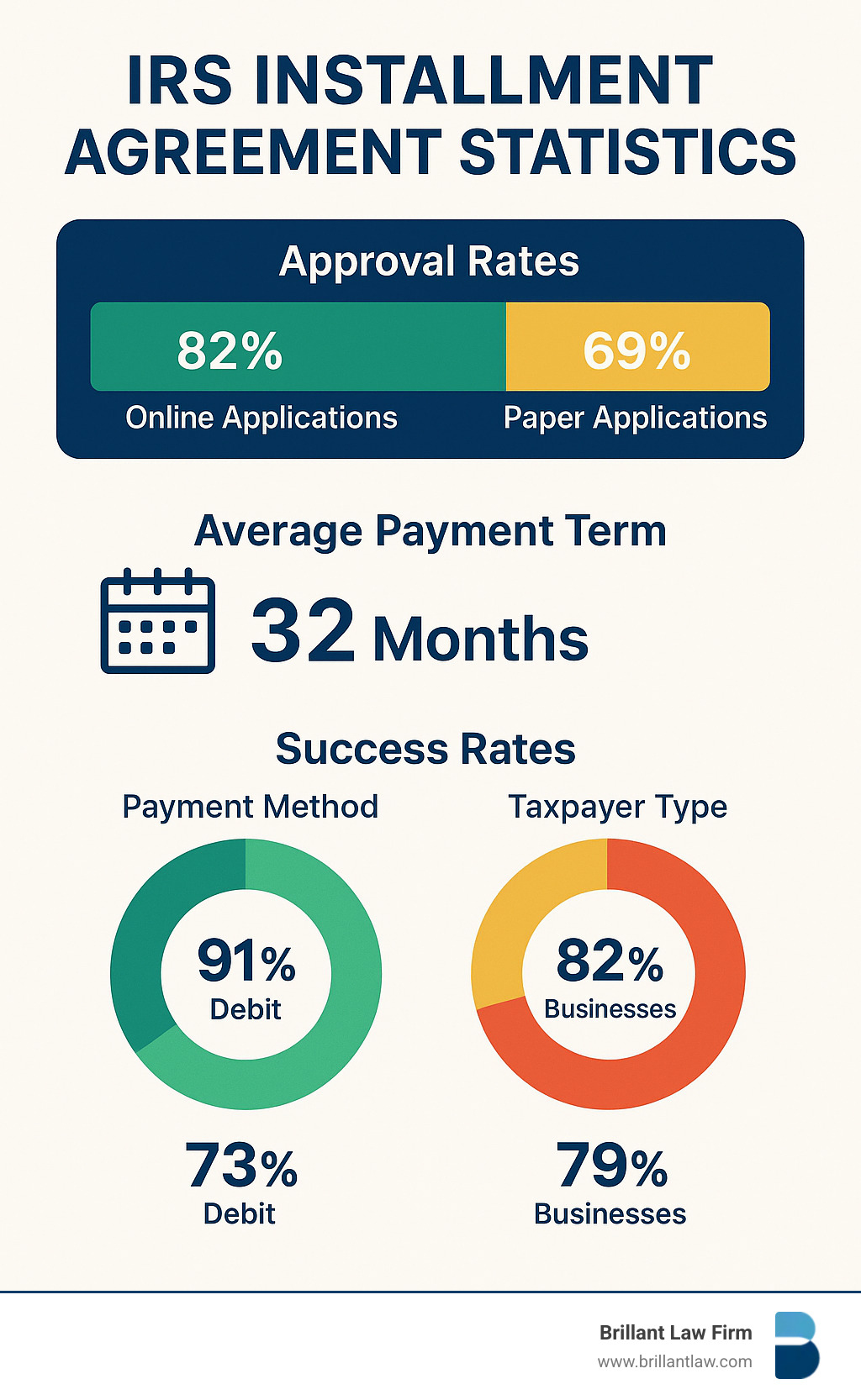
Conclusion
Navigating an IRS installment agreement doesn’t have to be overwhelming when you understand the process and requirements. The key takeaways for California taxpayers are:
Act Quickly: The sooner you address your tax debt, the more options you’ll have available. Interest and penalties continue to accrue, making delay costly.
Choose the Right Plan: Whether it’s a short-term payment plan or a long-term installment agreement, selecting the right option for your financial situation is crucial for success.
Maintain Compliance: Once you have an agreement, staying current on payments and future tax obligations is essential to avoid default.
Consider Professional Help: For significant tax debts or complex situations, the investment in professional guidance often pays for itself through better outcomes and asset protection.
At Brillant Law Firm, we’ve helped numerous California clients successfully steer IRS installment agreements and develop comprehensive tax debt resolution strategies. Our approach combines deep technical knowledge with practical experience to create bespoke solutions custom to each client’s unique situation.
Whether you’re dealing with personal income tax debt, business tax obligations, or complex multi-year issues, we’re here to help you find the best path forward. Our unparalleled expertise in taxation law, combined with our commitment to excellence, ensures that you receive ironclad strategies designed specifically for your circumstances.
Don’t let tax debt control your financial future. With the right strategy and professional guidance, you can resolve your IRS obligations while protecting your assets and maintaining your peace of mind.
More info about our California taxation lawyers
Remember: This article provides general information about IRS installment agreements but doesn’t constitute legal advice. Tax situations are highly individual, and the best approach depends on your specific circumstances. We recommend consulting with a qualified tax professional to develop a strategy custom to your situation.


