

IRS audit reconsideration: 7 Powerful Tips for Success 2025
Understanding Your Second Chance with the IRS
IRS audit reconsideration is a process that allows you to dispute tax assessments from a previous audit when you have new information or believe the IRS made an error. This is your opportunity for a “do-over” with the IRS when you disagree with audit results.
Quick Answer: What is IRS Audit Reconsideration?
An IRS audit reconsideration is a procedure that:
* Allows you to challenge completed audit results
* Requires new information not previously considered
* Can reduce or eliminate additional tax assessed
* Temporarily pauses collection activities
* Does not require a special form (though Form 12661 is recommended)
* Can be requested any time after assessment if tax remains unpaid
The IRS audit reconsideration process exists because the agency recognizes that sometimes things go wrong. Perhaps you moved and never received the audit notice. Maybe you finded new documentation after the audit concluded. Or perhaps the IRS made a computational error when calculating your tax liability.
Unlike formal appeals that must be filed within strict deadlines, reconsideration requests can be submitted any time after an assessment as long as the tax remains unpaid. This flexibility makes it a valuable option for taxpayers who missed their chance to dispute findings during the original audit.
What makes this process especially powerful? The IRS will typically suspend collection actions while reviewing your reconsideration request. This means no wage garnishments, bank levies, or other aggressive collection tactics while your case is being reconsidered.
I’m David Brillant, a Certified Specialist in Estate Planning, Trust and Probate Law with extensive experience handling complex IRS audit reconsideration cases throughout California, helping clients successfully challenge unfavorable audit determinations and reduce or eliminate assessed tax liabilities.
What Is IRS Audit Reconsideration?
IRS audit reconsideration gives you a second chance when you believe the IRS got it wrong. It’s the formal process that allows the IRS to take another look at a completed audit where they assessed additional tax that remains unpaid or reversed tax credits you believe you deserve.
This lifeline for taxpayers is authorized under Internal Revenue Code §6404(a), which empowers the IRS to remove assessments that are excessive, incorrect, or made after the statute of limitations expired. Think of it as the tax version of “let’s take another look at this.”
“I often explain audit reconsideration as the IRS’s version of a ‘motion for a new trial,'” says David Brillant of Brillant Law Firm. “It’s your opportunity to present your case with fresh evidence that wasn’t considered during the original audit.”

The IRS outlines this process in Publication 3598, “What You Should Know About The Audit Reconsideration Process”, which serves as your roadmap. At its heart, the process ensures you pay only what you actually owe—nothing more, nothing less.
You can request reconsideration for several types of IRS determinations:
– Traditional audits (whether conducted by mail or in person)
– Substitute for Return (SFR) cases where the IRS filed a return on your behalf
– Automated Underreporter assessments (those CP2000 notices)
– Simple computational or processing errors made by the IRS
Form 4549, “Income Tax Examination Changes,” details the adjustments from your original audit and will be your starting point for identifying which items you want to dispute.
IRS Audit Reconsideration Criteria
Not everyone qualifies for this second chance. The IRS will only consider your request if you meet all of these requirements:
You must have filed a tax return for the year in question. If you never filed, you can submit an original return to replace any SFR the IRS prepared.
The tax assessment must remain unpaid. If you’ve already paid in full, you’ll need to file a claim for refund using Form 1040X instead.
You need to clearly identify which specific items you’re disputing. Vague complaints won’t get you far—be precise about what you believe is wrong.
You must provide new information that wasn’t available or considered during the original audit. This is non-negotiable—the IRS won’t reconsider the same evidence twice.
You should demonstrate how the IRS made an error in their calculations or processing, if that’s part of your claim.
For California taxpayers, these requirements apply regardless of which IRS office handles your case. The process works the same nationwide, though you might see different response times depending on your location.
IRS Audit Reconsideration vs. Amended Return vs. Appeal
These three processes serve different purposes, and using the wrong one can cost you valuable time:
| Process | Purpose | Timeline | Key Form | When to Use |
|---|---|---|---|---|
| Audit Reconsideration | Review audit results with new information | Any time after assessment if unpaid | No specific form (Letter + Form 12661 recommended) | When you have new evidence after audit completion |
| Amended Return | Correct errors on an original return | Generally within 3 years of filing | Form 1040X | When you find errors on your filed return |
| Administrative Appeal | Challenge audit findings before they’re final | 30 days from examination report | Protest letter or Form 12203 | During the audit process, before assessment is final |
“The most common mistake I see California taxpayers make is confusing these processes,” explains Brillant. “If you’ve already been audited and assessed additional tax, simply filing Form 1040X won’t trigger reconsideration. You need a formal reconsideration request that clearly explains what you’re disputing and why.”
When the stakes are high or your tax situation is complex, consulting with an IRS Audit Attorney can help determine which approach makes the most sense for your situation. The right process can mean the difference between success and disappointment.
Eligibility: Who Can & Cannot Request
Not everyone qualifies for an IRS audit reconsideration. Before you invest time preparing your request, let’s make sure you’re eligible for this second chance with the tax authorities.
You CAN request audit reconsideration if you find yourself in any of these common situations:
You missed your original audit appointment because life got in the way—perhaps you were dealing with an illness, traveling out of town, or simply weren’t aware the IRS wanted to meet with you. It happens more often than you might think.
Maybe you moved houses during the audit period and the IRS notices never caught up with you. While the IRS is required to send correspondence to your “last known address,” anyone who’s relocated knows mail forwarding isn’t foolproof.
Having new information that wasn’t available during the original audit is actually the most frequent scenario we encounter at Brillant Law Firm. Perhaps you finally found those missing receipts in a forgotten folder, or your accountant finded documentation that changes everything.
You can also request reconsideration if you’ve identified a computational error in the IRS’s math. Even the nation’s tax authority occasionally makes calculation mistakes.
I remember helping a client from Walnut Creek who received a shocking $47,000 tax bill out of nowhere. She had moved twice during the audit period and never saw a single IRS notice. We filed for reconsideration, documenting both her relocations and providing evidence supporting the deductions the IRS had disallowed. The result? Her tax bill shrunk by more than 80%—a life-changing difference.
However, you CANNOT request audit reconsideration in several important situations:
If you’ve already paid the tax in full, reconsideration isn’t available to you. Instead, you’ll need to file a claim for refund using Form 1040X.
Signing a closing agreement (Form 906 or 870-AD) essentially closes the door on reconsideration. These are binding contracts where you’ve waived your right to dispute the issues covered.
When a U.S. Tax Court or other court has issued a final determination on your tax matter, their decision trumps the reconsideration process.
For assessments involving TEFRA partnership issues, separate procedures apply under partnership audit rules.
When IRS Audit Reconsideration Is Denied
Even if you appear eligible, the IRS might still deny your request for several reasons:
Full payment closes the door on reconsideration—if you’ve paid everything, you’ll need to pursue a refund claim instead.
Those signed closing agreements (Forms 906 and 870-AD) are serious business—they’re binding contracts that waive your right to further dispute.
The IRS has no patience for frivolous claims, such as constitutional challenges to the tax system. These get rejected immediately.
If you’re simply recycling the same documentation the IRS already reviewed without adding anything new, expect a denial. New information is essential.
“I remember a client from San Miguel who was adamant about pursuing reconsideration despite having signed Form 870-AD,” shares David Brillant. “We had to explain that his agreement had essentially closed that path. Instead, we guided him toward an Offer in Compromise based on doubt as to liability—a much more appropriate option for his situation.”
Time Limits & Common Filing Errors
Unlike many IRS procedures, there’s no specific deadline for requesting audit reconsideration. You can file your request any time after an assessment, as long as the tax remains unpaid. But procrastination comes with serious downsides:
Interest and penalties continue piling up while you prepare your request. The IRS’s 10-year collection statute keeps ticking away. And frankly, documentation becomes harder to track down the longer you wait.
Avoid these common filing mistakes that can derail your reconsideration request:
Resubmitting old documentation the IRS already considered won’t help your case—you need new evidence.
Unsigned returns are invalid in the eyes of the IRS—always double-check your signature.
When filing a late original return to replace an SFR, explain why it was late in the first place.
Vague objections won’t get you anywhere—identify exactly which items you’re disputing and why.
Never send original documents to the IRS—they might not find their way back to you. Always submit copies.
Step-By-Step Process to File Your Request
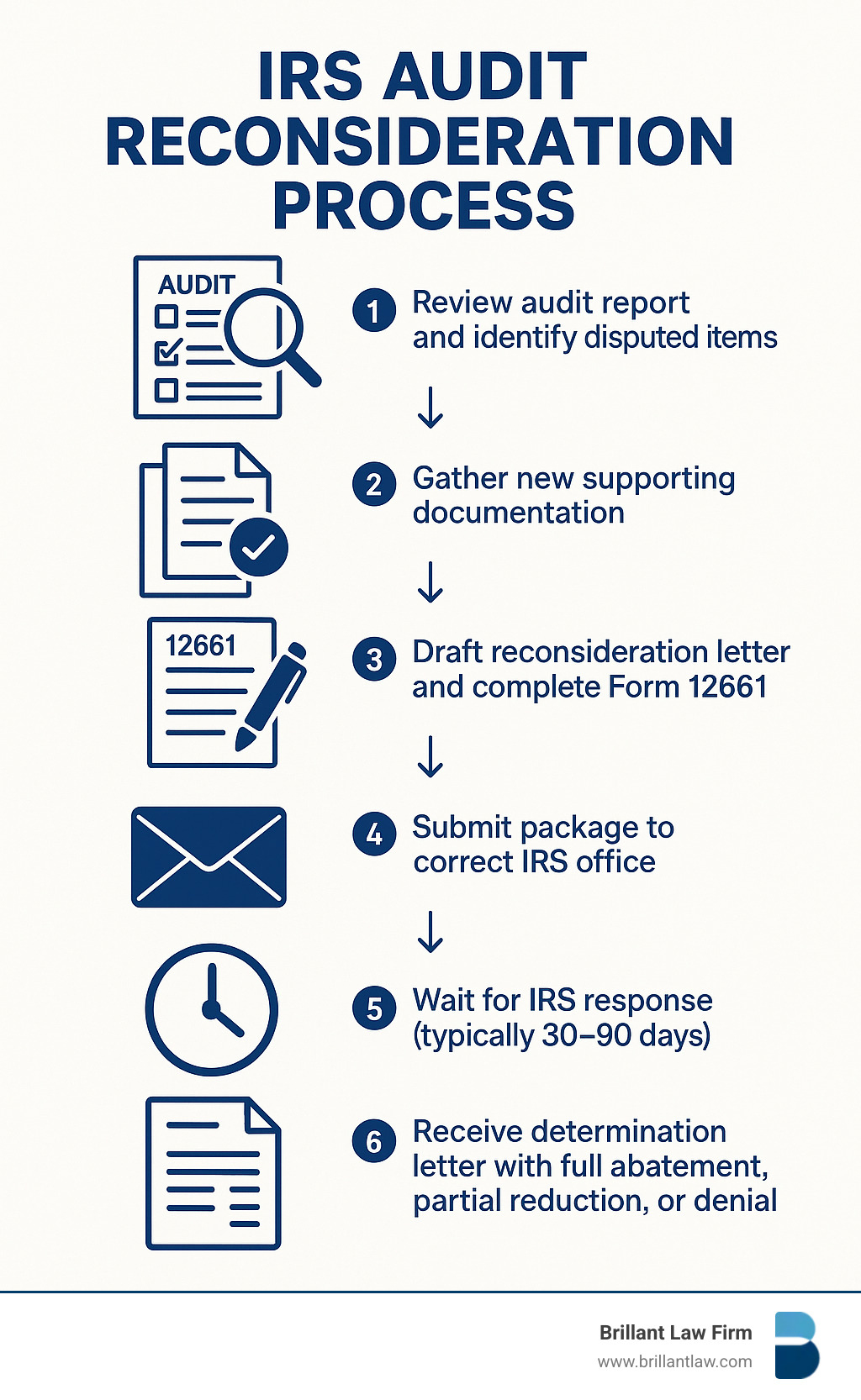
Ready to tackle your IRS audit reconsideration? Think of this process as preparing a compelling case to convince the IRS they got it wrong. Let’s walk through how to build your strongest argument:
First, gather all your ammunition. You’ll need your examination report (Form 4549), any IRS notices about the audit, your new supporting documentation, and a copy of the tax return in question. This creates the foundation for your case.
Next, craft a clear letter that tells your story. Include your name, address, and taxpayer identification number so the IRS knows exactly who you are. Specify which tax years you’re disputing and clearly state that you’re requesting audit reconsideration. The most important parts? Detailing exactly which items you’re disputing and explaining why this information wasn’t available during the original audit. Don’t forget to include your phone numbers so the IRS can reach you if needed.
“A well-organized reconsideration request can make all the difference,” explains David Brillant. “I’ve seen cases where the same facts led to completely different outcomes, simply because one taxpayer presented their case clearly while another submitted a disorganized jumble of papers.”
While not technically required, completing Form 12661 (Disputed Issue Verification) will help organize your case by specific issues. Think of it as creating a roadmap that makes it easy for the IRS examiner to follow your reasoning.
When submitting documentation, remember this golden rule: never send originals. The IRS may not return them, and you’ll be left without your precious evidence. Instead, send clearly labeled copies and explain how each document supports your case. Label each page with your TIN and tax year to prevent anything from getting misplaced in the IRS shuffle.
You can submit your package via fax or certified mail. While both are acceptable, certified mail provides better proof of submission—something that could prove invaluable if your request gets lost in the system. Whatever method you choose, keep proof of delivery through tracking numbers, certified mail receipts, or fax confirmation sheets.
One often-overlooked tip: if you’re on an installment agreement, continue making your payments even though collections may be suspended during reconsideration. This demonstrates good faith and prevents additional issues if your request is ultimately denied.
For California taxpayers facing complex tax situations, consulting with a California IRS Tax Attorney can provide peace of mind and potentially improve your chances of success.
Documentation Checklist for IRS Audit Reconsideration
The strength of your reconsideration request often comes down to your supporting evidence. Think of documentation as the building blocks of your case—each piece works together to create a solid foundation.
Your most important document is Form 4549 (Income Tax Examination Changes), which shows what the IRS adjusted in the original audit. This serves as your roadmap for what needs to be addressed. Beyond that, you’ll need evidence specific to your disputed items.
For income discrepancies, gather your Forms 1099, W-2, and other income statements. Disputing expenses or deductions? Round up those receipts and invoices. Bank statements can verify deposits, payments, or transfers in question, while mileage logs support business vehicle expense disputes.

“What happens if you can’t find your original documents?” asks Brillant. “Don’t panic. You can often reconstruct records using other evidence.” One of our clients from Berkeley had lost receipts for business equipment purchases during a flood. We helped him reconstruct proof using credit card statements, vendor emails, and photographs of the equipment in use. The IRS accepted this evidence and reduced his assessment by over $12,000.
Organization makes a tremendous difference. Consider creating a three-ring binder with tabbed sections for each disputed item, making it easy for the IRS examiner to review your evidence. This small step can significantly impact how your case is perceived.
Where & How to Submit in California
For California taxpayers, knowing where to send your reconsideration request is crucial for timely processing. Generally, you should submit your request to the IRS office that conducted the original audit or issued the examination report. This address typically appears on your examination report or other IRS correspondence.
If you can’t determine the appropriate office, California residents can submit their request to:
Internal Revenue Service
Attn: Audit Reconsideration
Stop 5501
P.O. Box 9941
Ogden, UT 84409
Need to fax instead? Contact the IRS at 1-877-477-9602 to get the secure fax number for your specific situation.
Whatever submission method you choose, always keep proof. For mailed documents, use certified mail with return receipt requested. If faxing, save the confirmation page showing successful transmission. These simple steps can save tremendous headaches if questions arise about whether or when you submitted your request.
What Happens After You File? Timeline & Outcomes
After dropping your reconsideration request in the mail or hitting the fax send button, the waiting game begins. Here’s what typically happens:
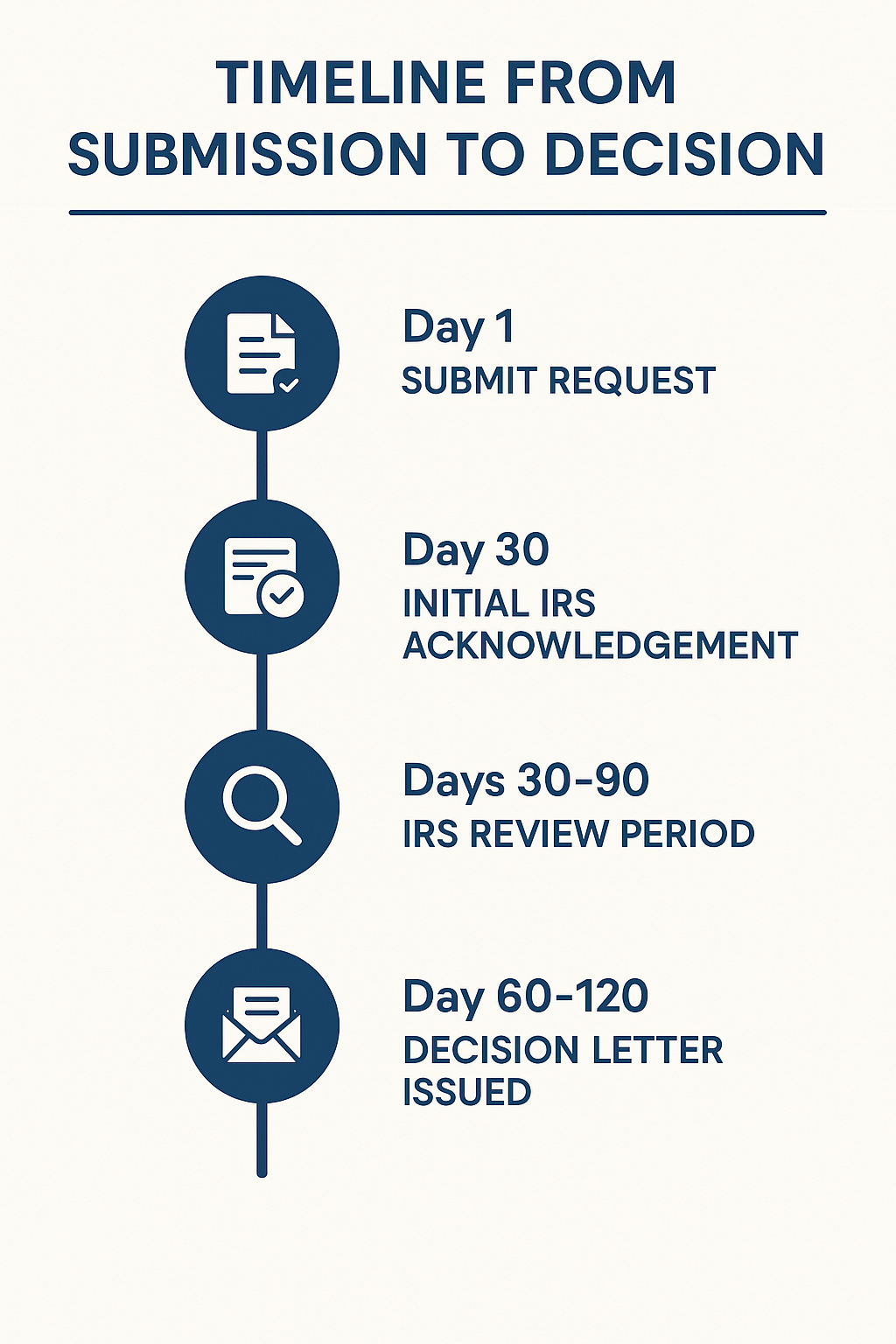
Within about 30 days, you should receive an acknowledgment letter confirming the IRS received your request. This starts the review process, which generally takes 60-90 days, though complex cases can stretch much longer.
During this review period, the IRS might contact you requesting additional information or clarification on certain points. Be ready to respond promptly—delays on your part can extend the process unnecessarily.
Eventually, you’ll receive a determination letter with one of three outcomes: full abatement (the entire additional tax is removed), partial abatement (some adjustments accepted, others maintained), or no change (original assessment upheld).
“The waiting period can be nerve-wracking,” admits Brillant. “We had a client from San Ramon whose reconsideration took nearly eight months. The delay was frustrating, but the outcome—a complete reversal of a $47,000 assessment—made the wait worthwhile. Sometimes the IRS moves at its own pace, especially with complex cases.”
Throughout this process, collections typically remain suspended. If your request is granted, this suspension continues while adjustments are processed. If denied, however, collection activities may resume quickly—so be prepared with a backup plan for addressing any remaining tax debt.
Your Rights & Next Moves
Navigating the IRS audit reconsideration process doesn’t mean you’re at the mercy of the system. You have specific rights and options available to you every step of the way.
The Taxpayer Bill of Rights isn’t just a fancy document – it’s your shield and roadmap. These ten fundamental rights ensure you’re treated fairly throughout your interactions with the IRS:
Your right to be informed means no surprises – the IRS must explain decisions clearly. Your right to quality service guarantees professional, prompt assistance. When you’re fighting to pay no more than the correct amount of tax, you’re standing on solid legal ground. Perhaps most importantly for reconsideration cases, your right to challenge the IRS’s position and be heard is the very foundation of this process.
“Many of my California clients are surprised to learn just how many rights they actually have,” says David Brillant. “The reconsideration process exists precisely because the IRS acknowledges that both taxpayers and the agency itself can make mistakes.”

Feeling overwhelmed? You don’t have to face the IRS alone. The Taxpayer Advocate Service (TAS) serves as an independent organization within the IRS that helps resolve problems when standard channels aren’t working. For those with limited financial resources, Low Income Taxpayer Clinics provide representation and guidance – a lifeline when navigating complex tax matters.
If You Agree or Disagree with the Reconsideration Results
Once the IRS makes its decision on your reconsideration request, the ball is back in your court.
If you agree with their findings, your path is straightforward: sign any consent forms they provide, pay whatever balance remains (if any), and close this chapter of your tax life. Simple enough.
If you disagree, you still have several powerful options:
You can request an Appeals conference by writing to the address on your determination letter. “Appeals officers often have more flexibility to negotiate than the original examiner,” Brillant explains. “I’ve seen cases transform dramatically at this stage, with much more favorable outcomes for our clients.”
Another approach is to pay the disputed amount and then file Form 1040X to claim a refund. This strategy shifts the dynamic from defense to offense – now the IRS must justify denying your refund.
For more serious disputes, you might consider petitioning the U.S. Tax Court, especially if you’ve received a statutory notice of deficiency. This formal legal challenge requires careful preparation but provides an independent forum for your case.
When facing complex disputes or significant amounts, many California taxpayers find value in professional guidance. Our team at Brillant Law Firm specializes in IRS Tax Debt Resolution and can help steer these challenging waters.
Payment Options If a Balance Remains
Even after a successful reconsideration, you might still owe some tax. Thankfully, you have several payment options that can make this burden more manageable.
Installment Agreements allow you to pay over time in monthly amounts you can afford. For balances under $50,000, you can even apply online. Setup fees range from $31 to $225 depending on your application method, though low-income taxpayers may qualify for reduced fees or waivers. Just remember that interest and penalties continue to accrue while you’re paying.
The Electronic Federal Tax Payment System (EFTPS) provides a free, secure way to make payments online or by phone. You’ll need to enroll first, but once set up, it’s a convenient option for many California taxpayers.
Credit and debit card payments offer immediate satisfaction but come with convenience fees (typically 1.87% to 1.99%) charged by the payment processors, not the IRS.
For those facing genuine financial hardship, an Offer in Compromise might be worth exploring. This program allows you to settle your tax debt for less than the full amount. “The high cost of living in the Bay Area and throughout California can actually work in your favor when demonstrating financial hardship,” notes Brillant. “We’ve helped clients reduce their tax debts significantly through this program.”
If you’re experiencing severe financial difficulties, you might qualify for a Temporary Delay of Collection based on economic hardship. This temporarily halts collection actions while you get back on your feet, though interest and penalties continue to accumulate.
Addressing your tax issues proactively almost always leads to better outcomes. Whether you’re just beginning the reconsideration process or dealing with the aftermath, understanding your rights and options empowers you to make informed decisions about your financial future.
IRS Audit Reconsideration: Pro Tips & Common Pitfalls
After helping hundreds of California taxpayers steer the IRS audit reconsideration process, I’ve noticed certain strategies that consistently lead to better outcomes. Let me share some insider wisdom that could make all the difference in your case.
The most successful reconsideration requests aren’t just about having the right documentation—they’re about presentation and approach. Think of yourself as telling a clear, evidence-based story to the IRS examiner who will review your case.
Always submit photocopies, never originals. I’ve seen heartbreaking situations where irreplaceable documents were lost in the IRS bureaucracy. One client from San Francisco sent original wedding receipts from 1982 to prove basis in property—documents she never saw again.
Number and clearly identify each disputed item. IRS examiners appreciate organization. When we represented a restaurant owner from Oakland, we created a simple numbering system that matched each disputed deduction with its supporting documentation. The examiner called it “the most organized reconsideration package I’ve seen all year.”
“The IRS responds to clarity and precision,” explains David Brillant. “When you make the examiner’s job easier, you dramatically improve your chances of success.”
Consider using the Freedom of Information Act (FOIA) to obtain your audit file before preparing your reconsideration request. This reveals exactly what the IRS already has and—more importantly—what they’re missing. This strategy helped one of our Walnut Creek clients find the IRS had completely overlooked a crucial 1099-R form that proved his pension distribution was properly reported.
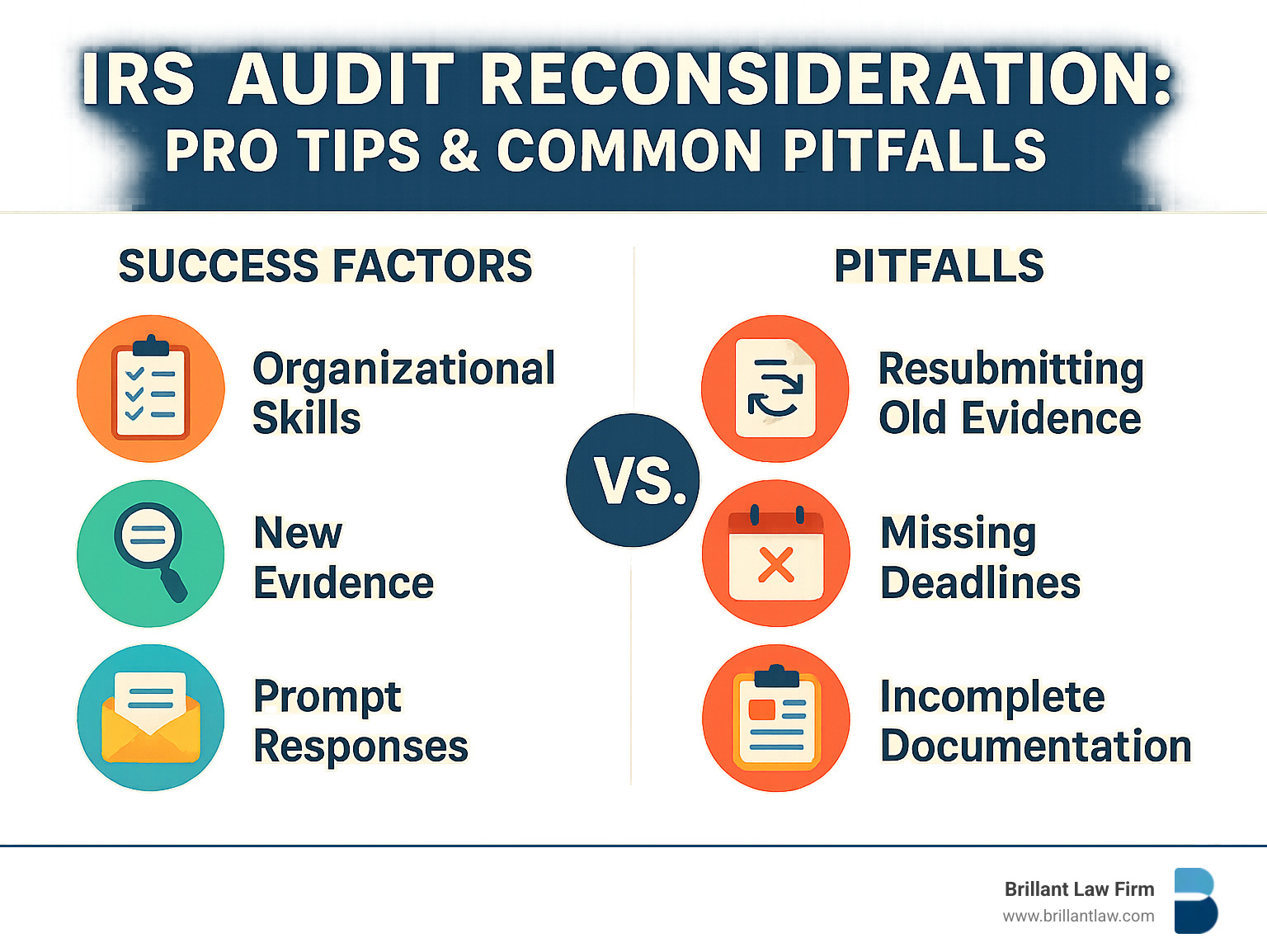
Track every submission with delivery confirmation. The IRS processes millions of documents annually, and things occasionally fall through the cracks. When you can prove exactly when and where you sent something, you have recourse if your submission goes missing.
While your reconsideration is pending, continue making any agreed payments. This demonstrates good faith and prevents additional penalties if your reconsideration is denied. You can always request a refund later if the decision is in your favor.
For particularly complex cases or substantial amounts, consulting with our IRS Tax Relief Attorneys can provide peace of mind and strategic advantages.
Top Mistakes That Trigger Rejection
I’ve seen countless reconsideration requests rejected for entirely preventable reasons. Here are the most common pitfalls to avoid:
Providing no new evidence is perhaps the biggest mistake. The entire premise of reconsideration is that you have information the IRS didn’t previously consider. One client insisted on requesting reconsideration using exactly the same documentation the IRS had already rejected—predictably, his request was denied again.
Missing signatures might seem minor, but in tax administration, an unsigned document might as well not exist. Always double-check that you’ve signed every return, form, and declaration.
Ignoring IRS follow-up requests is a fast track to denial. The IRS often requests additional information during reconsideration review. When a Berkeley client failed to respond to such a request within 30 days, her entire case was closed unfavorably—despite having strong documentation.
“The IRS actually wants to get it right,” Brillant notes with a smile. “But they can’t consider what you don’t show them, and they won’t wait forever for you to respond.”
Filing reconsideration after full payment is a procedural error. Once you’ve paid in full, you must use the refund claim process instead of reconsideration. The good news? You can still dispute the assessment—you just need to use the correct procedure.
Submitting frivolous arguments not only fails but can result in additional penalties. Constitutional challenges to the tax system are routinely rejected and may flag your file for extra scrutiny.
Case Study: How a Californian Freelancer Got $15K Abated
Maria, a freelance graphic designer from Walnut Creek, came to us in tears. She’d received a CP2000 notice assessing an additional $15,000 in taxes, penalties, and interest. The IRS claimed she had unreported income from several clients.
“I reported every penny!” she insisted, spreading her tax documents across my desk. “I just don’t understand where they’re getting these numbers.”
After reviewing her situation, we finded the problem: Maria had correctly reported all her income, but had categorized some payments differently than her clients had reported on their 1099 forms. This discrepancy triggered automated matching flags in the IRS system.
We helped Maria prepare a detailed reconsideration request that included:
- A carefully completed Form 12661 identifying each disputed item
- A color-coded spreadsheet reconciling her reported income with the 1099 forms
- Bank statements showing that deposits matched her reported income
- A clear explanation of how each item was reported on her original return
“What we did wasn’t magic,” Brillant explains. “We simply organized Maria’s information in a way that made it impossible for the IRS to miss the connection between what was reported and what was earned.”
The result? The IRS fully abated the $15,000 assessment within 75 days. Maria later told us the relief she felt was “like having a boulder lifted off my chest.”
The key takeaway from Maria’s case is that organization and clarity matter as much as having the right documentation. By making it easy for the IRS to verify her position, Maria turned what could have been a financial disaster into a complete victory.
Frequently Asked Questions about IRS Audit Reconsideration
How long does IRS audit reconsideration take?
When you submit an IRS audit reconsideration request, the waiting game begins. Most cases take between 60-90 days from submission to decision, though I’ve seen complex cases stretch longer. You should receive an initial acknowledgment letter within about 30 days, which at least confirms your paperwork didn’t disappear into the void.
“In our experience with California clients, reconsiderations submitted to the Ogden campus tend to move a bit faster than those sent to other locations,” I’ve observed over the years. “But patience is essential regardless of where your case is processed.”
If that 60-day mark comes and goes with no word, it’s perfectly reasonable to pick up the phone and politely inquire about your case status. Sometimes a gentle nudge is all it takes to move things along.
Does an IRS audit reconsideration stop wage levies and liens?
One of the most immediate benefits of filing for reconsideration is the breathing room it provides. Yes, in most cases, when the IRS accepts your reconsideration request, they’ll put collection actions on pause—including those dreaded wage levies, bank levies, and new liens.
But here’s the important part: this collection suspension isn’t automatic. You should explicitly request it in your reconsideration letter. Think of it as saying, “While we figure this out, please stop trying to collect.”
A few important things to know:
* Existing liens typically stay in place until your case is resolved (think of them as a “just in case” measure for the IRS)
* If your request gets denied, the collection machinery can restart immediately
* If the IRS believes you’re simply filing to delay payment without merit, they may continue collection anyway
One client called me in a panic when a levy notice arrived just days after submitting his reconsideration request. We quickly contacted the revenue officer to confirm the reconsideration was in process, and they agreed to suspend the levy while the case was reviewed.
Is there a specific IRS form for audit reconsideration requests?
Interestingly, there’s no mandatory form specifically designed for audit reconsideration requests. The process starts with a well-crafted letter that includes:
- Your name, address, and taxpayer identification number
- The tax year(s) you’re disputing
- A clear statement that you’re requesting audit reconsideration
- Specific items you’re contesting and why
- An explanation of why you couldn’t provide this information during the original audit
That said, the IRS does recommend using Form 12661 (Disputed Issue Verification) to outline the issues you’re contesting. Think of it as the difference between handing someone a neatly organized folder versus a stack of loose papers.
“While Form 12661 isn’t mandatory, we almost always include it with our clients’ reconsideration requests,” I often tell new clients. “It helps organize the information in exactly the format IRS examiners prefer, which can expedite the process.”
The form provides a structured way to present each disputed item separately, making it easier for the IRS examiner to follow your arguments and evidence. When an examiner can easily steer your submission, you’re already ahead of the game.
Conclusion
Taking on the IRS audit reconsideration process might feel like climbing a mountain, but I’ve seen how this powerful tool can transform seemingly hopeless tax situations into manageable ones. The beauty of this process isn’t about arguing the same points again—it’s about bringing new information to light that changes your tax story.
At Brillant Law Firm, we’ve walked alongside countless California taxpayers through this journey, helping them slash assessments that once seemed set in stone. From San Francisco entrepreneurs to Los Angeles professionals, our experience shows that success hinges on three things: attention to detail, rock-solid documentation, and strategic presentation.
If you take nothing else away from this guide, remember these essentials:
Reconsideration remains available to you anytime after assessment, as long as you haven’t paid in full. The IRS typically puts collection activities on pause while reviewing your case (giving you much-needed breathing room). And even if you achieve only partial success, the tax savings can be substantial.
What makes reconsideration particularly valuable is its flexibility. Unlike the strict 30-day window for formal appeals, this process gives you time to gather compelling evidence. I remember helping a Berkeley client who finded critical documentation in storage months after her audit concluded—we used reconsideration to reduce her assessment by over 60%.
For California taxpayers facing the particularly complex tax environment of our state, having experienced guidance can make all the difference. Our team of Taxation Lawyers understands the unique challenges you face, whether you’re in Oakland, San Jose, or anywhere else across the Golden State.
Don’t let an unfavorable audit be the final chapter in your tax story. With thoughtful preparation and the right approach to audit reconsideration, you can set the record straight and move forward with confidence—no accounting degree required.
This process isn’t about outsmarting the IRS; it’s about working within their system to ensure you pay only what you truly owe—nothing more, nothing less. And in my decades of practice, I’ve found that’s something both taxpayers and the IRS can agree is the right outcome.


