

IRS Appeals Attorney: 7 Powerful Ways to Protect Your Wallet
When the IRS Comes Knocking: Understanding Your Appeal Rights
An IRS appeals attorney is a tax law specialist who represents taxpayers in disputes with the IRS through the agency’s administrative appeals process. These professionals can help reduce or eliminate tax assessments, penalties, and interest charges while preventing costly litigation.
Quick Facts About IRS Appeals Attorneys:
– What they do: Represent taxpayers before the IRS Independent Office of Appeals
– When to hire one: After receiving an unfavorable audit, collection action, or tax decision
– Typical results: Average 40% reduction in tax, penalties, and interest for approved appeals
– Timeframe: Must file within 30 days of receiving IRS letter offering appeal rights
– Cost range: $400-$900/hour in California with retainers typically $5,000-$25,000
When the IRS takes an adverse position on your tax situation, it can feel like David facing Goliath. Whether you’ve received an audit determination letter, a collection notice, or a denied offer in compromise, you have the right to appeal—but the clock is ticking. Surprisingly, fewer than 10% of audited taxpayers pursue an appeal, despite the fact that successful appeals can reduce tax liabilities by an average of 40%.
The IRS Independent Office of Appeals was specifically created to provide taxpayers with a fair and impartial venue to resolve tax disputes without litigation. Appeals officers are not measured by how much tax they collect, making them more likely to consider the nuances of your case and often soften the rigid findings of an initial audit.
However, navigating the appeals process requires understanding complex tax regulations, strict deadlines, and strategic presentation of your case. Missing a deadline or failing to properly structure your appeal can forfeit your rights entirely.
I’m David Brillant, a Certified Specialist in Estate Planning, Trust and Probate Law with a Masters in Taxation who has spent years representing clients before the IRS Appeals Office as an IRS appeals attorney, specializing in resolving complex tax controversies that other attorneys often consider unsolvable.
Explore more about IRS appeals attorney:
– IRS audit reconsideration
– IRS installment agreement
Why This Guide Matters
If you’re a California taxpayer facing an IRS dispute, this guide could be the difference between financial devastation and peace of mind. The stakes are high—unpaid taxes can lead to wage garnishments, bank account levies, and even property seizures. Beyond the financial impact, the stress of dealing with the IRS can take a toll on your mental health, relationships, and business operations.
By understanding how an IRS appeals attorney can steer this complex process, you’ll gain:
- Peace of mind knowing that a professional is handling your case
- Potential savings of thousands (or even millions) in tax liabilities
- Protection from aggressive collection actions
- A strategic approach that considers the “hazards of litigation”
- Time to organize your finances while the appeal is pending
The IRS Appeals System 101: What, Why & How
Think of the IRS Independent Office of Appeals as your tax dispute mediator – a place where you can contest IRS decisions without the stress and expense of going to court. Created in 1998 and strengthened by the Taxpayer First Act of 2019, this office quietly resolves over 100,000 cases each year, offering a more informal and budget-friendly alternative to litigation.

Your journey through appeals begins when you receive that dreaded IRS letter offering appeal rights – typically a “30-day letter” that gives you exactly that long to request an appeals conference. Don’t miss this window! The good news is that the Appeals Office operates independently from the IRS examiners who made the initial determination about your taxes, ensuring your case gets a fresh look.
What makes the Appeals Office particularly valuable is their consideration of the “hazards of litigation” – a fancy way of saying they evaluate how your case might fare in court. Because of this, they’re often willing to settle for less than the full amount to avoid the uncertainty and expense of going to trial. For taxpayers with strong cases, this creates a significant opportunity to reduce what you owe.
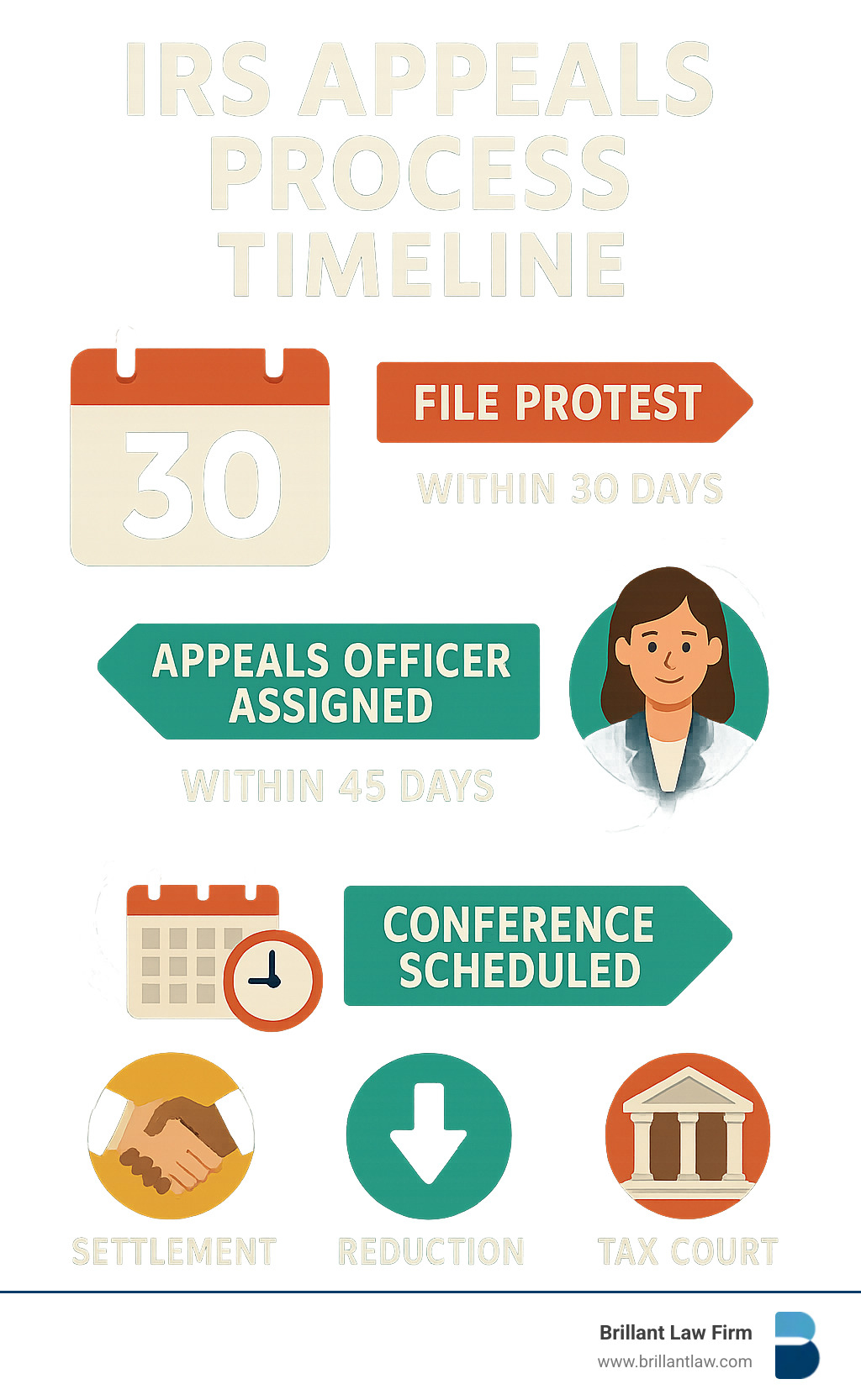
According to the IRS’s own guidance on what to expect from Appeals, your case will typically follow these steps:
- You submit your written protest or small case request
- An Appeals Officer reaches out (usually within about 45 days)
- You participate in a conference (by mail, phone, video, or in-person)
- The Appeals Officer reviews your case and works toward resolution
- If you reach a settlement, you sign an agreement; if not, you receive a statutory notice of deficiency
Just remember – throughout this process, interest continues to accumulate on unpaid balances, making a timely resolution beneficial for your wallet.
Key Reasons to Appeal an IRS Decision
Not every IRS decision deserves an appeal, but many do. Here are compelling grounds that an IRS appeals attorney would identify as worth fighting:
When the IRS has misapplied the law to your situation, you have strong appeal grounds. This happens surprisingly often with complex areas like business expense deductions, passive activity rules, or trust taxation where even IRS agents can misinterpret the tax code.
Appeals based on incorrect facts are also common. Perhaps the IRS missed crucial documentation or misunderstood the nature of a transaction in your business. Your appeal can set the record straight.
Facing collection overreach? If the IRS is taking aggressive collection actions that create genuine economic hardship or violate procedural requirements, an appeal can provide relief.
Had your Offer in Compromise denied despite presenting a fair reflection of your ability to pay? Appeals officers often take a more practical approach than the initial reviewers.
Appeals based solely on moral, religious, political, constitutional, or conscientious grounds won’t get traction. The Appeals Office focuses specifically on disagreements about tax liability or collection actions.
Independent Office vs. U.S. Tax Court vs. CAP/CDP
When disputing an IRS decision, California taxpayers have several forum choices, each with distinct advantages:
| Forum | When to Use | Pros | Cons |
|---|---|---|---|
| IRS Independent Office of Appeals | After audit or before Tax Court | Informal, no filing fee, settlement-focused | No judicial review of decision |
| U.S. Tax Court | After receiving Notice of Deficiency | Judicial review, no prepayment required | More formal, requires petition filing fee |
| Collection Appeals Program (CAP) | For collection actions | Quick resolution (3-5 days) | Decision is binding, no judicial review |
| Collection Due Process (CDP) | Within 30 days of lien/levy notice | Suspends collection, judicial review available | Limited to collection issues |
The IRS appeals attorney approach through the Independent Office of Appeals is typically the most cost-effective starting point. If you can’t reach a satisfactory resolution there, you can still proceed to Tax Court (assuming you’re within the 90-day window after receiving a Notice of Deficiency).
Collection Due Process hearings provide valuable breathing room by automatically suspending collection activity while your case is reviewed. They can address both collection alternatives and, in certain circumstances, underlying liability issues.
The Collection Appeals Program offers a faster resolution for collection disputes but comes with a significant drawback – no judicial review if you disagree with the decision.
Each forum has its place in your tax resolution strategy. An experienced IRS appeals attorney in California can help determine which path gives you the best chance of success based on your specific circumstances.
When Should You Call an IRS Appeals Attorney?

Let’s face it—not every tax disagreement requires bringing in the cavalry. But when the IRS is digging in its heels, knowing when to call an IRS appeals attorney can save you significant headaches (and money).
Most California taxpayers can handle simple matters on their own, but certain situations practically scream for professional help. If you’re facing a proposed adjustment exceeding $25,000, the potential savings from hiring representation typically far outweigh the costs. This is especially true when your dispute centers on legal interpretations rather than simple factual discrepancies—tax law is complex, and an experienced professional knows how to steer its nuances.
When the IRS threatens collection action through liens or levies, your financial stability hangs in the balance. This is no time to go it alone. An IRS appeals attorney can often suspend these actions while your appeal is pending, giving you breathing room to develop a strategy.
Business entities face particularly thorny issues during appeals. Partnerships, S-corporations, and other complex structures must follow additional procedural requirements that can trip up even financially savvy business owners. The technical rules governing these entities require specialized knowledge that an experienced California tax attorney brings to the table.
Time is rarely on your side in tax matters. If you’re approaching the 30-day appeal deadline or the 90-day Tax Court petition deadline, immediate professional help can preserve your rights. Many taxpayers come to us after trying to handle matters themselves without success—which often limits our options and increases costs. Earlier intervention almost always leads to better outcomes.
The distinction between business and individual appeals is worth noting. Business appeals frequently involve complex issues like reasonable compensation determinations, accumulated earnings tax, employee classification disputes, and trust fund recovery penalties. These specialized areas demand the expertise that only an IRS appeals attorney with deep tax law knowledge can provide.
Red Flags That Scream “Hire an IRS Appeals Attorney Now”
Some situations simply demand immediate professional intervention. When facing tax assessments exceeding $100,000, the potential savings from skilled representation almost always justify the cost. These high-stakes cases require strategic approaches that balance technical arguments with practical settlement considerations.
Payroll tax issues, especially Trust Fund Recovery Penalties (TFRP), represent a particularly dangerous area for California business owners. These penalties are assessed personally against responsible individuals and cannot be discharged in bankruptcy. An IRS appeals attorney can help contest responsibility or willfulness determinations, potentially saving you from personal financial ruin.
Complex partnership or S-corporation issues trigger specialized procedural requirements and tax treatments that require expert navigation. The technical rules governing these entities can be overwhelming without professional guidance.
International tax issues raise the stakes even higher. Foreign accounts, overseas income, or international business operations trigger complex reporting requirements with severe penalties for non-compliance. The technical knowledge required to handle these cases effectively is simply beyond most taxpayers’ expertise.
When you have unfiled tax returns complicating your appeal, professional help becomes crucial for developing a comprehensive resolution strategy. Similarly, statute of limitations disputes—where the IRS attempts to assess tax beyond the normal three-year period—require specialized knowledge of exceptions and extensions.
Perhaps most seriously, fraud allegations or suggestions of criminal investigation demand immediate legal representation. The stakes in these situations extend beyond financial penalties to potential criminal liability.
Small Case Request vs. Formal Written Protest
The path your appeal takes depends largely on the amount in dispute. For cases where the additional tax, penalties, and interest total $25,000 or less per tax period, you can use a Small Case Request. This simpler approach uses Form 12203 or a straightforward written statement and requires less formal documentation. However, this option isn’t available for employee plans, exempt organizations, partnerships, or S-corporations.
For disputes exceeding $25,000 per tax period, you’ll need to file a Formal Written Protest. This more rigorous document must include specific elements:
- Your name, address, and identification number
- A clear statement declaring your intent to appeal
- A copy of the letter showing the proposed changes
- Tax periods involved
- An itemized list of each disputed item
- Your reasons for disagreement
- Facts supporting your position
- Applicable law or authority
- A perjury statement and signature
The perjury statement is particularly critical and must read: “Under penalties of perjury, I declare that I have examined the facts stated in this protest, including any accompanying documents, and, to the best of my knowledge and belief, they are true, correct, and complete.”
An IRS appeals attorney ensures your protest meets all requirements while presenting your strongest arguments in the most compelling way. The difference between a well-crafted protest and a hastily assembled one can dramatically affect your outcome.
For more information about related services, visit our IRS audit attorney page to learn how we can help you steer these complex processes with confidence.
Step-By-Step Roadmap for a Successful IRS Appeal
Navigating the IRS appeals process requires careful planning and execution. Here’s a comprehensive roadmap:
Review Your Appeal Rights Letter: Identify the deadline (typically 30 days) and specific instructions.
Decide on Representation: Determine whether to self-represent or hire an IRS appeals attorney.
File Form 2848 (Power of Attorney): If using representation, ensure this form is properly completed and filed.
Submit a FOIA Request: File a Freedom of Information Act request to obtain the auditor’s file, including their workpapers and notes.
Prepare Your Appeal: Draft either a Small Case Request or Formal Written Protest based on the amount in dispute.
Submit Your Appeal: Mail your appeal to the address specified in your IRS letter (not directly to Appeals).
Prepare for the Conference: Organize documents, develop arguments, and anticipate counterarguments.
Participate in the Appeals Conference: Present your case clearly and concisely, focusing on key issues.
Negotiate a Settlement: Be prepared to compromise on certain issues to resolve the case.
Finalize Resolution: Sign settlement documents or prepare for the next steps if no agreement is reached.
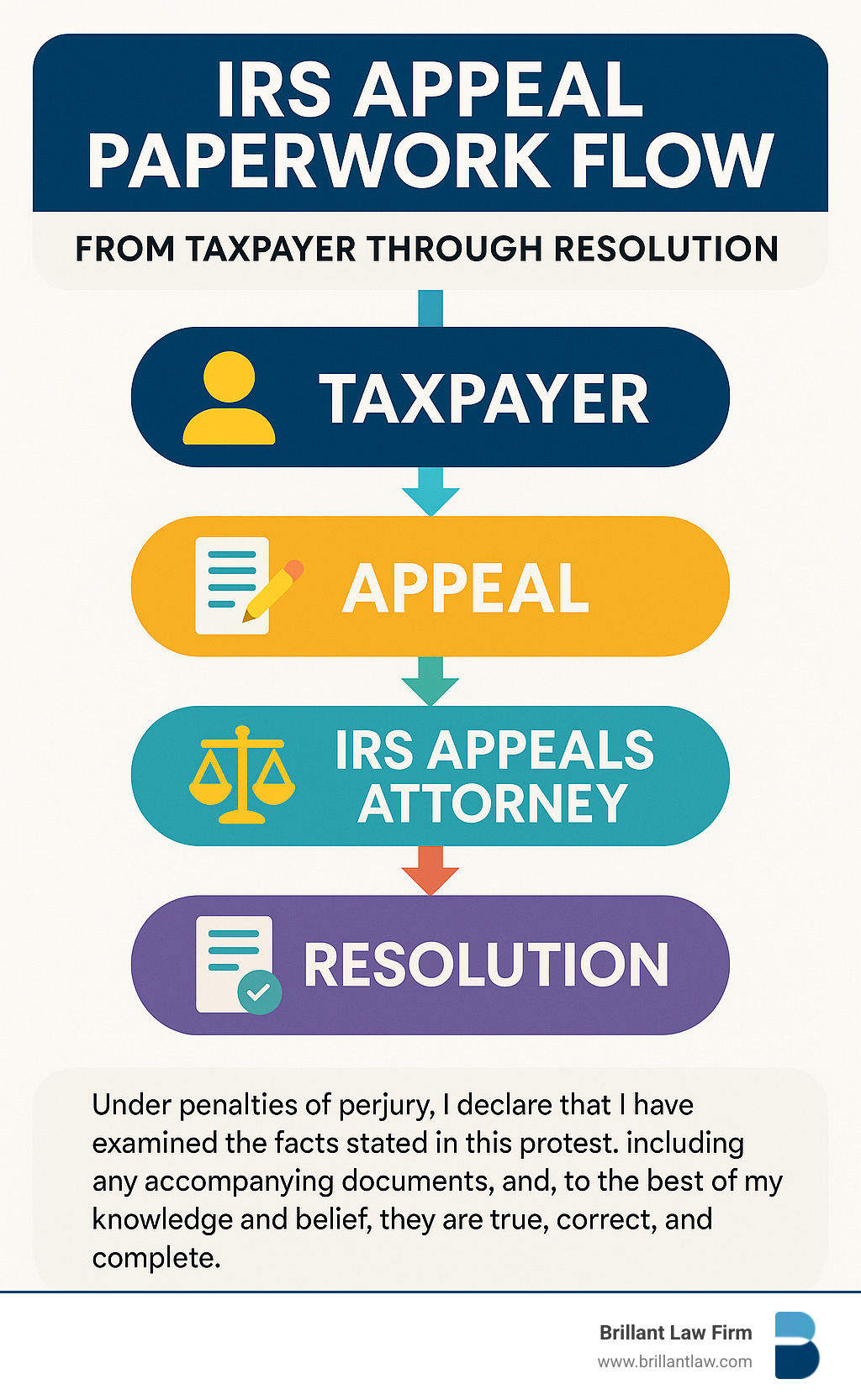
Throughout this process, the Appeals Officer will serve as a neutral party evaluating both the IRS’s position and yours. They have significant settlement authority and are motivated to resolve cases without litigation.
Documents & Evidence the IRS Can’t Ignore
The strength of your appeal largely depends on the quality of your supporting documentation. Here are the types of evidence that can make a compelling case:
Organized Financial Records: Bank statements, receipts, invoices, and payment records that directly contradict the IRS’s findings.
Business Records: Contracts, meeting minutes, business plans, and contemporaneous logs that establish business purpose or intent.
Expert Opinions: Written analyses from industry experts, CPAs, or appraisers that support your position on valuation or technical matters.
Visual Evidence: Charts, graphs, timelines, and photographs that clarify complex transactions or relationships.
Witness Statements: Affidavits from knowledgeable parties that corroborate your version of events.
Legal Precedents: Court cases, IRS rulings, or other authorities that support your interpretation of tax law.
Procedural Documentation: Evidence of IRS errors in following required procedures or timelines.
An IRS appeals attorney knows how to organize these materials for maximum impact and present them in a way that addresses the Appeals Officer’s primary concerns. The goal is to create a clear, compelling narrative supported by irrefutable evidence.
Deadlines California Taxpayers Can’t Miss
Missing deadlines in the IRS appeals process can permanently forfeit your rights. Here are the critical timeframes California taxpayers must observe:
30-Day Protest Window: You generally have 30 days from the date of the IRS letter to file your protest or appeal request.
90-Day Tax Court Petition: If you receive a Notice of Deficiency (90-day letter), you must file a petition with the U.S. Tax Court within 90 days.
30-Day CDP Request: For Collection Due Process hearings, you must file Form 12153 within 30 days of receiving a lien or levy notice.
3-Day CAP Window: After a conference with a Collection manager, you have 3 business days to submit Form 9423 for the Collection Appeals Program.
1-Year Equivalent Hearing: If you miss the 30-day CDP deadline, you can request an Equivalent Hearing within one year, though it doesn’t provide the same collection suspension or judicial review rights.
Interest continues to accrue throughout the appeals process, so timely resolution is in your financial interest. An IRS appeals attorney will ensure all deadlines are met and can often expedite the process through effective communication with the Appeals Office.
How a Skilled IRS Appeals Attorney Builds an Ironclad Case

When you’re facing off against the IRS, the difference between a tax bill that keeps you up at night and one you can live with often comes down to strategy. This isn’t just about paperwork—it’s about crafting a compelling narrative that resonates with Appeals Officers.
A truly effective IRS appeals attorney doesn’t just respond to IRS claims; they reframe the entire conversation. The best attorneys develop a cohesive case theory that ties all elements together into a single, persuasive story. Rather than treating each disputed item as a separate battle, they weave everything into a comprehensive narrative that makes sense of your tax situation.
One significant advantage of working with an attorney rather than an accountant is the protection of attorney-client privilege. When you share information with your IRS appeals attorney, those communications remain confidential—something that can be invaluable when discussing sensitive aspects of your case that you wouldn’t want revealed to the IRS.
“I always tell my clients that preparation is everything,” says David Brillant. “Before we ever sit down with Appeals, we’ve already conducted a thorough hazard analysis—looking at both sides of the case to determine where we’re strong and where we might need to compromise.”
This strategic approach extends to the psychology of negotiation. Skilled attorneys know when to stand firm and when a strategic concession on a minor point can create goodwill that helps resolve major issues. They understand the procedural pathways that allow for escalation to Appeals Team Managers or alternative dispute resolution methods when needed.
Throughout the process, your IRS appeals attorney keeps one eye on the possibility of litigation. Even while working toward settlement, they’re building a record that would support your position in Tax Court if necessary.
Appeals Officers are primarily concerned with the “hazards of litigation”—their assessment of how likely the IRS would be to lose in court and what precedent that might set. An experienced attorney frames every argument in terms that highlight these litigation risks, significantly strengthening your negotiating position.
For taxpayers with particularly complex situations, our firm offers specialized IRS tax relief attorneys who develop comprehensive strategies addressing both immediate appeals and long-term tax planning needs.
Tactics an IRS Appeals Attorney Uses to Tilt the Scales in Your Favor
The magic happens in the details. Your IRS appeals attorney employs specific tactics that can dramatically improve your outcomes.
One of the first steps is obtaining and analyzing the auditor’s file through FOIA requests. This reveals the examiner’s thought process, potential procedural errors, and weaknesses in the IRS’s position. It’s like getting a peek at the other team’s playbook before the big game.
Establishing credibility is essential in appeals work. Your attorney will typically develop what we call a “credibility package”—a professional presentation that demonstrates your history of good faith compliance efforts. This sets the tone for the entire appeal process.
“Sometimes, strategic concessions make all the difference,” explains Brillant. “By acknowledging and conceding minor issues where the IRS clearly has the stronger position, we build credibility that helps us win on the issues that really matter to our clients.”
In cases involving complex legal questions, your attorney might request technical advice from the IRS National Office, effectively elevating difficult interpretations to specialists who can provide authoritative guidance.
For particularly contentious issues, alternative dispute resolution methods like mediation or arbitration might be proposed. These approaches can break deadlocks when traditional negotiations stall.
Complex cases often benefit from being broken into manageable components. Your IRS appeals attorney will identify which issues can be resolved independently, allowing for partial settlements that reduce your overall tax exposure even when complete agreement isn’t possible.
Throughout the process, visual aids and clear summaries help simplify complex transactions or calculations. A well-designed chart or timeline can sometimes communicate more effectively than pages of text, especially when dealing with complicated business structures or transaction sequences.
These tactics require both deep technical knowledge and persuasive advocacy skills—a combination that comes only from years of experience handling IRS appeals cases.
Benefits for California Businesses vs. Individuals
The appeals process offers distinct advantages depending on whether you’re a business owner or individual taxpayer in California.
For California businesses, an effective appeal can protect your operations from disruptive collection actions while resolving fundamental issues like entity classification that might affect multiple tax years. Business owners facing Trust Fund Recovery Penalties—which can personally target officers and owners for unpaid employment taxes—find particular value in skilled representation.
California businesses often face overlapping federal and state tax disputes. Your IRS appeals attorney can coordinate strategies addressing both systems, preventing contradictory positions that could undermine either case. This coordination is especially valuable with California’s notoriously complex sales tax system.
Individual taxpayers in California benefit differently from the appeals process. Your attorney can secure relief from penalties through reasonable cause arguments or access collection alternatives like installment agreements or offers in compromise. For married taxpayers, innocent spouse relief may be available for joint return liabilities.
Protection of personal assets from IRS liens and levies is often a primary concern for individuals. Your IRS appeals attorney can negotiate collection alternatives that protect your home, retirement accounts, and other essential assets.
California residents also frequently face residency disputes affecting both federal and state tax obligations. An experienced attorney can develop consistent positions that work for both tax authorities, preventing you from getting caught between contradictory requirements.
Whether you’re running a business or managing personal finances, the expertise of an IRS appeals attorney can transform what seems like an impossible tax situation into a manageable resolution that lets you move forward with confidence.
Costs, Risks & ROI of Hiring an Appeals Lawyer in California

Let’s talk dollars and sense when it comes to hiring an IRS appeals attorney in California. I know what you’re thinking – lawyers aren’t cheap, especially in the Golden State. But when you’re facing the full force of the IRS, this is one investment that often pays for itself many times over.
In California’s competitive legal market, you can expect to pay premium rates for quality representation:
- Hourly rates typically range from $400 on the low end to $900 for senior specialists with decades of experience
- Most cases require retainers between $5,000 and $25,000 to get started
- Complex business disputes or high-value cases may require larger initial investments
But here’s the reality – successful appeals reduce tax liabilities by an average of 40%. Do the math: if you’re facing a $100,000 assessment and spend $10,000 on quality representation that cuts your liability by 40%, you’ve just saved $30,000 net. That’s a 300% return on your investment – try getting that in the stock market!
Beyond the direct financial savings, there’s tremendous value in the protection from collection actions. Having an IRS appeals attorney prevents the IRS from placing liens on your property, levying your accounts, or seizing assets while your appeal is pending. The peace of mind alone is worth a significant portion of the fee.
Then there’s the time factor. Most of my clients are busy professionals or business owners whose time is extraordinarily valuable. Every hour you spend trying to steer complex tax regulations is an hour you’re not generating income or growing your business. Professional representation typically resolves cases more efficiently, freeing you to focus on what you do best.
The cost of doing nothing? That’s where things get really expensive. Without a proper appeal, you’re likely facing:
Full payment of all disputed amounts – including penalties that could have been abated and interest that continues growing daily. Damaged credit scores from tax liens that can haunt you for years. Business disruption if the IRS levies your accounts. And perhaps most devastating for business owners, personal liability through Trust Fund Recovery Penalties that can’t be discharged even in bankruptcy.
Common Mistakes DIY Filers Make
I’ve seen too many well-intentioned taxpayers try to handle appeals themselves, only to make costly errors that could have been easily avoided.
Missing the 30-day filing deadline is perhaps the most devastating mistake – it permanently closes the door on your appeal rights. Many DIY filers also submit protests that lack the specific legal and factual support needed to be taken seriously by Appeals Officers.
Another common error is introducing new arguments or issues not raised during the original audit. While this might seem logical, it often backfires by expanding the scope of review and potentially creating new problems. Similarly, making emotional pleas about financial hardship without legal basis rarely moves the needle with Appeals Officers who are trained to focus on facts and law.
Many taxpayers fail to request the auditor’s file through a FOIA request, missing crucial insights into the IRS’s reasoning. Others go to the opposite extreme, providing mountains of unnecessary information that creates new areas for scrutiny.
Organization matters tremendously in appeals. Appeals Officers have limited time to review each case, and disorganized documentation often gets minimal attention. An IRS appeals attorney knows exactly how to present your information in a clear, compelling format that highlights your strongest arguments.
How to Choose the Right California IRS Appeals Attorney
Finding the right advocate can make all the difference in your case. When I meet with potential clients, I always encourage them to ask tough questions before making their decision.
First, look for specific experience with IRS appeals. Ask how many appeals they’ve handled and their success rate. An attorney who spends most of their time on estate planning or general tax preparation won’t have the specialized knowledge needed for effective appeals representation.
Tax Court admission is another important credential. Attorneys admitted to practice before the U.S. Tax Court understand how Appeals Officers evaluate litigation hazards – a crucial factor in settlement negotiations.
Pay attention to communication style during your initial consultation. Your attorney should explain complex concepts clearly without talking down to you. They should also be responsive to your questions – if they’re hard to reach before you’ve hired them, imagine how frustrating it will be once you’re a client!
Fee transparency is non-negotiable. Make sure you understand exactly how billing works and expect regular updates on costs as your case progresses. At Brillant Law Firm, we pride ourselves on clear, upfront fee discussions and no surprise billing.
Consider asking for client references with similar issues to yours. While attorney-client privilege limits what can be shared, many satisfied clients are happy to discuss their experience with a prospective client.
Local knowledge can be invaluable. An attorney familiar with the California Appeals Office and its officers may have strategic advantages in how they approach your case. If your case is particularly complex, you might want to explore our specialized Tax Litigation Lawyer California services as well.
The right IRS appeals attorney isn’t just solving today’s tax problem – they’re building a relationship that protects your financial future for years to come.
Frequently Asked Questions about IRS Appeals Attorneys
What are the possible outcomes of an IRS appeal?
When you work with an IRS appeals attorney to challenge a tax decision, three main outcomes are possible—and knowing what to expect can help you prepare mentally and financially.
Most commonly, your case will end in a settlement. This middle-ground solution typically reduces your tax liability while saving both you and the IRS the time and expense of litigation. Many of my clients find tremendous relief in settling, even when they don’t get everything they wanted.
In some cases, you might receive a full concession where the Appeals Officer completely agrees with your position. This home-run outcome usually happens when your IRS appeals attorney convincingly demonstrates that the IRS’s position simply can’t be defended if the case went to court.
The third possibility is a sustained decision, where the Appeals Officer upholds the original determination. While disappointing, this isn’t the end of the road. You’ll receive a statutory notice of deficiency (your “90-day letter”), which gives you the right to take your case to U.S. Tax Court.
Even partial settlements can dramatically reduce what you owe while providing the certainty you need to move forward with your life or business. I’ve seen clients save tens of thousands through skillful negotiation, even when we couldn’t eliminate the entire assessment.
Can I get the auditor’s file and notes?
Yes! This is one of the most powerful yet underused tools in the appeals process. Through a Freedom of Information Act (FOIA) request, your IRS appeals attorney can obtain the complete auditor’s file, giving you a behind-the-scenes look at how the IRS built its case against you.
These files are treasure troves of strategic information, containing the auditor’s calculations, internal notes, evidence they relied upon, and documentation of the procedures they followed. It’s like getting a peek at the other team’s playbook before the big game.
With these files in hand, your IRS appeals attorney can identify:
– Misunderstandings or factual errors in the auditor’s reasoning
– Procedural mistakes that could invalidate the entire assessment
– Weak points in the IRS’s position that can be strategically targeted
– Specific areas where additional documentation might change the outcome
I’ve personally seen cases turn completely around after reviewing these files. In one instance, we finded the auditor had misinterpreted a key business transaction, leading to an assessment that was fundamentally flawed. Without access to those notes, we might never have identified the exact point of disagreement.
What happens if I miss the 30-day deadline?
Missing the 30-day appeal deadline is serious business, and it’s something I urge all taxpayers to avoid at all costs. When that deadline passes, several doors close behind you:
Your appeal rights to the Independent Office of Appeals are waived, removing your access to this less formal, less expensive resolution forum. The IRS will move forward by issuing a statutory notice of deficiency (your 90-day letter).
At this point, your only remaining option is to file a petition with the U.S. Tax Court within 90 days. This is a more formal, potentially more expensive process—though still manageable with the right IRS appeals attorney by your side.
If you miss the Tax Court deadline too, things get even tougher. You’ll need to fully pay the disputed tax (yes, all of it) and then sue for a refund in District Court or the Court of Federal Claims. This requires significantly more resources and patience.
In limited situations, the IRS might grant an extension if you request it before the original deadline expires. These extensions aren’t guaranteed, though, which is why I always emphasize the importance of acting quickly when you receive an IRS notice.
If you’ve already missed critical deadlines, don’t despair completely. An experienced IRS appeals attorney can help identify any remaining options or alternative strategies. I’ve helped clients find paths forward even when they thought all hope was lost—but it’s always easier when you contact us before deadlines pass.
Conclusion & Next Steps

Taking on the IRS alone is like trying to steer a maze blindfolded. But with the right guide by your side, that overwhelming tax notice transforms from a crisis into an opportunity.
The numbers speak for themselves—successful appeals typically reduce tax liabilities by an average of 40%. That’s not just pocket change; it could mean tens of thousands of dollars staying in your bank account rather than going to the government. But beyond the financial relief, there’s something even more valuable: the peace of mind that comes from knowing a professional is handling your case.
I’ve seen the visible relief on clients’ faces when they realize they don’t have to face this burden alone. The weight that lifts from their shoulders when they understand that an IRS appeals attorney is now carrying the technical and emotional load of their tax dispute.
At Brillant Law Firm, we’ve guided countless California taxpayers through the appeals labyrinth, turning seemingly hopeless situations into manageable resolutions. Our approach isn’t just about knowing tax code—it’s about knowing how to present your case in a way that resonates with Appeals Officers who are evaluating the “hazards of litigation.”
Remember these critical points as you consider your next steps:
The 30-day clock starts ticking the moment you receive that IRS letter. Missing this deadline can close doors that can’t be reopened. Don’t wait until day 29 to seek help—by then, your options may already be limited.
Quality representation isn’t just about hiring any attorney—it’s about finding someone who speaks the language of tax appeals fluently. The IRS appeals process has its own rhythm and rules, and experience in this specific arena makes all the difference.
When weighing the cost of professional representation, consider what you stand to gain—or lose. A $10,000 investment that saves you $50,000 in tax liability isn’t an expense; it’s one of the best returns on investment you’ll ever make.
If you’re facing an IRS dispute in California, I invite you to reach out to our team at Brillant Law Firm. We’ll sit down together, review your situation, and develop a customized strategy that protects what you’ve worked so hard to build. Don’t become part of the 90% who leave money on the table by failing to appeal or appealing ineffectively.
Your tax situation doesn’t have to define your financial future. With expert guidance, what feels like an ending can actually be a new beginning—one with a much smaller tax bill.
Learn more about our comprehensive taxation services and take the first step toward resolving your IRS dispute with confidence.


