

Irrevocable Trust Walnut Creek: 7 Powerful Benefits in 2025
Understanding Irrevocable Trusts in Walnut Creek: Protection Beyond the Ordinary
If you’re researching irrevocable trust Walnut Creek options, here’s what you need to know:
- Definition: An irrevocable trust is a legal arrangement where assets are permanently transferred out of your ownership, offering strong asset protection and tax benefits
- Key Benefit: Once established, creditors cannot access these assets, and they’re removed from your taxable estate
- Local Consideration: In Walnut Creek and throughout California, irrevocable trusts are commonly used by high-net-worth individuals with estates exceeding the $13.99 million federal exemption threshold (2025)
- Cost Range: Setting up an irrevocable trust in Walnut Creek typically costs $4,000-$10,000 depending on complexity
An irrevocable trust Walnut Creek is a powerful estate planning tool that, once established, cannot be changed or canceled by the person who created it. Unlike its revocable counterpart, this type of trust permanently transfers assets out of your name, creating a separate legal entity with its own taxpayer identification number. This permanence is what gives the irrevocable trust its strength – and its limitations.
When you place assets in an irrevocable trust, you’re essentially saying goodbye to them as your personal property. In exchange, you gain significant protection from creditors, lawsuits, and estate taxes. As established in Empire Properties v. County of Los Angeles, beneficiaries gain a vested and present beneficial interest in the trust property that cannot be taken away.
For Walnut Creek residents with substantial assets, particularly those exceeding the federal estate tax exemption threshold, an irrevocable trust can be an essential component of a comprehensive estate plan. It’s not just about avoiding probate (though it does that too) – it’s about creating a fortress around your legacy.
I’m David Brillant, a Certified Specialist in Estate Planning, Trust and Probate Law with extensive experience creating and litigating irrevocable trust Walnut Creek matters for high-net-worth individuals throughout California. My practice focuses on developing custom trust solutions that provide maximum protection while addressing each client’s unique circumstances.
Key terms for irrevocable trust walnut creek:
– Trust Lawyers Walnut Creek
– conservatorship walnut creek ca
Why Read This Guide?
If you’re a high-net-worth individual living in Walnut Creek or the surrounding areas like Saranap, San Miguel, or Castle Hill, you likely have concerns about protecting your assets from potential lawsuits, minimizing estate taxes, or ensuring your legacy passes to your loved ones efficiently.
This guide is designed to help you understand how an irrevocable trust Walnut Creek can serve as a powerful tool in your estate planning arsenal. Trust litigation cases in Walnut Creek and the surrounding Bay Area often involve substantial assets exceeding $1 million, making proper trust planning essential.
With the federal estate tax exemption amount set at $13.99 million for 2025, high-net-worth individuals need strategic approaches to minimize tax exposure. Additionally, if you’re concerned about probate delays, which can take months in California courts, an irrevocable trust offers a solution by bypassing the probate process entirely.
Irrevocable Trust Walnut Creek: Core Concepts & Comparisons
When you’re diving into irrevocable trust Walnut Creek planning, it helps to understand the basic framework first. Think of an irrevocable trust as a three-part relationship:
- Grantor/Settlor: That’s you – the person creating the trust and transferring your assets into it
- Trustee: The responsible party (person or institution) who’ll manage those assets according to your instructions
- Beneficiaries: Your loved ones or organizations who’ll eventually receive the benefits from your trust
What makes this arrangement special – and sometimes intimidating – is its permanence. Once you establish an irrevocable trust Walnut Creek, you’re essentially giving up ownership and control of those assets. California law is quite specific about this, with 22 CCR § 50489 defining a trust as irrevocable when its terms explicitly state so or when it becomes irrevocable under state law.
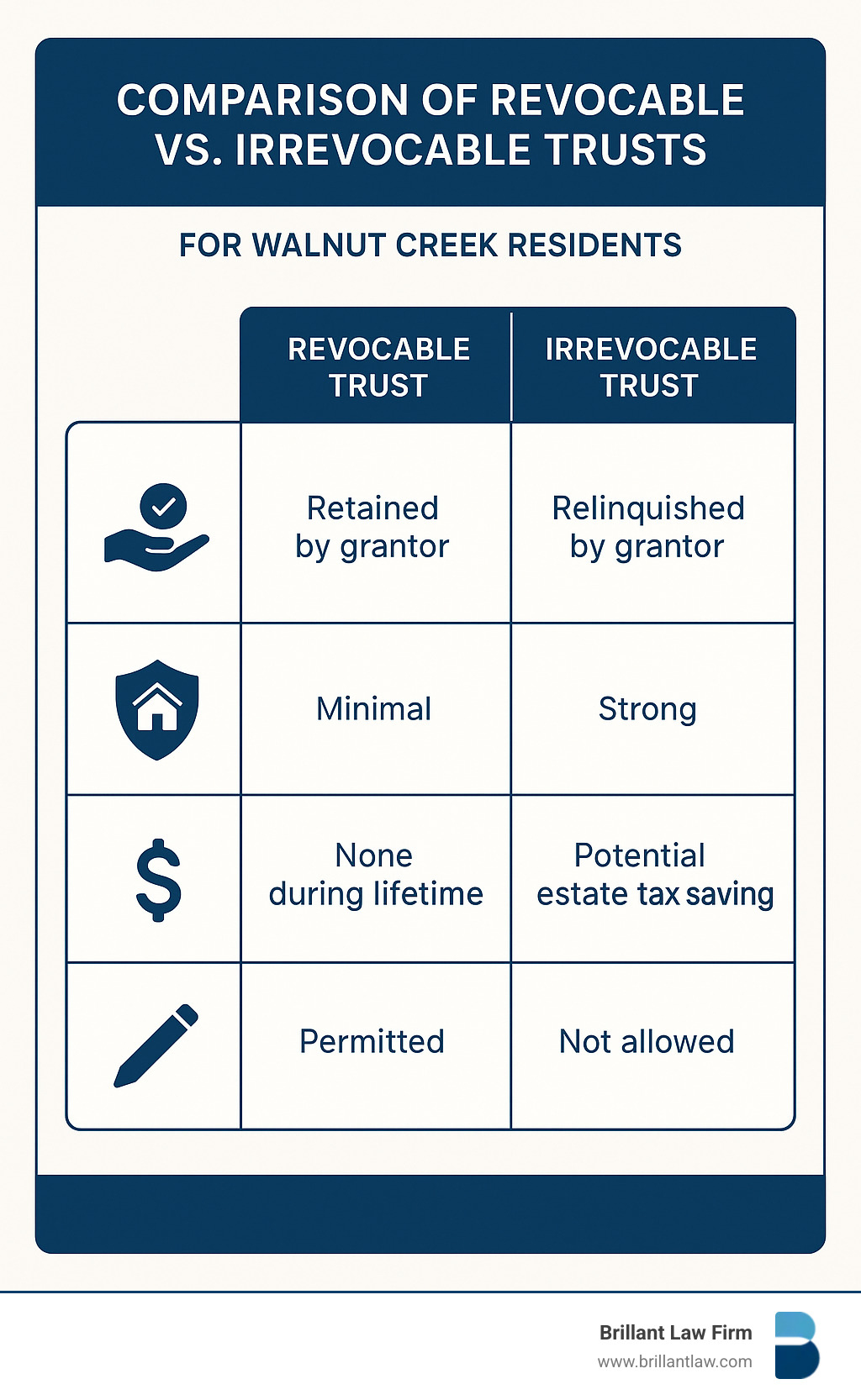
| Feature | Revocable Trust | Irrevocable Trust |
|---|---|---|
| Control | Grantor maintains full control | Grantor relinquishes control |
| Modification | Can be changed or revoked anytime | Generally cannot be modified |
| Asset Protection | No protection from creditors | Strong protection from creditors |
| Estate Tax Benefits | None (assets still in taxable estate) | Assets removed from taxable estate |
| Income Tax | Reported on grantor’s tax return | Separate tax entity with own return |
| Probate Avoidance | Yes | Yes |
| Privacy | Yes | Yes |
| Best For | Most individuals seeking probate avoidance | High-net-worth individuals, asset protection needs |
For more detailed information about irrevocable trusts and their legal implications, you can review this scientific research on asset protection.
How an Irrevocable Trust Walnut Creek Works
Setting up an irrevocable trust Walnut Creek triggers several important legal changes that you should understand before proceeding.
First, there’s what legal experts call “vesting of interest.” This means your beneficiaries immediately receive a present, vested interest in the trust property that can’t be taken away. This principle was established in the influential case Empire Properties v. County of Los Angeles (44 Cal.App.4th 781 (1996)), which continues to shape trust law in California today.
Second, you’ll experience a complete loss of control over the assets. As confirmed in cases like Dudek v. Dudek and Laycock v. Hammer, once you’ve placed assets in an irrevocable trust, you can’t later change your mind and reclaim them, regardless of what happens down the road.
Your trust also becomes its own separate tax entity, requiring its own Employer Identification Number (EIN) from the IRS. This allows your trustee to open bank accounts and manage investments under the trust’s name rather than yours.
One final note for Walnut Creek residents: even if you start with a revocable trust, it automatically becomes irrevocable when you pass away, locking in the terms and asset distribution you’ve specified.

Choosing Between a Revocable Living Trust and an Irrevocable Trust Walnut Creek
When my clients in Walnut Creek ask me which trust is right for them, I often frame it as a choice between control and protection. Which matters more to you?
A revocable living trust might be your best choice if maintaining control is your priority. With this option, you can change your mind, amend terms, or even dissolve the entire arrangement if needed. It’s perfect if your main goals are avoiding probate and simplifying asset management during your lifetime. This option makes sense if your estate falls below the federal estate tax exemption threshold and creditor protection isn’t a major concern.
On the other hand, an irrevocable trust Walnut Creek shines when protection is paramount. If you’re worried about potential lawsuits, want to reduce your taxable estate, need to plan for Medi-Cal eligibility, have a special needs beneficiary, or want to explore charitable giving strategies, this more permanent solution offers benefits that a revocable trust simply can’t match.
For many of my Walnut Creek clients, I actually recommend a thoughtful hybrid approach: a revocable living trust for most assets, with specialized irrevocable trusts for specific purposes like asset protection or tax planning. This gives you the best of both worlds.
Want to explore these differences in greater detail? Visit our comprehensive guide to Revocable and Irrevocable Trusts.
Ideal Asset Candidates
Not everything you own belongs in an irrevocable trust Walnut Creek. Some assets are perfect candidates, while others should probably stay out.
Real estate often makes an excellent addition to an irrevocable trust. This includes investment properties, vacation homes, and sometimes even your primary residence. Just be mindful of potential property tax reassessment issues under California’s Proposition 13.
Life insurance policies work beautifully in an Irrevocable Life Insurance Trust (ILIT). This arrangement removes the death benefit from your taxable estate while still providing liquidity for your heirs when they need it most.
Investment accounts containing stocks, bonds, mutual funds, and other securities can be transferred to your irrevocable trust. Remember though, you’ll no longer control investment decisions directly.
Closely-held business interests like family businesses, LLC interests, and corporate stock can gain valuable protection through an irrevocable trust structure, helping ensure your business legacy continues according to your wishes.
Valuable collectibles such as art, antiques, and other high-value collections that might appreciate over time often benefit from the protection an irrevocable trust provides.
However, some assets generally don’t belong in an irrevocable trust. These include qualified retirement accounts like IRAs and 401(k)s (due to potential tax complications), daily-use vehicles (they depreciate quickly and create liability concerns), and joint tenancy bank accounts you need for everyday expenses.
The right asset mix for your irrevocable trust Walnut Creek ultimately depends on your specific financial situation, family needs, and long-term goals – something we carefully evaluate with each client at Brillant Law Firm.
Why Choose an Irrevocable Trust in California: Benefits, Limitations & Use Cases
For Walnut Creek residents with substantial assets, an irrevocable trust Walnut Creek offers powerful advantages that often outweigh its limitations. These specialized legal structures serve as both shield and strategy for those looking to protect their legacy.

Asset Protection & Creditor Shield
One of the most compelling reasons our Walnut Creek clients establish irrevocable trusts is the fortress-like protection they provide. When you properly transfer assets to an irrevocable trust, you’re essentially placing them behind a legal barrier that most creditors cannot breach.
This protection proves especially valuable if you’re a doctor, attorney, or business owner facing liftd lawsuit risks. The more successful you become, the more you may find yourself a target for litigation – an unfortunate reality of wealth in today’s society. With an irrevocable trust Walnut Creek, you can sleep easier knowing your hard-earned assets have meaningful protection.
Your beneficiaries gain protection too. Through carefully crafted “spendthrift clauses,” you can shield their inheritance from their own creditors, divorce proceedings, or even their own financial missteps. California courts consistently uphold these protective features when trusts are properly structured and timed – transfers made specifically to dodge existing creditors may be challenged as fraudulent conveyances.
Estate & Gift Tax Savings
For those fortunate enough to have estates exceeding the federal exemption amount ($13.99 million in 2025), an irrevocable trust Walnut Creek can deliver significant tax advantages.
Assets transferred to your irrevocable trust – along with all their future growth and appreciation – leave your taxable estate entirely. This single feature can save millions in estate taxes for larger estates. With specialized structures like generation-skipping trusts, you can efficiently transfer wealth to grandchildren while minimizing the additional generation-skipping transfer taxes that would otherwise apply.
Business owners benefit particularly from valuation discount strategies. When transferring family business interests to an irrevocable trust Walnut Creek, you may qualify for substantial valuation discounts based on lack of marketability or minority interests – potentially reducing the taxable value by 15-35%.
Many of our clients implement annual gifting strategies, using the annual gift tax exclusion ($17,000 per recipient in 2023) to gradually fund certain types of irrevocable trusts without tapping into their lifetime exemption amount.

Specialized Trust Uses
Beyond basic protection and tax planning, irrevocable trust Walnut Creek arrangements serve specialized purposes for unique situations:
Dynasty trusts preserve family wealth across multiple generations while minimizing estate taxes at each generational transfer – creating a lasting legacy that can benefit your family for decades or even centuries.
Irrevocable Life Insurance Trusts (ILITs) offer a powerful planning tool, keeping life insurance proceeds outside your taxable estate while providing liquidity exactly when your family needs it most – whether for estate taxes, business succession, or other needs.
For those with charitable inclinations, Charitable Remainder Trusts allow you to support causes you care about while retaining an income stream for yourself or other beneficiaries for a specified period – effectively combining philanthropy with practical financial planning.
Families caring for loved ones with disabilities often establish Special Needs Trusts to provide supplemental benefits without disqualifying beneficiaries from essential government assistance programs – a critical planning tool that balances quality of life with program eligibility.
Homeowners with substantial equity might consider Qualified Personal Residence Trusts (QPRTs), which allow you to transfer your home to beneficiaries at a reduced gift tax value while retaining the right to live there for a specified term – effectively discounting the gift value of your home.
For more detailed information about how trusts can improve your estate plan, visit our page on Estate Planning with Trusts.
Drawbacks & Limitations
While the benefits can be substantial, irrevocable trust Walnut Creek arrangements come with important tradeoffs to consider carefully.
The defining characteristic – irrevocability – is also its primary limitation. Once established, you generally cannot change or revoke the trust without court intervention or unanimous beneficiary consent. This permanence requires thoughtful planning and foresight.
You must relinquish meaningful control over the assets. This means you typically cannot serve as trustee or retain powers that would cause inclusion in your estate. For many successful individuals accustomed to control, this represents a significant psychological hurdle.
The financial considerations are real. Establishing an irrevocable trust in Walnut Creek typically costs between $4,000 and $10,000, depending on complexity. Ongoing administration requires separate tax returns, formal accounting, and trustee fees (typically 1-1.5% of assets under management annually).
These sophisticated legal structures require expert guidance to establish and maintain properly. Working with an experienced trust attorney familiar with California’s unique trust laws is essential for success.
While these limitations are significant, many of our clients find that the protection and tax benefits far outweigh the drawbacks for their specific circumstances. The key is determining whether an irrevocable trust Walnut Creek aligns with your particular goals and comfort level.
Building & Managing Your Irrevocable Trust: Setup, Funding & Administration
Creating an irrevocable trust Walnut Creek isn’t just about signing documents—it’s about carefully constructing a legal fortress around your legacy. Let’s walk through how this process unfolds in the real world.
Legal Steps & Funding Timeline
Establishing your irrevocable trust Walnut Creek begins with a conversation about your goals. Are you primarily concerned with protecting assets from potential lawsuits? Planning for estate taxes? Creating a safety net for a loved one with special needs? These initial discussions shape everything that follows.
Once we understand your objectives, we’ll help you select the right trustee—a critical decision since you generally can’t serve in this role yourself. Many clients choose a trusted family member, while others prefer a professional trustee for more complex situations.
With these foundations in place, we draft a comprehensive trust document that addresses California-specific requirements, including important spendthrift protections under Probate Code §15300. After signing and notarizing the document, we obtain an Employer Identification Number (EIN) from the IRS—your trust’s tax identity.
Then comes the most crucial step: funding. This is where many trusts fail, as people create beautiful legal documents but never actually transfer their assets. We’ll guide you through transferring real estate via new deeds, reassigning business interests, and retitling financial accounts. A properly funded trust is the difference between a plan that works and one that fails when you need it most.
From our first meeting to full implementation typically takes 4-6 weeks, though more complex situations might require additional time. Throughout this process, we’re there to answer questions and ensure everything transitions smoothly.
Trustee Duties & Beneficiary Rights
Being a trustee of an irrevocable trust Walnut Creek isn’t a ceremonial title—it’s a position with serious legal responsibilities. Trustees must uphold a fiduciary duty to act solely in the beneficiaries’ best interests, putting aside personal gain or conflicts of interest.
California’s “prudent investor rule” requires trustees to manage investments with reasonable care and diversification. They can’t simply park trust assets in a savings account and forget about them, nor can they make speculative investments that put the principal at risk.
Transparency is non-negotiable. Trustees must maintain meticulous records and provide regular accountings to beneficiaries. They’re also responsible for ensuring all tax returns are filed properly—a task that often requires professional assistance.
On the flip side, beneficiaries aren’t passive participants. They have the right to information about how the trust is being managed, can request and receive periodic accountings, and may petition the court if they believe the trustee isn’t fulfilling their duties. These checks and balances help ensure the trust operates as intended.
For more detailed guidance on the ongoing management of trusts, visit our page on Trust Administration.
Costs, Fees & Ongoing Compliance
Let’s talk about the investment required for an irrevocable trust Walnut Creek. Initial setup costs typically range from $4,000 to $10,000, reflecting the complex legal work involved. Walnut Creek attorneys with specialized trust expertise generally charge between $400 and $750 per hour. Additional startup expenses include recording fees for property deeds and potential appraisals for certain assets.
Once established, your trust requires ongoing financial support. Trustee fees typically run 1-1.5% of assets under management annually. If you’ve chosen a professional trustee, this compensates them for the significant responsibilities they’ve assumed. Your trust will also need annual tax returns prepared by a CPA (usually $500-$1,200), plus potential investment management fees and insurance for trust assets.
Compliance requirements continue throughout the trust’s existence. Form 1041 (the trust’s income tax return) must be filed annually, beneficiary notices must be sent according to California requirements, and detailed records must be maintained for all transactions. While these requirements may seem burdensome, they’re the necessary maintenance that keeps your trust legally sound and functioning properly.
Modification or Termination Options
Despite the word “irrevocable” in its name, your irrevocable trust Walnut Creek isn’t necessarily set in stone forever. California law provides several pathways for modification when circumstances warrant.
Under Probate Code §15403, a trust can be modified or even terminated if all beneficiaries consent and the change doesn’t interfere with a material purpose of the trust. For example, if a trust was created primarily for tax benefits that no longer exist due to law changes, this provision might allow modification.
When unexpected circumstances arise that weren’t anticipated by the original trust creator, Probate Code §15409 allows for court-ordered modifications. I’ve helped clients steer this process when dramatic changes in tax law or family circumstances made the original trust provisions problematic.
For funding issues, a Heggstad Petition under Probate Code §850 can be a lifesaver, allowing property to be transferred into a trust after incapacity or death without going through probate. Modern trusts often include “trust protector” provisions that allow a designated person to make limited modifications without court involvement.
Trust “decanting”—essentially pouring assets from an old trust into a new one with more favorable terms—represents another potential option in certain circumstances. Having successfully guided numerous Walnut Creek clients through these complex procedures, we understand the nuances of when and how to pursue trust modifications.
Property & Income Taxes
The tax implications of an irrevocable trust Walnut Creek deserve careful attention. When transferring California real property to your trust, be mindful of Proposition 13 reassessment triggers. While some transfers between parents and children may qualify for exclusion from reassessment, others could result in significantly higher property taxes.
Income taxation presents another layer of complexity. Your irrevocable trust will file its own tax return using Form 1041, and trust tax brackets are notoriously compressed—reaching the highest tax rate at much lower income levels than individual brackets. Depending on your trust’s structure, income might be taxable to the trust itself, passed through to beneficiaries, or in some cases, still attributable to you as the grantor.
Smart tax planning can help mitigate these challenges. Distributing income to beneficiaries in lower tax brackets, timing distributions strategically, and investing in tax-advantaged assets can all help optimize your trust’s tax situation. These aren’t decisions to make alone—they require ongoing collaboration between your trustee, tax advisor, and trust attorney.
With proper planning and management, your irrevocable trust Walnut Creek can provide the asset protection, tax benefits, and legacy preservation you’re seeking, while minimizing administrative burdens and tax implications.
Frequently Asked Questions about Irrevocable Trust Walnut Creek
Can I serve as my own trustee?
Generally, no. For an irrevocable trust Walnut Creek to achieve its asset protection and tax benefits, you should not serve as your own trustee. Doing so could cause the trust assets to be included in your estate for tax purposes or vulnerable to creditor claims.
Instead, consider:
– A trusted family member (not your spouse if estate tax planning is a goal)
– A professional trustee (bank trust department or trust company)
– A combination of family and professional trustees (co-trustees)
The ideal trustee will have financial acumen, understand the trust’s purpose, and be committed to fulfilling their fiduciary duties. For complex situations, we often recommend professional trustees or a combination of family and professional trustees.
For more guidance on selecting appropriate trustees, visit our page on Trust Lawyers Walnut Creek.
What assets should stay out of the trust?
While many assets benefit from placement in an irrevocable trust Walnut Creek, some should generally remain outside:
Qualified Retirement Plans: IRAs, 401(k)s, and other qualified retirement accounts should not be transferred to an irrevocable trust during your lifetime, as this would be treated as a distribution, triggering immediate income tax. Instead, consider naming the trust as a beneficiary.
Daily-Use Vehicles: Cars and other vehicles used regularly depreciate quickly and carry liability risks that are better managed through proper insurance rather than trust ownership.
Joint Tenancy Bank Accounts: Accounts needed for daily expenses should remain accessible and not be transferred to an irrevocable trust.
Recently Acquired Assets: If you’re concerned about fraudulent transfer laws, recently acquired assets or those purchased with borrowed funds should be carefully evaluated before transfer.
How does an irrevocable trust fit into my wider estate plan?
An irrevocable trust Walnut Creek should be part of a comprehensive estate plan that typically includes:
Pour-Over Will: This catches any assets not transferred to your trusts and directs them to the appropriate trust upon your death.
Durable Power of Attorney: This appoints someone to manage your financial affairs if you become incapacitated.
Advance Healthcare Directive: This specifies your healthcare preferences and appoints someone to make medical decisions if you cannot.
Complementary Entities: Family Limited Liability Companies (LLCs) or Family Limited Partnerships often work alongside irrevocable trusts for comprehensive asset protection and business succession planning.
Coordinated Beneficiary Designations: Life insurance, retirement accounts, and other assets with beneficiary designations should be coordinated with your trust planning.
At Brillant Law Firm, we take a holistic approach to estate planning, ensuring that all elements work together seamlessly to achieve your goals.

Conclusion
An irrevocable trust Walnut Creek represents one of the most powerful tools in estate planning for those seeking asset protection, tax benefits, and legacy preservation. While the irrevocable nature may seem daunting, the benefits often far outweigh the limitations for many high-net-worth individuals and families in Walnut Creek and the surrounding areas.
The key to success with irrevocable trusts lies in proper planning, precise drafting, and ongoing professional management. At Brillant Law Firm, we specialize in creating customized irrevocable trust solutions that address your specific concerns while maximizing the benefits available under California law.
Whether you’re concerned about estate taxes, professional liability, providing for special needs beneficiaries, or preserving wealth for future generations, an irrevocable trust may be the solution you’re seeking. We invite you to schedule a consultation with our experienced trust attorneys to discuss how we can help you protect what matters most.
For more information about creating a comprehensive estate plan that includes both revocable and irrevocable trusts, visit our page on Living Trust Attorney Walnut Creek.
When it comes to protecting your legacy, sometimes the most powerful words are “Trust me, it’s irrevocable!”


