

Understanding the Complexities of Trust Administration: A Quick Guide
Trust Administration is the process of managing assets held in a trust according to the trust document’s terms after the trust creator (settlor) has passed away or become incapacitated. If you’re looking for a quick overview of what trust administration involves:
| Trust Administration Basics | Description |
|---|---|
| Definition | Management and distribution of trust assets according to trust terms |
| Key Participants | Trustee, Settlor (creator), Beneficiaries |
| Primary Tasks | Asset inventory, debt payment, tax filing, asset distribution |
| Timeline | Typically 6-12 months for standard trusts in California |
| Legal Requirements | Fiduciary duties, beneficiary notifications, tax compliance |
Trust administration serves as the critical bridge between creating a trust and fulfilling its purpose. Without proper administration, even the most carefully drafted trust can fail to achieve its intended goals.
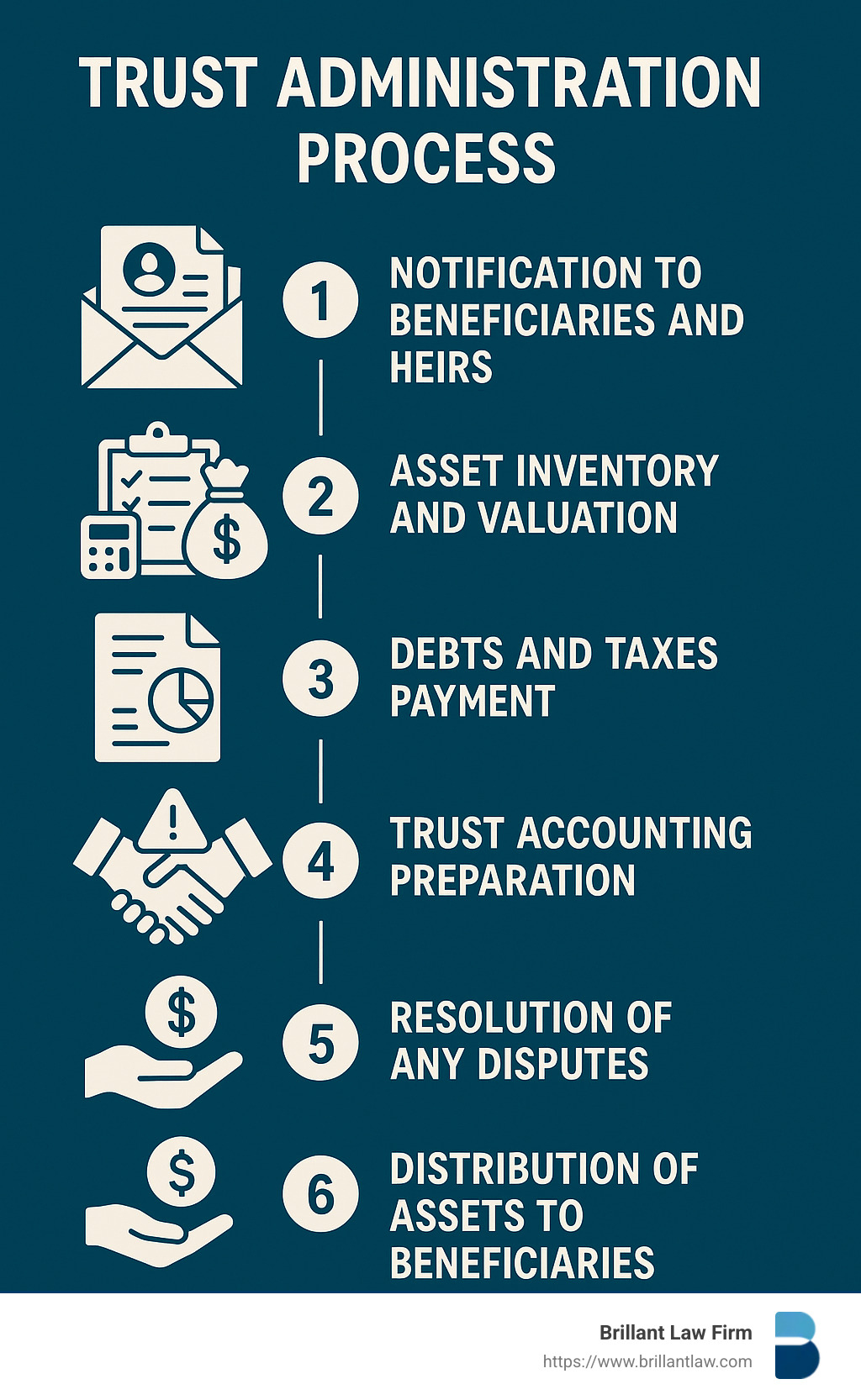
The process begins when the trustee receives the settlor’s death certificate and involves multiple responsibilities including inventorying assets, obtaining date-of-death valuations, notifying beneficiaries, filing necessary tax returns, and ultimately distributing assets to the intended beneficiaries.
Many people underestimate the complexity of trust administration, assuming it’s simply a matter of handing out assets. In reality, it requires careful navigation of legal, financial, and interpersonal challenges.
I’m David Brillant, a Certified Specialist in Estate Planning, Trust and Probate Law with the State Bar of California Board of Legal Specialization, who has guided hundreds of trustees through the complex Trust Administration process with a focus on ensuring legal compliance while honoring the settlor’s intentions.
Similar topics to Trust Administration:
- fiduciary accounting and trust administration guide
- how to become a trust administrator
- trust administration accounting
What Is Trust Administration?
Trust Administration is like bringing a trust to life – it’s where all the careful planning actually gets put into action. When someone creates a trust, they’re making a roadmap for their assets. But it’s during the administration phase that this roadmap actually gets followed.
When the person who created the trust (known as the settlor) passes away or becomes unable to manage their affairs, the trustee steps in to handle everything according to the settlor’s wishes.
As Olivia Wathne, Esq. explains it: “Trust administration is the management of the assets that exist within a trust.”
One of the biggest advantages of Trust Administration is avoiding probate – that court-supervised process that can drain both time and money from an estate. While probate in California typically drags on for 9 months to several years, trust administration usually wraps up in just 6-12 months for standard trusts.
The Trust Administration process begins when the trustee obtains the settlor’s death certificate. From there, they start on several important responsibilities: gathering and managing all trust assets, paying off any outstanding debts, filing necessary tax returns, distributing assets to beneficiaries according to the trust terms, and maintaining detailed records throughout.
Think of it as orchestrating the final wishes of the settlor – making sure everything happens just as they intended, with minimal hassle for their loved ones.
Key Participants in Trust Administration
Every Trust Administration involves three main players, each with their own crucial role to play:
The Trustee sits at the center of everything. This person (or sometimes an institution) carries the responsibility of following the trust’s instructions to the letter. They have what’s called a “fiduciary duty” – a legal obligation to act in the best interests of the beneficiaries, even if it means putting aside their own interests.
The Settlor (sometimes called the grantor or trustor) is the person who created the trust in the first place. They’re the one who transferred their assets into the trust and wrote the instructions for how everything should be handled. In a revocable living trust, the settlor often serves as their own trustee until they can no longer do so.
The Beneficiaries are the people or organizations who will ultimately receive assets from the trust. Some might receive their inheritance right away, while others might need to wait until certain conditions are met – like reaching a certain age or milestone.
As one trustee beautifully expressed to us: “Being a successor trustee is an honor and privilege since the person who created the trust trusted your judgment and character.”
Successful Trust Administration depends on the trustee understanding exactly what the settlor wanted, communicating clearly with the beneficiaries, and carefully fulfilling all legal obligations. When done right, it honors the settlor’s legacy while providing for their loved ones with minimal stress and confusion.
More info about Trust Administration
Primary Duties and Responsibilities of a Trustee
Being a trustee is much more than just managing money and property – it’s a position of tremendous trust and responsibility. When someone names you as their trustee, they’re essentially saying, “I trust you to handle my life’s work and care for my loved ones when I’m gone.” That’s a powerful vote of confidence, but it also comes with significant legal obligations.
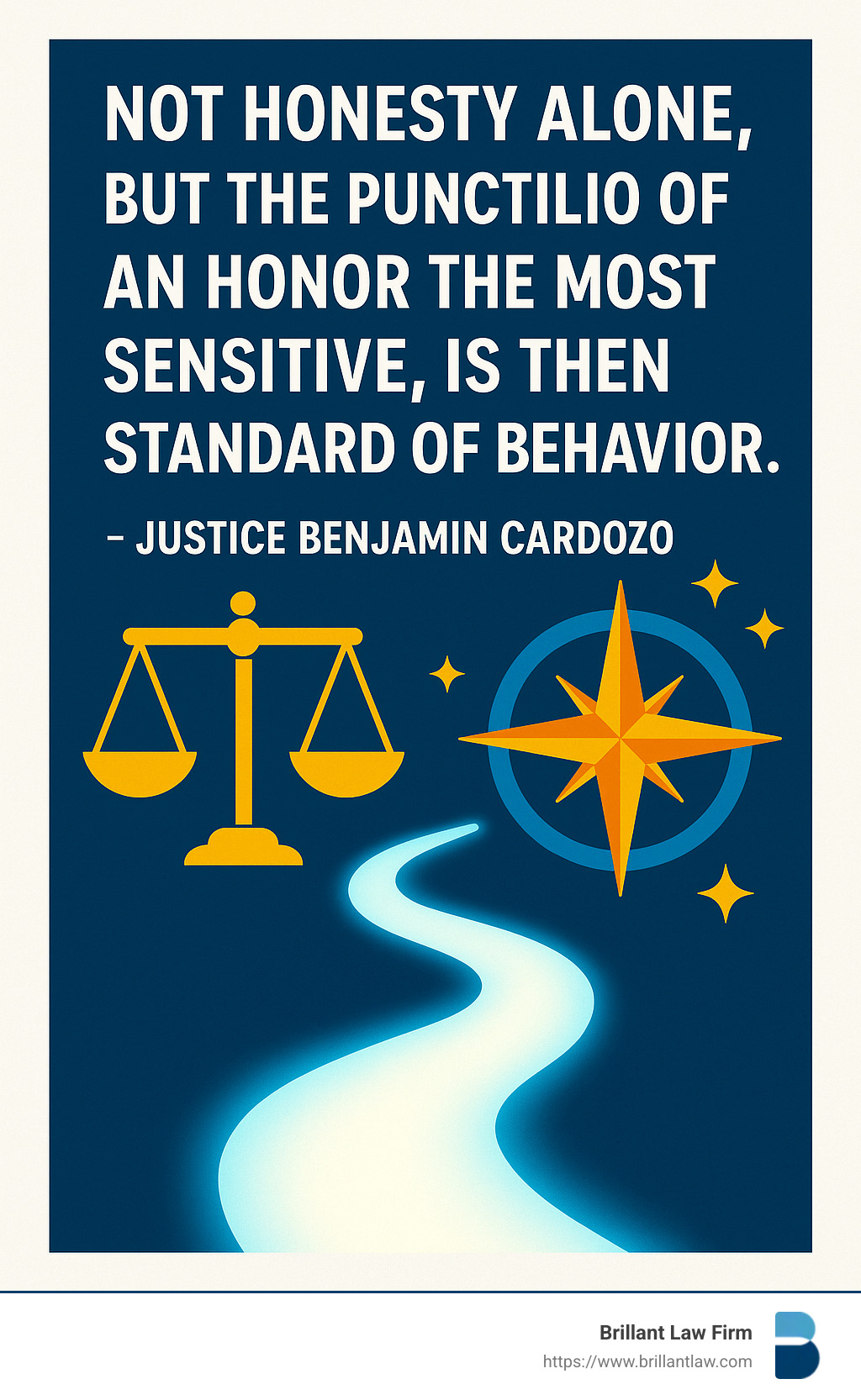
At the heart of a trustee’s role is the fiduciary duty – a legal relationship that requires the highest standards of care and loyalty. As Justice Benjamin Cardozo so eloquently put it: “A trustee is held to something stricter than the morals of the marketplace. Not honesty alone, but the punctilio of an honor the most sensitive, is then standard of behavior.”
When you serve as a trustee, you’re bound by several fundamental duties. Your duty of loyalty means putting the beneficiaries’ interests first – always. This isn’t just about avoiding obvious conflicts like using trust funds to buy yourself a new car. It extends to subtler situations, like investing in your own business or making decisions that might benefit one beneficiary (perhaps one you’re closer to) at the expense of others.
The duty of impartiality can be particularly challenging when trusts have multiple beneficiaries with competing interests. Imagine balancing the needs of a surviving spouse who needs income now against children who will inherit later. You need to be fair to everyone, even when they want different things.
Your duty of prudence means managing assets with the care and skill that a reasonable person would use. This doesn’t mean you need to be a financial genius or predict market movements perfectly. But it does mean making thoughtful, informed decisions and not taking unnecessary risks with trust assets.
The duty to administer the trust covers the nuts and bolts of daily trust management – identifying all assets, paying legitimate debts and taxes, making wise investments, distributing assets according to the trust’s terms, and keeping meticulous records. This last part is crucial – good documentation protects both the beneficiaries and you as trustee.
Here in California, trustees face particular scrutiny. Our state laws have specific requirements, and failure to meet them can result in personal liability – meaning your own assets could be at risk if you make serious mistakes. That’s why many trustees work with professionals like us at Brillant Law Firm to steer these complex waters safely.
Trust Administration Fees Schedule
What Does a Trust Administrator Do?
Ensuring Compliance with Legal and Tax Obligations in Trust Administration
One of the most daunting aspects of Trust Administration is handling the maze of tax and legal requirements. Even the most well-intentioned trustee can stumble here without proper guidance.
After the trust creator passes away, you’ll need to obtain a new tax ID number (EIN) for the trust – it’s essentially the trust’s social security number. This is your first step in establishing the trust as its own tax entity.
Tax filing obligations can catch many trustees by surprise. Trusts with more than $600 in annual income must file federal income tax returns (Form 1041), and in California, you’ll need to file state returns as well. The tax rates for trusts can be surprisingly high, reaching the top tax brackets at relatively low income levels – making tax planning especially important.
For larger estates, you might need to file federal estate tax returns (Form 706) even if no tax is actually due. This filing can be crucial for preserving certain tax benefits, like portability of the deceased’s unused exemption amount to a surviving spouse.
California’s property tax rules add another layer of complexity. Some property transfers trigger reassessment (and potentially much higher property taxes), while others qualify for exclusions. Knowing the difference can save beneficiaries thousands of dollars annually.
Beyond taxes, California law imposes specific legal notification requirements on trustees. Within 60 days of the settlor’s death, you must send proper notices to beneficiaries and heirs. You’re also required to lodge the settlor’s will with the probate court within 30 days of death, even if all assets are held in the trust.
Handling creditor claims properly is another critical legal obligation. California has specific procedures for notifying creditors and addressing their claims – getting this wrong can create personal liability for the trustee.
To avoid conflicts of interest, I always advise trustees to maintain crystal-clear boundaries. Keep trust assets entirely separate from your personal finances. Document your decision-making process, especially for significant actions. And perhaps most importantly, recognize when you need professional help – the cost of good advice upfront is almost always less than fixing problems later.
In my years of practice at Brillant Law Firm, I’ve seen too many trustees face penalties, litigation, and personal liability because they didn’t understand their obligations. California trust law is simply too complex to steer alone unless you have specific training in this area.
Latest research on trustee compliance
Steps Involved in the Trust Administration Process
When someone you love passes away and you’re named as a trustee, you might feel overwhelmed by the responsibilities ahead. Trust Administration isn’t just a legal process—it’s a journey that honors the wishes of someone who trusted you with their legacy. Let’s walk through this journey together.
The Trust Administration process typically takes 6-12 months in California, though more complex situations may require additional time. Think of it as a carefully choreographed sequence of steps, each building on the last.
First things first: when your loved one passes away, you’ll need to gather about 10 copies of the death certificate. You’ll be surprised how many different institutions require an original copy! You’ll also want to locate the original trust document and any amendments, notify Social Security, and secure any valuable assets—sometimes this means changing locks on properties to prevent unauthorized access.
Within 60 days of the death, California law requires trustees to send specific notifications to all beneficiaries and legal heirs. This formal notice (under Probate Code Section 16061.7) starts a 120-day clock during which beneficiaries can contest the trust if they wish. It’s like opening the curtains to let in transparency and clarity.
Next comes one of the most detailed parts of the process: creating a comprehensive inventory of all trust assets. This means identifying everything from real estate to bank accounts, getting professional appraisals, and documenting date-of-death values. This step isn’t just paperwork—it establishes the new tax basis for these assets, which can have significant implications down the road.
Even when all assets are held in a trust, you’ll still need to lodge the original will with the probate court within 30 days of death. It’s a common misconception that having a trust means you can skip this step, but California law requires it.
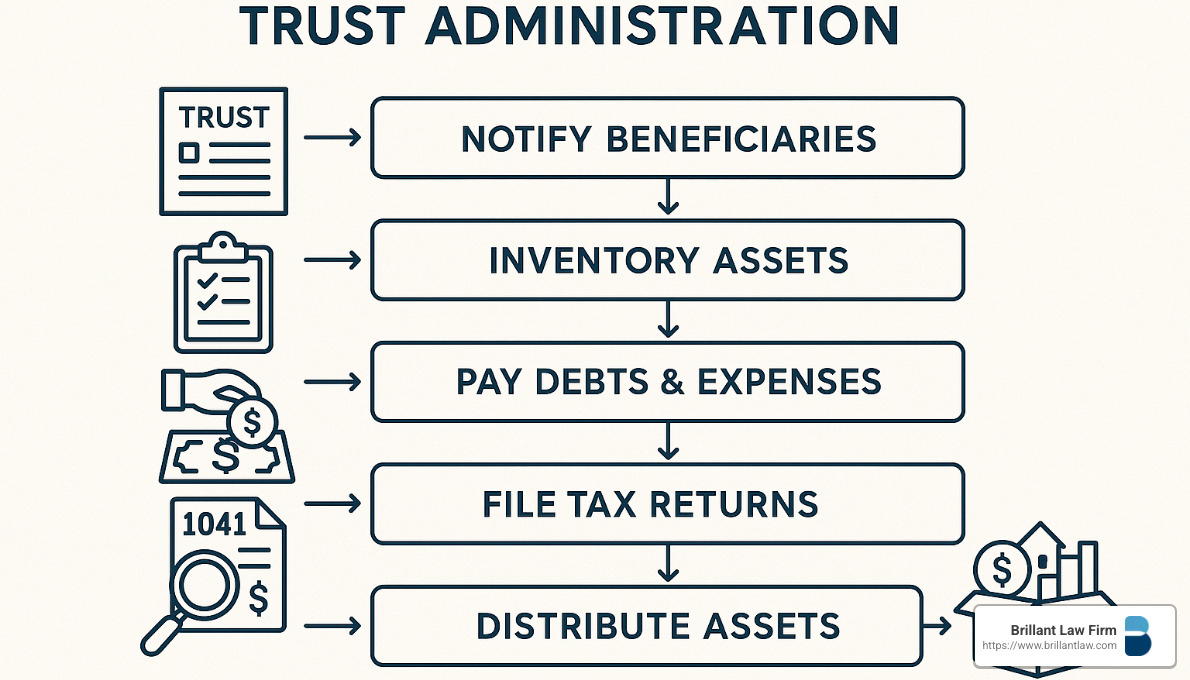
Managing creditor claims comes next. You’ll identify outstanding debts, publish notices to creditors if appropriate, and pay valid claims from trust assets. This ensures that all financial obligations are properly addressed before distributions begin.
The tax component of Trust Administration requires careful attention. You’ll need to obtain a tax ID number for the trust, file final personal income tax returns for the deceased, handle trust income tax returns (Form 1041), and potentially file estate tax returns (Form 706) if the estate is large enough. Any taxes due must be paid from trust assets before distributions.
Before distributing assets, you’ll prepare a trust accounting that documents all transactions—income, expenses, and proposed distributions. Think of this as showing your work; it demonstrates your careful stewardship of the trust assets.
Finally, the moment beneficiaries have been waiting for: distributing assets according to the trust’s instructions. You’ll transfer titles, update registrations, and obtain receipts from beneficiaries acknowledging their distributions. Once all administrative tasks are complete, you’ll provide a final accounting and obtain releases from beneficiaries if appropriate.
“I had no idea how many steps were involved,” one client told us. “Having professional guidance made all the difference in navigating this complex process.”
At Brillant Law Firm, we’ve developed systems to ensure each step is completed properly and in the correct order, minimizing delays and preventing costly mistakes that could affect beneficiaries or expose you to liability as a trustee.
More info about How to Administer a Trust in California
Managing Disputes Between Beneficiaries
Family dynamics can become complicated when inheritance enters the picture. Even in the most harmonious families, Trust Administration can sometimes stir up tensions and disagreements among beneficiaries. These disputes aren’t just emotionally draining—they can significantly delay the administration process and deplete trust assets if they escalate to litigation.
In my years of practice, I’ve seen disputes arise from several common situations. Unequal distributions often trigger feelings of unfairness, especially when beneficiaries receive different amounts without understanding the settlor’s reasoning. Interpretation of trust terms can lead to disagreements about what the settlor truly intended. Sometimes beneficiaries raise accusations of trustee misconduct, claiming the trustee isn’t fulfilling their fiduciary duties. Delays in distribution frequently cause frustration, particularly when beneficiaries don’t understand why the process takes time. And of course, long-standing family dynamics that have nothing to do with the trust itself often resurface during this emotional time.
The good news? Many disputes can be prevented or resolved with thoughtful management. Clear, transparent communication is your strongest tool. Regular updates about the process, timeline, and decisions help beneficiaries feel included and respected. Even when you can’t share everything or accommodate every request, explaining “why” goes a long way.

Thorough documentation protects everyone involved. Keep detailed records of all actions taken and the reasoning behind decisions—this creates an objective record that can defuse accusations of impropriety. When tensions rise despite your best efforts, mediation with a neutral third party often helps resolve disputes before they escalate to costly litigation.
Sometimes, making distributions in stages can satisfy immediate needs while giving you time to resolve more complex issues. And of course, working with experienced trust administration attorneys who understand both the legal requirements and the human elements can make all the difference.
I remember working with a trustee who was administering a trust with four siblings as beneficiaries. There was initial tension—two siblings felt they deserved larger shares because they had cared for their parent in their final years. By holding regular family meetings, providing detailed accountings, and creating a space where everyone could express their feelings, the trustee completed the administration without litigation. The siblings ultimately understood their parent’s wishes, even if they didn’t all agree with them.
When disputes do arise, having an experienced trust attorney can be invaluable. We often serve as a buffer between trustees and beneficiaries, explaining complex legal concepts in understandable terms and setting realistic expectations. Sometimes, just having a neutral professional involved helps everyone take a step back and focus on honoring the settlor’s wishes—which is, after all, what Trust Administration is all about.
Advantages and Disadvantages of Using a Trust for Estate Planning
When considering your estate plan, understanding the pros and cons of Trust Administration can help you make choices that best protect your legacy and loved ones. While trusts offer remarkable benefits for many California families, they aren’t necessarily the right fit for everyone.
The Bright Side of Trusts
Bypassing probate is perhaps the most celebrated advantage of a properly funded trust. In California, probate can be particularly painful—often dragging on for 9-18 months (sometimes years!) and costing families between 3-7% of their estate’s value. A trust neatly sidesteps this entire process.
Privacy is another compelling benefit. Unlike probate proceedings that become public record—potentially exposing your financial details and family matters to anyone curious enough to look—Trust Administration keeps your affairs confidential. As one client recently told me, “The privacy alone made setting up our trust worthwhile.”
Trusts also typically enable faster distribution of assets to your beneficiaries. Rather than waiting for court proceedings to conclude, your loved ones can often receive their inheritances within months of your passing.
The flexibility and control offered by trusts simply can’t be matched by wills alone. You can create detailed instructions for how your assets should be managed and distributed—perhaps gradually over time for younger beneficiaries or those who might need protection from themselves or others.
For many of my California clients, incapacity planning proves to be an unexpected but crucial benefit. Should you become unable to manage your affairs, your successor trustee can step in without court intervention, avoiding the expense and stress of conservatorship proceedings.
Certain specialized trusts can also provide meaningful tax advantages, potentially preserving more of your hard-earned assets for your beneficiaries rather than Uncle Sam.
The Potential Drawbacks
Setting up a trust requires a higher initial investment than a simple will. In California, expect to pay more upfront for a comprehensive trust package—though these costs are typically far less than what your estate would pay in probate fees.
Trust Administration also demands a certain level of complexity. As one trustee client shared, “I had no idea how many moving parts were involved until I had to handle my mother’s trust.” Many trustees find they need professional guidance to steer the process correctly.
The effectiveness of your trust depends entirely on proper funding—transferring your assets into the trust’s name during your lifetime. This requires ongoing attention as you acquire new assets. I’ve seen too many cases where a beautifully drafted trust failed to avoid probate because assets were left outside it.
Without the oversight of probate court, there’s less built-in supervision of the trustee’s actions. While this reduces costs and delays, it can potentially leave room for trustee misconduct if you don’t choose your trustee wisely.
Finally, resolving beneficiary disputes can sometimes be more challenging without the structured framework of court supervision, though an experienced trust attorney can help steer these waters.
| Feature | Trust Administration | Probate Administration |
|---|---|---|
| Timeline | Typically 6-12 months | 9-18+ months in California |
| Cost | 1-2% of trust assets | 3-7% of estate assets |
| Privacy | Private process | Public record |
| Court Involvement | Minimal unless disputes arise | Extensive court oversight |
| Asset Protection | Can provide asset protection | Limited protection |
| Incapacity Planning | Included | Requires separate documents |
| Creditor Claims Period | Varies | Fixed by statute (typically 4 months) |
At Brillant Law Firm, we’ve found trusts to be particularly valuable for clients who own California real estate (especially for avoiding property tax reassessment), have minor children or beneficiaries with special needs, steer the complexities of blended families, value their privacy, or own businesses that require uninterrupted management.
Every family’s situation is unique. While trusts offer powerful benefits for many, the right estate planning approach depends on your specific circumstances, goals, and the legacy you wish to leave behind.
More info about Trust and Estate Planning
Common Challenges in Trust Administration
Trust Administration can feel like navigating a maze with unexpected twists and turns. Even the most prepared trustees often encounter roadblocks that test their patience and abilities. Let’s explore these challenges with an eye toward practical solutions.
1. Complex or Unique Assets
Not all trust assets are as straightforward as cash in a bank account. Many trustees find themselves scratching their heads when dealing with:
Business interests often present valuation challenges – is that family business worth $500,000 or $2 million? And who will run it during the transition? I recently helped a trustee steer the complex process of selling her father’s manufacturing business, which required specialized business valuation experts and careful timing to avoid disrupting operations.
Real estate brings its own headaches, from deciding whether to sell or maintain properties to handling tenants and property taxes. California’s property tax rules add another layer of complexity that requires careful navigation.
Retirement accounts like IRAs and 401(k)s follow different distribution rules than other assets and can trigger significant tax consequences if handled incorrectly.
Digital assets – from cryptocurrency to online businesses – may be difficult to access, value, and transfer. Many trustees don’t even know these assets exist until they find a password manager or crypto wallet during their inventory process.
2. Unclear Trust Language
Trust documents sometimes contain ambiguous language that leaves trustees wondering what the settlor actually intended. A trust might direct the trustee to distribute assets “as needed for support” without clearly defining what constitutes “need” or “support.” Does that include a beneficiary’s college tuition? A down payment on a house? A luxury vacation?
This ambiguity often puts trustees in the uncomfortable position of interpreting the settlor’s wishes while facing pressure from beneficiaries with their own interpretations.
3. Difficult Beneficiaries
Family dynamics can turn Trust Administration into an emotional minefield. Some beneficiaries may:
Make unreasonable demands for immediate distributions when proper administration requires time and patience. One trustee told me, “My sister called me every day for two months asking when she would get her money, even though I explained the process takes time.”
Question every decision the trustee makes, creating an atmosphere of distrust and making the trustee feel constantly under scrutiny.
Struggle with personal issues like substance abuse or financial management problems, making the trustee worry about how distributions might be used.
Threaten litigation to get their way, adding stress and potentially draining trust assets through legal fees.
4. Tax Complications
The tax aspects of Trust Administration often feel like a puzzle with missing pieces. Trustees must handle:
Income tax for the trust itself, which requires understanding complex rules about deductions and income distribution.
Final income tax returns for the deceased person, which might include unusual items like medical expenses or investment transactions.
Estate tax considerations for larger estates, even if no tax is ultimately due.
Property tax reassessment issues in California, where transferring real estate can trigger significant property tax increases without proper planning.
One trustee shared with me: “I thought I was good with finances until I tried to figure out the trust’s tax returns. I ended up hiring a professional after spending three weekends trying to make sense of it all.”
5. Trustee Inexperience
Most trustees are family members with no prior experience in Trust Administration. They’re often grieving the loss of a loved one while simultaneously trying to learn complex legal and financial concepts. This inexperience can lead to innocent mistakes with serious consequences.
As one first-time trustee put it: “I felt like I was thrown into the deep end without knowing how to swim. The trust document was over 50 pages long and filled with legal terms I didn’t understand.”
6. Time Constraints
Many trustees underestimate the time commitment involved in proper Trust Administration. What seems like a straightforward process often requires hundreds of hours spread over many months. When trustees have their own careers and families, finding this time can be incredibly challenging.
“I was spending 15-20 hours a week on trust matters for the first three months after my mom died,” one client told me. “It felt like a part-time job that I hadn’t signed up for.”
7. Record-Keeping Requirements
Trustees must maintain meticulous records of everything – every penny spent, every decision made, every communication with beneficiaries. Poor record-keeping can lead to disputes and potential liability down the road.
At Brillant Law Firm, we’ve developed systems to address these common challenges. We create customized administration timelines for each trust, help trustees set up proper accounting systems, and provide guidance on communicating with difficult beneficiaries.
One client shared: “When my father passed away, I had no idea what I was getting into as trustee. The team at Brillant Law helped me steer complex tax issues and a difficult relationship with my brother. Their guidance saved me countless hours and probably prevented a lawsuit.”
Potential Legal Consequences for Breach of Fiduciary Duties
The stakes in Trust Administration are high, and trustees who fail to fulfill their fiduciary duties can face serious legal consequences. Understanding these potential liabilities helps trustees appreciate why proper administration matters.
A trustee who breaches their fiduciary duties may face:
Removal as trustee by court order, which can be embarrassing and damage family relationships.
Personal liability for losses to the trust resulting from the breach – meaning the trustee might have to pay out of their own pocket for investment losses, tax penalties, or other damages.
Surcharge actions where the court orders the trustee to reimburse the trust for losses caused by their breach.
Disgorgement of fees – any compensation the trustee received might have to be returned if they’ve breached their duties.
Punitive damages in cases involving fraud or malicious conduct, which can far exceed the actual damages.
As Justice Benjamin Cardozo eloquently stated: “Not honesty alone, but the punctilio of an honor the most sensitive, is then the standard of behavior.”
Common breaches that lead to litigation include using trust assets for personal benefit, conflicts of interest, imprudent investments, favoritism among beneficiaries, negligence in managing assets, and failing to provide required information to beneficiaries.
I’ve seen well-meaning trustees face significant personal liability simply because they didn’t understand their legal obligations. One trustee invested trust funds in a friend’s business without proper due diligence. When the business failed, the trustee was held personally liable for the lost investment – over $200,000 out of his own pocket.
Working with experienced trust attorneys can help trustees understand and fulfill their fiduciary duties, protecting both the trust assets and the trustee from potential liability. At Brillant Law Firm, we see our role not just as legal advisors but as guides through what is often a challenging emotional and financial journey.
Frequently Asked Questions about Trust Administration
How Can a Trustee Ensure Compliance with Legal and Tax Obligations?
When it comes to Trust Administration, staying on the right side of legal and tax requirements can feel overwhelming. I’ve seen many trustees breathe a sigh of relief when they realize there’s a clear path forward.
The first and most important step is finding the right professional help. Working with experienced trust attorneys and tax professionals who know California trust law inside and out can make all the difference. Think of them as your guides through unfamiliar territory.
Understanding which tax returns need filing is crucial. This typically includes the decedent’s final personal income tax returns, trust income tax returns (Form 1041) for trusts earning more than $600 annually, and potentially estate tax returns. California has its own state tax requirements too, which your professional team can help steer.
Record-keeping might sound boring, but it’s your best protection. Keep detailed records of everything—assets and their values, income received, expenses paid, distributions to beneficiaries, and all communications. As one client told me, “I never thought I’d be so grateful for my filing system until I became a trustee!”
Following the trust terms exactly as written is non-negotiable. The trust document is your roadmap—if something seems unclear, seek court guidance rather than making assumptions. California has specific notice requirements for trustees, with strict timeframes that must be followed.
At Brillant Law Firm, we provide our trustee clients with comprehensive checklists and calendar reminders. Having these systems in place helps ensure nothing falls through the cracks during what is often an emotionally challenging time.
What Factors Should Be Considered When Choosing a Trustee?
Selecting the right trustee can make or break your Trust Administration experience. It’s one of the most important decisions a person makes when creating their estate plan.
Integrity stands above all other qualities. The person must be honest and trustworthy, someone who will always put the beneficiaries’ interests ahead of their own. As one client beautifully put it, “You’re looking for someone who will honor your wishes when you’re no longer there to speak for yourself.”
Financial smarts matter too. While the trustee doesn’t need to be a financial genius, they should understand basic concepts about investments, taxes, and money management. They’ll be making important financial decisions that impact your loved ones.
The ability to be impartial becomes especially important when there are multiple beneficiaries. Family dynamics can be complicated, and the trustee needs to steer these waters with fairness and diplomacy.
Availability and longevity are practical considerations often overlooked. Being a trustee takes time—sometimes lots of it. Ideally, choose someone who not only has the bandwidth to handle these responsibilities but is also likely to outlive the term of the trust.
While not essential, geographic proximity to trust assets can simplify things considerably. A trustee living in California will find it easier to manage California real estate than someone living across the country.
Many people choose professional trustees or create co-trustee arrangements, pairing a family member with a professional. This approach combines the personal touch of someone who knows the family with the expertise of a professional who knows the law.
How Can a Trust Administration Lawyer Assist in the Process?
A good trust administration lawyer is worth their weight in gold during the Trust Administration process. They don’t just help with paperwork—they provide peace of mind during what can be a stressful time.
When you first step into the trustee role, everything can feel overwhelming. A trust attorney helps you understand your responsibilities from day one, breaking down complex legal concepts into manageable steps. They’ll help you understand not just what to do, but why it matters.
Legal compliance is non-negotiable in California, where trust laws are particularly complex. Your attorney ensures you’re meeting all requirements, from proper notices to beneficiaries and creditors to filing deadlines.
The tax aspects of trust administration can be especially tricky. Your attorney works with accountants to develop tax strategies that benefit the trust and its beneficiaries while ensuring all filings are accurate and on time.
When conflicts arise—and they often do, even in the closest families—your attorney serves as a buffer and mediator. They can help resolve disputes before they escalate to costly litigation, saving both relationships and trust assets.
Document preparation is another area where professional help proves invaluable. Your attorney will draft notices to beneficiaries, certifications of trust for financial institutions, property transfer deeds, and other essential paperwork with precision.
Perhaps most importantly, a good trust attorney helps protect you from personal liability. By guiding you to fulfill your fiduciary duties properly, they help ensure you won’t face legal consequences for mistakes or oversights.
At Brillant Law Firm, our California trust administration attorneys typically charge between $350 and $600 per hour, depending on experience and the complexity of the trust. While this might seem substantial, most clients find the investment pays for itself through prevented problems and efficient administration.
As one grateful client shared with me, “Having a professional in my corner didn’t just save me from making costly mistakes—it gave me the confidence to honor my father’s wishes exactly as he intended.”
Conclusion
Trust Administration is a complex journey that requires careful attention to detail, legal knowledge, and financial savvy. Throughout this guide, we’ve explored the intricate dance of managing trust assets, fulfilling legal obligations, and ultimately honoring the wishes of someone who placed their trust in you.
When someone creates a trust, they’re doing more than just planning for asset distribution—they’re placing profound faith in the trustee to carry out their final wishes. This responsibility shouldn’t be taken lightly, as we’ve seen how trustees must steer a landscape filled with potential challenges:
The meticulous management of trust assets requires prudent decision-making and careful stewardship. Tax and legal requirements can feel like a maze without proper guidance. Effective communication with beneficiaries—sometimes during emotionally charged times—tests even the most diplomatic among us. And the specter of potential disputes always looms in the background.
Behind every trust document is a human story—a person who worked hard, accumulated assets, and wanted to care for their loved ones even after they’re gone. As David Brillant, I’ve guided hundreds of trustees through this process, and I’ve seen how proper administration brings peace to families during difficult transitions.
The stakes in Trust Administration are significant. Trustees who misstep may face personal liability, removal from their position, or painful litigation that can tear families apart. Yet with thoughtful guidance and a systematic approach, even first-time trustees can steer these waters successfully.
Remember these essential points as you consider trust administration:
The clock starts ticking immediately following the settlor’s death or incapacity. Your fiduciary duties require the highest standards of loyalty and care—far beyond what’s expected in ordinary business relationships. Proper documentation serves as both your shield and compass throughout the process. Tax compliance, while complex, is non-negotiable. And while a typical trust administration takes 6-12 months in California, complex situations may require more time and patience.
Whether you’re currently serving as a trustee or planning your own estate, understanding the administration process is crucial for protecting your loved ones and ensuring your wishes are carried out. The right professional guidance doesn’t just help you avoid pitfalls—it provides peace of mind during what is often an emotionally challenging time.
At Brillant Law Firm, we understand that behind every trust is a family’s legacy. Our experienced team is dedicated to guiding trustees through each step of the administration process with clarity and compassion. We’re committed to making this complex process as smooth as possible while ensuring your legal obligations are met with precision.
More info about Trust Administration Services
Contact Brillant Law Firm today for expert assistance with trust administration in California. Our offices in Walnut Creek, Saranap, San Miguel, and Castle Hill are ready to serve your trust and estate planning needs.


