

How to Setup a Living Trust in Texas: 7 Powerful Steps 2025
Why Living Trusts Are Essential for California Estate Planning
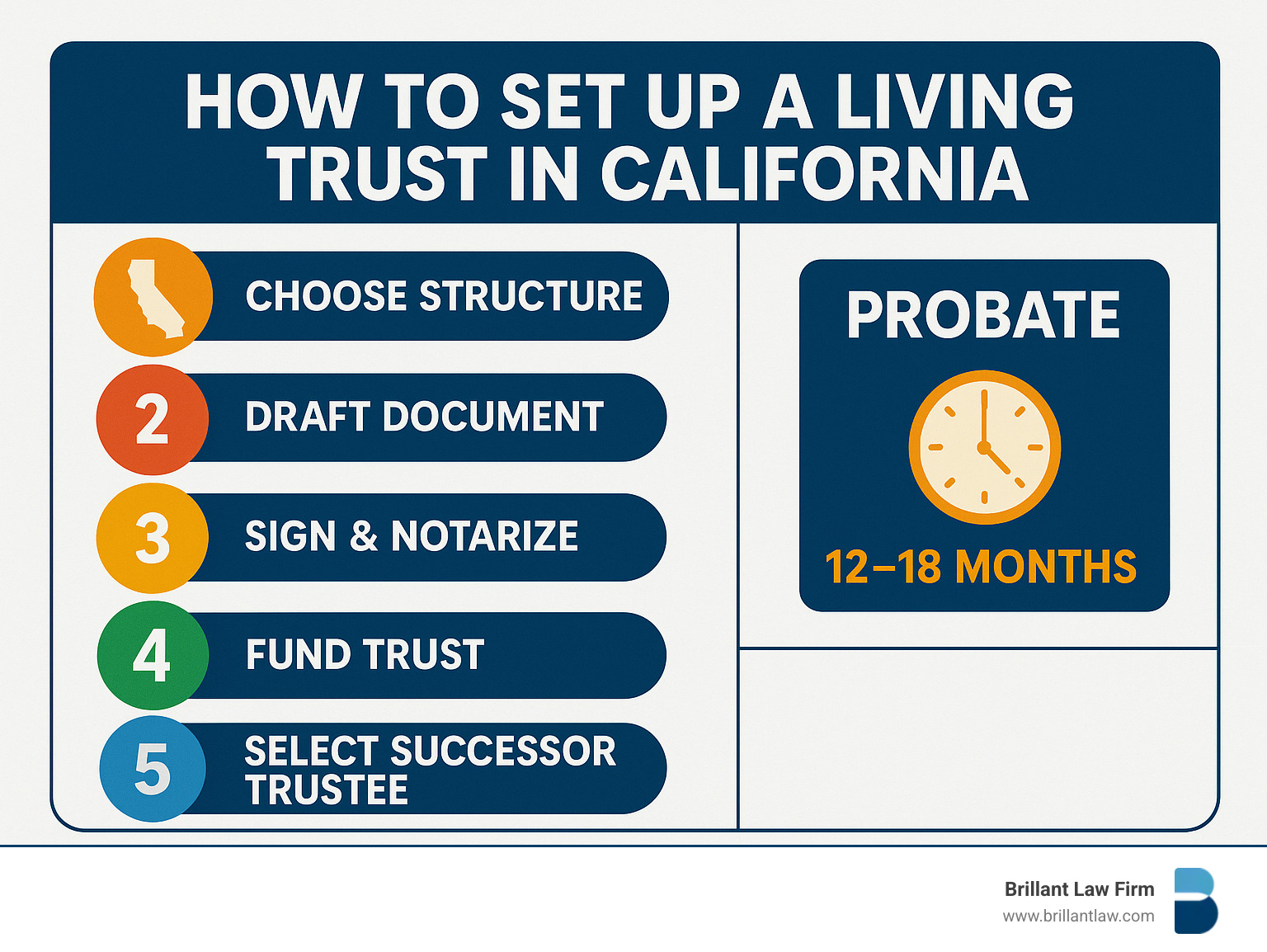
Setting up a living trust in California involves five key steps: choosing your trust structure, drafting the document, signing and notarizing it properly, funding the trust with your assets, and selecting a qualified successor trustee.
Quick Setup Steps for California Living Trusts:
- Choose Structure – Individual or joint trust based on marital status
- Draft Document – Include beneficiaries, distribution terms, and successor trustees
- Sign & Notarize – Meet California Civil Code requirements
- Fund Immediately – Transfer real estate, bank accounts, and personal property
- Select Successor – Name and educate your backup trustee
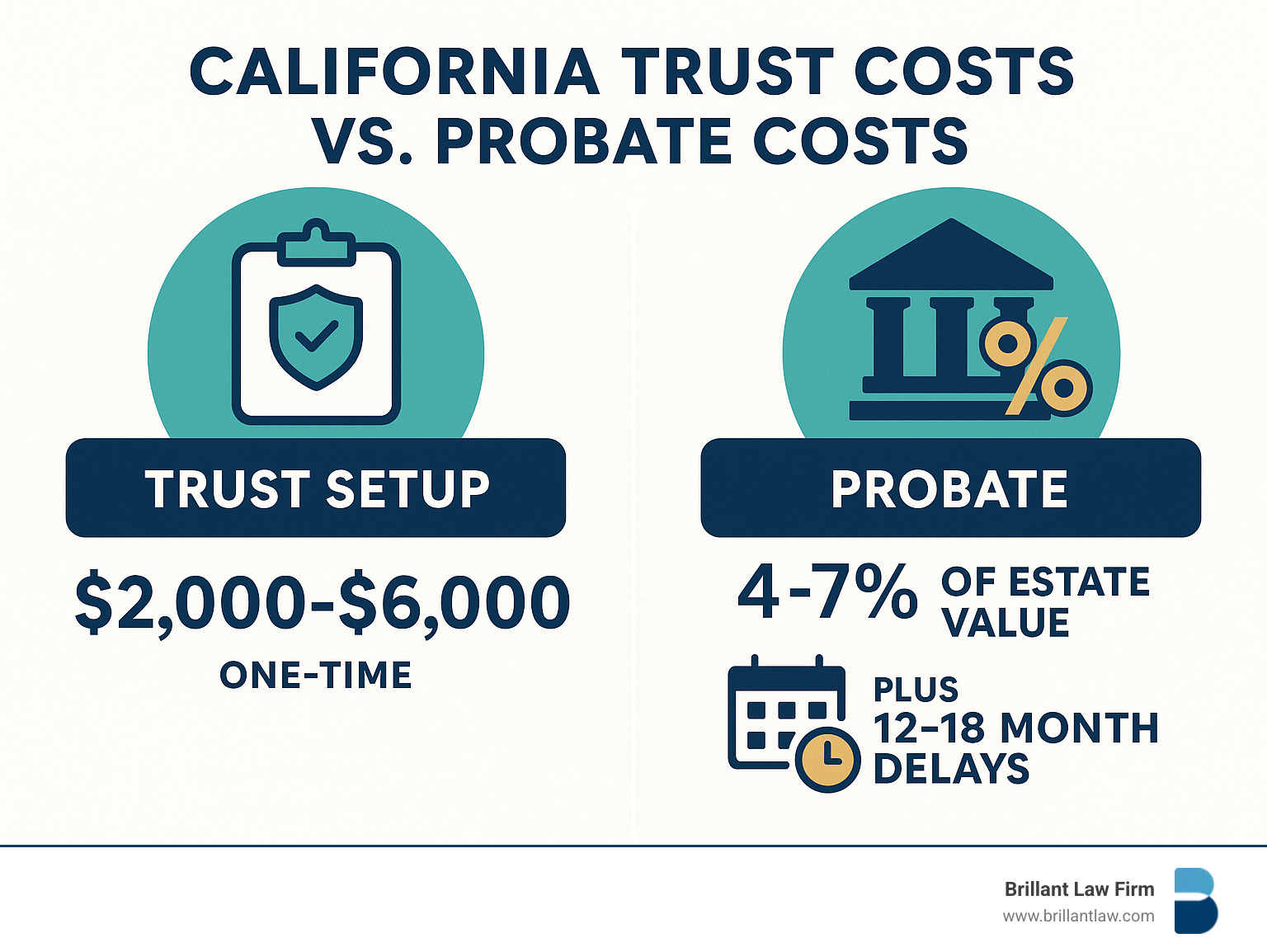
Living trusts offer California residents significant advantages over traditional wills. Assets in a properly funded trust avoid probate entirely, saving your family months or years of court delays and thousands in legal fees. California’s probate process can cost 4-7% of your estate value, while a living trust provides immediate access to assets upon your death or incapacitation.
The privacy benefits are equally compelling. While probate records become public documents, trust distributions remain completely confidential. This protection is especially valuable for high-net-worth individuals who prefer to keep their financial affairs private.
California’s community property laws add another layer of complexity that makes professional guidance invaluable. Married couples can structure their trusts to maximize federal estate tax benefits, potentially protecting up to $27.98 million from taxation in 2025.
I’m David Brillant, a Certified Specialist in Estate Planning, Trust and Probate Law with a Masters in Taxation, and I’ve helped countless California families steer complex estate planning challenges. My experience solving seemingly impossible trust and tax problems has shown me that proper planning today prevents costly disputes tomorrow.
Related content:
– Estate planning guidance
– Family trust planning
– Estate and trust lawyer
Why a Living Trust Matters in California
California residents face unique challenges that make living trusts particularly valuable. Without proper planning, families often struggle with probate headaches that are completely avoidable.
Last month, I watched a widow struggle to pay her mortgage because her husband’s assets were tied up in probate. She had to ask the court for permission to access their own bank account – a process that took three months and cost thousands in legal fees.
California Probate Drawbacks
California’s probate system hits families hard. Our state uses a statutory fee schedule that can devour 4-7% of your estate’s value before your loved ones see anything.
A $1 million estate generates $23,000 in attorney fees and $23,000 in executor fees automatically. That’s $46,000 vanishing into the court system instead of supporting your family.
Most California probate cases drag on for 12-18 months, but complex estates can be stuck in court for years. During this period, your assets sit frozen while your family waits for permission to make basic financial decisions.
Probate records become public documents the moment they’re filed. Anyone can learn intimate details about your finances, family relationships, and personal disputes.
Key Living Trust Advantages
A properly funded living trust flips this entire script. When you pass away, your successor trustee can distribute assets immediately – no court involvement, no waiting periods, no public records.
The incapacity planning benefits often matter even more. If illness or injury leaves you unable to manage your affairs, your living trust prevents the need for a conservatorship. Your chosen successor trustee simply takes over seamlessly.
California’s community property laws create unique tax advantages for married couples with living trusts. When structured correctly, all community property assets receive a “stepped-up basis” at the first spouse’s death, saving tens of thousands in capital gains taxes.
Step-by-Step: Creating a Revocable Living Trust in California
Creating an effective living trust requires building a comprehensive plan that protects your family’s future. California residents need to understand our state’s unique requirements and opportunities.
The process begins with honest self-reflection about your goals. Are you primarily worried about probate costs? Do you want to ensure someone can manage your affairs if you become incapacitated? Your answers will shape every decision moving forward.
Asset inventory is crucial. We often find that clients have forgotten about old bank accounts, inherited jewelry, or business interests. This comprehensive cataloging helps determine which assets belong in your trust.
The successor trustee decision requires careful consideration. This person will have sweeping authority over your life’s work, so you need someone who combines trustworthiness with practical competence. We typically recommend naming a primary successor plus backups.
California’s community property rules add complexity that requires careful attention. Married couples need to consider whether a single joint trust or separate individual trusts work better for their situation.
The Checklist for Creating a Trust walks you through these considerations systematically.
Notary requirements in California are stricter than many states, and getting this step wrong can invalidate your entire trust. The funding process – actually transferring your assets into the trust – is where many DIY efforts fall apart.
1. Choose Trust Structure & Draft Document
The first major decision is choosing the right trust structure. California married couples typically benefit most from a joint revocable living trust, which handles the state’s community property laws while giving both spouses flexibility to manage their separate assets.
If you’re single, an individual trust offers simplicity and complete control. You won’t need to steer community property rules, making the structure more straightforward.
California’s community property laws create unique opportunities. When a married couple structures their trust properly, all community property receives a “stepped-up basis” when the first spouse dies, saving thousands in capital gains taxes.
The trust document itself must be comprehensive. Vague language like “distribute fairly among my children” has sparked countless family feuds. We’ve seen siblings stop speaking over ambiguous trust terms that could have been clarified with precise drafting.
Your trust document should address real-world scenarios. What happens if you and your spouse die simultaneously? How should assets be managed if a beneficiary develops addiction issues? What about digital assets?
California Civil Code requirements make professional drafting invaluable. The document must include specific language about community property characterization, trustee powers, and distribution mechanisms that comply with state law.
While online tools like WillMaker & Trust exist, they can’t provide the customization that California families need. Professional drafting ensures your trust accomplishes your actual goals rather than just checking legal boxes.
2. Sign & Notarize Correctly
California Civil Code Section 15600 has specific requirements that can make or break your trust’s validity. Getting the signatures right is crucial.
You must sign your trust document in writing. As the settlor, your signature is absolutely essential. Without it, you don’t have a valid trust.
While California law doesn’t technically require notarization for the trust document itself, we always recommend it. Notarization provides insurance against future challenges. When emotions run high after someone passes away, family members sometimes question signature authenticity.
Witness signatures provide another layer of protection. Having two disinterested witnesses sign your trust document significantly strengthens its validity, making it easier to prove authenticity if questions arise later.
We always prepare a certification of trust simultaneously. This abbreviated document allows your successor trustee to conduct business with banks and title companies without revealing your trust’s private terms.
Proper execution prevents expensive headaches. I’ve represented families who spent $25,000 to $50,000 in legal fees fighting over trust validity issues that proper signing procedures would have prevented entirely.
3. Fund the Trust Immediately
You can have the most beautifully written trust document, but if you don’t actually move your assets into it, you’ve created an expensive paperweight. This funding process is absolutely critical because unfunded trusts don’t avoid probate.
Real estate transfers are usually the biggest piece. We prepare grant deeds or quitclaim deeds that officially transfer ownership from you personally to your trust, then ensure proper recording with your county recorder’s office.

Bank and brokerage accounts require their own procedures. Each financial institution has different requirements for trust accounts. Most need new signature cards and account agreements showing the trust as owner.
Personal property presents unique challenges since you can’t get titles for china or art collections. Instead, we prepare a comprehensive assignment document that legally transfers ownership of personal belongings to the trust.
Business interests deserve extra attention because partnership agreements and corporate bylaws sometimes restrict how you can transfer ownership interests. We review these documents before making changes to avoid complications.
The key is doing this immediately after signing your trust document. We’ve seen families find after a loved one’s death that the trust was never properly funded, meaning they face the exact probate process they thought they’d avoided.
4. Select & Educate Your Successor Trustee
Choosing your successor trustee might be your most important decision. This person will manage your investments, pay bills, file tax returns, and distribute assets to your loved ones.
Your successor trustee needs three key qualities: absolute trustworthiness, financial competence, and time to do the job properly.
Family members bring irreplaceable advantages – they understand your values and care about your beneficiaries. However, they may lack investment expertise or feel overwhelmed by fiduciary duties.
Corporate trustees offer professional management but charge ongoing fees. Professional trustee fees in California typically range from 0.5% to 1.5% of trust assets annually.
Co-trustee arrangements often provide the perfect solution. A family member handles personal decisions while a professional trustee manages investments and complex administration.
California law imposes extensive fiduciary duties on trustees. They must act solely in beneficiaries’ best interests, avoid conflicts of interest, invest prudently, maintain detailed records, and communicate regularly with beneficiaries.
We always schedule education sessions with chosen successor trustees, covering everything from basic fiduciary duties to practical administration tips. Understanding compensation options upfront prevents awkward conversations later.
You can always change your successor trustee by amending your trust. Regular reviews help ensure your trustee selection remains appropriate as circumstances evolve.
5. Maintain, Amend, or Revoke as Life Changes
One of the biggest advantages of a revocable trust is its flexibility – you can modify it whenever circumstances change.
Marriage changes everything. If you created an individual trust while single, you’ll likely want to consider converting to a joint trust. California’s community property laws mean assets acquired after marriage may need different treatment.
Divorce requires immediate attention. Your ex-spouse should typically be removed as beneficiary and successor trustee right away. Asset division during divorce often requires trust amendments to reflect new ownership structures.
New children or grandchildren often prompt joyful trust updates. Adding new beneficiaries is usually straightforward, but consider how their addition affects the overall distribution plan.
Large asset purchases sometimes require specific trust amendments. That vacation home, classic car collection, or new business venture might benefit from detailed management instructions.
The beauty of revocable trusts is that you maintain complete control during your lifetime. You can amend specific provisions, add new assets, change beneficiaries, or revoke the entire trust if circumstances change dramatically.
Funding & Maintaining Your California Living Trust
The real work begins after signing your trust document. Every new bank account, investment, or piece of real estate you acquire needs to be titled in your trust’s name.
Real estate recording involves specific procedures that vary by California county. Some counties charge minimal recording fees, while others may impose transfer taxes reaching thousands of dollars.
Digital assets are often forgotten. Your online banking, cryptocurrency wallets, photo libraries, and social media accounts all have value. Your trust document should include specific language about digital assets.
Retirement accounts require a different approach. You can’t transfer your 401(k) or IRA to a trust during your lifetime. Instead, you name the trust as beneficiary.
For detailed guidance, our Living Trust Administration After Death resource walks families through the entire process.
Keeping Your Trust Up-to-Date
We recommend annual reviews to ensure everything still makes sense with your current situation. California’s legislature occasionally modifies trust laws, and professional monitoring of these changes is part of what we provide.
Tax & Fee Considerations
California imposes no state estate tax, making planning simpler. You only need to worry about federal estate tax, which affects estates over $13.99 million per person in 2025.
Professional trust preparation typically costs $3,000 to $8,000 in California. Consider this: probate on a $1 million estate costs about $46,000 in statutory fees alone.
Common Pitfalls & Frequently Asked Questions
After years of helping California families, I’ve seen the same mistakes repeatedly – often with expensive consequences.
Funding gaps represent the biggest trap. Clients create comprehensive trust documents but never transfer assets into the trust. When these folks pass away, their “protected” assets still go through probate.
Vague distribution terms create litigation nightmares. Instructions like “divide my assets fairly among my children” might seem clear when writing them, but become family conflict sources later.
Can I Set Up a Trust Without a Lawyer in California?
DIY trust software promises quick, affordable solutions, and some people do manage to create basic trusts this way. But California’s legal landscape is particularly treacherous for do-it-yourselfers.
Our state’s community property rules create complexities that generic software can’t handle. When married couples mix separate and community property in trusts, tax implications can be enormous.
Legal risks multiply quickly with homemade trusts. Invalid execution procedures, improper funding instructions, and missed tax-saving opportunities often cost more to fix than professional preparation would have cost initially.
Our analysis in Can I Set Up a Trust Without a Lawyer? walks through specific scenarios where professional help becomes essential.
What Assets Should Stay Outside the Trust?
Retirement plans like 401(k)s and traditional IRAs should never be transferred directly during your lifetime. These accounts lose their tax-deferred status if you change ownership. Instead, name your trust as beneficiary.
Health Savings Accounts present similar issues. Transfer an HSA to your trust, and you’ll immediately owe taxes plus penalties.
How Often Should I Review My Trust?
Every three years represents our baseline recommendation, but major life events should trigger immediate attention.

Conclusion
Setting up a living trust in California isn’t just about following a checklist – it’s about creating a comprehensive safety net that protects your family’s future. California residents have distinct advantages that make trusts particularly powerful here.
The numbers speak for themselves. California’s probate system can consume 4-7% of your estate value and tie up assets for 12-18 months or longer. A properly funded living trust eliminates these costs entirely while maintaining complete privacy.
Estate planning is holistic. Your living trust should work seamlessly with your other planning documents like wills, powers of attorney, and healthcare directives. When these pieces fit together properly, they create ironclad protection.
The peace of mind from comprehensive planning is invaluable. Your spouse won’t be locked out of bank accounts, your children won’t steer complex probate systems, and your family’s private affairs will stay private.
California’s community property laws make professional guidance essential. The tax-saving opportunities available to married couples can be substantial, but only if your trust is structured correctly.
At Brillant Law Firm, we’ve spent years perfecting our approach to California living trusts. Our bespoke, ironclad California estate strategies aren’t cookie-cutter solutions – they’re custom-built for each client’s unique situation.
The investment in professional trust planning typically pays for itself many times over. While attorney fees range from $3,000 to $8,000 for comprehensive trust preparation, this cost pales compared to probate expenses that can easily reach $50,000 or more.
For detailed guidance on our comprehensive approach, visit our Living Trust Attorney page. You’ll find how our unparalleled expertise in trusts, estates, and taxation ensures your plan will work exactly as intended.
Whether you’re just starting to think about estate planning or need to update an existing trust, we’re here to help. The best time to create a living trust was yesterday – the second best time is today. Contact us to schedule a consultation and take the first step toward protecting your family’s future.


