

If you're searching for how to remove a trustee from a trust, you're probably already dealing with a problem that feels personal, expensive, and hard to prove. In Walnut Creek and nearby communities, that often starts the same way. A beneficiary asks for an accounting. The trustee delays. Distributions stop making sense. Questions get answered with half-explanations or silence.
That uneasy feeling matters. In trust disputes, people usually notice the behavior before they know the legal label for it. The law doesn't remove trustees because a beneficiary is frustrated. It removes trustees when the facts show the trustee is harming the trust, ignoring duties, or can no longer serve properly.
When Trust Is Broken A Beneficiary's Dilemma
A common local scenario looks like this. An adult child in Saranap or Castle Hill learns that a parent’s trust is supposed to pay certain expenses or make regular distributions. Instead, months pass with no clear reporting. The trustee says the market is down, bills are complicated, or records are being organized. But there’s still no accounting, no timeline, and no straight answer about where the money went.

By the time someone calls a trust litigator, the issue usually isn't one bad conversation. It's a pattern. The trustee won't provide backup documents. Family members hear conflicting stories. A property isn't being maintained. A sale happens without clear explanation. The trust starts feeling like a black box.
Why beneficiaries hesitate
Most beneficiaries don't want a court fight. They worry they'll look aggressive, damage family relationships, or spend money they can't recover. Co-trustees often face a different problem. They know something is wrong, but they aren't sure when disagreement becomes legal misconduct.
That hesitation is understandable. Trustee removal sounds extreme. In practice, it's often a protective remedy. The point is to preserve trust assets and carry out the settlor's instructions, not to punish personality conflicts.
A trustee removal case is strongest when the story isn't "we don't get along." It's "the trustee's conduct is hurting the trust, and here's the record that proves it."
The issue usually starts with rights, not removal
Before removal becomes the focus, beneficiaries usually need information. They need the trust terms, the accounting history, and the trustee's written explanations. Those are not favors. They are part of trust administration. If you need a grounding in those basics, Brillant Law's page on California trust beneficiary rights is a useful starting point.
In Contra Costa County matters, the practical question is rarely whether a trustee has upset the family. The question is whether the trustee can still be trusted to administer the trust lawfully and competently. When the answer is no, California law provides a removal process. But it works only when the petitioner treats it like a legal case, not a family argument.
Legal Grounds for Trustee Removal in California
California courts don't remove trustees because a beneficiary thinks someone else would do a better job. The court needs a recognized legal basis. Under California Probate Code section 15642(a), a trustee may be removed in four basic ways: under the trust instrument's own terms, by the court on its own motion, on petition by a settlor, co-trustee, or beneficiary under section 17200, or for specific grounds under section 15642(b).
The grounds that matter most in practice
Under California Probate Code section 15642(b), a trustee can be removed for serious breach of trust, failure to administer the trust effectively, or substantial inability to resist fraud or undue influence. In Northern California superior courts, petitions based on documented breaches under section 15642(b)(1) succeed in approximately 40 to 50 percent of contested cases, and Bay Area counties including Contra Costa and Santa Clara see over 1,200 trust disputes filed annually according to Keystone Law's discussion of trustee removal.
That rule sounds broad. Courts apply it in specific ways.
Serious breach of trust
This category often comes to mind first. It includes conduct such as self-dealing, diverting trust opportunities, using trust assets for personal benefit, failing to keep required records, or making unauthorized distributions.
A serious breach usually has documents behind it. The record may show a transfer to the trustee, unexplained withdrawals, an undisclosed loan, or accounting gaps that shouldn't exist.
Failure to administer the trust
Some trustees aren't stealing. They're not doing the job. That can still justify removal.
Examples include:
- Ignoring required tasks such as collecting assets, paying valid expenses, or handling tax-related responsibilities tied to administration.
- Failing to provide information when beneficiaries are entitled to updates and accountings.
- Letting assets deteriorate such as real property with unpaid carrying costs, lapsed insurance, or unmanaged maintenance.
- Paralyzing decision-making so the trust sits in limbo while beneficiaries absorb the damage.
A court looks at whether the trust is being administered competently, not whether the trustee had good intentions.
What doesn't usually work
Many beneficiaries come in with real anger and no legal case. That's fixable if there are facts. It isn't fixable if the complaint is only interpersonal.
The weakest removal petitions usually sound like this:
| Complaint | Court's likely response |
|---|---|
| "The trustee is rude." | Rudeness alone won't justify removal. |
| "We argue constantly." | Hostility by itself usually isn't enough. |
| "I don't trust her." | The court wants conduct, records, and measurable failures. |
| "He favors one side of the family." | The court asks whether that favoritism translated into a breach of duty. |
Hostility matters only when it interferes with proper administration or reflects a deeper problem such as bias, obstruction, or refusal to account.
Practical rule: Judges remove trustees for misconduct, incapacity, or administrative failure. They don't referee ordinary family resentment.
Unfitness and vulnerability to influence
Section 15642(b) also reaches trustees who are substantially unable to resist fraud or undue influence. That issue often develops subtly. A trustee may be elderly, cognitively impaired, or under heavy pressure from another family member or advisor. The problem isn't age by itself. The problem is whether the trustee can still protect the trust and make independent decisions.
Evidence becomes critical here. Courts don't act on suspicion alone.
Trust terms can control removal too
Always read the trust before assuming court intervention is required. Some trust instruments contain express removal provisions. Those may allow removal by a beneficiary vote, by a co-trustee, or upon a stated event such as certified incapacity. If the trust gives a clear method, that route may be faster and cheaper than litigation.
A lot of these cases also involve an underlying breach of fiduciary duty claim, because removal and surcharge issues often overlap. If you want the broader legal context, Brillant Law's page on what is breach of fiduciary duty explains the duty side of the analysis.
The Three Paths to Removing a California Trustee
Not every trustee removal starts in court. In practice, there are three main paths, and the right one depends on the trust language, the urgency of the risk, and the quality of the evidence.
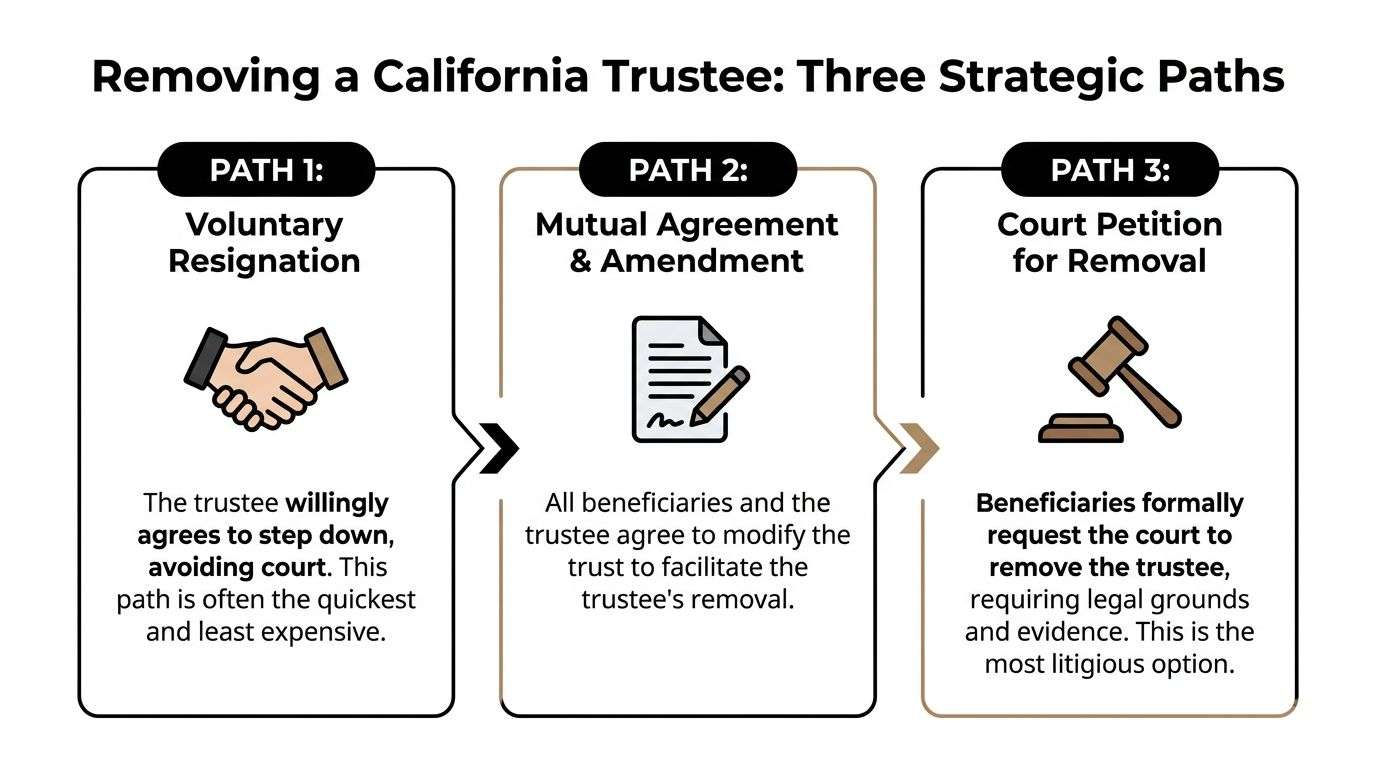
Path one uses the trust's own removal language
This is the cleanest route when it's available. Some trusts say a trustee may be removed by named parties, by a majority of beneficiaries, or after a defined event such as incapacity certification.
When that language exists, the work is mostly technical. You confirm who holds the power, what notice is required, whether a successor is named, and what transition documents need to be signed.
This path works best when:
- The trust is explicit and doesn't leave room for interpretation.
- The people with removal power agree on using it.
- There isn't an emergency fight over records or access that requires court orders.
It doesn't work well when the trustee disputes the validity of the process, refuses to turn over property, or claims the conditions for removal haven't been met.
Path two is negotiated resignation
Many strong trustee removal matters don't end with a removal hearing. They end with pressure. A carefully drafted demand letter can force a trustee to confront the paper trail, the likely petition, and the risk of a surcharge claim.
A negotiated exit often includes a resignation, turnover deadlines, interim record production, and a neutral process for successor transfer. That can spare the trust a long public fight.
Negotiation is especially effective when the trustee is a family member who never wanted the role, has poor records, or realizes the case will get worse in discovery. It is less effective when the trustee has already taken a hardened position, is hiding transactions, or believes control of the trust provides an advantage in a broader family conflict.
The best demand letters don't sound emotional. They read like the first draft of a petition.
Some trusts also require attention to succession mechanics when a trustee steps aside. If you're dealing with replacement issues, Brillant Law's page on successor trustees can help clarify what happens next.
Path three is a court petition under Probate Code section 15642
When the trust doesn't provide a workable removal method and voluntary resignation isn't happening, the case goes to court. In Contra Costa County, that means careful pleading, strong evidentiary support, and attention to local procedure.
The petition typically asks for removal and may also ask for related relief. Depending on the facts, that can include an accounting, instructions, appointment of a replacement trustee, surcharge-related issues, or restrictions on current trustee authority.
Here is the practical comparison:
| Path | Speed | Cost exposure | Control | Best fit |
|---|---|---|---|---|
| Trust instrument removal | Usually fastest | Usually lowest | High if terms are clear | Trust has strong removal language |
| Negotiated resignation | Moderate to fast | Lower than full litigation | Moderate | Trustee may step down under pressure |
| Court petition | Slowest | Highest | Court-controlled | Trustee resists and evidence is strong |
Interim suspension is often the overlooked move
California practice doesn't stop at filing a removal petition. For beneficiaries facing an uncooperative trustee, California law allows interim relief, including a request for immediate suspension of the trustee's powers while the case is pending. Removal petitions can take 6 to 18 months, and local procedure matters. Contra Costa Superior Court may require pre-filing mediation in some matters. Trustee removal petitions have also risen 22 percent in recent years, as noted in this California-focused overview of trustee removal procedure.
That matters because the biggest mistake in these cases is assuming you have to sit still while the trustee keeps control. If the record shows imminent harm, a suspension request may be the most important part of the filing.
When suspension makes sense
A suspension request deserves serious consideration when the trustee is:
- Draining accounts or moving assets
- Refusing to account while transactions continue
- Trying to sell or encumber property under suspicious circumstances
- Using trust control to block access to records
Suspension isn't automatic. The court needs facts showing immediate risk. But when the danger is real, asking only for eventual removal can be too passive.
What usually fails
A weak petition often has one of these flaws:
- No documentary support. The petitioner believes misconduct happened but has little in writing.
- No urgency theory. Harm is alleged, but not tied to a present risk.
- No practical successor plan. The court is asked to remove someone without a clear administrative next step.
A trustee removal case works when the remedy matches the problem. Sometimes that means using the trust's own language. Sometimes it means forcing a resignation. Sometimes it means asking the court to step in immediately before more damage is done.
How to Build a Compelling Case for Removal
A judge in a Northern California trust matter won't remove a trustee because the beneficiary sounds credible. The court wants records, chronology, and a direct connection between the trustee's conduct and the risk to the trust.

In California courts, successful trustee removal petitions require technical evidence, such as audited ledgers showing mismanagement or medical reports proving incapacity. Petitions tend to succeed at around 50 percent when there are clear breaches like self-dealing, but can drop to 20 to 30 percent for incapacity claims without definitive medical evaluation. Courts require proof of positive abuse that jeopardizes trust property, not just personal antagonism, as summarized in this discussion of removal evidence in California trust disputes.
Build the record before you build the rhetoric
The strongest cases usually start with the documents the trustee didn't expect anyone to organize.
Focus on these categories:
- Financial records such as account statements, canceled checks, wire records, escrow papers, and property expense records.
- Trust administration records including formal accountings, notices, distribution schedules, and tax-related administration documents.
- Communications like emails, text messages, letters, and portal messages where the trustee explains delays, denials, or transactions.
- Medical evidence if incapacity is part of the claim. General observations are weak. Clinical documentation is what matters.
- Third-party records from brokers, bookkeepers, care facilities, property managers, or escrow holders when those records tie directly to the trust's administration.
What judges notice quickly
Judges tend to focus on clarity. If your evidence is scattered across screenshots, mislabeled PDFs, and incomplete records, even a valid case can look weak.
That is why presentation matters. Before producing digital records to counsel or using them in litigation prep, it can help to review file properties and hidden document history. A practical guide on removing metadata from PDF is useful when you're organizing sensitive trust materials for disclosure.
Organize records in date order. A clean timeline often proves more than a dramatic accusation.
Use a working evidence map
Instead of dumping documents into folders, tie each record to a legal issue. A simple internal chart can include:
| Document | What it shows | Why it matters |
|---|---|---|
| Bank statement | Unexplained withdrawal | Supports breach or self-dealing theory |
| Email refusal | Trustee denies accounting | Supports failure to administer |
| Medical report | Cognitive decline | Supports unfitness or incapacity claim |
| Escrow file | Sale proceeds mismatch | Supports tracing of misapplied funds |
This approach helps counsel decide what belongs in the petition, what should wait for discovery, and what may justify interim relief.
Depositions and forensic work
Some cases can't be built from voluntary records alone. If the transactions are layered, a forensic accountant may be necessary to trace funds or explain accounting irregularities. If the trustee has changed stories, deposition testimony can lock in explanations that later collapse against documents.
Brillant Law Firm handles these cases as a California trust and estate litigation practice and can work with beneficiaries, co-trustees, and fiduciaries on petitions, accountings, and related evidence development. In a removal matter, that practical coordination often matters as much as the legal theory.
The Financial Reality Trustee Removal Costs and Timelines
People ask the same two questions early. How much will this cost, and how long will it take. In California trust litigation, especially around Walnut Creek and Contra Costa County, those questions need straight answers.

Attorney fees for trust litigation in California, particularly in Bay Area communities like Walnut Creek, typically range from $400 to $1,000+ per hour. A contested trustee removal petition can cost a beneficiary $25,000 to $75,000, while the trustee often uses trust funds for defense. Complex cases involving forensic accounting can exceed $150,000, and mediation can resolve disputes 60 percent faster than litigation, according to Brillant Law's discussion of civil litigation costs in California.
Where the money goes
A removal case isn't just a filing fee and a hearing. Costs usually come from several layers of work.
- Initial case development includes trust review, record analysis, and strategy on whether to demand resignation or file immediately.
- Petition drafting and response work often expands once the trustee contests facts or files objections.
- Discovery can include subpoenas, document review, depositions, and accounting analysis.
- Experts may be needed for tracing, valuation, or medical capacity issues.
- Mediation and hearings add another round of preparation and advocacy.
The hidden pressure point is this: the trustee may be defending with trust assets while the beneficiary is paying personally. That dynamic changes settlement advantage and should be addressed early.
Time is rarely your friend
Even strong cases take time. Courts move on calendars, not family urgency. In a contested matter, the practical timeline often depends on whether records are produced voluntarily, whether emergency relief is requested, and whether the parties can resolve the succession issue without a full evidentiary fight.
A rough reality check looks like this:
| Phase | What happens |
|---|---|
| Early stage | Trust review, demand, emergency evaluation, petition prep |
| Filing stage | Petition, service, initial responses |
| Active litigation | Discovery, accountings, subpoenas, possible mediation |
| Decision point | Settlement, resignation, or court ruling |
The timeline feels longest when the trustee is nonresponsive but not openly reckless. Those are the cases where litigation keeps moving, yet every step requires another order or motion.
Cost control comes from case selection and sequencing. Not every bad trustee requires every possible motion.
The practical trade-off
Some beneficiaries should litigate immediately. Others should use the threat of litigation to force records, a resignation, or a structured transition. Spending heavily without a clear asset-protection goal can damage the very trust you're trying to protect.
In Walnut Creek, San Miguel, Saranap, and Castle Hill matters, the best approach usually starts with a realistic budget, a candid look at likely evidence, and a plan for what outcome fixes the problem. Sometimes that is removal. Sometimes it is a corrected accounting, tighter oversight, or a negotiated handoff.
Why You Need a Specialist for Your Trust Dispute
Trustee removal cases look simple from the outside. A trustee did something wrong, so ask the court to remove them. In real practice, that isn't how these matters unfold.
The case has to be framed under the right California statute. The evidence has to match the legal ground. The requested remedy has to fit the risk. In Contra Costa County, local procedure can affect timing and strategy before the judge ever reaches the merits.
This isn't a DIY probate filing
A self-represented beneficiary usually runs into the same problems. They overstate family conflict, under-document the actual breach, and ask for broad relief without a practical transition plan. Even when they are morally right, the petition can still fail.
A specialist approaches the matter differently:
- Reads the trust first to see whether court action is even necessary.
- Separates anger from evidence so the petition stays persuasive.
- Targets the right remedy such as accounting, suspension, removal, or a combination.
- Anticipates defense arguments about discretion, intent, consent, or harmless error.
- Protects the handoff so a successor can take control of assets and records.
Local court experience matters
Northern California trust disputes have their own practical rhythm. Counsel needs to know how these cases are presented, how judges react to incomplete records, and when mediation or emergency relief is worth pursuing. That local fluency matters in Walnut Creek and across Contra Costa County because trust litigation is rarely just about abstract legal principles. It is about getting a workable order that can be enforced.
A certified California estate litigation specialist also sees the overlap issues earlier. Trustee removal cases often involve accounting disputes, surcharge exposure, property management failures, and tax-sensitive administration choices. If those issues are ignored, a "win" on removal can still leave the trust in chaos.
What works and what doesn't
What works is disciplined preparation. Written demands tied to legal duties. Organized exhibits. A clear story of harm to the trust. A realistic proposal for successor administration.
What doesn't work is filing out of frustration, assuming a judge will infer misconduct from silence, or treating the case like a referendum on family behavior.
The court's question is narrower than most clients expect. Can this trustee continue to administer the trust safely and lawfully.
That is why these disputes belong with counsel who handles California trust litigation regularly and understands both the legal standard and the courthouse reality in this region.
If you're dealing with a trustee who won't account, appears to be mismanaging assets, or needs to be suspended or removed, Brillant Law Firm can evaluate the trust, the records, and the practical options available in Walnut Creek, Saranap, San Miguel, and Castle Hill. The right first step is usually a focused case assessment that identifies the governing trust terms, the strongest evidence, and whether the matter should be resolved by demand, mediation, or probate petition.


