

How to reduce taxable income for high earners: Top 2025 Tips
Why High Earners Need Strategic Tax Planning
For high earners facing substantial tax bills, learning how to reduce taxable income for high earners is critical. Fortunately, numerous legal strategies exist to lower your tax burden while building lasting wealth.
Quick Tax Reduction Strategies for High Earners:
- Maximize retirement contributions: Contribute to 401(k)s and other plans.
- Use Health Savings Accounts (HSAs): Take advantage of triple-tax benefits.
- Harvest investment losses: Offset capital gains and up to $3,000 of ordinary income.
- Donate appreciated assets: Avoid capital gains tax and get a full deduction.
- Leverage real estate depreciation: Create “paper losses” to offset income.
- Structure business entities strategically: An S-corp election can lower self-employment taxes.
- Time capital gains: Hold investments over a year for lower long-term rates.
As Judge Learned Hand famously stated, “Any one may so arrange his affairs that his taxes shall be as low as possible; he is not bound to choose that pattern which will best pay the Treasury.”
The stakes are high for California residents. With a top federal rate of 37% plus California’s state income tax, high earners can face combined rates over 50%. This makes proactive tax planning essential for preserving your wealth.
Effective tax reduction requires a comprehensive approach, implementing multiple strategies that work together to minimize your tax liability while ensuring full compliance. As David Brillant, a Certified Specialist in Estate Planning, Trust and Probate Law with a Masters in Taxation, I’ve helped countless clients develop sophisticated strategies on how to reduce taxable income for high earners through proper planning and implementation.
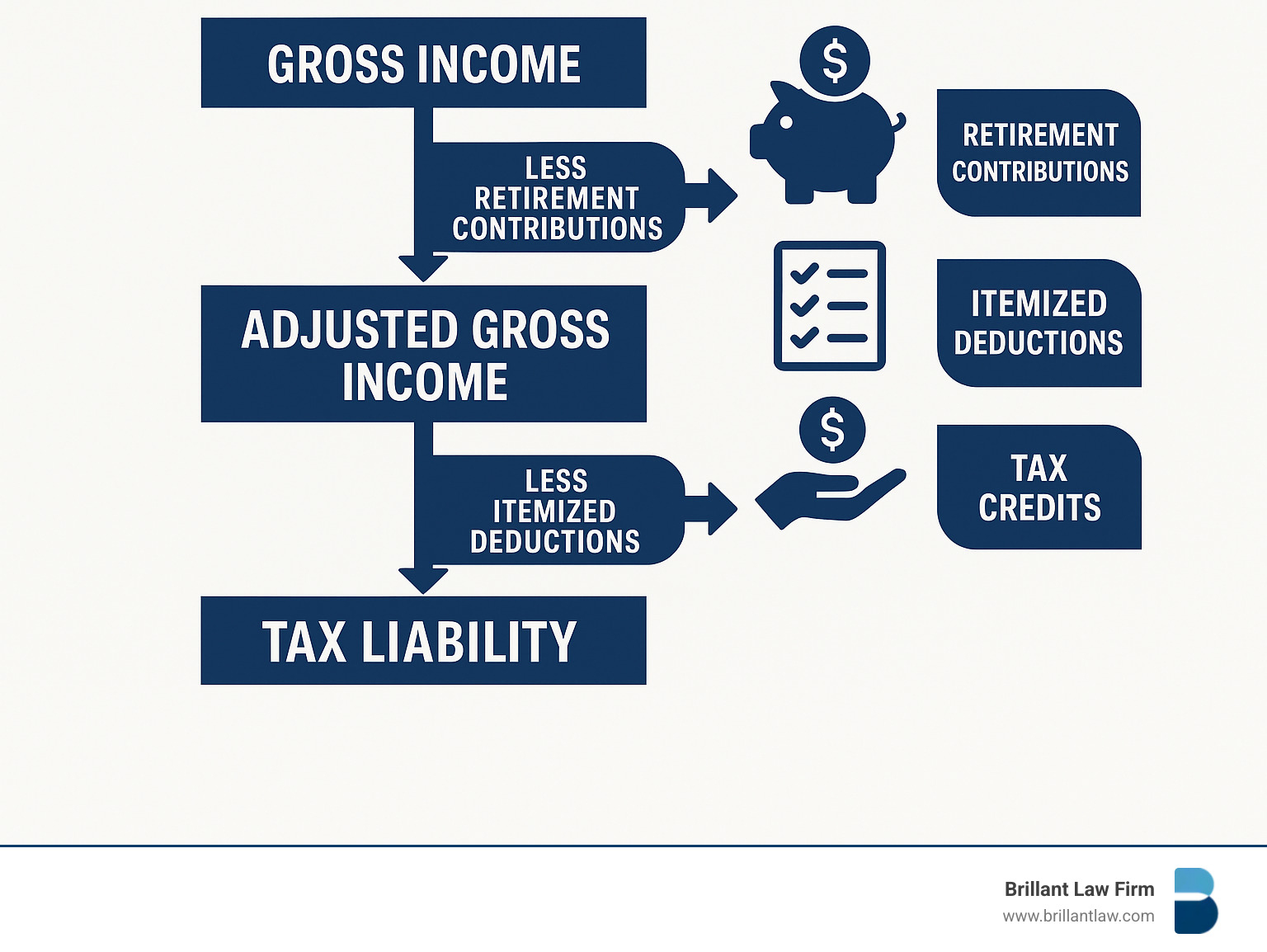
Quick how to reduce taxable income for high earners definitions:
Understanding Your High-Income Tax Landscape
Understanding the tax landscape is the first step toward keeping more of what you earn. Our progressive tax system means the more you make, the higher percentage you pay in taxes, making proactive planning essential for protecting your wealth. For California residents, this creates a double whammy when you combine federal and state taxes. The good news? Once you understand the system, you can work within it to your advantage.
What is a “High-Income Earner”?
The term “high-income earner” isn’t just for billionaires. The IRS defines it as anyone with Total Positive Income (TPI) of $200,000 or more on their tax return, including salary, business income, and investment returns.
For the 2025 tax year, the top federal tax bracket of 37% applies to taxable income over $626,350 for single filers and $751,600 for married couples filing jointly. Add California’s state income tax, and your combined burden can easily top 50%.

Your Adjusted Gross Income (AGI) is a crucial number, as it’s your gross income minus certain “above-the-line” deductions. Many tax benefits are limited based on your AGI, so lowering it is a primary goal. This is where knowing how to reduce taxable income for high earners becomes invaluable, helping you minimize the income taxed at the highest rates.
What defines a high-income earner
Why Your Income Type Matters
Not all income is treated equally by the IRS, a fundamental concept for tax optimization.
Ordinary income—like your salary and most business income—is taxed at federal rates up to 37%. In contrast, long-term capital gains and qualified dividends receive preferential treatment, with tax rates of 0%, 15%, or 20%.
Most high earners fall into the 20% bracket for long-term capital gains, plus a potential 3.8% Net Investment Income Tax on income above certain thresholds. Even with this extra tax, the rate is significantly lower than for ordinary income.
This disparity is why a primary goal is to convert ordinary income to capital gains whenever legally possible. The savings are substantial. Holding an investment for more than one year is one of the simplest ways to achieve this, changing a potential short-term gain (taxed as ordinary income) into a long-term one.
Foundational Tax Reduction: Maximizing Deductions and Accounts
Think of tax reduction like building a house—you need a solid foundation. This section covers the fundamental building blocks for any strategy on how to reduce taxable income for high earners. These are the tried-and-true methods that create immediate, substantial tax savings.
Boost Your Retirement and Health Savings
The most direct way to cut your taxable income is by maximizing contributions to tax-advantaged accounts. These “above-the-line” deductions reduce your Adjusted Gross Income (AGI).
Start with retirement contributions. Max out pre-tax contributions to employer plans like 401(k)s and 403(b)s. For 2025, you can contribute up to $23,500, plus a $7,500 “catch-up” if you’re 50 or older, for a potential $31,000 income reduction.
Traditional IRAs can also help, though deductibility may be limited for high earners with workplace plans. Still, they offer valuable tax-deferred growth. For those who exceed Roth IRA income limits, the Backdoor Roth IRA is a popular legal workaround. You make a non-deductible contribution to a Traditional IRA and then convert it to a Roth IRA, securing tax-free growth and withdrawals in retirement.
A Health Savings Account (HSA) offers a powerful “triple tax advantage” for those with high-deductible health plans: contributions are deductible, growth is tax-free, and withdrawals for medical expenses are tax-free. 2025 limits are $4,300 for individuals and $8,550 for families. By paying for current medical costs out-of-pocket and letting your HSA grow, you can create an additional tax-free retirement account.
Understanding these foundational strategies is crucial for effective taxation and tax planning.
Strategically Itemize Your Deductions
For most high earners in California, itemizing deductions provides greater tax benefits than taking the standard deduction.
The mortgage interest deduction is often the largest, allowing you to deduct interest on the first $750,000 of mortgage debt. The State and Local Tax (SALT) deduction is vital for Californians but is currently capped at $10,000 per household. While the cap limits the benefit, it’s still a deduction worth claiming.
Don’t overlook the medical expense deduction, which allows you to deduct costs that exceed 7.5% of your AGI. This can be significant in years with major medical events.
Successful itemizing requires meticulous record-keeping. This attention to detail is what separates effective tax planning from wishful thinking. These foundational strategies are the cornerstone of the comprehensive taxation strategies we implement for clients.
Investment and Real Estate Strategies to Lower Your Tax Bill
Your investment portfolio and real estate holdings offer powerful opportunities to lower your tax liability. The key is understanding how to reduce taxable income for high earners through smart tax management of those assets. A successful strategy involves both growing your wealth and minimizing what you owe.
How to Reduce Taxable Income for High Earners Through Smart Investing
Tax-loss harvesting is a highly effective technique. It involves selling investments at a loss to offset capital gains from your winners. You can offset unlimited capital gains and then use up to $3,000 of remaining losses to reduce your ordinary income annually. Any excess losses carry forward to future years.

Conversely, tax-gain harvesting can be useful in lower-income years. If your income drops, you may fall into the 0% long-term capital gains bracket, allowing you to sell and repurchase assets to step up your cost basis tax-free, reducing future tax bills.
For California residents, tax-exempt municipal bonds are especially attractive. Interest from California municipal bonds is generally exempt from both federal and California state income tax, a valuable “double tax-free” benefit.
When building your portfolio, focus on investments that pay qualified dividends. These are taxed at the same lower rates as long-term capital gains, not your higher ordinary income rate, saving you thousands annually.
Leveraging Real Estate for Substantial Tax Benefits
Real estate provides some of the most robust tax advantages, especially in California. Its beauty lies in generating “paper losses” that can offset real income.
Depreciation is a powerful tool. The IRS allows you to deduct a portion of your property’s value each year (typically over 27.5 years for residential real estate). These deductions can offset rental income and sometimes other ordinary income, even if the property’s market value is increasing.
The 1031 exchange lets you defer capital gains taxes on an investment property sale by reinvesting the proceeds into a similar property, allowing your wealth to grow tax-deferred.
The primary residence exclusion is a significant benefit for homeowners. You can exclude up to $250,000 of capital gains ($500,000 for married couples) from the sale of your main home.
For those heavily involved in real estate, achieving Real Estate Professional Status (REPS) allows you to deduct unlimited passive real estate losses against your ordinary income, provided you meet strict hour requirements.
Short-term rental strategies, when managed properly, can sometimes be treated as non-passive activities, allowing you to deduct losses against other income, especially when paired with cost segregation studies.
Advanced Tax Planning: How to Reduce Taxable Income for High Earners
Once you’ve mastered the foundational strategies, it’s time to explore more sophisticated approaches. These advanced techniques are particularly effective in charitable giving, business ownership, and estate planning—areas where personalized, ironclad strategies make a significant difference.
Optimize Charitable Giving for Maximum Impact
Strategic generosity can be a powerful tax reduction tool. The key is being smart about what and how you give.
Donating appreciated assets like stocks or real estate held for over a year is a premier strategy. You can avoid paying capital gains tax on the appreciation while still deducting the asset’s full fair market value. The charity gets a larger gift, and you get a larger tax benefit.
For those 70½ or older, Qualified Charitable Distributions (QCDs) allow you to make tax-free distributions of up to $100,000 per year directly from your IRA to charities. These count toward your Required Minimum Distributions but aren’t included in your AGI.
Charitable Remainder Trusts (CRTs) are a sophisticated option for those with highly appreciated assets. You transfer assets to an irrevocable trust, get an immediate income tax deduction, and receive an income stream for life or a set term. The remainder goes to charity, allowing you to convert appreciated assets into income while avoiding capital gains tax on the transfer.
High Net Worth Estate Planning
IRS rules on charitable deductions
Unique Opportunities for Business Owners
Business ownership open ups tax reduction opportunities unavailable to employees. Proper structure and operation are key.
Business entity structuring is critical. For many service businesses, an S-corporation election can significantly reduce self-employment taxes by allowing you to take profits as distributions rather than salary.
Maximizing business deductions for all “ordinary and necessary” expenses is essential. The Qualified Business Income (QBI) deduction also offers a valuable break, allowing eligible owners to deduct up to 20% of their qualified business income, though income limitations apply.
Hiring your children is an excellent strategy for family businesses. You can pay them a reasonable wage for legitimate work, which is a deductible expense for you. The income is typically taxed at the child’s much lower rate (or not at all) and can be used to fund a Roth IRA for their future.
Business Tax Advisory Services
Sophisticated Gifting and Estate Planning Techniques
For high-net-worth individuals, tax planning extends to wealth transfer. The annual gift tax exclusion lets you give up to $18,000 (in 2024) to any individual tax-free. The lifetime gift tax exemption is currently very high but is scheduled to be cut in half after 2025, creating a significant planning window.
Superfunding 529 plans allows you to contribute up to five years of the annual exclusion at once ($90,000 for an individual in 2024), removing a large sum from your taxable estate.
Using trusts for asset protection and tax reduction is a cornerstone of advanced planning. Trusts can move assets out of your taxable estate, protect them from creditors, and control their distribution. Structures like Grantor Retained Annuity Trusts (GRATs) can transfer appreciating assets with minimal gift tax consequences.

Frequently Asked Questions about Reducing Taxable Income
What is the single most effective way for a high earner to reduce taxable income?
There is no single “best” way, as the optimal strategy depends entirely on your unique financial situation. However, a universal starting point for nearly every high-earning client is to maximize contributions to all available tax-advantaged retirement accounts, such as a 401(k) and HSA. This provides an immediate, dollar-for-dollar reduction in your taxable income and builds wealth for the future. Once this foundation is in place, we can explore more advanced strategies custom to you.
Can I really pay my children to work for my business to save on taxes?
Yes, this is a legitimate and powerful strategy when executed correctly. The key requirements are that the business is real, the work performed is necessary, and the compensation is reasonable for the services rendered. For example, your child can manage social media or perform administrative tasks, but their pay must align with market rates.
The tax benefits are especially strong for sole proprietorships and family partnerships, where wages paid to a child under 18 are exempt from Social Security and Medicare taxes. This allows you to shift income to a lower tax bracket while saving on payroll taxes. Meticulous documentation of hours and work performed is essential.
Are the tax strategies discussed in this article legal?
Absolutely. Every strategy discussed is a form of tax avoidance, which is the completely legal process of arranging your financial affairs to minimize your tax liability within the bounds of the law. This is fundamentally different from tax evasion, which is the illegal underpayment or non-payment of taxes.
The methods we’ve covered are established, IRS-approved tools that Congress created to encourage behaviors like saving for retirement, investing in business, and giving to charity. They are not loopholes or gray areas.
However, proper implementation is crucial. Tax laws are complex and change frequently, especially in California. Working with a qualified tax professional ensures your strategies are structured correctly and remain fully compliant. At Brillant Law Firm, our expertise in both the transactional and litigation aspects of tax law ensures we design strategies that are not only effective but also defensible.
Take Control of Your Tax Future
We’ve covered strategies from foundational to advanced, all highlighting the power of proactive planning. The truth is that building long-term wealth isn’t just about earning more—it’s about keeping more of what you earn. For high earners in California, where combined tax rates can exceed 50%, strategic tax planning is essential for preserving your financial future.
Tax laws are complex and ever-changing. The upcoming sunset of the Tax Cuts and Jobs Act provisions in 2026 is just one example of why professional guidance is critical. Strategies like tax-loss harvesting, charitable trusts, and sophisticated business structuring require careful timing and expert implementation.
This is why personalized advice is invaluable. A skilled California tax attorney with a deep understanding of trusts, estates, and business law can help you steer these complexities. They can address California-specific issues, from residency rules to state tax benefits.
At Brillant Law Firm, we understand every high earner’s situation is unique. We provide bespoke, ironclad strategies custom specifically to your financial goals. Whether you’re dealing with stock options, real estate, business ownership, or wealth transfer, our expertise spans the full spectrum of tax planning.
Our unparalleled expertise and unwavering dedication mean we’re not just helping you save money today—we’re helping you secure your financial future for generations to come. We know California’s tax landscape, and we’re here to ensure you take advantage of every legal opportunity to minimize your tax burden.
Explore our advanced tax planning techniques to secure your financial future.


