

how much does it cost to setup a living trust: 7 Powerful Truths in 2025
The Real Cost of Creating a Living Trust in California
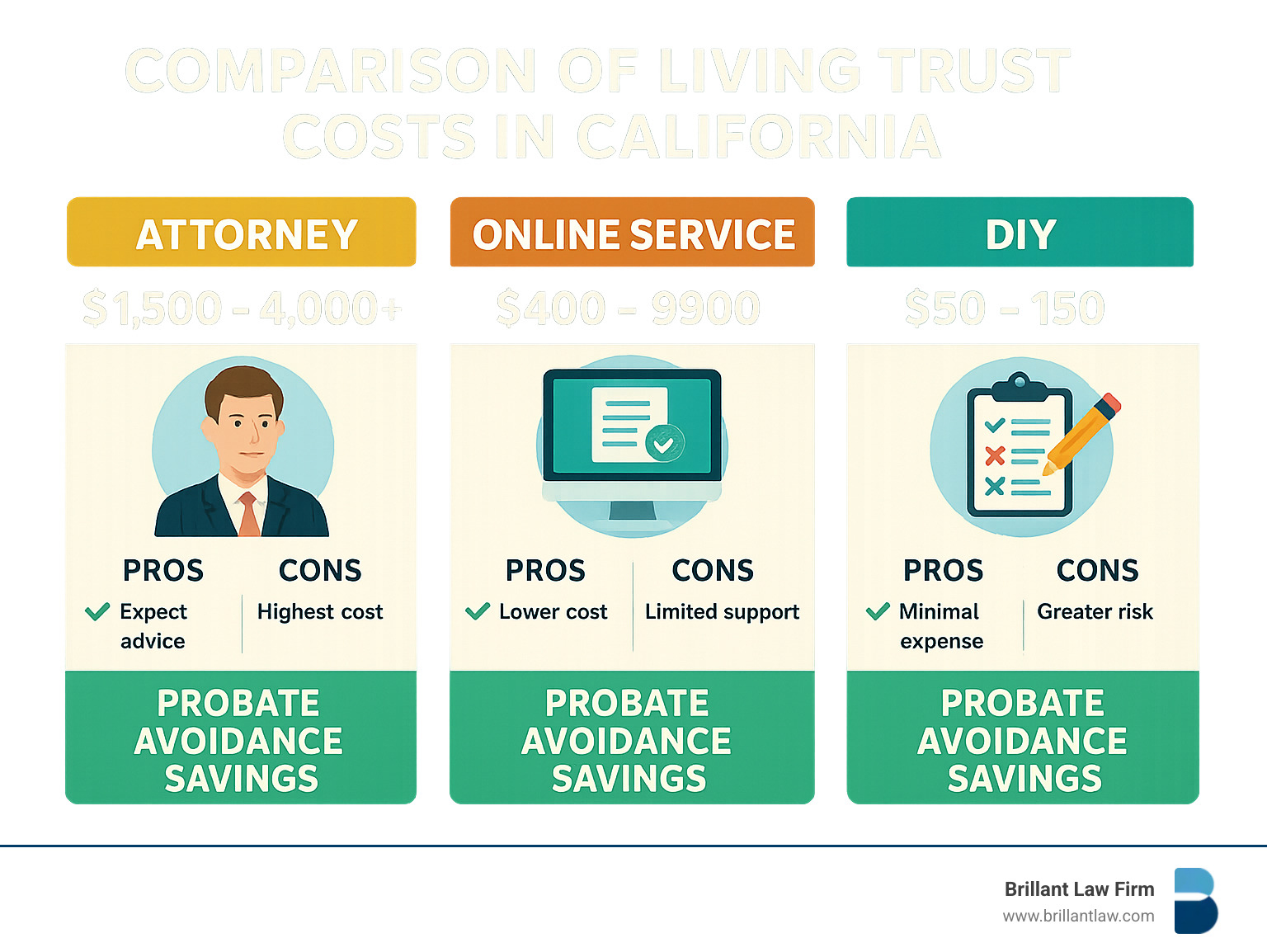
How much does it cost to setup a living trust typically ranges from $1,000 to $4,000 in California, depending on several factors:
| Creation Method | Cost Range (California) | Best For |
|---|---|---|
| Attorney-drafted | $1,500 – $4,000+ | Complex estates, high-value assets |
| Online services | $400 – $900 | Simple estates, budget-conscious |
| DIY kits | $50 – $150 | Very simple situations (higher risk) |
When considering a living trust, understanding the true costs involved helps you make an informed decision about protecting your legacy and providing for your loved ones. The investment varies based on your estate’s complexity, geographical location within California, and whether you’re creating a trust for an individual or a couple (which typically costs 30-50% more).
While the upfront cost may seem significant, a properly established living trust helps your beneficiaries avoid the expensive and time-consuming probate process in California, which can consume 4-7% of your estate’s value and tie up assets for months or even years.
I’m David Brillant, a Certified Specialist in Estate Planning, Trust and Probate Law by the State Bar of California Board of Legal Specialization with extensive experience helping clients understand how much does it cost to setup a living trust and creating customized solutions for both simple and complex estates throughout California.
Key how much does it cost to setup a living trust vocabulary:
– Estate and trust lawyer
– Estate planning guidance
– Trust planning services
Living Trust Fundamentals: Definitions, Types, Benefits
Before we talk about costs, let’s take a moment to understand what you’re actually paying for. A living trust isn’t just a legal document—it’s peace of mind wrapped in legal protection for your family’s future.
Think of a living trust as a special container where you (the grantor) place your assets under the management of a trustee (typically yourself at first) to benefit the people you care about most. It’s like creating a roadmap for your legacy.

Living trusts come in two main varieties, each serving different needs:
Revocable Living Trust: This is the flexible option most California families choose. As the name suggests, you can change, amend, or even completely cancel this trust during your lifetime. You maintain full control of your assets and can adjust your plan as life happens—marriages, births, career changes, and more.
Irrevocable Living Trust: Once established, this type is much harder to change. While this reduces your direct control, it offers stronger protection from creditors and potential tax advantages for larger estates.
When my client Maria from San Jose established her trust, she told me, “I always thought trusts were just for wealthy people, but after watching my neighbor’s family struggle through probate for over a year—spending thousands on court costs and lawyer fees—I realized a trust was the responsible choice for my modest home and savings too.”
The benefits of creating a living trust in California are substantial and practical:
Probate Avoidance means your family won’t face California’s lengthy court process to access their inheritance. Assets properly transferred to your trust pass directly to your loved ones, often in weeks rather than years.
Privacy Protection keeps your family’s financial matters confidential. Unlike wills, which become public record during probate, trusts maintain your family’s privacy and dignity during a difficult time.
Incapacity Planning provides a safety net if you become unable to manage your affairs. Your chosen successor trustee can step in seamlessly without complicated court conservatorship proceedings.
Distribution Control gives you the final say in how and when your beneficiaries receive assets, even long after you’re gone. This can be especially important for younger heirs or those who might need protection from their own spending habits.
For a deeper dive into living trusts and how they work, visit our comprehensive guide: What is a Living Trust?
Revocable vs. Irrevocable: Which Fits Your Goals?
When considering how much does it cost to setup a living trust, the type you choose affects both your initial investment and long-term expenses.
Revocable Living Trusts give you maximum flexibility and control. You can change beneficiaries, adjust terms, or even dissolve the trust entirely if your circumstances change. They’re typically more affordable to establish ($1,500-$3,000 in California) and simpler to manage while you’re alive.
The trade-off? They don’t shield assets from creditors during your lifetime, and they don’t provide tax advantages while you’re alive since the assets remain part of your taxable estate.
Irrevocable Living Trusts offer stronger protections but less flexibility. They can potentially shield assets from creditors, reduce estate taxes for high-value estates, and provide specialized protection for beneficiaries with special needs.
However, they come with higher setup costs ($3,000-$7,000+ in California), less direct control over your assets, more complex administration, and possibly ongoing professional trustee fees.
Most California families start with a revocable trust for its probate-avoidance benefits while maintaining flexibility. As your wealth grows or your situation becomes more complex, specialized irrevocable trusts can complement your plan.
Why Californians Lean on Living Trusts
California’s unique legal and economic landscape makes living trusts particularly valuable for residents of the Golden State:
Extended Probate Timelines in California typically stretch 9-18 months, even for straightforward estates. During this time, your loved ones may have limited or no access to the assets they’ve inherited—just when they might need them most.
High Probate Costs follow California’s statutory fee schedule and can quickly add up:
– 4% of the first $100,000
– 3% of the next $100,000
– 2% of the next $800,000
– 1% of the next $9 million
– 0.5% of the next $15 million
Valuable Real Estate pushes many modest California estates into expensive probate territory. With median home values exceeding $800,000 in many areas, even a simple estate with just a family home could generate $19,000+ in statutory attorney fees during probate.
Privacy Concerns matter to most families. California probate proceedings create public records of all assets, beneficiaries, and distributions—information most people prefer to keep private.
As my client in Oakland recently shared: “After watching my brother’s family wait almost two years to access their inheritance through probate, spending over $30,000 in the process, the $2,800 I invested in my living trust seems like the bargain of a lifetime.”
The initial cost of creating a trust is an investment that typically pays for itself many times over in saved probate fees, reduced stress, and protected privacy for your loved ones.
How Much Does It Cost to Set Up a Living Trust in California
Let’s talk dollars and cents – what will you actually pay to create a living trust in California? After helping hundreds of families through this process, I can share the real numbers you’re likely to encounter:
Attorney-Drafted Living Trusts: $1,500-$4,000+
– Basic individual trust package: $1,500-$2,500
– Complex estate planning: $3,000-$7,000+
– Specialized provisions (business succession, special needs planning): Additional $1,000-$3,000
Online Legal Services: $400-$900
– Basic individual trust: $400-$500
– Couples trust: $500-$600
– Attorney review add-on: Additional $200-$300
DIY Trust Kits: $50-$150
– Basic forms: $50-$100
– Software with guidance: $100-$150
If you’re in California’s major metropolitan areas like the Bay Area (including Walnut Creek), expect to land at the higher end of these ranges. This reflects the higher cost of living and attorney rates in these regions.
With attorney-drafted trusts, you’re not just buying documents—you’re investing in legal expertise, customized planning, and professional guidance throughout the entire process. The peace of mind that comes from knowing your trust is properly structured for California’s specific laws is invaluable.
For those who enjoy research, you might want to explore this comprehensive analysis on revocable living trusts. That said, there’s no substitute for personalized advice from a California-licensed attorney who understands your unique situation.
How much does it cost to setup a living trust for an individual?
For a single person in California, establishing a basic living trust typically costs:
Attorney-drafted: $1,500-$2,500
This usually includes your trust document, pour-over will, durable power of attorney, and advance healthcare directive. Many attorneys also provide initial asset transfer assistance and basic funding instructions as part of their package.
Online services: $400-$500
These typically include a basic trust document, simple will, and powers of attorney. The tradeoff is limited customization and no legal advice.
DIY kit: $50-$150
The budget option provides template documents only, with no guidance or support.
Most California attorneys offer flat-fee packages for individuals with standard assets like a home, bank accounts, and investments. As your situation gets more complex, so does the price tag:
Adding rental properties might cost an extra $300-$500. Business interests could add $500-$1,500 to your bill. Complex beneficiary arrangements (like providing for children from multiple marriages) might increase costs by $300-$800.
One of our San Miguel clients recently shared: “I was surprised at how quotes ranged from $1,200 to $3,500 for what seemed like the same trust package. After asking questions, I realized the difference was in the attorney’s experience, level of customization, and whether they included preparing and recording the deed for my home.”
How much does it cost to setup a living trust for a couple?
Married or partnered couples in California should expect to pay more than individuals for their living trust. This price difference reflects the additional complexity of addressing joint and separate property issues, potential tax planning, and creating provisions for the surviving spouse.
Here’s what couples typically pay:
Attorney-drafted: $2,000-$4,000
This runs about 30-50% more than individual trusts and includes a joint trust document, individual pour-over wills, powers of attorney, and healthcare directives for both spouses.
Online services: $500-$600
About 20-30% more than individual packages, providing the same documents but for both parties.
DIY kit: $75-$200
Slightly higher than individual kits, with template documents only.
California’s community property laws add unique complexities to couples’ trusts. Without proper handling of separate property and community property, unintended consequences and family disputes can arise later.
I remember a Castle Hill couple who initially questioned their $3,200 quote. “It seemed high until our attorney explained how she would structure things to protect the surviving spouse while preserving separate property from our previous marriages,” they told me. “That expertise was absolutely worth the investment.”
The cost to setup a living trust for couples isn’t just about duplicate documents—it’s about navigating California’s specific marital property laws and creating a seamless transition plan for the surviving spouse.
Cost Factors & Provider Comparisons
When figuring out how much does it cost to setup a living trust in California, several factors come into play that can significantly impact the final price tag. Think of it like buying a car—the base model has one price, but add-ons and upgrades change your total investment.
Your estate’s complexity plays a major role in determining costs. A straightforward estate with a family home and some bank accounts will cost less than one with multiple properties, business interests, and complicated family dynamics. For example, blended families often require more nuanced planning, which translates to more attorney time and higher fees.
The types of assets you own also affect your total cost. Real estate properties require new deeds to be prepared and recorded with the county. Business interests might need operating agreement amendments. Even your vehicles and investment accounts need proper transfers to fully fund your trust. Each of these transfers represents additional work—and potentially additional costs.

Geography matters too. If you’re in Walnut Creek or anywhere in the Bay Area, expect to pay toward the higher end of the price spectrum. As one of our clients from San Francisco mentioned, “I was quoted $3,500 for my trust package, while my sister in a rural county paid only $2,200 for essentially the same documents.”
Attorney experience is another significant factor. California estate planning attorneys typically charge:
– Junior attorneys: $250-$350 per hour
– Experienced specialists: $350-$550 per hour
– Certified specialists (like our team at Brillant Law): $450-$650 per hour
Higher rates often reflect deeper expertise and more efficient service—meaning you might actually get better value despite the higher hourly rate.
Here’s a detailed comparison of your three main options:
| Feature | Attorney-Drafted | Online Service | DIY Kit |
|---|---|---|---|
| Cost Range | $1,500-$4,000+ | $400-$900 | $50-$150 |
| Legal Advice | Included | None or limited | None |
| Customization | High | Limited | Minimal |
| Funding Assistance | Often included | None or minimal | None |
| Complementary Documents | Comprehensive package | Basic documents | Basic templates |
| Error Risk | Low | Medium | High |
| Support After Creation | Ongoing relationship | Limited or subscription | None |
For more insights about working with a professional, check out our guide on Estate Planning Attorney.
Attorney vs. Online vs. DIY Breakdown
Each option for creating your living trust comes with its own fee structure and inclusions.
With an attorney-drafted trust, you’re typically paying a flat fee between $1,500 and $4,000+ for standard situations. This usually includes a personalized consultation, customized trust document (often 20-30 pages of carefully crafted legal language), a pour-over will, durable power of attorney, and healthcare directives. Many attorneys, including our team at Brillant Law, also include deed preparation and notary services, though some charge separately for these.
“I was initially hesitant about the $2,800 cost,” shared Maria from Oakland, “but when my attorney spent over two hours discussing my unique family situation and crafting provisions to address my concerns about my spendthrift son, I realized I was getting tremendous value.”
With online legal services ($400-$900), you’re paying for template-based documents with limited customization. Some offer attorney review for an additional $200-$300, but you won’t get the same level of personalized advice. Updates are either included in a subscription model ($39-$199 annually) or available for additional one-time fees.
DIY kits ($50-$150) are the bare-bones option—you get template documents and basic instructions, but you’re entirely on your own for legal guidance and future updates.
The upfront cost doesn’t tell the whole story. As one of our attorneys often says, “I’ve helped numerous families fix problematic DIY trusts, and they invariably end up spending much more than if they’d consulted a professional from the start.”
California-Specific Filing & Recording Fees
Beyond the cost of creating your trust documents, you’ll need to budget for implementation expenses specific to California:
County recorder fees typically run $50-$75 per document in most California counties. If you own multiple properties, each new deed will need to be recorded separately. The good news is that transfers to your own trust generally don’t trigger transfer taxes or documentary transfer taxes in California.
Notary fees in California are fixed by law at $15 per signature. If you need a mobile notary to come to your home or office, expect to pay $75-$150 for the convenience.
Most financial institutions don’t charge fees to retitle accounts in your trust’s name, though some investment firms may have nominal processing charges.
A client from Alamo recently shared, “Beyond my attorney’s fee of $3,200, I spent about $240 on recording four property deeds and $90 for notarizations. When I calculated that probate would have cost my heirs over $50,000 and tied up my assets for at least a year, I realized what a bargain my trust really was.”
For those who want to understand the full scope of trust administration costs beyond just the setup, our detailed guide on the Cost of Administering a Trust provides valuable insights.
Hidden & Ongoing Expenses After Setup
When budgeting for how much does it cost to setup a living trust, many Californians focus only on the initial creation costs, overlooking the potential ongoing expenses that can add up over time.

Your trust isn’t just a one-time document – it’s a living arrangement that may require ongoing attention and maintenance. Let’s explore these often-overlooked costs:
If you’re serving as your own trustee while alive, there’s no cost for trustee services. However, after you’re gone, a professional trustee typically charges between 0.5-2% of trust assets annually. To put that in perspective, a $500,000 trust might incur $2,500-$10,000 in annual trustee fees, while a $1,000,000 trust could cost $5,000-$20,000 each year. Many family members who serve as trustees either decline compensation or charge reduced fees, but professional management often provides valuable expertise and objectivity.
Life changes, and your trust documents will need to keep up. Simple amendments with an attorney typically range from $300-$800, while a complete trust restatement might cost $1,000-$2,500. If you’ve used an online service, updates might be free with a subscription (typically $39-$199/year) or cost $100-$300 per change.
“I never anticipated how many times I’d need to update my trust,” shared one of our Walnut Creek clients. “Over ten years, I’ve had three amendments – when my daughter was born, when I bought a vacation property, and when my mother needed to be added as a beneficiary. Those updates added about $1,800 to my initial investment.”
Annual reviews with an attorney ($300-$750) can help ensure your trust remains aligned with your goals and current laws. If you acquire new assets, expect additional costs for property deed preparation ($150-$300) and recording fees ($50-$75 per document). Some trusts also require annual tax returns ($500-$1,000) and formal accountings for beneficiaries ($1,000-$3,000+).
For more comprehensive information about these ongoing expenses, visit our detailed guide: Cost of Administering a Trust
Funding Pitfalls That Trigger Probate Anyway
One of the most expensive mistakes in trust planning is failing to properly fund your trust. Even the most expertly drafted trust documents won’t help your family avoid probate if your assets aren’t properly transferred into the trust.
I’ve seen too many California families find this painful truth too late. As one client sadly shared: “I spent $2,800 on a beautiful trust, then died with my house still in my individual name because I never recorded the new deed. My family ended up in probate anyway, spending another $25,000 and waiting 14 months for the house to transfer.”
Common funding failures include forgetting to change deeds and account ownerships to the trust’s name, misaligning beneficiary designations with your trust plan, acquiring new assets after trust creation but not titling them in the trust, and failing to transfer property back into your trust after refinancing (many lenders temporarily take property out of trusts during this process).
To protect against these potential gaps, your estate plan should include a pour-over will that catches any assets not in your trust (though probate is still required for these items), an assignment of personal property document that transfers personal items to the trust, clear funding instructions for different asset types, and regular review sessions to ensure new assets are properly titled.
Amending Your Trust: What Will It Cost?
Life rarely stands still, and your trust needs to evolve as your circumstances change. Marriage, divorce, birth of children or grandchildren, significant asset changes, relocation, or tax law revisions all might necessitate updates to your trust.
The cost to update your trust in California depends on the extent of changes needed:
For simple amendments like changing beneficiaries, updating successor trustees, or making minor clarifications, expect to pay $300-$800 when working with an attorney. These targeted changes address specific provisions without overhauling the entire document.
When more substantial changes are needed, a trust restatement ($1,000-$2,500) might be more appropriate. This essentially rewrites your trust while legally maintaining it as the same trust. Restatements are ideal for major distribution plan changes, updates for significant tax law changes, or modernizing older trusts.
In some situations, like after divorce or remarriage, a complete replacement ($1,500-$3,500) makes more sense than trying to patch up the existing document. This creates an entirely new trust that better reflects your current situation.
“After my divorce, I needed to completely revamp my trust,” a Walnut Creek client shared. “The attorney charged $1,800 for a full restatement, which was actually less than trying to amend the numerous provisions that needed changing.”
If you’re using online services, expect to pay $100-$300 for amendments or consider their subscription models ($39-$199/year) that include free updates.
The cost of keeping your trust updated is minimal compared to the potential expense and headache your loved ones might face if your trust doesn’t accurately reflect your wishes or current situation when they need it most.
Step-by-Step California Living Trust Setup & Budget
Creating a living trust in California isn’t just about signing some papers—it’s a journey that involves several distinct steps, each with its own associated costs. Understanding this process helps you budget appropriately and ensures your trust will actually work when your family needs it most.

The journey typically begins with an initial consultation costing between $0-$500. I’ve noticed many California attorneys (ourselves included) offer complimentary consultations, while others charge a fee that’s credited toward your trust package if you decide to proceed. This meeting is your opportunity to share your goals and concerns while the attorney assesses your specific needs.
Next comes the asset inventory stage. Whether you handle this yourself or your attorney helps you through it, you’ll need to list all your assets with their approximate values, gather important documents like deeds and account statements, and determine which assets are separate versus community property (particularly important for California couples).
The heart of the process is the trust design and drafting phase, which typically runs $1,500-$4,000+ when working with an attorney. This is where your estate planning goals transform into legally binding documents custom to your specific situation. If you opt for an online service instead, expect to pay $400-$900 for standard document generation.
Once your documents are ready, the execution phase involves signing everything with proper witnesses and notarization. In California, notary fees run about $15 per signature. Most attorneys include this step in their package fee, but if handling it yourself, budget $0-$150 depending on the number of signatures required.
Perhaps the most critical step—and one that’s often overlooked—is funding your trust. This is where many DIY approaches fall short. Expect to spend $200-$1,000+ on recording new deeds ($50-$75 per document in California counties, plus preparation fees), changing account titling, updating beneficiary designations, and transferring business interests if applicable.
Finally, don’t forget ongoing maintenance. While not an immediate cost, budget $0-$750 annually for regular reviews and updates as your life circumstances change.
For a comprehensive walkthrough of these steps, check out our detailed Checklist for Creating a Trust.
How much does it cost to setup a living trust step-by-step?
Let me break down the typical costs for creating a living trust in California with an attorney, so you can see exactly where your money goes:
For a basic individual trust package totaling around $2,500, here’s what you’re typically paying for:
– Initial consultation: Usually complimentary ($0)
– Document drafting: Approximately $1,800 covering your trust agreement, pour-over will, durable power of attorney, and advance healthcare directive
– Document execution and notarization: About $100
– Deed preparation for one property: $300
– Deed recording: $75
– Funding instructions and assistance: $225
Couples can expect to pay more—a basic couple’s trust package typically runs around $3,500 total, breaking down as:
– Initial consultation: Usually complimentary ($0)
– Document drafting: Approximately $2,600 for a joint trust agreement, two individual pour-over wills, two durable powers of attorney, and two advance healthcare directives
– Document execution and notarization: About $200
– Deed preparation for one property: $300
– Deed recording: $75
– Funding instructions and assistance: $325
For those with more complex situations, a comprehensive estate plan might start at $5,000 and include:
– Initial consultation: Usually complimentary ($0)
– Document drafting: $3,800+ for a customized trust with specialized provisions, pour-over wills, improved powers of attorney, healthcare directives, and possibly special needs provisions or subtrusts
– Document execution and notarization: $200
– Deed preparation for multiple properties: $600
– Deed recording: $225
– Business interest transfers: $500
– Comprehensive funding assistance: $675
As one of our clients from Castle Hill recently told me, “I was initially shocked by the price tag, but when I saw the itemized invoice, I realized the actual trust document was only about half the total cost. The rest covered essential supporting documents, deed work, and my attorney’s time helping me transfer everything correctly. Seeing that breakdown made the value much clearer.”
Frequently Asked Questions about How Much Does It Cost to Setup a Living Trust
Is a living trust really worth the upfront expense in California?
For most California property owners, my answer is an emphatic yes. Consider the math: California’s statutory probate fees on a modest $1 million estate (which in many California communities is just an average home) would be approximately $23,000 in attorney fees plus another $23,000 in executor fees, totaling a staggering $46,000.
Beyond the financial savings, a trust typically reduces administrative time from 9-18 months (typical for California probate) to just 3-6 months. Your family’s privacy remains protected, unlike the public record created through probate. And perhaps most importantly, a living trust provides seamless management if you become incapacitated, avoiding costly and stressful conservatorship proceedings.
As one client memorably put it: “The trust was like buying insurance—a known, reasonable cost now to avoid a potentially much larger, unknown cost later.” For a $1 million California estate, spending $2,500-$4,000 on a trust package potentially saves $40,000+ in probate fees and months of delays—that’s a return on investment that’s hard to beat.
Can I start with a DIY trust and have an attorney fix it later?
While this approach seems financially prudent at first glance, I’ve found it typically costs more in the long run. Having an attorney review and correct a DIY trust often costs $750-$2,000, depending on the issues found. Many DIY trusts have fundamental problems requiring complete restatement rather than simple fixes, costing $1,500-$3,000.
More concerning are the funding problems that plague many DIY trusts—incorrect or incomplete asset transfers that can completely undermine the trust’s purpose. And most troubling of all: until these problems are fixed, your estate remains vulnerable to probate or unintended distributions.
One of our attorneys often observes, “In twenty years of practice, I’ve never seen a situation where starting with a DIY trust and later having an attorney fix it cost less than simply having the attorney prepare it correctly from the beginning.”
Will my annual trustee fees ever exceed probate savings?
This is a thoughtful question that many clients ask. The math usually favors trusts because probate fees are paid once, at 4-7% of the gross estate value, while professional trustee fees (typically 0.5-2% annually) accumulate over time.
For example, on a $1 million California estate:
– One-time probate costs would be approximately $46,000
– Annual professional trustee fee at 1% would be $10,000 per year
It would take over four years of professional trustee management to equal the one-time probate cost. And here’s the part many people forget: most families use family member trustees who charge reduced fees or nothing at all, making the comparison even more favorable for trusts.
A client from Walnut Creek recently shared, “My mother’s trust has been administered by my brother for three years at no cost. Had we gone through probate, we would have paid over $35,000 in fees for her modest home and investments.” When viewed this way, how much does it cost to setup a living trust becomes less about the expense and more about the long-term value.
Conclusion
Understanding how much does it cost to setup a living trust helps you make informed decisions about your family’s future. While the initial investment of $1,500-$4,000 for a professionally drafted trust in California might seem substantial, it represents just a fraction of what your loved ones might spend on probate costs—not to mention the months or even years of delays they’d face.
The true value of a living trust goes far beyond simple dollars and cents. When clients come into our Walnut Creek office, they often focus initially on the price tag. But as we discuss their goals, they begin to see the living trust as an investment in:
- Protection for loved ones from lengthy court proceedings
- Privacy during a vulnerable time in your family’s life
- Control over your legacy and how your assets are distributed
- Preparation for potential incapacity or health challenges
- Peace of mind knowing your affairs are in proper order
One client recently shared, “After watching my neighbor’s family struggle through probate for 14 months, spending tens of thousands in fees and fighting over unclear intentions, my trust feels like the best money I’ve ever spent—and it cost less than my last family vacation.”
At Brillant Law Firm, we understand that each family’s situation is unique. Some clients have straightforward needs with modest estates, while others have complex business interests or blended family considerations. Our approach is to provide transparent pricing with no hidden fees, clear explanations of what your investment covers, and customized solutions that address your specific California estate planning needs.
Whether you own a modest home in Contra Costa County or manage complex business interests across California, we can help you create a living trust that protects what matters most to you at a fair and transparent cost.
To learn more about our living trust services and how we can help you protect your legacy, visit: More info about our Living Trust services
The question isn’t just how much does it cost to setup a living trust—it’s how much it might cost your loved ones if you don’t.


