Estate Planning Strategies: 10 Powerful Tips for 2025 Success
Why Smart Estate Planning Strategies Matter More Than Ever
Estate planning strategies are essential tools that help you protect your wealth, minimize taxes, and ensure your assets pass to your loved ones according to your wishes. Whether you’re a business owner, high-net-worth individual, or simply want to avoid costly probate, the right strategies can save your family thousands of dollars and months of court proceedings.
Key Estate Planning Strategies:
– Revocable Living Trusts – Avoid probate and maintain privacy
– Tax Minimization – Use lifetime gifting and charitable giving
– Asset Protection – Shield wealth from creditors and lawsuits
– Business Succession – Plan for smooth ownership transitions
– Incapacity Planning – Protect yourself if you can’t make decisions
In California, the average estate pays between 25% and 54% of its value in taxes, fees, and other costs before beneficiaries receive anything. With attorney fees ranging from $450-$800 per hour and probate proceedings that can drag on for years, poor planning becomes extremely expensive.
The good news? Smart estate planning strategies can help you avoid most of these costs while giving you complete control over your legacy.
As David Brillant, a Certified Specialist in Estate Planning, Trust and Probate Law with a Masters in Taxation, I’ve helped countless California families implement estate planning strategies that protect their wealth and provide peace of mind.
Why You Need an Estate Plan—Beyond Just a Will
Estate planning strategies go far beyond deciding who gets your assets when you’re gone. Your estate plan needs to tackle four big goals: protecting your assets while you’re alive, ensuring your wealth gets to the people you love, keeping money out of the government’s pockets, and protecting you if you can’t make decisions for yourself.
Without proper planning, probate timelines in California stretch 12-18 months. During this time, your family can’t access assets, bills pile up, and attorney fees ranging from $450-$800 per hour start eating away at everything you worked to build.
Incapacity planning might be even more important than death planning. Without the right documents, your family faces expensive conservatorship proceedings costing $15,000-$30,000 while struggling with financial uncertainty.
If you have minor children, without proper guardianship nominations, a judge decides who raises your kids. Without financial planning, the court controls how their inheritance gets managed.
Privacy is another crucial factor. Probate proceedings become public record, while properly structured trusts keep your family’s business completely private.

The High Cost of Doing Nothing
Estate erosion from poor planning can be devastating. We’ve watched families lose 40-50% of everything their parents built due to preventable mistakes.
Court delays make everything worse. California probate courts are swamped, and even simple estates often take over a year to resolve. During this time, businesses may lose value and family relationships crack under pressure.
The family conflict that emerges breaks hearts every day. Siblings find themselves in bitter fights that require expensive litigation, meaning even more family wealth goes to attorneys instead of beneficiaries.
Core Documents Every Californian Should Have
Most Californians can achieve comprehensive protection with six essential documents that work together seamlessly.
Your will directs how your assets get distributed and names guardians for minor children. A durable power of attorney authorizes someone you trust to handle your affairs if you become incapacitated, preventing expensive conservatorship proceedings costing $15,000-$30,000.
Your advance health care directive specifies your medical treatment preferences and names a health care agent. A revocable living trust holds your assets during your lifetime and distributes them seamlessly after death, avoiding probate entirely.
Beneficiary designations on retirement accounts and life insurance trump your will and trust, transferring assets directly to named beneficiaries. Guardianship nominations designate who will care for your minor children.
For comprehensive guidance, check out our Estate Planning Checklist.
Will vs. Trust—Which Serves You Better?
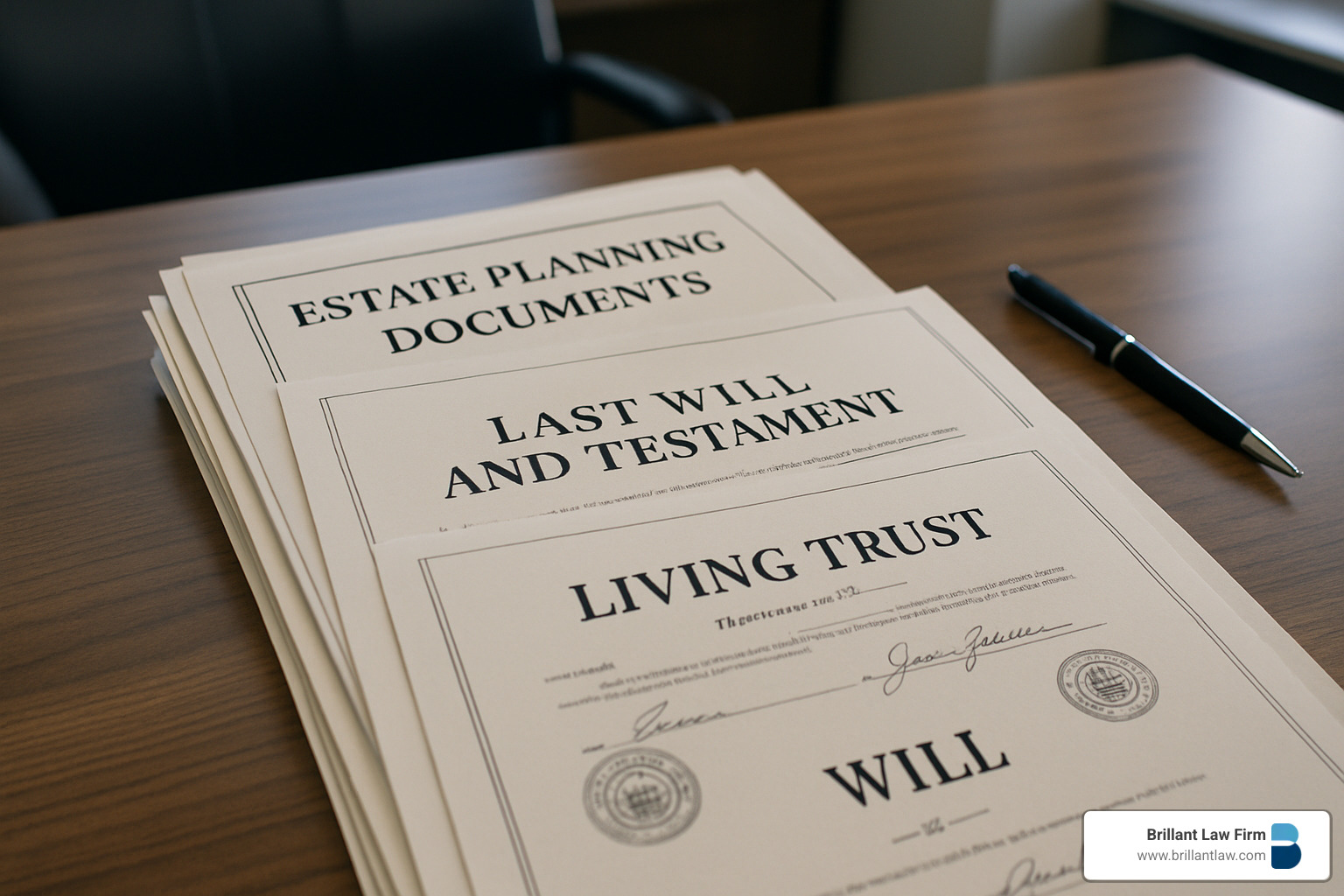
The choice between relying primarily on a will versus establishing a trust represents one of the most important decisions in estate planning. For detailed analysis, see our guide on the Difference Between a Will and a Trust.
Will vs. Revocable Living Trust Comparison:
| Feature | Will | Revocable Living Trust |
|---|---|---|
| Probate Required | Yes | No (for trust assets) |
| Privacy | Public record | Private |
| Incapacity Planning | No | Yes |
| Cost to Create | $500-$2,000 | $2,500-$5,000 |
| Time to Distribute Assets | 12-18 months | Immediate |
| Ongoing Maintenance | Minimal | Requires funding |
Wills offer simplicity and lower upfront costs but guarantee your estate will steer California’s probate system. Trusts require higher upfront investment but deliver superior results through complete probate avoidance, absolute privacy, and seamless incapacity handling.
Business owners, parents with minor children, and anyone with assets exceeding $184,500 typically benefit significantly from trust-based planning.
Keeping Documents Current
Estate planning documents don’t improve with age. Major life events trigger immediate review needs. Marriage, divorce, births, deaths, or significant asset changes can dramatically alter your planning needs.
Law changes also impact planning effectiveness. We proactively monitor these changes and contact clients when updates become necessary. Regular reviews every three to five years ensure your estate plan continues serving your family’s evolving needs effectively.
Estate Planning Strategies to Cut Taxes and Protect Your Legacy
Smart estate planning strategies can be the difference between leaving your family a legacy and leaving them a tax bill. Without proper planning, estates can lose 25-54% of their value to taxes and fees.
The capital gains step-up is powerful—when someone inherits assets in California, they receive a new tax basis equal to the property’s fair market value at death. California’s community property laws make this even better, as both halves of community property receive the step-up.
The portability election allows surviving spouses to claim unused portions of the deceased spouse’s federal estate tax exemption. With the current exemption at $13.61 million per person, this can preserve up to $27.22 million for married couples.
Lifetime gifting strategies become important as we approach 2026, when the federal estate tax exemption drops significantly. Charitable bequests support causes you care about while reducing estate taxes.
For comprehensive guidance, explore our resources on Estate Tax Planning and Estate Planning with Trusts. Additional insights are available from Estate Planning Essentials research.
Primary Residence & Prop 13—Smart Moves
Your family home is often your largest asset. California’s Proposition 13 creates unique opportunities to preserve both the property and significant tax savings for your children.
The parent-child exclusion allows you to pass Prop 13 tax advantages to your children. A home purchased for $200,000 in 1990 might have a current assessed value of $350,000 while its market value is $1.5 million. Your children can inherit both the property and the lower tax basis.
Transfer-on-death deeds offer simple real estate transfer without probate while preserving Prop 13 benefits. However, they don’t help with incapacity planning or provide asset protection.

Using Trusts for Tax-Smart Giving
Irrevocable life insurance trusts remove life insurance from your taxable estate while ensuring proceeds help your family pay estate taxes. For a family facing 40% estate tax, removing a $2 million policy saves $800,000.
Charitable remainder trusts let you support charity while maintaining income from appreciated assets, avoiding capital gains tax entirely while receiving income tax deductions.
Special needs trusts support disabled family members while preserving government benefits eligibility. Dynasty trust provisions extend planning benefits across multiple generations, with California allowing trusts to continue for 90 years.
Advanced Estate Planning Strategies for Special Situations
Complex family and business situations require estate planning strategies custom to your exact needs. These advanced techniques provide tremendous benefits but need expert guidance to work properly.
Business succession planning prevents forced sales or family disputes. Smart strategies include buy-sell agreements, employee stock ownership plans (ESOPs), and management succession planning.
Estate freeze techniques lock in today’s value for estate tax purposes while transferring future appreciation to children. Family Limited Liability Companies (LLCs) offer asset protection and 20-40% valuation discounts for gift and estate tax purposes.
Special needs trusts provide supplemental support without jeopardizing government benefits. Pet trusts are valid in California for your animals’ care. Digital asset planning addresses cryptocurrency, online businesses, and digital photos.
For sophisticated planning techniques, explore our High Net Worth Estate Planning resources.

Estate Planning Strategies for Minor Children & Dependents
Education trusts provide dedicated funding for children’s educational expenses while offering tax benefits. Custodial accounts (UTMA/UGMA) seem simple but have significant drawbacks—assets become your child’s property at age 18-21 regardless of maturity level.
Standby guardianship arrangements provide protection if you become incapacitated, ensuring stable care without court proceedings.
Download our Free Estate Planning Worksheet to organize your family’s unique needs.
Estate Planning Strategies During Incapacity
Springing powers of attorney become effective only when you become incapacitated, while immediate powers of attorney take effect immediately, providing maximum flexibility.
Successor trustee protocols ensure smooth transitions in trust management. HIPAA waivers allow your agents to obtain necessary health information to make informed decisions.
Avoiding Pitfalls—Common Mistakes Californians Make
I’ve seen the same costly mistakes repeated over and over. These errors can devastate families and destroy wealth, but they’re completely preventable.
Outdated beneficiary designations top my list. Your retirement accounts and life insurance pass directly to whoever is named on beneficiary forms—regardless of your will or trust. I’ve watched ex-spouses inherit substantial 401(k)s because nobody updated the paperwork after divorce.
Digital assets present modern challenges most estate plans ignore. Families lose access to valuable photo collections, business accounts, and cryptocurrency holdings because nobody knew passwords or had proper authorization.
Community property rules create opportunities and pitfalls. Couples miss valuable tax benefits because they didn’t structure asset ownership correctly.
The single biggest waste is “empty trust syndrome”—spending thousands creating trusts, then never transferring assets into them. These empty trusts provide zero benefits.
DIY estate planning often produces documents that don’t comply with California law. The few hundred dollars saved upfront can cost families tens of thousands later.
For detailed guidance, check out our guide on the Top 5 Estate Planning Mistakes.

How Regular Reviews Safeguard Estate Planning Strategies
Annual checkups catch problems before they become disasters. We address major life changes and stay on top of California law changes that might affect your planning.
Asset audits verify that all assets are properly titled and beneficiary designations remain current. Regular reviews create opportunities to improve your existing plan as tax laws change and new techniques emerge.
Use our Asset Checklist for Estate Planning to organize your annual review process. Think of estate plan reviews like medical checkups—much easier and less expensive than dealing with emergencies.
Frequently Asked Questions about Estate Planning Strategies
What taxes could hit my estate in California?
California doesn’t impose estate or inheritance taxes, but federal estate taxes affect estates exceeding $13.61 million ($27.22 million for married couples). This exemption drops dramatically in 2026.
Income taxes on inherited assets create complexity. Retirement account beneficiaries owe income taxes on distributions, and most must withdraw inherited IRA funds within 10 years.
Capital gains considerations generally favor beneficiaries through “step-up in basis.” Property taxes under Proposition 13 can preserve low assessments for children or create crushing tax burdens if transfers aren’t handled properly.
How often should I update my estate planning strategies?
Annual reviews should be standard practice. We look at asset value changes, family updates, and law changes that might affect your planning.
Major life events demand immediate attention—marriage, divorce, new children, deaths, significant asset changes, or business ownership changes all trigger update needs.
California law changes happen frequently. We track these changes and reach out proactively when updates are needed. Most updates can be handled through simple amendments rather than starting from scratch.
Who should be on my estate-planning team?
Your estate planning attorney serves as quarterback, coordinating all moving pieces. In California, with attorney fees ranging from $450-$800 per hour, you want someone specializing in estate planning.
A skilled CPA provides tax expertise that can save significant money. Your financial advisor ensures investment strategies align with estate planning goals. An insurance professional evaluates whether life insurance makes sense for your situation.
At Brillant Law Firm, we coordinate closely with your other advisors to create truly integrated estate planning strategies that work in the real world.
Conclusion
Proper estate planning strategies aren’t just about what happens after you’re gone—they protect your family’s future and give you peace of mind today. Without proper planning, California’s complex legal system could consume 25-50% of everything you’ve built through taxes, fees, and delays.
The good news is that you have the power to change this outcome. Whether you need straightforward document preparation or complex estate planning strategies for business succession and tax optimization, the right planning makes all the difference.
At Brillant Law Firm, we create bespoke estate planning solutions that fit your specific needs, goals, and values. Our deep expertise in California trust and estate law, combined with advanced tax planning knowledge, ensures your plan works effectively both now and for generations to come.
The most important step is the first one. Every day without proper planning puts your family at risk, but every day is also a new opportunity to take control of your legacy.
Ready to protect what matters most? Learn more about our Estate Planning services and find how the right estate planning strategies can secure your family’s future.