

Estate Planning Real Estate: Secure Your 2026 Plan
Why Your Home Deserves a Thoughtful Estate Plan
Estate planning real estate is a critical,, part of securing your family’s future. For most California homeowners, a house is their single largest asset. Still, more than half of Americans lack a will or living trust, leaving their most valuable possession vulnerable to lengthy probate, family disputes, and unnecessary taxes.
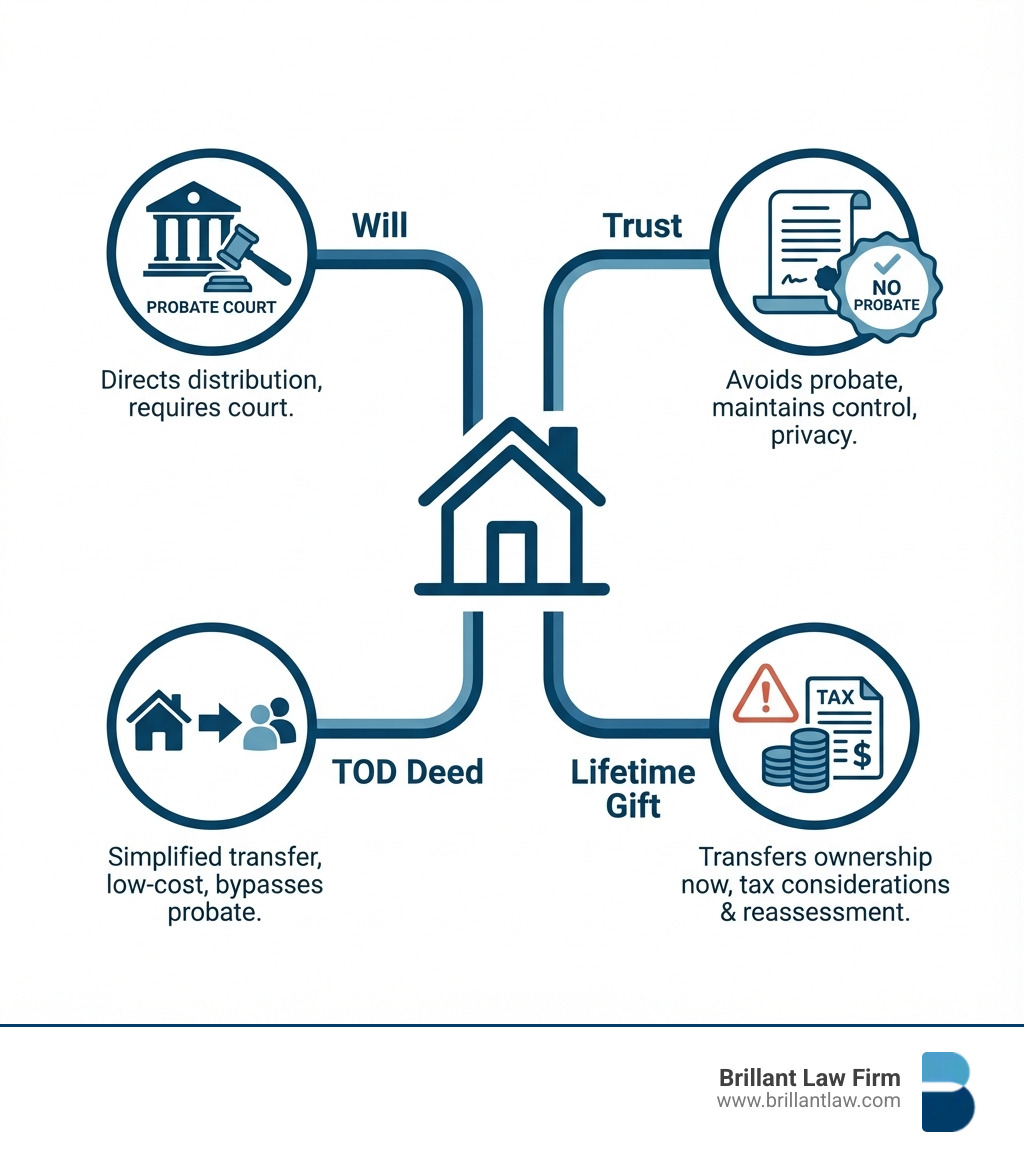
If you want to transfer your California home to loved ones, these are the five most effective strategies:
- Revocable Living Trust: Avoids probate, maintains your control, and ensures privacy.
- Transfer on Death (TOD) Deed: A simple, low-cost option in California to bypass probate.
- Will: Directs distribution but requires probate court involvement.
- Lifetime Gift: Transfers ownership now but can trigger negative tax and property reassessment consequences.
- Qualified Personal Residence Trust (QPRT): An advanced strategy for high-value estates to reduce estate taxes.
Without a proper plan, your home could face lengthy probate proceedings (6-24 months), high fees, capital gains taxes for heirs, and property tax reassessment under California’s Proposition 19. A home is more than a financial asset; it’s a place of memories. Ensuring it passes smoothly requires understanding California’s unique laws, especially recent changes under Prop 19. For a helpful overview, see the National Association of Realtors’ Consumer Guide to Your Home and Estate Planning.
Local expertise is vital in Walnut Creek, Saranap, San Miguel, and Castle Hill. Bay Area property values and California laws create unique challenges. I’m David Brillant, a Certified Specialist in Estate Planning, Trust and Probate Law with a Masters in Taxation. I’ve helped countless local families steer the complexities of estate planning real estate, protecting high-value assets in California.
Learn more about estate planning real estate:
Understanding the Ground Rules: Property Ownership and Taxes
Before choosing a strategy, understand the foundational concepts governing California real estate transfers and their tax implications.

How You Own Your Home Matters
The way you hold title to your property in California dictates whether it goes through probate and who receives it.
- Joint Tenancy with Right of Survivorship: Co-owners have equal shares, and a deceased owner’s share automatically passes to the surviving owner(s), avoiding probate. While simple, it offers limited long-term control over the property’s ultimate destination.
- Tenants in Common: Co-owners hold distinct shares that do not automatically transfer upon death. Each owner’s share passes according to their will, meaning it will go through probate.
- Community Property in California: As a community property state, assets acquired during a marriage are generally owned equally by both spouses. Holding title as “community property with right of survivorship” allows the property to bypass probate and can offer significant tax advantages.
- Sole Ownership: Property owned solely in your name will be part of your probate estate, subjecting it to a lengthy and expensive court process.
The Tax Implications of Transferring Real Estate
Taxes are a major factor in estate planning real estate. While California has no inheritance tax, federal estate tax and state property tax rules like Proposition 19 are critical.
- Federal Estate Tax: California does not have a state inheritance or estate tax. However, the federal estate tax applies to very large estates. As of 2024, the exemption is over $13.6 million per person. Amounts above this are taxed heavily. For married couples, this exemption is “portable,” potentially doubling the amount they can pass tax-free, but this requires filing an estate tax return.
- Capital Gains Tax & Stepped-Up Basis: Inherited property receives a “stepped-up basis,” meaning its cost basis for tax purposes is reset to its fair market value at the time of death. This can eliminate or significantly reduce capital gains tax if the heirs sell the property, a major advantage over gifting property during your lifetime.
- California Property Tax Reassessment (Proposition 19): This is a crucial, and often misunderstood, rule. Prop 19 severely limited the parent-child exclusion for property taxes.
- Primary Residence: Your children can only inherit your low property tax base if they use the home as their primary residence and the home’s value meets specific thresholds. Otherwise, the property tax will be partially or fully reassessed.
- Investment/Vacation Homes: There is no parent-child exclusion for these properties. They will be fully reassessed to current market value upon transfer, often leading to a massive tax increase.
- Gifting and Gift Tax: You can gift a certain amount annually per person (in 2024, it’s $18,000) without filing a gift tax return. However, gifting appreciated real estate is often a poor strategy. The recipient gets your original cost basis (“carryover basis”), forfeiting the valuable stepped-up basis and potentially facing a large capital gains tax bill upon sale.
Key Strategies for Estate Planning Real Estate
With the ground rules established, let’s explore the most effective tools for transferring real estate in California to avoid probate and minimize taxes.
Using Trusts to Control Your Property
Trusts are versatile tools in estate planning real estate, offering control, privacy, and probate avoidance.
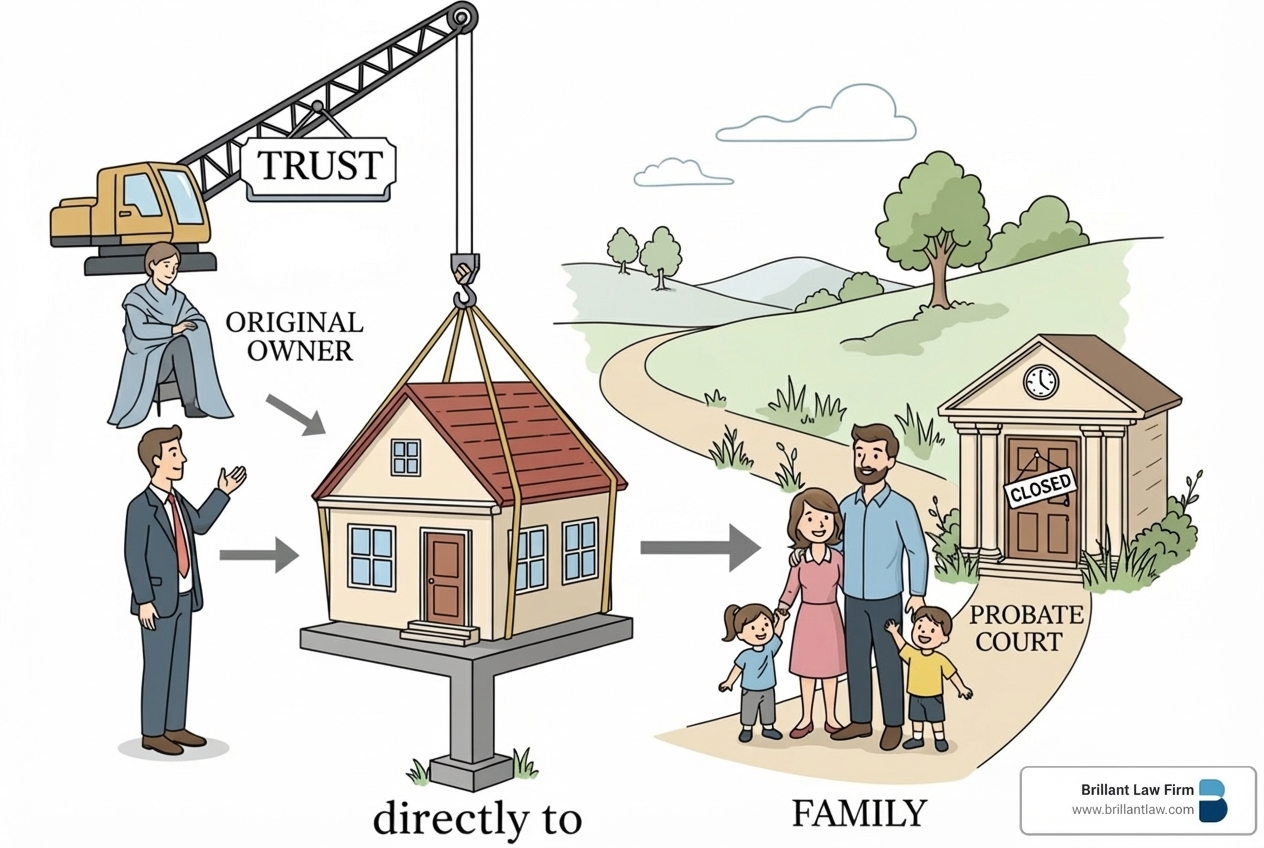
- Revocable Living Trusts: This is the cornerstone of most California estate plans. By transferring your real estate into a revocable living trust, you remain in full control as the trustee during your lifetime. Upon your death, your chosen successor trustee manages and distributes the property according to your instructions, entirely bypassing the lengthy and costly probate court process. A trust also provides for management of your property if you become incapacitated, avoiding the need for a court conservatorship.
- Qualified Personal Residence Trust (QPRT): This is an advanced, irrevocable trust for high-net-worth individuals. It removes a primary or vacation home from your taxable estate to reduce federal estate taxes. You transfer the home to the trust but retain the right to live in it for a set term. After the term, the home passes to your beneficiaries at a reduced gift tax value. This is a complex strategy requiring expert legal guidance.
- Other Irrevocable Trusts: Various irrevocable trusts can be used to minimize estate taxes for very large estates. Transferring property to such a trust removes it from your taxable estate, but you give up control. These require careful planning around capital gains and Prop 19 rules.
Wills and Transfer on Death (TOD) Deeds
For simpler situations, a will or a TOD deed can be useful, though they have limitations.
- The Role of a Will for Real Estate: A will states your wishes for asset distribution, but it does not avoid probate for real estate held in your name. In California, this means a court process is nearly guaranteed. A will is often used as a “pour-over” will to catch any assets left out of a trust and direct them into it.
- California’s Transfer on Death (TOD) Deed: This simple, low-cost deed allows you to name a beneficiary to automatically inherit your residential property upon your death, bypassing probate. It is revocable and doesn’t affect your ownership rights while you are alive.
- Limitations: A TOD deed is limited to residential property (1-4 units), condos, or small agricultural parcels. It cannot name alternate beneficiaries or set conditions on the inheritance. For anything more complex, a trust is the superior tool.
Advanced Scenarios and Special Considerations
Estate planning real estate often involves more than just a primary home. This section covers complex situations like gifting property, planning for investments, and business succession.
Gifting Property vs. Leaving it as an Inheritance
Deciding whether to gift real estate during your lifetime or leave it as an inheritance involves major tax and control trade-offs.
- The Case Against Lifetime Gifting: While it may feel good to give property to loved ones now, the downsides are significant:
- Loss of Stepped-Up Basis: This is the biggest drawback. Gifting property means the recipient gets your original cost basis. When they sell, they’ll pay capital gains tax on the entire appreciation. Inherited property gets a “stepped-up basis” to its value at your death, often erasing this tax liability.
- Loss of Control: Once gifted, the property is no longer yours. You cannot sell, refinance, or change your mind.
- Property Tax Reassessment: Under Prop 19, gifting property to a child will almost certainly trigger a full property tax reassessment to current market value.
- Medi-Cal Ineligibility: Gifting assets can trigger a look-back period that may disqualify you from receiving long-term care benefits.
- The Risks of Adding a Child to Your Deed: This is a form of lifetime gift and carries substantial risks. You lose sole control of your property, and it becomes exposed to your child’s creditors, lawsuits, or divorce proceedings. It also creates the same negative tax consequences as an outright gift, including loss of the stepped-up basis and a likely property tax reassessment.
Special Considerations for Your Estate Planning Real Estate
Different types of property require different strategies.
- Investment, Rental, and Vacation Homes: Under Prop 19, these properties do not receive any parent-child exclusion and will be fully reassessed to market value upon transfer to children. This can cause a massive property tax hike. Using a trust is an excellent way to manage these assets, avoid probate, and provide clear instructions for beneficiaries who may not want to be landlords.
- Business-Owned Real Estate: This merges estate planning with business succession. Your plan must address who inherits the business, who owns the real estate, and whether the property will be sold or leased. LLCs, buy-sell agreements, and specialized trusts are common tools to ensure a smooth transition and minimize taxes.
- Using Life Insurance for Estate Liquidity: Real estate is not a liquid asset. Life insurance can provide immediate cash to your heirs, allowing them to pay estate taxes, property taxes, or other expenses without being forced to sell a cherished family property under pressure.
Building Your Plan and Your Team
Effective estate planning real estate is not a DIY project. It requires a collaborative team of professionals who understand the complexities of California law.
Assembling Your Professional Team
For a comprehensive plan, you need a team working together.
- California Estate Planning Attorney: The attorney is the quarterback, designing a bespoke plan (trusts, wills, deeds) to meet your goals, minimize taxes, and avoid probate. Local expertise in Walnut Creek, Saranap, San Miguel, and Castle Hill is invaluable for navigating Bay Area property values and county-specific rules.
- CPA/Accountant: Your CPA advises on the tax basis of properties, potential capital gains, and income tax implications to ensure the plan is tax-efficient.
- Financial Advisor: Your advisor helps align the estate plan with your broader wealth management goals, ensuring your real estate strategy fits your overall financial picture.
- Typical Attorney Fees in California: Investing in a proper plan is far less costly than probate. Fees vary by complexity. A comprehensive trust-based plan in California typically has a flat fee ranging from $2,500 to $7,500+. More advanced planning is higher. Hourly rates for experienced attorneys generally fall between $350–$700/hour.
The Importance of Family Communication
Legal documents alone can’t prevent family discord. Clear communication is key.
- Preventing Disputes: Discussing your decisions with loved ones can prevent surprises and resentment. Explaining the “why” behind your choices helps heirs understand your perspective.
- Preparing Beneficiaries: Educate your heirs about the responsibilities of inheriting property, such as taxes and management. This ensures they are prepared.
- Documenting Your Intentions: A personal “letter of instruction” can supplement legal documents, offering context and personal wishes to provide clarity and emotional closure.
Frequently Asked Questions about Real Estate Estate Planning
Here are answers to common questions about estate planning real estate.
What is probate and why should I try to avoid it for my California real estate?
Probate is the court-supervised process of distributing a deceased person’s assets. In California, it is notoriously slow (12-18+ months) and expensive. Statutory fees for the attorney and executor are based on the gross value of the estate; for a $1 million home, fees can easily exceed $46,000, plus court costs. A revocable living trust or a Transfer on Death (TOD) Deed allows your real estate to pass to your heirs directly, completely avoiding the time, cost, and public nature of probate.
What is the difference between estate tax and inheritance tax in California?
These terms are often confused. Here’s the simple breakdown for Californians:
- Estate Tax (Federal): A tax on the total value of a person’s estate before distribution. It only affects very wealthy individuals, with a federal exemption of over $13.6 million per person (as of 2024).
- Inheritance Tax (State): A tax paid by the person who receives an inheritance. California does not have an inheritance tax. Your beneficiaries will not pay a state tax for inheriting your property.
Can I just add my child’s name to the deed of my house?
While it seems simple, this is one of the riskiest things you can do. We strongly advise against it. Adding a child to your deed means:
- You lose control: You can no longer sell or refinance without their permission.
- Creditor exposure: Your home is now at risk from your child’s potential debts, lawsuits, or divorce.
- Negative tax consequences: Your child loses the valuable “stepped-up basis,” creating a large future capital gains tax bill. It will also likely trigger a property tax reassessment under Prop 19, increasing your annual tax bill.
A revocable living trust or a TOD deed are far safer and more effective alternatives.
Conclusion: Secure Your Legacy in Walnut Creek and Beyond
Your home is a legacy. Thoughtful estate planning real estate ensures it passes to your loved ones smoothly, efficiently, and with a minimal tax burden or family conflict. Understanding California property law, navigating Proposition 19, and using tools like trusts and TOD deeds are critical.
A personalized plan is paramount, especially as laws and your life change. What works for one family in Walnut Creek may not be right for another in Saranap, San Miguel, or Castle Hill. Regular reviews are essential.
At Brillant Law Firm, we craft bespoke, ironclad estate plans for our Bay Area clients. Our expertise and dedication can help you steer these complexities and secure your family’s future.


