

Estate Attorney Fees: 7 Powerful Ways to Save in 2025
What You Need to Know About Estate Attorney Fees
When a loved one passes away or when you’re planning your own legacy, understanding the financial aspects of estate administration becomes incredibly important. Estate attorney fees in California can vary significantly, and knowing what to expect helps prevent unwelcome surprises during an already challenging time.
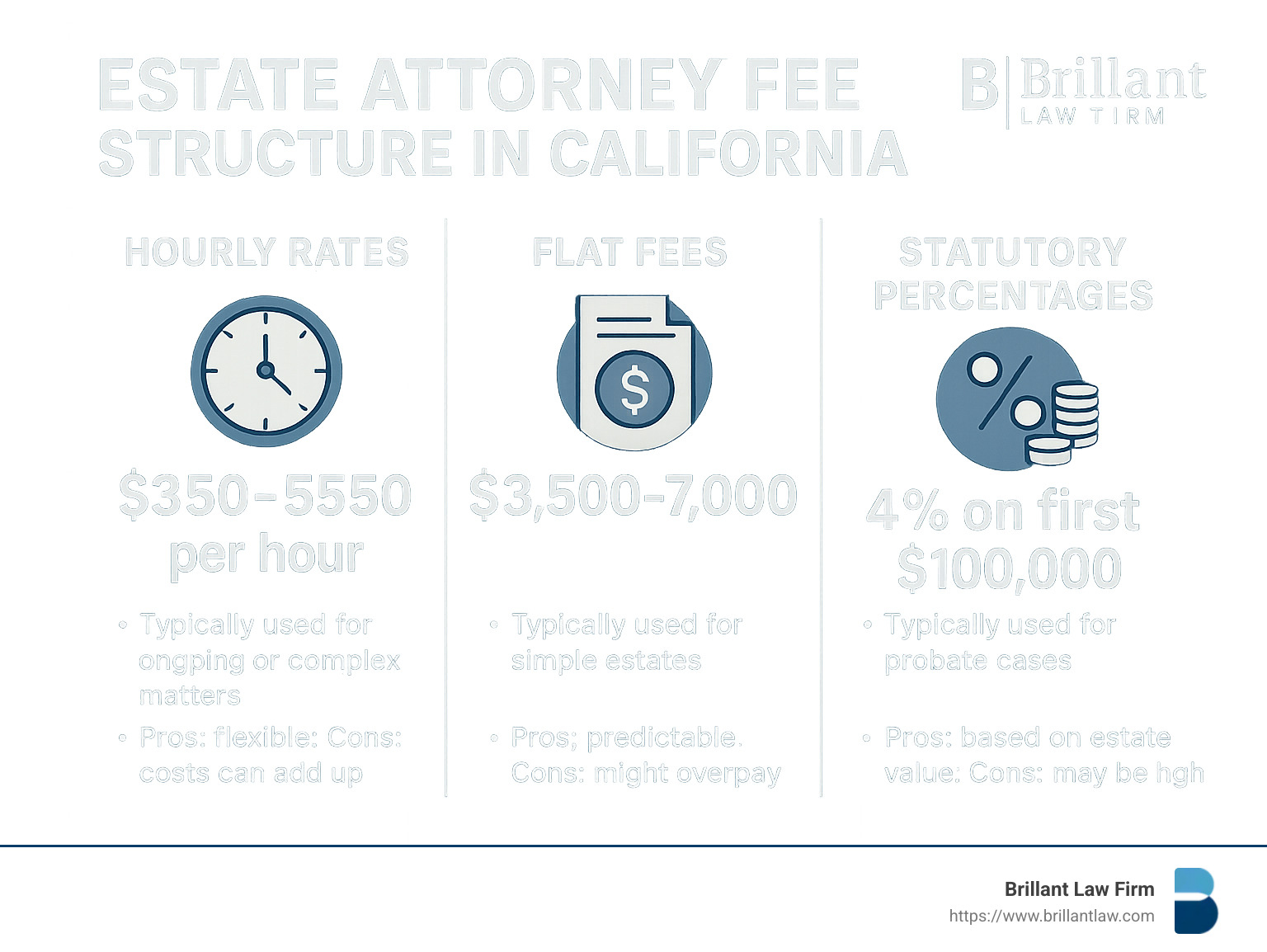
In California, estate attorney fees typically fall into three main categories:
- Hourly rates: $350-$550 per hour
- Flat fees: $3,500-$7,000 for simple estates
- Statutory percentages: 4% on first $100,000, 3% on next $100,000, 2% on next $800,000, etc.
The structure your attorney uses will depend on several factors including your estate’s complexity, the attorney’s experience level, and sometimes your own preferences. What many families find, unfortunately, is that probate costs can creep up unexpectedly. As one legal scholar aptly noted, “the cost of probate expands to consume the money available.” This reality underscores why having a clear understanding of fees from the beginning matters so much.
I’m David Brillant, a Certified Specialist in Estate Planning, Trust and Probate Law by the State Bar of California Board of Legal Specialization. Throughout my career, I’ve handled estate attorney fees ranging from straightforward probate matters to complex trust litigation. My background in taxation gives me a unique perspective on maximizing value for families navigating estate administration, and I’m passionate about helping clients understand exactly what they’re paying for.
Why Reading This Guide Matters
Understanding estate attorney fees isn’t just about budgeting—it’s about finding peace of mind during what’s often an emotionally difficult journey. When families are grieving, the last thing they need is the added stress of unexpected legal bills or confusion about the probate process.
This comprehensive guide will equip you with practical knowledge that empowers you to make confident decisions. You’ll learn exactly how estate attorneys charge in California, how to calculate potential costs before starting probate, and find effective strategies to minimize legal expenses. Perhaps most importantly, you’ll know how to prepare for your first meeting with an estate attorney so you can make the most of your time together.
Knowledge truly is power, especially when it comes to protecting your family’s assets and honoring a loved one’s legacy. By understanding the mechanics of estate attorney fees, you’ll be better positioned to steer the probate process with confidence and clarity—allowing you to focus on what really matters during this important transition.
Factors that Drive Estate Attorney Fees in California

When you’re dealing with a loved one’s estate, understanding what drives legal costs can help prevent unwelcome surprises. Let’s walk through the key factors that influence what you’ll pay for estate administration here in California.
Estate Size
The size of the estate is often the biggest factor affecting Estate Attorney Fees in California. Our state’s famously high property values mean even modest homes can push estates into higher fee brackets. What catches many families off guard is that statutory fees are calculated on the gross value of assets—not the equity.
This distinction matters tremendously. A $1 million home in the Bay Area would generate $23,000 in statutory attorney fees, whether it has a $900,000 mortgage or is fully paid off. I’ve seen families shocked by this reality when they assumed only the equity would count.
Complexity
Estates with diverse assets naturally require more attorney time and expertise. When an estate includes multiple properties, business interests, intellectual property rights, or assets held overseas, the administration becomes significantly more involved.
I recently worked with a client whose father left behind three rental properties, a small business, and a valuable patent. Each asset category required different handling, documentation, and transfer processes—all contributing to higher overall Estate Attorney Fees.
Disputes Among Beneficiaries
Family disagreements can dramatically increase costs. When beneficiaries contest a will or disagree about how assets should be distributed, legal fees can quickly multiply. In my experience at Brillant Law Firm, contested estates often see costs double or even triple compared to amicable administrations.
These disputes typically trigger hourly billing for “extraordinary services” on top of statutory fees. More importantly, they extend the timeline of administration, sometimes adding years to what should be months.
Extraordinary Work
California Probate Code recognizes that some estates require services beyond routine administration. When attorneys handle complicated matters like tax audits, business sales, or will contests, they can petition the court for additional “extraordinary fees.”
These situations often require specialized expertise. For instance, when helping a family sell a deceased’s interest in a closely-held business, we needed to coordinate business valuations, negotiate with partners, and structure the sale to minimize tax implications—all extraordinary services billed hourly.
Attorney Experience and Location
In California’s metropolitan areas like Walnut Creek, San Francisco, and Los Angeles, Estate Attorney Fees tend to run higher than in rural regions. Experienced specialists—particularly those with advanced credentials or state bar specializations—typically charge between $450-$550 per hour.
Though this might seem steep, their expertise often results in more efficient handling of complex matters. An experienced attorney might resolve in two hours what would take a less experienced attorney five hours, potentially saving money despite the higher hourly rate.
Why Estate Attorney Fees Exist
Estate Attorney Fees serve a genuine purpose. The probate process in California involves navigating complex legal requirements designed to protect everyone with an interest in the estate—heirs, creditors, and tax authorities.
Attorneys guide executors through validating the will, identifying assets, notifying creditors, paying debts and taxes, and distributing remaining assets according to legal requirements. Without proper guidance, executors risk personal liability for mistakes in administration. I’ve seen executors face personal lawsuits for distributing assets too early or failing to properly notify creditors.
Estate Size vs. Fee Size
One piece of good news: larger estates don’t face proportionally larger fees. California’s statutory fee structure operates on a sliding scale:
- 4% on the first $100,000
- 3% on the next $100,000
- 2% on the next $800,000
- 1% on the next $9 million
- 0.5% on the next $15 million
This means a $25 million estate doesn’t pay 4% across the board—the percentage drops significantly as values increase. For estates exceeding $25 million, the court determines what constitutes a reasonable fee.
Another practical consideration is liquidity. Estates rich in real estate but low on cash may struggle to pay legal fees without selling assets, sometimes at disadvantageous times. At Brillant Law Firm, we work with executors to develop fee payment strategies that minimize disruption and preserve asset value whenever possible.
Understanding these factors can help you better prepare for the costs associated with settling an estate in California—and potentially identify opportunities to reduce those expenses.
How California Estate Attorneys Charge: Hourly, Flat, or Statutory Percentages
Understanding how estate attorneys structure their fees is like having a roadmap before starting a journey. In California, attorneys typically follow three main paths when it comes to billing: hourly rates, flat fees, or statutory percentages. Each approach has its own advantages and considerations worth knowing about.
| Fee Structure | Typical Range | Best For | Potential Drawbacks |
|---|---|---|---|
| Hourly Rates | $350-$550/hour | Complex estates, litigation | Unpredictable total cost |
| Flat Fees | $3,500-$7,000 | Simple estates, specific tasks | May exclude “extras” |
| Statutory Percentages | 4% on first $100K, sliding scale after | Standard probate administration | Based on gross value, not equity |
Hourly Billing in Metro California
When you’re dealing with a complex estate or anticipating litigation, you’ll likely encounter hourly billing. In California’s metropolitan areas, rates typically reflect the attorney’s experience and expertise. At Brillant Law Firm, we see senior attorneys and partners charging between $450-$550 per hour, while associate attorneys generally bill $350-$450 per hour. Paralegals, who handle many routine aspects of estate administration, typically charge $150-$250 per hour.
Time tracking in law firms is precise—attorneys typically record their work in six-minute increments (1/10 of an hour). That quick five-minute call about your case? It often counts as a full six-minute billing increment. Most estate attorneys require an initial retainer, usually between $5,000-$10,000, which they hold in a client trust account and draw from as they complete work.
The beauty of hourly billing is its fairness—you pay only for the actual time spent on your matter. The downside? It’s hard to predict the final bill. To avoid surprises, consider asking for regular detailed billing statements, estimated ranges for specific tasks, advance notification if costs will exceed estimates, and perhaps even caps on fees for certain aspects of your case.
Flat-Fee Packages for Simple Estates
“How much is this going to cost me, exactly?” If that’s your primary concern, you might prefer a flat-fee arrangement. For straightforward estate administrations, many California attorneys offer packages with a single, predictable price tag. At Brillant Law Firm, we’ve observed that about 32% of estate administrations nationwide use this approach.
In California, typical flat fees for probate might range from $3,500-$5,000 for estates under $500,000 with minimal complexity, $5,000-$7,000 for estates between $500,000-$1 million, and $7,000-$10,000 for larger estates without unusual complications.
Before signing a flat-fee agreement, clarify exactly what services are included, what might trigger additional fees, whether court costs and third-party expenses are covered, and if the fee applies to the entire administration or just specific phases. This approach works beautifully when an estate’s parameters are clear and surprises are unlikely, giving everyone involved peace of mind about costs.
For those planning ahead, our Estate Planning Checklist can help you prepare documents that will make administration smoother and potentially less expensive.
Statutory Percentage Fees & When They Apply
California law provides a unique option for probate cases: a predetermined fee schedule that courts automatically consider reasonable. Under California Probate Code §10810, these Estate Attorney Fees follow a sliding scale:
- 4% of the first $100,000
- 3% of the next $100,000
- 2% of the next $800,000
- 1% of the next $9 million
- 0.5% of the next $15 million
- For amounts above $25 million, the court determines what’s reasonable
An important detail many people miss: these percentages apply to the gross value of the estate, not the net value after debts. That means a house worth $800,000 with a $600,000 mortgage still counts as $800,000 when calculating fees. Additionally, both the attorney and the executor are entitled to the same fee—effectively doubling the percentage. For a $1 million estate, this would mean $23,000 for the attorney and another $23,000 for the executor, totaling $46,000.
Statutory fees cover “ordinary services” in probate administration, and the court must approve them before payment, typically when probate concludes. For anything beyond ordinary administration, attorneys may petition for additional “extraordinary fees,” which we’ll discuss later.
Understanding these fee structures helps you make informed decisions when selecting an attorney and managing estate administration costs. While cost is important, experience and expertise often prove invaluable when navigating California’s complex probate system.
Crunching the Numbers: California Statutory Probate Fee Schedule
When it comes to Estate Attorney Fees in California, knowing exactly how the statutory schedule works can save you from sticker shock and help with proper financial planning. Let’s look at how these fees actually break down in real numbers:
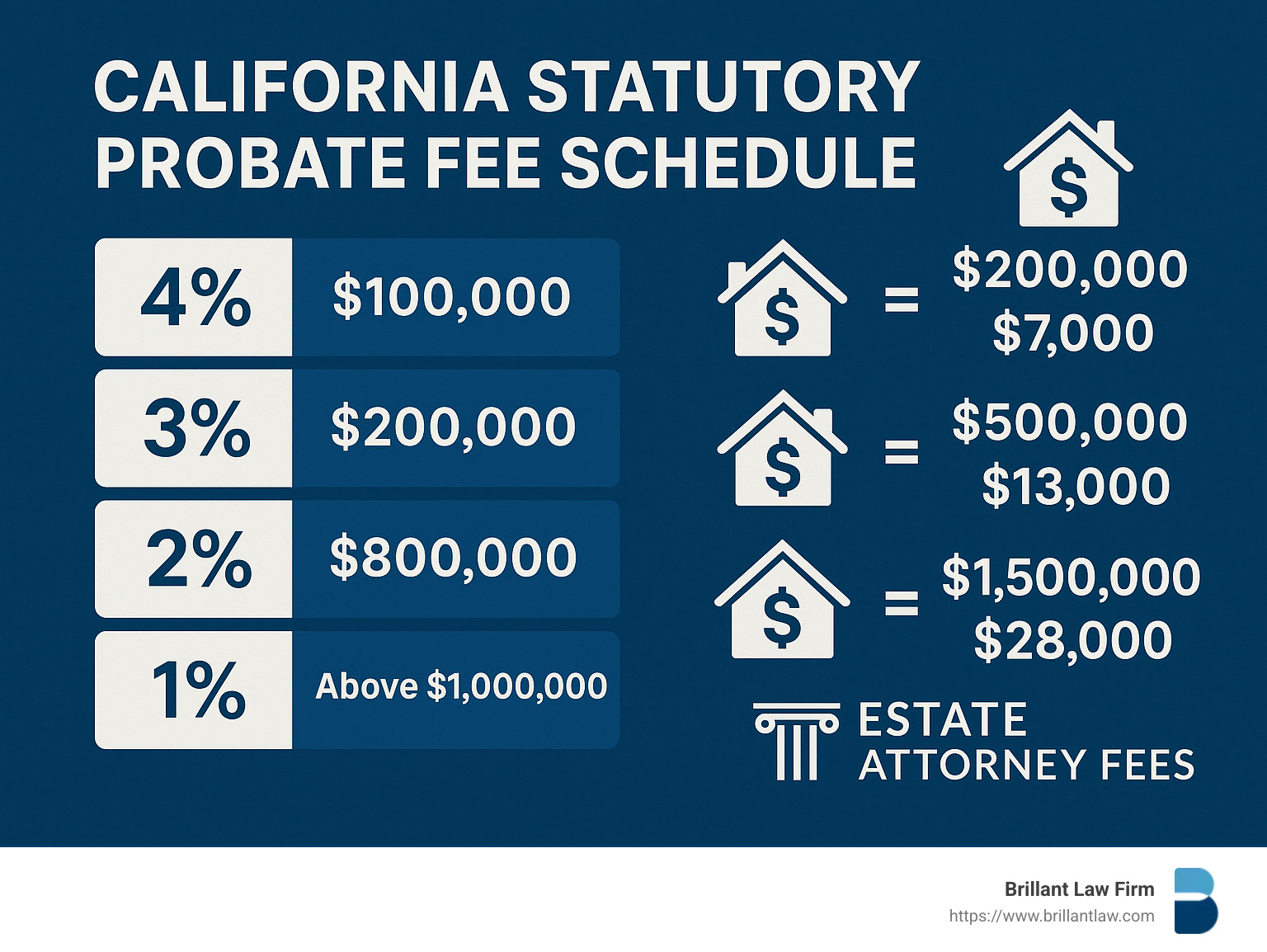
To put this into everyday terms, imagine you’re handling a $2 million estate in California. Here’s how the math works out:
– 4% of first $100,000 = $4,000
– 3% of next $100,000 = $3,000
– 2% of next $800,000 = $16,000
– 1% of next $1,000,000 = $10,000
This gives you a total statutory fee of $33,000. And remember, both the attorney and executor are entitled to this same amount, meaning the estate would pay a total of $66,000 in statutory fees. That’s a significant chunk of money that many families don’t anticipate.
What Counts in the “Gross Value” of an Estate?
One of the most important things to understand about Estate Attorney Fees is that they’re based on the gross value of the estate—not the net value after debts. This distinction can dramatically affect the final bill.
For California probate purposes, gross value includes:
Real property at fair market value (without deducting mortgages), bank accounts, investment portfolios, business interests, vehicles, furniture, collections, and even life insurance or retirement accounts if they’re payable to the estate.
This means that beautiful family home in San Francisco worth $1.5 million with a $1.2 million mortgage still counts as $1.5 million for fee calculations. I’ve seen many clients surprised by this reality, expecting fees to be based on their equity position rather than the property’s full value.
What’s not included? Assets in a living trust, property with designated beneficiaries (like most life insurance policies), jointly owned property with right of survivorship, and “transfer on death” accounts all typically bypass probate and aren’t counted in fee calculations. This is why proper estate planning can significantly reduce Estate Attorney Fees—something we emphasize with all our clients at Brillant Law Firm.
Additional Court & Third-Party Costs
The statutory attorney fees are just one piece of the probate expense puzzle. You’ll also encounter various court costs and third-party expenses that can add up quickly:
Court filing fees in California typically range from $435-$650 depending on your county. Then there’s the probate referee fee (0.1% of non-cash assets with a $75 minimum), publication costs for legal notices ($100-$400), certification fees for court documents ($25-$50 per document), and recording fees for property transfers ($50-$100).
If the court requires an executor’s bond, that’s another expense that varies based on the estate size. These costs might seem minor compared to the attorney fees, but they can easily add several thousand dollars to your total probate expenses.
For the most current information on court filing fees and procedures, you can visit the California Courts Self-Help Center, which provides valuable resources for those navigating the probate process.
Extraordinary Fees: Beyond Ordinary Administration
Sometimes estate administration goes beyond the routine, and that’s when “extraordinary fees” come into play. The California Probate Code §10810 recognizes that certain situations require additional work and allows attorneys to petition the court for fees beyond the statutory amount.
What might trigger extraordinary fees? Tax complications are a common culprit. If your estate requires federal estate tax returns or faces an audit, that’s considered extraordinary work. Selling real property, conducting litigation related to the estate, managing a business, or resolving complex creditor claims all fall into this category too.
Unlike statutory fees with their fixed percentages, extraordinary fees are typically calculated based on hourly rates and actual time spent. The court must approve these fees, looking at factors like complexity, time required, results achieved, and the attorney’s expertise.
I remember one case where a seemingly straightforward $3 million estate ended up with over $45,000 in extraordinary fees due to a contested will and complicated real estate transactions. The statutory fee was $39,000, but the extraordinary circumstances nearly doubled the legal costs. This isn’t uncommon when family disagreements enter the picture.
At Brillant Law Firm, we always strive to give clients a realistic picture of potential extraordinary fees early in the process. While we can’t predict every complication, our experience helps us identify red flags that might lead to additional costs down the road.
Smart Ways to Minimize or Avoid Estate Attorney Fees

Nobody enjoys paying legal fees, even when they’re necessary. The good news? With some smart planning, you can significantly reduce—or even eliminate—estate attorney fees in California. At Brillant Law Firm, we believe in empowering you with practical strategies that can save your family both money and stress during an already difficult time.
Create a Living Trust
The gold standard for avoiding probate and its hefty fees is establishing a revocable living trust. When you properly transfer assets to a trust, they completely bypass the probate process—and those substantial statutory fees that come with it.
Let’s look at the math: A $1.5 million estate would typically generate about $28,000 in statutory estate attorney fees through probate. Creating and funding a comprehensive trust might cost $3,000-$5,000 upfront, but saves your heirs from those probate fees—resulting in net savings exceeding $20,000.
Beyond just saving money, a living trust offers several other compelling benefits. Your estate remains private (unlike probate, which creates public records), provides management of your assets if you become incapacitated, typically allows faster distribution to your loved ones, and often reduces the likelihood of family disputes over your wishes.
Use Transfer-on-Death Deeds for Real Property
California homeowners have access to a useful tool called Transfer-on-Death (TOD) deeds. This relatively simple document allows your real estate to pass directly to your named beneficiaries without going through probate.
While not as comprehensive as a trust, TOD deeds can be particularly cost-effective when real property represents your most significant asset. Just remember that proper execution is crucial—one technical mistake could render the transfer ineffective and send your property back through probate.
Consider Joint Tenancy (With Caution)
Joint tenancy with right of survivorship seems straightforward—when one owner dies, their interest automatically passes to the surviving owner(s). This can indeed avoid probate for that specific asset.
However, I always urge clients to approach this option carefully. When you add someone as a joint tenant, you’re giving them immediate ownership rights to your property. This could expose your assets to their creditors, create unintended gift tax consequences, and ultimately doesn’t solve the probate problem when the last joint tenant passes away. It’s a solution that sometimes creates more problems than it solves.
Use California’s Small Estate Procedures
If your estate is valued under $184,500 (as of 2024), California offers simplified procedures that can help you avoid formal probate:
For estates without real property, a Small Estate Affidavit can transfer assets to rightful heirs with minimal paperwork and expense. If real property is involved but still under the threshold, a Simplified Probate Petition offers a streamlined alternative to full probate. Both options typically cost a fraction of formal probate and conclude much faster.
Mediate Disputes Early
Nothing inflates estate attorney fees quite like family conflict. When beneficiaries disagree about inheritances or contest a will, legal costs can skyrocket—particularly if disagreements escalate to litigation.
At Brillant Law Firm, we’ve witnessed early mediation resolve inheritance disputes in days that might have consumed years and substantial estate assets if fully litigated. A skilled mediator can help family members find common ground before positions become entrenched and expensive to unwind. Sometimes the best legal strategy is avoiding the courtroom altogether.
Do Your Own Preparation Work
While navigating probate without legal guidance isn’t advisable, you can significantly reduce billable hours by coming prepared. Being organized isn’t just a personality trait—it’s a money-saving strategy when dealing with estate attorney fees.
Before your first meeting with an attorney, gather relevant documents, create an asset inventory, obtain preliminary valuations of major items, identify all potential heirs, and organize financial records. The more groundwork you complete, the less time your attorney needs to spend on administrative tasks that can quickly consume billable hours.
How Timing & Organization Cut Estate Attorney Fees
The clock is literally ticking when it comes to estate attorney fees. Delays in probate often lead to increased costs through additional court appearances, extended asset management periods, ongoing correspondence, and continued property maintenance expenses.
I recommend executors maintain meticulous records and respond promptly to attorney requests. Something as simple as creating a dedicated filing system for estate documents and tracking all related expenses can streamline the process and reduce billable hours. In estate administration, time really is money.
Estate Attorney Fees in Estate Planning vs. Probate
The numbers don’t lie—preventive estate planning is dramatically less expensive than probate. Consider this cost comparison:
A basic estate plan with a will typically costs $1,500-$3,000 in California. A comprehensive estate plan with a trust might run $3,000-$7,000. Compare that to probate of a $1 million estate, which generates $23,000 in statutory estate attorney fees alone—not counting executor fees and court costs.
The investment in proper estate planning clearly pays off, saving your heirs significant money while providing additional benefits like privacy, faster asset transfers, and reduced family stress. As the saying goes, an ounce of prevention is worth a pound of cure—especially when it comes to legal fees.
Common Pitfalls That Inflate Costs
Over years of practice at Brillant Law Firm, we’ve identified several common mistakes that unnecessarily increase estate attorney fees. Missing probate deadlines can extend the process and increase costs dramatically. Finding undisclosed assets late requires amending court filings—a time-consuming and expensive process.
Family conflict almost invariably leads to higher fees, as does attempting DIY legal work that later needs professional correction. Poor record-keeping forces attorneys to spend billable hours sorting through disorganized documents. And perhaps most frustrating is creating a trust but failing to fund it—leaving those assets still subject to probate despite your planning efforts.
By avoiding these common pitfalls, you can keep estate attorney fees to a minimum while ensuring proper administration of your loved one’s estate. The best time to plan is now—before circumstances force more expensive solutions.
For more information about minimizing legal costs through proper planning, visit our pages on Estate Planning Attorney and Attorney Fees for Trust Administration.
Getting the Most from Your First Attorney Meeting

That first meeting with your estate attorney sets the tone for your entire working relationship. Coming prepared doesn’t just make the meeting more productive—it can actually save you money on Estate Attorney Fees in the long run. Think of it as laying the groundwork for an efficient, transparent partnership during what’s often an emotionally challenging time.
What to Bring to Your Consultation
Walking into your attorney’s office with an organized file of documents makes an immediate positive impression. I’ve seen how preparation can transform the probate process.
One client shared with me: “I spent a weekend organizing all the documents before meeting my attorney. That preparation saved me at least $1,000 in legal fees because the attorney didn’t have to spend time hunting down basic information.”
To make your consultation truly productive, gather these essential items beforehand:
The basics include the death certificate (if applicable) and the will with any amendments (codicils). Don’t forget any existing trust documents and deeds to real property—these are fundamental to understanding the estate’s structure.
Financial documents matter tremendously: bring recent bank statements, investment account statements, and life insurance policies. Include vehicle titles, business ownership documents, and the past three years of tax returns to provide a complete financial picture.
For planning purposes, prepare a preliminary inventory of assets with estimated values, a list of known creditors, and contact information for beneficiaries. If you’re starting probate, bringing a completed Petition for Probate (form DE-111) or at least having the information ready for this form can jump-start the process.
Questions to Ask About Estate Attorney Fees
Don’t be shy about discussing money—good attorneys expect and welcome these conversations. Clear communication about Estate Attorney Fees prevents misunderstandings down the road.
Start by asking what fee structure they recommend for your specific situation and why. Understanding whether hourly rates, flat fees, or statutory percentages would work best gives you valuable insight into how the attorney views your case.
Request a written estimate of total expected costs based on your estate’s complexity. This provides a ballpark figure for budgeting purposes. Clarify what’s included in their quoted fee and what might trigger additional charges—court costs, filing fees, and other expenses can add up quickly.
If your attorney charges hourly, consider asking about establishing caps for certain phases of the administration. This hybrid approach provides some cost certainty while still allowing for the flexibility of hourly billing.
Discuss billing frequency and detail level—regular, detailed invoices help you monitor costs and understand where the time is being spent. Most importantly, ask directly: “What can I do to help keep fees down?” Most attorneys appreciate clients who want to partner in keeping costs reasonable.
Finally, understand what circumstances might lead to extraordinary fees beyond the statutory amount. Litigation, tax issues, or property sales often trigger these additional charges, and knowing the warning signs helps avoid surprises.
Drafting a Written Fee Agreement That Protects You
Never proceed without a clear, comprehensive fee agreement in writing. This document serves as your roadmap for financial expectations throughout the estate administration process.
A solid fee agreement should clearly outline the scope of representation—exactly what services the attorney will provide and what falls outside those boundaries. The fee structure section should specify whether you’re paying hourly, flat fee, or statutory rates, with specific amounts listed.
Retainer details matter—know how much is required upfront and how it will be applied to your bill. Understand the billing frequency (monthly is standard) and payment terms, including when payment is due and what methods are accepted.
Don’t overlook sections addressing additional costs like court filing fees, appraisals, and other expenses. Termination provisions explain how either party can end the relationship and what happens to paid fees. Finally, dispute resolution clauses outline how fee disagreements will be handled if they arise.
At Brillant Law Firm, we believe transparency about Estate Attorney Fees builds trust and prevents misunderstandings. We provide detailed written fee agreements and welcome questions about any aspect of our billing practices.
Fee agreements are negotiable. If certain terms seem unclear or unreasonable, speak up before signing. A reputable attorney should willingly explain their fee structure and consider reasonable modifications. After all, this is the beginning of an important relationship during a significant life transition—getting the financial aspects clear from the start sets everyone up for success.
Frequently Asked Questions about Estate Attorney Fees
How long does California probate take and how does that change Estate Attorney Fees?
The California probate process typically spans 9-18 months, though I’ve seen complex cases stretch well beyond that timeframe. This duration directly impacts what you’ll pay in Estate Attorney Fees, especially if your attorney bills by the hour.
Think of probate like a taxi meter that keeps running—the longer it takes, the more it costs. Several factors can extend your probate timeline, including family disputes over the will, unique or hard-to-value assets like business interests or intellectual property, ongoing tax issues, contested creditor claims, or simply court backlogs in busy California counties.
Each delay translates to more attorney time. For perspective, a single dispute requiring additional court hearings might add 10-20 hours of attorney work at $450 per hour—that’s an extra $4,500-$9,000 in fees that could have stayed in the estate.
Even with statutory fees, prolonged probates often lead to requests for extraordinary fees to compensate for additional work. Plus, the estate continues incurring carrying costs like property maintenance, insurance premiums, and tax preparation while assets remain tied up.
At Brillant Law Firm, we prioritize efficient administration to minimize these ongoing expenses. As one relieved client shared with us: “What impressed me most was how proactively they managed the timeline, keeping the process moving forward despite court delays.”
Who actually pays the lawyer—the executor or the estate?
Good news for executors—Estate Attorney Fees come from the estate’s assets, not your personal bank account. However, the payment process varies depending on the fee arrangement:
For statutory fees, payment typically happens at the end of probate after receiving court approval. With hourly billing, many attorneys request a retainer upfront, which you as executor might pay personally and later be reimbursed from estate assets once they become available. Flat fee arrangements are often split into payments at different stages of administration.
While you’re responsible for ensuring the attorney gets paid, you shouldn’t permanently use personal funds. If the estate lacks sufficient liquid assets to cover legal fees, you may need to sell some estate assets or negotiate a payment plan with your attorney.
California provides a helpful safeguard: the court must approve all Estate Attorney Fees before final payment from estate assets. This judicial oversight protects against unreasonable charges, as the court can reduce fees it considers excessive.
Can Estate Attorney Fees be negotiated in California?
Absolutely! Even with California’s statutory fee structure, Estate Attorney Fees often have room for negotiation. Over the years, I’ve seen several effective approaches work for our clients:
Request an hourly cap while maintaining the standard rate: “I’m comfortable with your hourly rate, but could we cap the total for the initial phase at $10,000?”
Propose a blended rate that applies to all work regardless of who does it: “Would you consider a single blended rate rather than different rates for partners and associates?”
Suggest dividing the work into phases with separate flat fees: “Could we structure this as separate flat fees for different stages of the probate process?”
Discuss fee timing if the estate is cash-poor: “The estate has valuable real estate but limited cash. Would you consider deferring part of your fee until property is sold?”
Negotiate responsibilities: “If I handle document gathering and beneficiary communications, can we reduce the fee?”
Attorneys have discretion to accept less than the statutory fee, particularly for straightforward administrations. Some attorneys may offer discounts when multiple family members use their services for related matters.
At Brillant Law Firm, we welcome conversations about fee arrangements that address our clients’ financial concerns while ensuring we can provide the quality representation their loved one’s estate deserves.
Conclusion
Understanding estate attorney fees is essential for effective estate planning and administration in California. Whether you’re creating an estate plan or serving as an executor, knowledge of fee structures and cost-saving strategies can help preserve more assets for beneficiaries.
Key takeaways from this guide include:
Estate attorney fees in California follow three main structures: hourly rates ($350-$550), flat fees ($3,500-$7,000 for simple estates), or statutory percentages (4% on first $100,000, with decreasing percentages for higher amounts).
Factors affecting fees include estate size, complexity, disputes among beneficiaries, and whether extraordinary services are required.
Statutory fees are based on the gross value of the estate, not the net value after debts, which can significantly impact costs for mortgaged properties.
Proactive estate planning, particularly through living trusts, can substantially reduce or eliminate probate costs.
Coming prepared to attorney meetings with organized documents and specific questions about fees can lead to more cost-effective representation.
At Brillant Law Firm, we believe in transparent fee discussions and custom approaches that address each client’s unique circumstances. Our experience in estate planning, trust administration, and probate allows us to steer complex legal requirements while keeping costs reasonable.
Ready to safeguard your legacy?
The best time to address estate planning is now, before urgent needs arise. Proper planning not only minimizes estate attorney fees but also provides peace of mind knowing your wishes will be honored and your loved ones protected.
We invite you to schedule a complimentary consultation at Brillant Law Firm to discuss your estate planning or administration needs. Our offices in Walnut Creek serve clients throughout the surrounding areas, including Saranap, San Miguel, and Castle Hill.
Contact us today to learn how we can help you steer estate attorney fees and create a comprehensive plan that protects what matters most to you.


