

difference between a will and a trust: 7 Powerful Facts 2025
Understanding the Key Differences Between Wills and Trusts
When families sit down at my office to discuss their legacy plans, one of the first questions that often comes up is about the difference between a will and a trust. It’s a crucial distinction that shapes how your wishes will be carried out and how your loved ones will experience the transfer of your legacy.
I like to explain it this way: Think of a will as instructions that activate after you’re gone, while a trust is more like creating a protective container for your assets that works both during your lifetime and afterward.
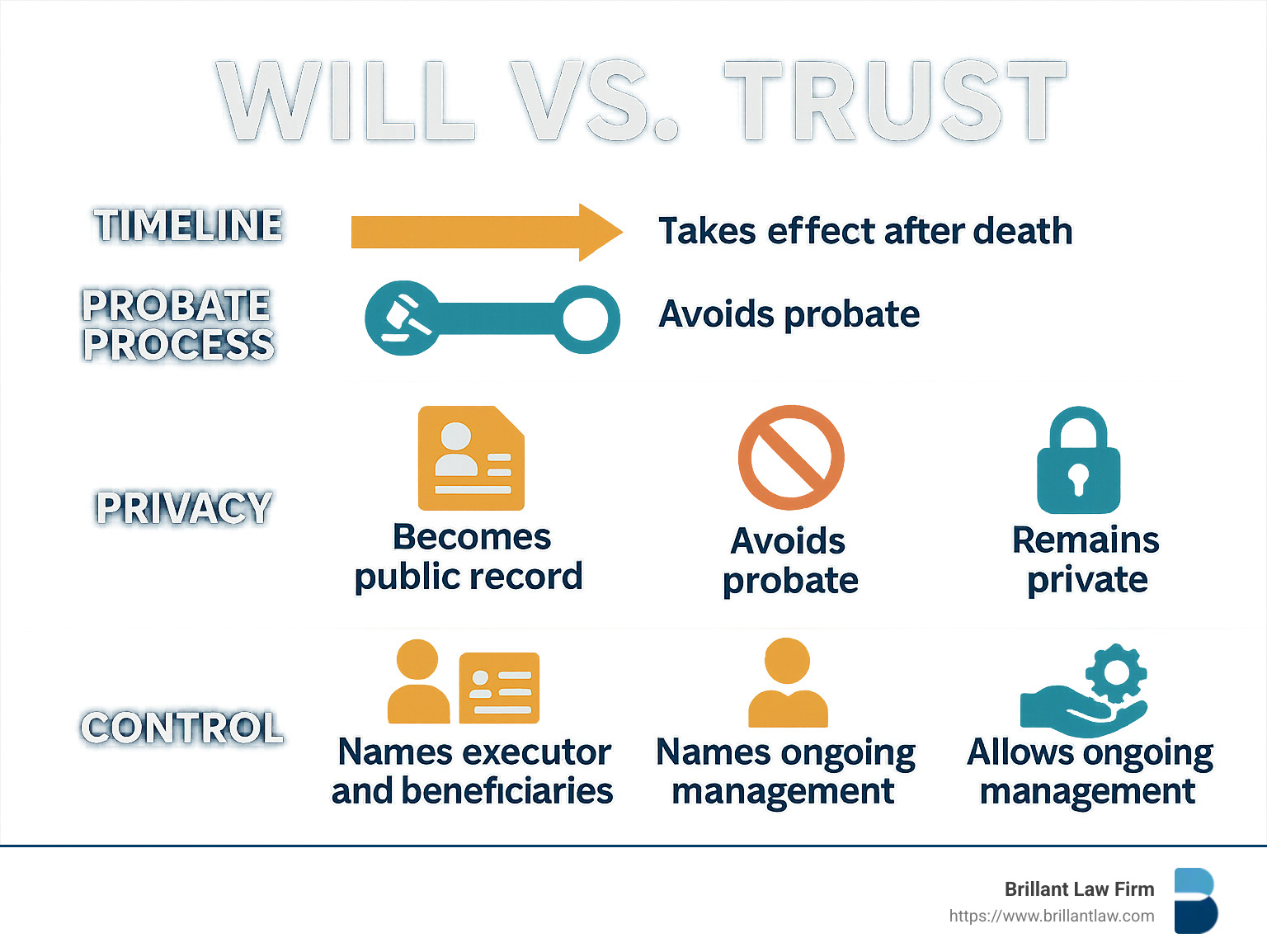
Here’s how these important documents compare side by side:
| Feature | Will | Trust |
|---|---|---|
| Takes effect | Only after death | Immediately upon creation and funding |
| Probate | Must go through probate | Avoids probate |
| Privacy | Becomes public record | Remains private |
| Control | Names executor, guardians, beneficiaries | Allows ongoing management during life and after death |
| Complexity | Simpler to create | More complex to establish and maintain |
| Cost | Generally less expensive ($300-1,000) | More expensive upfront ($2,500-6,000) |
A will is essentially your voice after you’re gone. It speaks up in court to say who should receive your belongings, who should look after your children, and who should handle wrapping up your affairs. But here’s the catch – it must go through probate, which means the court oversees the entire process. In California, probate can take months or even years, with records available for anyone to see.
On the other hand, a trust creates a relationship where someone (often you initially) manages assets for the benefit of others. The beauty of a trust is that it works immediately after you create and fund it – no waiting until death. If you become ill or unable to manage your affairs, your successor trustee can step in seamlessly. After death, your assets can transfer to beneficiaries without court involvement, keeping your family business private.
My name is David Brillant, and as a Certified Specialist in Estate Planning, Trust and Probate Law with a Masters in Taxation, I’ve guided countless California families through these decisions. What I’ve found most rewarding is helping clients steer the difference between a will and a trust to build plans that truly fit their unique circumstances – whether it’s protecting a child with special needs, managing a blended family situation, or preserving a family business.
The right choice between these documents depends on your unique circumstances. For some families, a simple will is perfectly adequate. For others – particularly those with significant assets, real estate in multiple locations, concerns about privacy, or family members with special needs – a trust offers invaluable benefits that far outweigh the initial setup costs.
Many of my clients actually benefit from having both: a trust for their major assets, and a will that catches anything that might have been missed in the trust funding process (sometimes called a “pour-over will”) and names guardians for minor children.
Want to explore more about the difference between a will and a trust and how they might work for your family situation? Here are some helpful resources:
– Changing executor of will
– Changing your will
– Wills for unmarried couples
The peace of mind that comes from having the right estate planning documents in place is truly priceless. Whether you choose a will, a trust, or both, what matters most is that you’re taking steps to protect what you’ve built and the people you love.
The Difference Between a Will and a Trust Explained
When clients walk into our Walnut Creek office, they often have a puzzled look that says it all: “I know I need estate planning documents, but what’s the difference between a will and a trust?” This confusion is completely normal. While both are powerful estate planning tools, they operate in fundamentally different ways—like two different vehicles that can take you to similar destinations but via very different routes.
Core Features of Each Document: the “difference between a will and a trust” in a Nutshell
A will—formally called a “Last Will and Testament”—is essentially your final set of instructions that spring to life only after you’re gone. Think of it as your farewell letter with legal muscle, outlining:
Your chosen beneficiaries who’ll receive your assets, your carefully selected guardian for minor children, and your appointed executor who’ll handle everything from paying final bills to distributing keepsakes.
As Justice Cardozo wisely noted in a famous case, executors are held to “a level of conduct higher than that trodden by the crowd.” This is why choosing someone trustworthy and detail-oriented is crucial—they’ll be carrying out your final wishes when you can no longer speak for yourself.
A trust, on the other hand, is like creating a protective legal container that activates the moment you sign and fund it. This three-party arrangement involves you as the creator (grantor), a trustee who manages everything, and your beneficiaries who ultimately receive the benefits.
One client put it perfectly: “My will felt like posting my financial decisions on a public bulletin board, while my trust feels like having a private, secure vault that only my chosen people can access.” This privacy difference is just one of many important distinctions.
Why the “difference between a will and a trust” matters for California families
For California families in particular, understanding the difference between a will and a trust isn’t just academic—it can have profound practical impacts:
If you own property in multiple California locations (perhaps a home in Walnut Creek and a vacation cabin in Lake Tahoe), a will alone might require separate probate proceedings in different counties. A trust can simplify this considerably.
California’s beautiful diversity means many blended families with complex relationships. Trusts offer nuanced control over how assets flow to current spouses, children from previous marriages, and other loved ones, with timing and conditions you specify.
For families with members who have special needs, specialized trusts can provide ongoing care without jeopardizing government benefits—something a simple will can’t accomplish effectively.
Perhaps most eye-opening for many clients is learning about California’s statutory probate fees. They’re significant—an estate worth $1 million would generate about $23,000 in attorney fees alone during probate. Trusts typically avoid this process entirely.
As one relieved parent recently told me, “I never realized how much control a trust would give me over not just who gets my assets, but when and how they receive them. For my son with special needs, it’s been absolutely life-changing.”

How and When Each Document Takes Effect
Understanding when your estate planning documents activate is crucial to making the right choice for your family. This timing difference is one of the most fundamental aspects of the difference between a will and a trust.
A will remains dormant throughout your lifetime, like a letter locked away until needed. It only springs into action after you’ve passed away, when your executor presents it to the probate court to begin the distribution process under judicial supervision.
A trust, however, comes alive the moment you sign the documents and fund it with assets. It’s immediately operational—ready to protect and manage your assets while you’re alive and seamlessly transition after you’re gone.
“I often tell clients that a will is like leaving instructions for after you’ve left the party,” says David Brillant. “A trust is more like having a trusted friend who can help manage things both during the party and after you’ve gone home.”
Avoiding or Navigating Probate in California
Probate in California can be particularly challenging for families already dealing with loss:
The typical California probate takes 9-18 months to complete, though complex estates can extend well beyond this timeframe. During this period, your assets remain largely frozen, with your loved ones unable to access their inheritances without court approval.
The financial impact is equally significant. Between statutory attorney fees and court costs, probate can consume 3-7% of your estate’s total value. For a $1 million estate—not uncommon with California’s property values—this could mean $30,000-$70,000 in fees alone.
Perhaps most concerning for many families is the lack of privacy. Probate proceedings become public record, meaning anyone can access details about your assets, debts, and beneficiaries.
While California does offer a simplified process for estates valued under $166,250, many California homes alone exceed this threshold.
“After watching my sister’s family struggle through probate for nearly two years after her husband died, I immediately set up a trust,” shares one client. “When my time came, I wanted my children to have immediate access to their inheritance without that additional stress.”
Incapacity & Lifetime Management Benefits of Trusts
The incapacity protection a trust provides is perhaps its most underappreciated benefit. Consider what happens if you become unable to manage your affairs due to illness or injury:
With only a will in place, your family may need to petition for conservatorship—an often expensive, public, and potentially contentious court process. Your loved ones must prove your incapacity and request permission to manage your assets, all while navigating an emotionally difficult time.
With a trust, your named successor trustee can step in immediately according to your documented wishes. There’s no court involvement, no public record, and no delay in managing your affairs when you need help most.
“Preparing for incapacity is like having insurance for your decision-making,” explains Brillant. “You hope you’ll never need it, but having it in place provides tremendous peace of mind.”
This is why we typically recommend complementing your estate plan with a durable power of attorney for financial matters and an advance healthcare directive for medical decisions—regardless of whether you choose a will or trust as your primary planning tool.
For many California families, especially those with significant assets or complex family situations, the lifetime benefits of a trust provide compelling advantages that a will simply cannot match.
Probate, Privacy, and Asset Distribution
When it comes to estate planning, the difference between a will and a trust becomes especially apparent in how your assets are handled after you’re gone. Let’s take a closer look at these crucial differences.
Who Sees Your Estate? Privacy Stakes
Privacy might not be your first concern when planning your estate, but perhaps it should be. When your will enters probate, it becomes as public as yesterday’s newspaper. Anyone with curiosity and a few minutes to spare can access intimate details about:
- Your complete asset inventory
- Who received what from your estate
- The exact value of your possessions
- Any family disagreements that bubble up during proceedings
Celebrity cases make this reality painfully clear. When acclaimed actor Philip Seymour Hoffman passed away with only a will in place, his $35 million estate became public knowledge, including his personal wishes about where his son should be raised. What might seem like private family matters suddenly become fodder for public consumption.

A trust, however, wraps your estate in a blanket of privacy. No court filings are necessary, keeping your assets, beneficiaries, and distributions completely confidential. For California business owners, individuals with substantial wealth, or anyone who simply values keeping family matters private, this distinction alone often makes a trust the preferred choice.
“Your financial life is your business,” as one of our clients recently put it. “Why would I want my neighbors knowing exactly what I left to each of my children?”
Speed of Distribution: Weeks vs. Months
Time is another significant factor highlighting the difference between a will and a trust. The contrast in how quickly your loved ones can access needed funds is striking:
With a will, your assets essentially enter a state of limbo during probate. In California, this process typically stretches 9-18 months, sometimes longer for complex estates. During this time, assets remain frozen while creditors have about 4 months to stake their claims. Nothing moves without the court’s blessing, which can create real hardship for families needing immediate access to funds.
Trusts operate on a completely different timeline. Since trust assets avoid probate entirely, distribution can begin almost immediately after death. No court approval is needed, and assets remain accessible throughout the process. What takes a year or more with a will can often be completed in weeks with a trust.
One California family I worked with experienced both scenarios. “When my mother passed with her assets in a trust, we had funds available within days to handle her final arrangements,” the daughter told me. “But when my aunt died with only a will the previous year, her children couldn’t access anything for nearly 14 months. They actually had to take out loans to cover her funeral costs.”
This speed difference isn’t just about convenience—it can have real financial implications. Mortgage payments, educational expenses, and basic living costs don’t pause for probate. For beneficiaries who depend on their inheritance to meet immediate needs, waiting a year or more can create genuine hardship.
The American Bar Association notes that “probate avoidance is one of the primary benefits of using a revocable living trust instead of a will,” particularly in states like California with lengthy probate processes. You can learn more about this perspective at the American Bar Association resource.
For California families seeking to avoid these probate challenges altogether, our firm offers guidance on strategies beyond trusts, including beneficiary designations, joint tenancy arrangements, and proper asset funding. Learn more about these options in our guide on How to Avoid Probate.
Costs, Complexity, and Choosing What Fits Your Estate
Let’s talk money and effort – two things that matter when weighing the difference between a will and a trust. As with most things in life, there are tradeoffs to consider.
Here in California, legal fees reflect our higher cost of living. You can expect to pay around $500-1,500 for a professionally drafted will, while a comprehensive revocable living trust package typically runs $3,000-6,000. But these initial numbers don’t tell the whole story.
Think of it like buying a car – the sticker price is just the beginning. The real cost includes maintenance, insurance, and fuel over its lifetime. Estate planning works similarly.
Advantages & Disadvantages of a Will
A will is like a reliable sedan – straightforward, gets the job done, and won’t break the bank upfront.
The simplicity of a will makes it appealing for many families. You’ll spend less initially, and the document itself is typically easier to understand. There’s minimal maintenance required during your lifetime – just periodic reviews when major life events occur.
For parents with young children, a will shines in one critical area: it clearly establishes guardianship. As one client told me, “Knowing our kids would be with my sister if something happened to us – that peace of mind was worth everything.”
However, wills have their limitations. The probate process can consume roughly 3-7% of your estate’s value in California – a significant “hidden cost.” Your financial life becomes an open book through public court records. And if you own property in another state? Your family might face additional probate proceedings there too.
“I thought saving money with just a will was smart,” a client recently shared, “until I calculated what probate would cost my kids later. The math just didn’t make sense.”
Advantages & Disadvantages of a Trust
A trust, meanwhile, is more like a luxury vehicle – higher upfront investment but equipped with features that make the journey smoother.
The probate avoidance alone can justify the cost for many California families. A $1 million estate (which in California might simply mean a modest home) would generate approximately $23,000 in statutory attorney fees during probate. Suddenly, that $5,000 trust seems like a bargain.
Privacy is another major benefit. Your family’s financial matters remain confidential, away from curious neighbors or opportunistic strangers. Trusts also provide immediate effectiveness – if you become incapacitated, your successor trustee can step in without court intervention.
The flexibility of trusts allows for sophisticated distribution strategies. One client used his trust to incentivize education by creating milestone distributions for his grandchildren when they reached educational achievements.
But trusts aren’t without drawbacks. They require more setup work and ongoing attention. You must “fund” your trust by transferring assets into it – a step many people unfortunately neglect. As your financial life changes, your trust needs updating too.
For very simple estates with minimal assets, a trust might be more firepower than needed. As I often tell younger clients, “Your estate plan should grow with you. What’s right today might change tomorrow.”
The difference between a will and a trust ultimately comes down to your unique situation. Do you own a home in California? Have minor children or family members with special needs? Value privacy? Worry about potential family conflicts? These factors all influence which tool will serve you best.
At Brillant Law Firm, we take time to understand your specific circumstances before recommending either option. Sometimes, we even suggest a combination approach – using both tools to create the most effective plan for your family.
Want to explore which option might be right for you? Learn more about our approach to Estate Planning Attorney services and how we can help protect what matters most.
Using Both: Coordinating Wills, Trusts & Beneficiary Designations
Most comprehensive estate plans don’t rely on just one tool. In fact, the most effective strategies often combine wills, trusts, and beneficiary designations to create a safety net that catches everything. Let’s talk about how these pieces work together in real life.
A “pour-over will” is like your trust’s best friend. If you accidentally forget to transfer something into your trust (which happens more often than you’d think!), this special will “pours” those overlooked assets into your trust after you’re gone. While these forgotten items will still need to go through probate, they’ll ultimately follow your trust’s instructions rather than being distributed according to California’s intestacy laws.
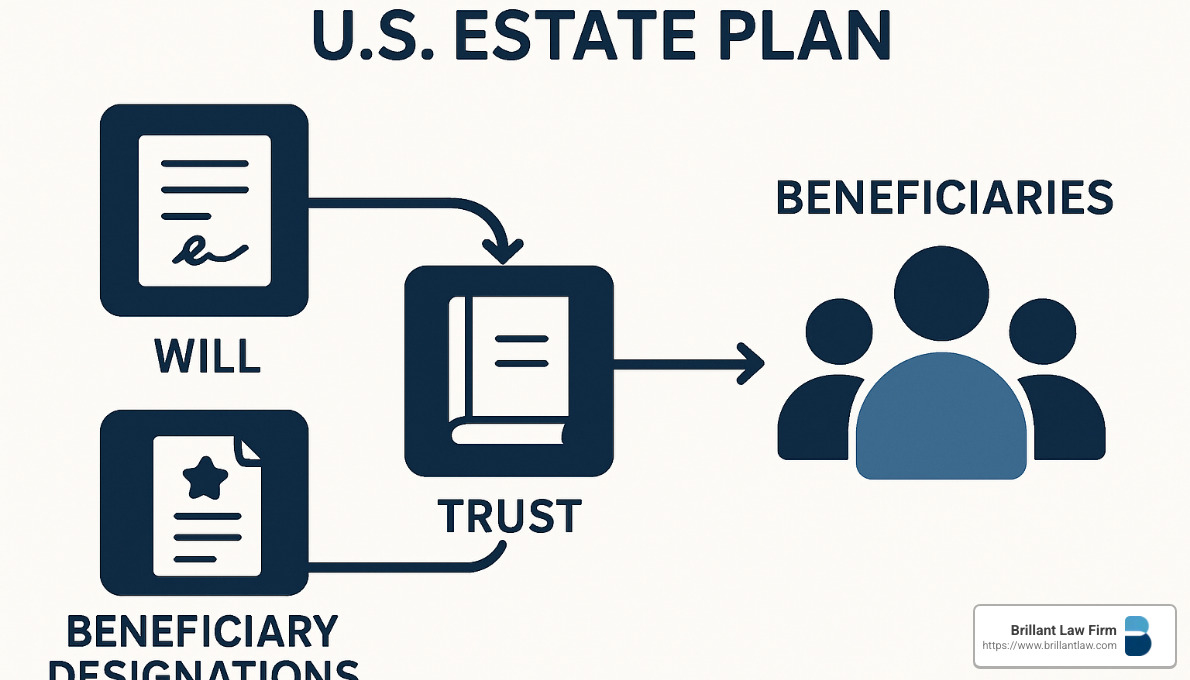
Your retirement accounts, life insurance policies, and payable-on-death accounts have their own built-in estate planning mechanism: the beneficiary designation. These assets transfer directly to whoever you’ve named, completely bypassing both probate and your trust. This can be incredibly efficient—but only if these designations align with your overall plan.
Take one of our clients with a special needs child. Their comprehensive plan included:
- A special needs trust that provides for their child while preserving essential government benefits
- A pour-over will to catch any assets that might slip through the cracks
- Life insurance policies naming the special needs trust (not the child directly) as beneficiary
- A detailed letter of intent giving future caregivers essential information about their child’s needs and preferences
For blended families, the difference between a will and a trust becomes especially important. A trust can ensure your current spouse is provided for during their lifetime while guaranteeing that your children from a previous marriage ultimately receive their inheritance—something a simple will often can’t accomplish.
Common Mistakes to Avoid
After helping hundreds of California families, we’ve seen certain mistakes come up again and again. Here are the big ones to watch out for:
Creating what I call an “empty trust.” This happens when someone goes through the effort of establishing a trust but never actually transfers their assets into it. It’s like building a beautiful safe but never putting anything inside—it doesn’t protect a thing!
Conflicting beneficiary designations can solve even the most carefully crafted estate plan. Your IRA might name your brother as beneficiary while your will leaves everything to your children. Guess who gets the IRA? Your brother—because beneficiary designations trump wills and trusts.
Neglecting to update documents after major life changes is another common pitfall. That trust you created before your second marriage and the birth of your youngest child? It might not include them unless you’ve updated it.
DIY estate planning often leads to expensive problems. As one California judge noted in a recent case, “The deceased saved $3,000 by using an online will service, and his heirs spent $30,000 resolving the ambiguities.” When it comes to legal documents that determine your family’s future, professional guidance isn’t a luxury—it’s a necessity.
Estate Taxes & Creditor Protection Strategies
While most Californians won’t face federal estate taxes (the 2024 exemption is a whopping $13.61 million per individual), the difference between a will and a trust can still have significant tax implications.
California doesn’t have a state estate tax, but trusts can provide tax benefits through:
Step-up in basis for appreciated assets, potentially saving your heirs significant capital gains taxes
Income splitting for tax efficiency, particularly with certain irrevocable trusts
Generation-skipping provisions that can help preserve wealth for grandchildren and beyond
For creditor protection—something many of our clients are concerned about—certain irrevocable trusts can shield assets from future creditors, lawsuits, or nursing home costs. A spendthrift provision in your trust can also protect your beneficiaries from their own creditors or financial missteps.
“I set up my trust primarily to avoid probate,” one client told me, “but the peace of mind knowing my daughter’s inheritance is protected from her ex-husband turned out to be the biggest benefit.”
Understanding the difference between a will and a trust is just the beginning. The real magic happens when these tools work together as part of a thoughtfully designed estate plan. At Brillant Law Firm, we specialize in creating these coordinated plans that protect what matters most to you.
Learn more about your options by exploring our detailed guide to Estate Planning with Trusts or scheduling a consultation to discuss your specific situation.
Frequently Asked Questions About the Difference Between a Will and a Trust
How do beneficiary designations interact with my will or trust?
When clients visit our California offices, they’re often surprised to learn that beneficiary designations actually trump both wills and trusts. These powerful little forms you fill out for your retirement accounts, life insurance policies, and transfer-on-death accounts create what I like to call “express lanes” for your assets.
Beneficiary designations operate independently of your other estate planning documents. No matter what your will or trust specifies, assets with designated beneficiaries flow directly to those named individuals, bypassing both probate and trust administration.
“Your beneficiary designations are essentially mini-wills that override your actual will,” as one financial advisor perfectly puts it. This is why we strongly recommend reviewing these designations annually—especially after marriages, divorces, births, or deaths in the family. A 15-minute beneficiary review can prevent years of headaches for your loved ones.
Can I change or revoke my trust after it’s created?
Good news: with a revocable living trust (the most common type we create for California families), you maintain complete control during your lifetime. Think of it as clay that hasn’t been fired in the kiln yet—still fully moldable.
You can change trustees if your original choice moves away, add a new grandchild as beneficiary, alter how assets are distributed, move property in or out of the trust, or even scrap the whole thing and start over. The flexibility is one of its greatest advantages.
Irrevocable trusts, as their name suggests, generally can’t be changed after creation. These specialized tools serve specific purposes like tax planning or asset protection, but they require surrendering some control—like clay that’s been hardened in the kiln. We typically recommend these only in specific circumstances where their benefits clearly outweigh the loss of flexibility.
What happens in California if I die without a will or trust?
Dying without an estate plan (called dying “intestate”) means California’s default laws determine who gets what—and it might not align with your wishes.
If you’re married, your spouse receives all community property and a portion of your separate property. If you have children, they typically share in your separate property according to California’s intestate succession laws. For unmarried individuals without children, assets flow to parents, siblings, or other relatives based on a predetermined statutory formula.
Perhaps most concerning for parents: the court will appoint a guardian for your minor children without any input from you about who would best raise them according to your values.
Additionally, someone (possibly not who you would have chosen) will be appointed as administrator to handle your estate through the probate process, often at significant expense to your heirs.
As one California probate judge eloquently stated, “An estate plan is a gift to your loved ones. Dying intestate is often a burden they bear during their time of grief.”

The difference between a will and a trust becomes particularly meaningful when you consider these scenarios. While both documents serve important purposes, understanding how they work—and don’t work—in these common situations helps clarify which approach might better serve your family’s unique needs.
Conclusion
The journey to understanding the difference between a will and a trust can feel overwhelming at first, but it’s one of the most important steps you’ll take to protect your family’s future. Throughout this guide, we’ve explored how these two powerful estate planning tools serve different purposes while working together to create a complete legacy plan.
For California families, especially those with homes in our state’s expensive real estate market, the decision between these options carries significant weight. While wills offer simplicity and lower upfront costs, the privacy and probate avoidance benefits of trusts often outweigh these initial savings.
I’ve seen how the right estate plan brings families peace of mind. One client recently told me, “After setting up our trust, I sleep better knowing my children won’t have to steer probate court while grieving.” These moments of relief are why I’ve dedicated my career to estate planning.
For most Californians – particularly those with real estate, minor children, or assets exceeding the $166,250 small estate threshold – a comprehensive approach works best. This typically includes a revocable living trust as your primary tool, supported by a pour-over will to catch any assets that might be missed.
Estate planning isn’t a one-and-done task. Life changes, and your plan should too. We recommend reviewing your documents every 3-5 years or after significant life events like marriages, births, divorces, or substantial changes in your financial situation.
At Brillant Law Firm, we believe everyone deserves an estate plan as unique as their family. Our approach combines technical expertise with genuine care for your legacy goals. We take the time to understand your specific situation, creating customized solutions where others might offer only standard templates.
As Justice Cardozo wisely noted, those handling our final affairs must be held to standards “kept at a level higher than that trodden by the crowd.” Your family deserves nothing less than this high standard when it comes to protecting what you’ve worked so hard to build.
Ready to create clarity for your family’s future? Whether you’re just starting to explore the difference between a will and a trust or you need to update existing documents, we’re here to help guide you through each step with warmth, expertise, and attention to detail that truly makes a difference.


