

Finding the Right Criminal Appellate Lawyer to Fight Your Case
Criminal appellate lawyer: three words that can make all the difference if you’re looking to challenge a conviction. Appeals are complex and require expert help. If you need a quick answer to understand why hiring a top criminal appellate lawyer is essential, here it is:
- Expert Legal Insight: Deep understanding of appellate law.
- Thorough Record Review: They find legal errors in the trial.
- Persuasive Briefs: Crafting compelling legal arguments.
- Experienced Oral Arguments: Effectively answering judges’ questions.
Why This Matters
Understanding the importance of a criminal appellate lawyer is crucial because your freedom or a loved one’s freedom may be at stake. This role is not the same as a trial lawyer; it demands a unique skill set. Appellate courts won’t look at new evidence, only at whether the law was correctly applied at the trial. This makes it essential to have an attorney who is experienced in navigating the subtleties and complexities of appellate law.
I’m David Brillant, a full-service attorney specializing in complex legal matters, including criminal appeals. With my extensive knowledge in both transactional and litigation sides, I’m committed to guiding clients through challenging legal landscapes.
Understanding Criminal Appeals
What is a Criminal Appeal?
A criminal appeal is a request for a higher court to review the judgment of a lower court. This process is initiated after a conviction, making it a post-conviction proceeding. The goal is to determine whether legal errors were made during the trial that could have affected the outcome.
Think of it as a judicial peer review. A panel of judges examines the trial court’s record to identify any mistakes. These could be errors in applying the law, improper admission of evidence, or issues with jury instructions. The appellate court does not consider new evidence. Instead, it focuses solely on the existing record to ensure the trial was fair and just.
Types of Criminal Appeals
Understanding the types of criminal appeals can help you know what to expect and how to prepare.
State Appeals
State appeals are handled by state appellate courts. In New York, for example, the Appellate Division is divided into four departments based on geographic location. Your appeal will be heard by the department covering the area where your conviction occurred. This is the first level of review in the New York appeal process.
Federal Appeals
Federal appeals are heard by the United States Courts of Appeals. In New York, this includes the Second Circuit Court of Appeals located in Manhattan. Federal appeals can be more complex, as they involve federal laws and regulations. Having a lawyer experienced in federal appellate courts can be crucial.
Direct Appeals
A direct appeal is the immediate step taken after a conviction. It challenges the legal basis of the conviction or the sentence imposed. This is the most common type of appeal and usually focuses on errors that occurred during the trial, such as improper jury instructions or the admission of inadmissible evidence.
Post-Conviction Relief
Post-conviction relief is another avenue for overturning a conviction, separate from direct appeals. This can include habeas corpus petitions, which challenge the legality of the defendant’s detention. These are often used to address issues that were not raised during the trial or direct appeal, such as new evidence or ineffective assistance of counsel.
Legal Errors and Factual Inconsistencies
Several grounds can justify a criminal appeal:
- Insufficient Evidence: The state must provide enough evidence to prove each element of the crime. If the evidence is lacking, the conviction can be overturned.
- Improper Admission of Evidence: Evidence obtained illegally, such as without a proper search warrant, cannot be used in court.
- Errors in Jury Instructions: Incorrect instructions can mislead the jury, affecting their decision.
- Prosecutorial Misconduct: Actions like making improper emotional appeals to the jury can also be grounds for an appeal.
Understanding these types of appeals and potential errors can help you and your criminal appellate lawyer build a strong case for overturning a conviction.
Now that you have a grasp on what criminal appeals entail, let’s move on to the key qualities you should look for in a top criminal appellate lawyer.
Key Qualities of a Top Criminal Appellate Lawyer
Finding the right criminal appellate lawyer can make all the difference in your appeal. Here are the key qualities to look for:
Experience and Expertise
Experience matters. A seasoned appellate lawyer has the know-how to steer complex legal waters. They’ve seen a variety of cases and know the ins and outs of appellate courts.
Take, for example, lawyers who bring decades of combined experience, including former judges and prosecutors who understand the judicial system from multiple angles. Such experience is invaluable when crafting arguments and anticipating opposing counsel’s moves.
Case examples: Consider a case where an appellate lawyer successfully overturned a conviction due to improper jury instructions. This type of expertise can mean the difference between freedom and continued incarceration.
Diligent Research and Preparation
A top criminal appellate lawyer dedicates significant time to reviewing records and identifying errors. This phase involves meticulous scrutiny of trial transcripts, evidence, and legal documents.
Legal research is equally critical. Each identified issue must be thoroughly researched to find supporting laws and precedents. This ensures that the arguments presented are solid and persuasive.
Identifying errors: For instance, finding that a confession was admitted without a proper Miranda warning can be pivotal. Such an error could lead to the reversal of a conviction if properly argued.
Strong Advocacy Skills
Persuasive arguments are the cornerstone of any successful appeal. A skilled appellate lawyer knows how to weave legal arguments with compelling storytelling to persuade judges.
Appellate briefs are the written arguments submitted to the court. They must be clear, concise, and convincing. Crafting these briefs requires a blend of legal knowledge and writing prowess.
Oral arguments are another critical component. Here, the lawyer has a brief window to present the case and respond to judges’ questions. This requires quick thinking and a deep understanding of the case.
Imagine an appellate lawyer who, during oral arguments, effectively counters a judge’s skepticism by highlighting a critical piece of overlooked evidence. This kind of advocacy can sway the court’s opinion.

With these qualities in mind, you’re better equipped to find a criminal appellate lawyer who can effectively handle your case. Next, we’ll explore the practical steps to identify and select the best lawyer for your appeal.
Steps to Find the Best Criminal Appellate Lawyer
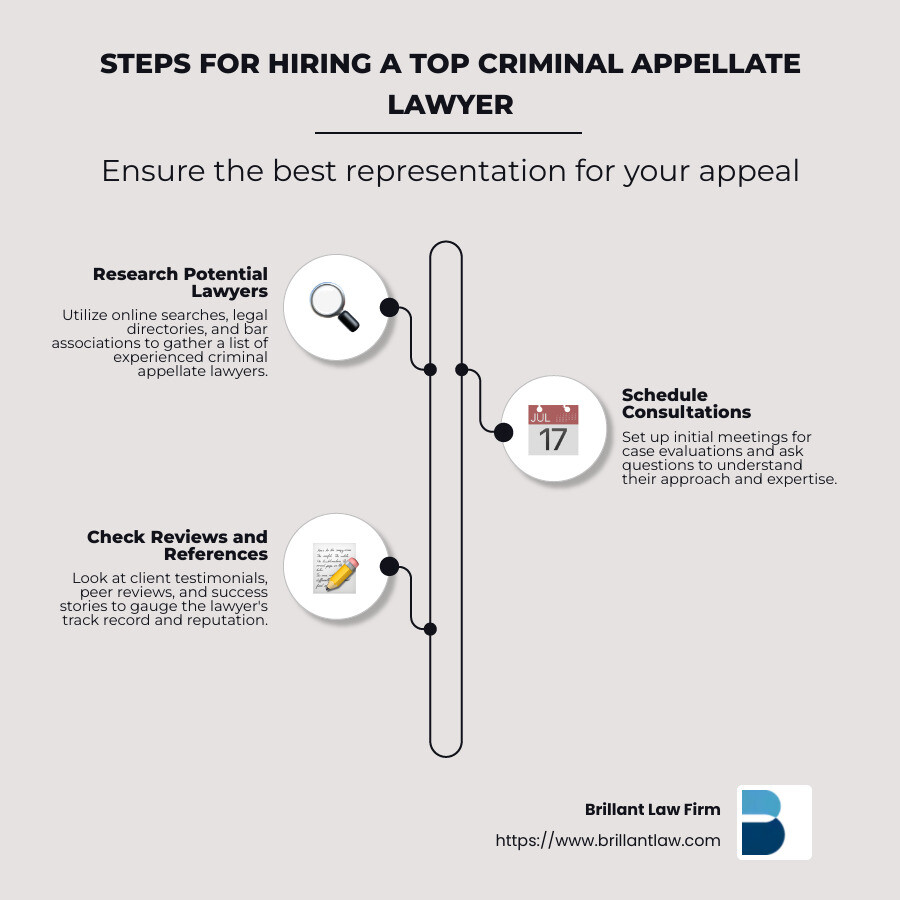
Research Potential Lawyers
Start with online searches and legal directories. Look for attorneys who specialize in criminal appeals. Websites like Avvo or Martindale-Hubbell can provide ratings and reviews.
Check the bar association in your state. They often have directories of licensed attorneys and can help you verify credentials.
Example: If you’re in New York, the New York State Bar Association provides a searchable database of attorneys.
Schedule Consultations
Once you have a list, schedule initial meetings. Many lawyers offer free consultations. Use this time to evaluate their experience and approach.
Case evaluations are crucial. Bring any documents related to your case and ask specific questions about their strategy.
Questions to ask:
– How many criminal appeals have you handled?
– What is your success rate?
– Can you explain your process for handling appeals?
Check Reviews and References
Client testimonials and peer reviews offer insight into a lawyer’s reputation. Look for success stories that match your situation.
Example: A client review might highlight how a lawyer successfully appealed a conviction based on insufficient evidence. This can give you confidence in their ability to handle similar issues.
Verify Qualifications and Track Record
Ensure the lawyer is a member of the bar association and has a clean disciplinary record.
Review their past cases and see if they have specialized in appeals. A specialization in appeals indicates a focused expertise, which is crucial for complex cases.
Example: A lawyer with numerous appellate cases listed on their profile shows a strong track record in this area.
Following these steps will help you find a criminal appellate lawyer who is experienced, diligent, and capable of advocating effectively for your case. Next, we’ll discuss common grounds for criminal appeals.
Common Grounds for Criminal Appeals
When appealing a criminal conviction, it’s crucial to understand the common grounds on which an appeal can be based. Here are three primary reasons:
Insufficient Evidence
To convict a defendant, the state must provide enough evidence to prove every element of the crime beyond a reasonable doubt. If the evidence presented at trial was insufficient, an appellate court can overturn the conviction.
Example: In a theft case, the prosecution must show that the defendant took property with the intent to permanently deprive the owner of it. If the evidence only shows the defendant was near the stolen property, but not that they actually took it, this could be grounds for appeal.
Appellate Review: An appellate attorney will scrutinize the trial record to ensure the evidence met all legal standards. If it didn’t, they can argue that the conviction should be reversed due to insufficient evidence.
Improper Admission of Evidence
Courts must follow strict rules about what evidence can be used in a trial. If evidence was improperly admitted, it can be grounds for an appeal.
Confessions: A confession must be made voluntarily and with full awareness of one’s rights. If a defendant wasn’t read their Miranda rights before confessing, that confession is usually inadmissible.
Search and Seizure: The Fourth Amendment protects against unreasonable searches and seizures. Evidence obtained without a proper warrant or probable cause can’t be used in court.
Case Study: In a recent case, the U.S. Supreme Court declined to hear an appeal from a Baltimore lawyer convicted of money laundering. The defense argued that the evidence was outside the statute of limitations, but the trial judge didn’t instruct the jury on this. This highlights how critical proper admission of evidence is.
Prosecutorial Misconduct
The prosecution must follow ethical guidelines during a trial. Misconduct can lead to an unfair trial and is often a solid ground for appeal.
Emotional Appeals: Prosecutors cannot make appeals to the jury’s emotions that unfairly prejudice the defendant. For example, showing graphic images not directly related to the case can be considered misconduct.
Improper Evidence: Referring to evidence that hasn’t been admitted or making statements that aren’t supported by evidence can also be grounds for appeal.
Exculpatory Evidence: Prosecutors are required to disclose evidence that could exonerate the defendant. Failure to do so can lead to a conviction being overturned. This is known as a Brady violation, named after the landmark Supreme Court case Brady v. Maryland.
Example: If a prosecutor withholds a witness statement that supports the defendant’s alibi, this could be grounds for an appeal based on prosecutorial misconduct.
These common grounds for criminal appeals highlight the importance of a skilled criminal appellate lawyer. They will carefully review the trial records to identify any errors that could have impacted the verdict.
Next, we’ll address some frequently asked questions about criminal appellate lawyers.
Frequently Asked Questions about Criminal Appellate Lawyers
What is the Role of a Criminal Appellate Lawyer?
A criminal appellate lawyer specializes in challenging and defending convictions in higher courts. Their primary role is to identify legal errors or injustices that occurred during the trial. They carefully review trial records, research applicable laws, and write compelling briefs to argue that the conviction should be overturned or the sentence reduced.
Key Tasks:
– Reviewing Transcripts: They comb through trial records to find errors or inconsistencies.
– Research: They dig into legal precedents and statutes to build strong arguments.
– Writing Briefs: They draft detailed legal documents to present their case to appellate judges.
– Oral Arguments: They present and defend their arguments before a panel of judges.
How Long Does the Appeals Process Take?
The appeals process can be lengthy and varies depending on the complexity of the case and the court’s schedule. On average, it can take anywhere from several months to a few years.
Timeline Overview:
1. Filing Notice of Appeal: This must be done promptly, often within 30-60 days of the verdict.
2. Preparing the Record: Gathering trial transcripts and relevant documents can take a few months.
3. Briefing: Writing and submitting briefs, followed by the prosecution’s response, can take several months.
4. Oral Argument: If scheduled, this usually happens a few months after briefs are submitted.
5. Decision: The appellate court’s decision can take several months to over a year.
Tip: Patience is crucial. Regular updates from your lawyer can help manage expectations.
Can I Change Lawyers for My Appeal?
Yes, you can change lawyers for your appeal. In fact, it’s often beneficial to hire a criminal appellate lawyer with specialized skills and experience in handling appeals.
Steps to Change Lawyers:
1. Evaluate Your Current Representation: Determine if your current lawyer has the necessary appellate expertise.
2. Consult New Lawyers: Schedule consultations to find a lawyer experienced in appeals.
3. Formalize the Change: Notify the court and your current lawyer about the change in representation.
Considerations:
– Expertise: Ensure the new lawyer has a strong track record in appellate cases.
– Communication: Choose a lawyer who communicates clearly and keeps you informed.
– Strategy: Discuss the new lawyer’s approach to your appeal to ensure it aligns with your goals.
Switching to a specialized criminal appellate lawyer can make a significant difference in the outcome of your appeal.
Conclusion
Choosing the right criminal appellate lawyer can make all the difference in overturning a conviction or reducing a sentence. The appeals process is complex and requires a lawyer with specific expertise, diligence, and strong advocacy skills.
At Brillant Law Firm, we pride ourselves on our unparalleled expertise and commitment to excellence. Our team includes former judges, former prosecutors, and thought leaders in appellate law, bringing over 200 years of combined experience to each case. We understand the nuances of the legal system and are dedicated to providing the best possible representation for our clients.
Key Takeaways:
- Experience Matters: Look for a lawyer with a proven track record in criminal appeals. Our attorneys have successfully handled thousands of cases, from DWI to homicide.
- Diligent Research: A thorough review of trial records and meticulous legal research are crucial. Our team leaves no stone unturned to find every possible argument for appeal.
- Strong Advocacy: Persuasive legal briefs and effective oral arguments are essential. We excel in crafting compelling narratives and presenting strong arguments before appellate judges.
Don’t take any chances with your appeal. Trust the expertise and dedication of Brillant Law Firm to steer the complexities of the appellate process and fight for the best possible outcome for your case.
For more information on how we can assist with your appeal, visit our Appeals Attorney page or contact us today. Let us put our experience and commitment to work for you.


