

The criminal appeal process can seem daunting. At its core, it is a legal process where a convicted individual challenges a court decision. Here’s a quick look at what you need to know:
- Purpose: To review the legal principles applied in the original case.
- Outcome Options: Reverse conviction, alter sentence, or order a new trial.
- Finality: Appeals are often final unless further appeal to the United States Supreme Court is possible.
The criminal appeal process is not a retrial but a review of the legal principles applied by the trial court. It ensures that justice prevails by correcting errors. Whether it’s about appealing a guilty verdict or questioning the imposed sentence, understanding how appeals work is crucial.
I’m David Brillant, a seasoned legal expert specializing in criminal appeal processes in California. My background in tax, trust, and probate law means I approach each case with comprehensive legal insight, ensuring effective legal support through complex appeals.
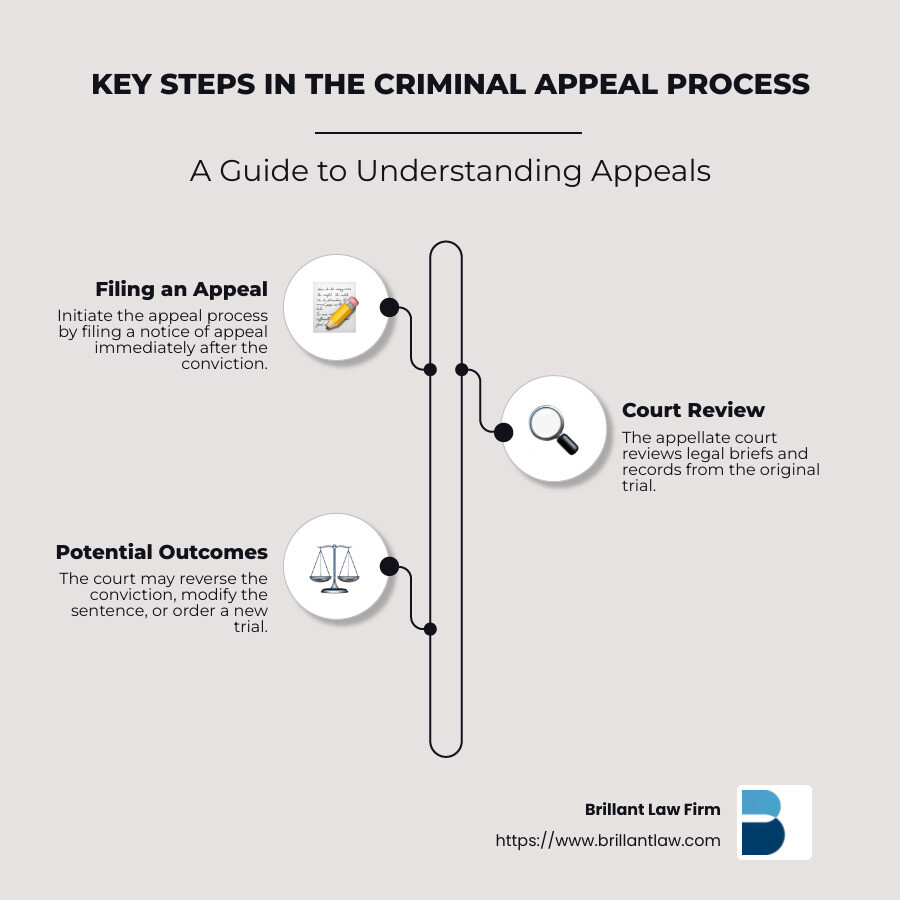
Understanding Criminal Appeals
When someone is found guilty in a criminal court, they have the right to challenge that decision through a criminal appeal. This process is less about re-examining the facts and more about scrutinizing legal errors that may have occurred during the trial. Let’s break down the key aspects of criminal appeals:
Appeal Grounds
For an appeal to be successful, it must be based on valid grounds. Common grounds for a criminal appeal include:
Insufficient Evidence: The appellant argues that the evidence presented at trial was not strong enough to support the verdict. This claim focuses on the quality and quantity of evidence used to convict.
Legal Errors: These can involve incorrect jury instructions, improper admission or exclusion of evidence, or errors in the interpretation of the law. Such mistakes can significantly impact the fairness of the trial.
Sentencing Issues: The appellant might argue that the sentence imposed was too harsh or not in line with legal guidelines.
Insufficient Evidence
Claiming insufficient evidence is a common basis for appeal. The appellant believes that the trial lacked enough credible evidence to justify the conviction. This isn’t about presenting new evidence but questioning whether the existing evidence was adequate.
For instance, if a conviction was largely based on circumstantial evidence without direct proof, an appeal might argue that this evidence was not enough to meet the burden of proof required in criminal cases.
Conviction Reversal
A successful criminal appeal can lead to a reversal of the conviction. This means that the appellate court finds the original trial’s decision flawed due to legal errors or insufficient evidence. A conviction reversal can result in:
- Acquittal: The appellant is found not guilty, and the conviction is overturned.
- Retrial: The case is sent back to the trial court for a new trial, addressing the issues identified in the appeal.
- Sentence Modification: The appellate court may adjust the sentence if it finds it was improperly imposed.
Understanding these elements is crucial for anyone navigating the complexities of a criminal appeal. It’s about ensuring that justice is served by correcting mistakes that could have led to an unjust outcome.
The Appeals Process Explained
When it comes to a criminal appeal, understanding the process can make a big difference. Let’s explore how this journey unfolds, focusing on oral arguments, the appellate court, and legal briefs.
Oral Argument
In the appeals process, oral arguments play a crucial role. This isn’t a full trial but rather a structured discussion. Lawyers from both sides present their arguments to a panel of judges. Each side usually gets about 15 minutes to make their case.
During this time, the judges may ask questions. These questions help clarify the legal issues at hand. It’s a chance for lawyers to highlight key points and persuade the judges why the trial court’s decision should be upheld or overturned.
The Appellate Court
The appellate court is where the action happens in a criminal appeal. Unlike a trial court, there are no juries or new evidence. Instead, a panel of judges reviews the case. They examine the trial court’s proceedings to see if any legal errors occurred.
In California, the appellate court’s decision is often the final say. However, if the case involves significant legal principles, it might be taken to the U.S. Supreme Court. But remember, the Supreme Court only hears a small number of cases each year.
Legal Briefs
Legal briefs are the backbone of any criminal appeal. These documents are where each side lays out their arguments in writing. The appellant, or the person appealing, submits a brief explaining why they believe the trial court made a mistake. They focus on legal principles and point out errors that could have affected the outcome.
On the other side, the appellee defends the trial court’s decision. Their brief argues why the decision was correct or why any errors were minor and didn’t impact the verdict.
The judges rely heavily on these briefs to understand the case before oral arguments. It’s vital that these documents are clear, concise, and well-reasoned.
Understanding these aspects of the appeals process is essential. It ensures that everyone involved knows what to expect and how to steer the complexities of a criminal appeal.
Common Grounds for Criminal Appeal
When a defendant believes something went wrong in their trial, they might file a criminal appeal. Let’s explore some of the most common reasons why someone might appeal their case.
Insufficient Evidence
One major reason for a criminal appeal is insufficient evidence. This means the evidence presented at trial wasn’t strong enough to support a guilty verdict. Imagine being convicted when the facts just don’t add up. If the evidence seems shaky, a defendant can argue that no reasonable jury could have found them guilty beyond a reasonable doubt. This can lead to a conviction being overturned or a new trial being ordered.
Incorrect Decision
Another common ground for appeal is an incorrect decision by the trial judge. Judges make many decisions during a trial, from what evidence can be shown to the jury to how the law is explained. If a judge makes a mistake in these decisions, it can impact the entire case. For example, if a judge wrongly allows certain evidence that shouldn’t have been admitted, it might unfairly sway the jury. Highlighting these errors is crucial in an appeal, as they can lead to a reversal of the conviction or modifications to the trial’s outcome.
Sentence Appeal
Sometimes, the issue isn’t the conviction itself but the sentence that follows. A defendant might feel the punishment is too harsh or doesn’t fit the crime. In a sentence appeal, the focus is on whether the trial court followed the law when deciding the punishment. For instance, if a sentence exceeds what the law allows or seems disproportionate compared to similar cases, it can be challenged. Successful sentence appeals can lead to reduced sentences or even probation instead of jail time.
Understanding these common grounds for a criminal appeal helps clarify why defendants might seek another chance in court. It’s about ensuring fairness and justice, providing a vital check on the legal system.
The Role of the United States Supreme Court
When it comes to criminal appeals, the United States Supreme Court plays a crucial role. It’s the highest court in the country, and its decisions can have far-reaching impacts.
Writ of Certiorari
To get your case heard by the Supreme Court, you need to file a writ of certiorari. This is a formal request asking the court to review your case. However, the Supreme Court doesn’t take every case. In fact, it only hears a small number each year. They usually select cases that involve important legal principles or where different courts have interpreted a law in conflicting ways. So, while it’s an option, it’s not guaranteed that your case will make it to this stage.
Final Decision
If the Supreme Court decides to hear a case, its decision is the final word. There’s no higher court to appeal to. This means whatever the Supreme Court decides, that’s it. Their rulings can overturn lower court decisions or set new legal standards that affect future cases. This is why the Supreme Court’s role is so significant in the appeal process.
Legal Principles
The Supreme Court often focuses on broad legal principles when making its decisions. This is more than just deciding who wins or loses a case. They’re looking at how the law is applied and interpreted. For example, if a case involves constitutional rights, the Supreme Court’s ruling could clarify or even redefine those rights for everyone in the country. This makes their decisions pivotal in shaping the legal landscape.
In summary, while the path to the Supreme Court is narrow, its influence on criminal appeals and legal principles is profound. Understanding this role helps appreciate why some cases strive to reach this level.
Frequently Asked Questions about Criminal Appeals
What does it mean to appeal a crime?
When you appeal a crime, you’re asking a higher court to review the decision of a lower court. This isn’t about starting a new trial; it’s about checking if there were mistakes during the original trial. For example, if there was insufficient evidence to support a conviction, this could be a reason to appeal. The goal is to see if the trial was fair and if the law was applied correctly.
What are the most common grounds for criminal appeal?
Criminal appeals often revolve around a few key issues:
Incorrect Decision: Sometimes, a judge might have made a wrong decision, like allowing evidence that should have been excluded. If this affected the outcome, it could be grounds for an appeal.
Sentence Appeal: After a guilty verdict, the defendant might feel the sentence is too harsh. They can appeal the sentence itself, arguing it doesn’t fit the crime or circumstances.
Insufficient Evidence: If the evidence presented at trial wasn’t enough to support a conviction, this can be a strong reason to appeal. The appellate court will review whether the evidence was adequate to justify the verdict.
Can a not guilty verdict be appealed?
In most cases, a not guilty verdict can’t be appealed by the government due to legal restrictions. This is because of the double jeopardy rule, which prevents someone from being tried twice for the same crime. The government can’t appeal a not guilty verdict to try and get a different outcome. However, there are exceptions, like if there’s a legal question about the trial process itself. But these situations are rare.
Conclusion
At Brillant Law Firm, we understand that navigating the complexities of criminal appeals can be daunting. That’s why we’re here to provide expert guidance and unwavering dedication to our clients in California. Our team is committed to ensuring that every case is handled with the utmost care and precision, leveraging our extensive expertise in appeals to secure the best possible outcomes.
Why Choose Brillant Law Firm?
Expertise: Our firm is renowned for its deep understanding of the appeals process. We craft bespoke strategies custom to the unique circumstances of each case, ensuring that every legal avenue is thoroughly explored.
Dedication: We are fully committed to our clients, providing support and guidance every step of the way. Our goal is to explain the appeals process, making it as straightforward and stress-free as possible.
California Focus: Based in California, we have a keen understanding of the state’s legal landscape. This local expertise ensures that we’re well-equipped to handle any appeals within California’s jurisdiction.
If you’re facing the challenges of a criminal appeal, know that you’re not alone. At Brillant Law Firm, we stand ready to assist you with unparalleled dedication and expertise. For more information or to discuss your case, visit our Appeals Lawyers Near Me page.
In conclusion, criminal appeals require a strategic approach and a deep understanding of legal principles. With Brillant Law Firm by your side, you can be confident that you have a dedicated team fighting for your rights and working tirelessly to achieve justice.


