

Corporate law in the US: 5 Essential Steps to Success
Why Corporate Law in the US Matters for California Entrepreneurs
Corporate law in the US is the framework shaping how businesses form, operate, and grow. For California entrepreneurs, understanding this legal landscape is crucial to protect assets, ensure compliance, and position their companies for long-term success.
Quick Answer: What You Need to Know About Corporate Law in the US
- Dual Legal System: Corporate law operates under both state law (California’s Corporations Code) and federal law (Securities Acts, Sarbanes-Oxley).
- Formation Requirements: Businesses must file articles of incorporation, adopt bylaws, and maintain proper corporate records.
- Key Benefits: Limited liability protection, perpetual existence, and an improved ability to raise capital.
- Governance Structure: Shareholders elect directors who oversee the company and appoint officers for daily management.
- Compliance Obligations: Companies must meet ongoing reporting requirements, including the new Corporate Transparency Act (CTA).
- Primary Challenges: Double taxation for C-Corps, regulatory complexity, and the risk of “piercing the corporate veil.”
In the United States, corporations are formed under state law, not federal law. For businesses operating in the Golden State, this means California’s robust legal framework is paramount, with specific rules that affect any company doing business here.
For businesses in Walnut Creek, Saranap, San Miguel, and Castle Hill, understanding both California state requirements and federal regulations is essential. The California Corporations Code governs how you form and manage your company internally, while federal laws like the Securities Acts and the recently enacted Corporate Transparency Act impose nationwide standards for investor protection and ownership disclosure.
The stakes are high. Failing to follow proper corporate formalities can lead to “piercing the corporate veil”—a legal action that removes the limited liability protection that makes incorporating so attractive. Meanwhile, non-compliance with federal securities laws or disclosure requirements can lead to significant penalties and litigation.
I’m David Brillant, a full-service Tax and Trust and Estate lawyer who handles both transactional and litigation matters for businesses navigating corporate law in the us. As a Certified Specialist in Estate Planning, Trust and Probate Law with a Masters in Taxation, I’ve helped California business owners tackle complex legal challenges where they initially believed no solution existed.
Corporate law in the us terms to remember:
The Foundation: Forming Your California Corporation
Choosing the right legal structure is a critical first step for any new business. For entrepreneurs in Walnut Creek, Saranap, San Miguel, and Castle Hill, incorporating in California offers significant advantages. We guide clients through the nuances of corporate formation to establish a solid legal foundation for growth.
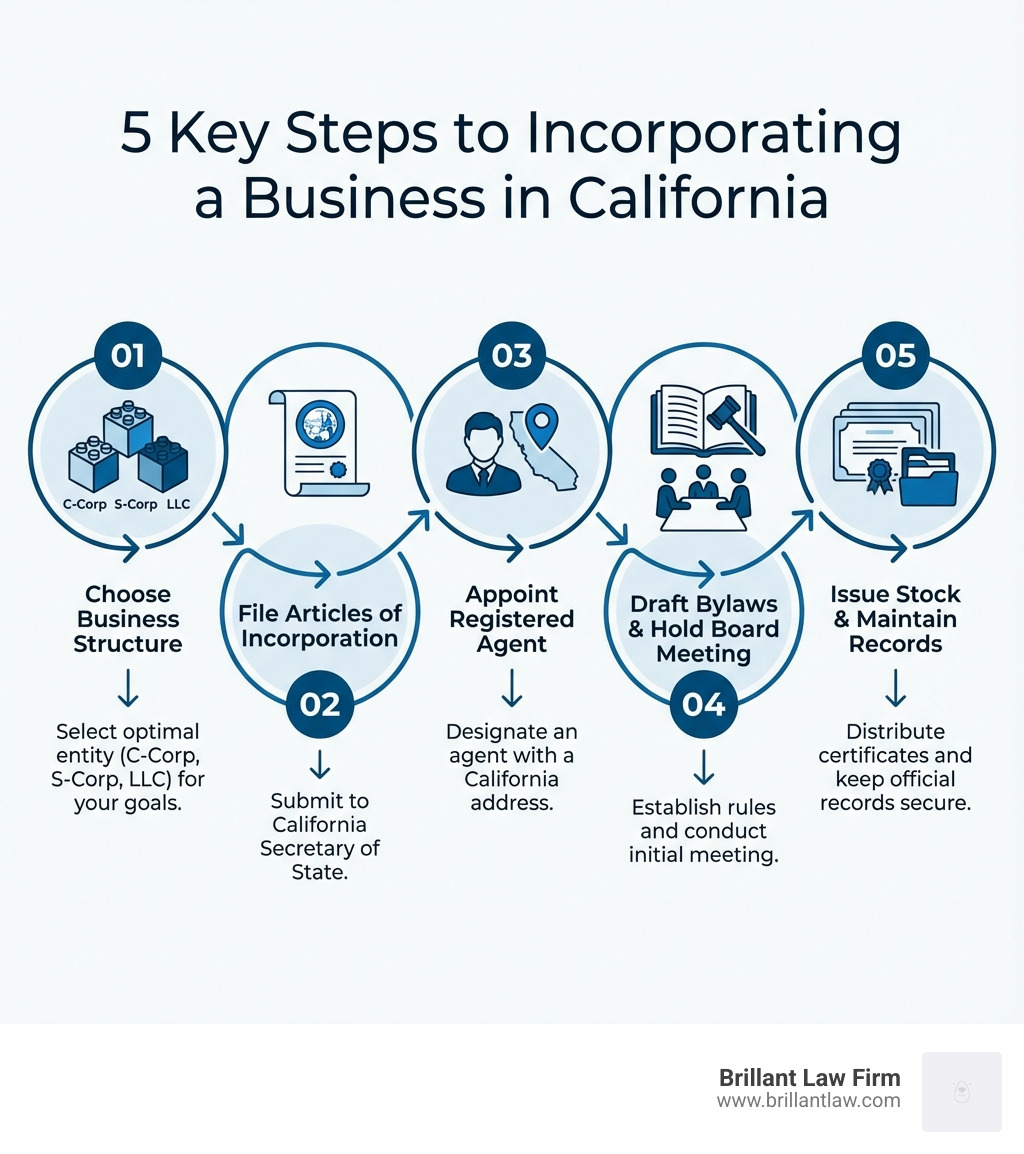
Corporate formation creates a new, separate legal entity that can sue, be sued, and borrow money. This foundational step involves selecting a corporate structure, primarily the C-Corp or S-Corp, each with distinct tax implications. A C corporation is the default structure and is any corporation that does not qualify or elect to be an S corporation under the Internal Revenue Code.
The process of forming a corporation in California begins with filing specific documents with the California Secretary of State. This includes choosing a unique business name and appointing a registered agent—an individual or entity designated to receive legal documents on behalf of your corporation. This ensures your business remains legally compliant from day one.
Key Components of California Corporate Formation
The articles of incorporation are your corporation’s “birth certificate,” officially registering it with the state. This document includes the corporate name, the number of authorized shares, and the registered office address, as outlined in California Corporations Code §200. For businesses in San Miguel, understanding these components is vital for establishing a clear legal identity.
Once incorporated, your business needs bylaws—a rulebook governing its internal affairs. Bylaws outline the management structure, meeting procedures, director elections, and shareholder voting rights. Without clear bylaws, disputes among shareholders and directors can easily arise.
Other essential steps include holding an initial board meeting to adopt bylaws and elect officers, formally issuing stock to shareholders to document ownership, and maintaining meticulous corporate records. These records, including meeting minutes and shareholder registers, demonstrate that your corporation is operating as a distinct legal entity.
Benefits and Drawbacks of Incorporating in California
Incorporating in California offers a compelling set of advantages.
One of the most significant benefits is limited liability. This means your personal assets are generally protected from the corporation’s debts and lawsuits. If the company faces legal action, only corporate assets are typically at risk, not your personal property. This protection is a cornerstone of corporate law in the us and a major draw for entrepreneurs in Castle Hill and beyond.
Another advantage is perpetual existence. A corporation can continue indefinitely, regardless of changes in ownership or management, which is attractive to investors.
Incorporating also improves your ability to raise capital. Corporations can issue shares of stock to attract investors and fund expansion. This structure provides a clear framework for investment and can lend your business improved credibility with customers, suppliers, and partners.
However, incorporating also has drawbacks, primarily concerning tax implications and regulatory compliance.
The most cited drawback for C-Corps is double taxation: profits are taxed at the corporate level and again at the individual level when distributed as dividends. To mitigate this, many small businesses in California elect to be an S-Corporation, which allows profits and losses to pass directly to the owners’ personal income, avoiding federal double taxation.
Navigating regulatory compliance is another challenge. Corporations face more stringent rules and reporting obligations than simpler business structures, including annual filings and maintaining corporate records, which often requires professional legal guidance.
| Feature | California C-Corp | California S-Corp |
|---|---|---|
| Federal Income Tax | Taxed at corporate level; dividends taxed to shareholders (double taxation) | Profits/losses passed through to shareholders’ personal income (no federal double taxation) |
| State Income Tax | Taxed at corporate level; dividends taxed to shareholders | Subject to 1.5% state corporate income tax on net income (minimum $800) |
| Eligibility | No restrictions on number or type of shareholders | Limited to 100 shareholders; must be U.S. citizens/residents; only one class of stock |
| Tax Flexibility | Can retain earnings for growth; more complex tax planning | Simpler tax structure; avoids double taxation; less flexibility for retained earnings |
| Complexity | Higher administrative burden; more complex regulations | Moderate administrative burden; simpler tax reporting |
Navigating the Dual System: An Overview of Corporate Law in the US
The landscape of corporate law in the us involves a dual system of state and federal authority. While California law governs businesses incorporated here, federal laws also apply, especially to public companies and those in interstate commerce.
This dual system creates a unique environment for California businesses. We help clients steer this intricate web, ensuring they understand how California’s legal landscape interacts with federal oversight. The “internal affairs doctrine” dictates that a corporation’s internal operations—like shareholder rights and director duties—are governed by the laws of its state of incorporation. For a California company, the California Corporations Code is supreme for these matters.
However, federal law intervenes where there is a clear federal interest, such as investor protection or interstate commerce. While California law governs your corporate structure, federal agencies like the Securities and Exchange Commission (SEC) regulate how companies raise capital and report financial information. This requires careful corporate compliance from our clients in Saranap and Castle Hill.
The Role of California State Law
For California businesses, the California Corporations Code is the primary authority. It dictates everything from formation to dissolution, including requirements for articles of incorporation, bylaws, shareholder meetings, and the duties of directors and officers. California’s laws are known for their strong emphasis on shareholder rights and, increasingly, on social and environmental considerations, such as board diversity rules and certain environmental regulations.
The Code also establishes corporate governance rules, detailing how decisions are made and who is accountable. Directors owe specific fiduciary duties to the corporation and its shareholders, requiring them to act in the company’s best interest. We help our clients in Walnut Creek understand these responsibilities, leveraging our local expertise to provide custom guidance.
The Impact of Federal Law on California Companies
While California law handles internal mechanics, federal law provides the broader regulatory ecosystem. The Securities Act of 1933 and the Securities Exchange Act of 1934 are cornerstones of federal regulation, designed for investor protection. The 1933 Act requires companies to register securities with the SEC before a public sale, while the 1934 Act governs secondary trading and mandates ongoing disclosures.
For public companies, this means rigorous reporting requirements, including annual (10-K), quarterly (10-Q), and current (8-K) reports. Non-compliance can lead to severe penalties.
Further federal oversight comes from laws like the Sarbanes-Oxley Act of 2002 (SOX), which introduced stricter financial reporting and governance rules, and the Dodd-Frank Act of 2010, which improved financial stability and consumer protection. These federal mandates significantly shape the compliance strategies for publicly traded companies in California. You can learn more about The SEC’s role in regulation directly from their website.
Corporate Governance in the Golden State: Roles and Responsibilities
Effective corporate governance is the system of rules and practices by which a company is directed and controlled. It is the backbone of any successful enterprise, balancing the interests of all stakeholders.
At the heart of this system are the shareholders (owners), the board of directors (providing oversight), and the officers (managing daily operations). Beyond these internal actors, stakeholders like employees, customers, and the community also influence corporate decisions, particularly in progressive California.
A fundamental concept is fiduciary duties, which directors and officers owe to the corporation and its shareholders. The duty of care requires them to make informed, prudent decisions, while the duty of loyalty demands they act in the corporation’s best interests, avoiding conflicts of interest. These duties are often protected by the business judgment rule, which shields directors from liability for honest mistakes in judgment, provided they acted on an informed basis and in good faith.
The Power and Duties of the Board of Directors
The board of directors is the corporation’s ultimate governing body. Its primary role is strategic oversight, setting the company’s direction, managing risk, and ensuring legal compliance. A critical responsibility is appointing officers—the executive team—and monitoring their performance.
Directors have significant fiduciary responsibilities, including the duties of care and loyalty. For public companies, director independence is key, with stock exchanges requiring a majority of independent directors. Specialized board committees, such as the Audit and Compensation Committees, play vital roles in oversight.
The board’s decision-making authority is broad, guided by the California Corporations Code. For instance, California Corporations Code §300(a) states that “The business and affairs of the corporation shall be managed and all corporate powers shall be exercised by or under the direction of the board of directors,” ensuring robust oversight.
Shareholder Rights and Activism
Shareholders, as owners, possess crucial rights to influence corporate governance. Chief among these are voting rights, exercised at annual meetings to elect directors and approve major corporate actions. They can also submit shareholder proposals for a company-wide vote.
Shareholders have the right to access to records, which is essential for informed oversight. In cases of fiduciary breach, they can initiate derivative lawsuits on behalf of the corporation. Protecting minority shareholders is a significant aspect of corporate law in the us, ensuring their voices are heard.
Proxy voting allows shareholders to vote without attending meetings and facilitates shareholder activism, where investors pressure management for changes. We’ve seen this influence grow significantly in areas like Saranap and San Miguel, where engaged investors hold companies accountable.
Modern Compliance and Challenges for California Businesses
The modern business environment presents unique compliance challenges for California companies. Staying current with evolving legal standards, from ESG (Environmental, Social, and Governance) factors to data privacy and cybersecurity, requires vigilance and expert legal counsel.
The cost of non-compliance can be substantial, not just in fines but also in reputational damage. Attorney fees in California for specialized corporate law matters can range from $350 to $750+ per hour, underscoring the importance of proactive legal strategies. We help our clients mitigate litigation risks by building strong compliance frameworks.
Understanding the Corporate Transparency Act (CTA)
One of the most significant recent developments in corporate law in the us is the Corporate Transparency Act (CTA). Enacted to combat illicit financial activities, the CTA requires most businesses to disclose information about their beneficial owners to the U.S. Treasury’s Financial Crimes Enforcement Network (FinCEN).
This means companies in California must identify and report individuals who ultimately own or control them, peeling back layers of anonymity. The reporting requirements and compliance deadlines are critical: businesses formed before 2024 must file by January 1, 2025. Those formed during 2024 have 90 days to file. Companies formed from January 1, 2025, onward will have 30 days. Any changes to beneficial ownership information must be reported within 30 days.
We assist our clients in Walnut Creek, Saranap, San Miguel, and Castle Hill in identifying beneficial owners and meeting these new obligations. For a deeper dive, explore The Corporate Transparency Act explained.
Piercing the Corporate Veil: A Critical Risk for Business Owners
Limited liability is a primary benefit of incorporating, but it is not absolute. The legal concept of “piercing the corporate veil” is a critical risk, as it is an exception to limited liability that can expose shareholders to personal liability for corporate debts.
Courts may pierce the veil if they find the corporation was not operated as a truly separate entity. Common triggers include undercapitalization (insufficient funds), commingling of assets (mixing personal and corporate funds), or a failure to follow corporate formalities (not holding meetings or keeping records). This is often called the “alter ego doctrine,” where the corporation is seen as a mere façade for the owner’s personal dealings.
To maintain the corporate shield, it is crucial to observe corporate formalities, keep separate bank accounts, and ensure the corporation is adequately funded. We work with clients to establish these practices, safeguarding their personal assets. Understanding What is limited liability? is key to appreciating this risk.
Frequently Asked Questions about Corporate Law in the US
What are the primary sources of corporate law for a California business?
A California business is governed by two primary sources of law. The California Corporations Code dictates the creation, internal management, and dissolution of corporations within the state. Concurrently, federal laws like the Securities Act of 1933, the Securities Exchange Act of 1934, and the Corporate Transparency Act (CTA) impose nationwide standards for investor protection and ownership disclosure, which apply to businesses in California.
How does corporate governance function in a California corporation?
In a California corporation, governance functions through a clear hierarchy. Shareholders own the company and elect the board of directors. The board provides strategic oversight and appoints officers (like the CEO and CFO) to manage daily operations. A cornerstone of this system is that directors and officers owe fiduciary duties of care and loyalty to the corporation and its shareholders, requiring them to act in the company’s best interests and avoid conflicts.
What are the main benefits of incorporating a business in California?
The main benefits of incorporating in California are significant for entrepreneurs in Walnut Creek, Saranap, San Miguel, and Castle Hill. The primary advantage is limited liability protection, which shields owners’ personal assets from business debts. Another is perpetual existence, allowing the company to operate indefinitely. Finally, incorporating improves the ability to raise capital by issuing stock to investors and improves the business’s credibility.
Conclusion
Navigating corporate law in the us requires careful planning and expert guidance. For California businesses, understanding this legal framework is essential for building a resilient and successful enterprise, not just for avoiding penalties.
Our key takeaways emphasize that California businesses operate within a dual legal system, balancing state mandates from the California Corporations Code with federal regulations like the Securities Acts and the Corporate Transparency Act. The benefits of incorporation are powerful, but they come with the responsibility of maintaining corporate formalities to avoid risks like “piercing the corporate veil.”
For entrepreneurs in Walnut Creek, Saranap, San Miguel, and Castle Hill, the importance of proactive legal guidance cannot be overstated. Our firm, Brillant Law, offers unparalleled expertise and unwavering dedication to crafting bespoke strategies for your California business. We clarify the complexities of corporate law, allowing you to focus on what you do best: innovating and growing.
For comprehensive legal support custom to your California business, explore our Business Law Lawyers services.


