

Contract Dispute Lawyers: Your 2025 Expert Guide
Why Contract Disputes Are More Common Than You Think
In the world of California business, agreements are made every second. From multi-million dollar mergers to simple vendor contracts, these documents are the bedrock of commerce. But what happens when the promises they contain are broken? This is where contract dispute lawyers become essential. They help businesses and individuals steer the complex and often stressful world of broken agreements and failed obligations. Whether you’re facing a vendor who failed to deliver, a business partner who violated the terms of your agreement, or a contractor who abandoned a project midway, these legal professionals provide the critical expertise needed to protect your interests, enforce your rights, and recover your losses.
An experienced contract dispute lawyer is your advocate and strategist. Their role extends far beyond the courtroom. They provide comprehensive support designed to resolve your issue as efficiently and favorably as possible.
What Contract Dispute Lawyers Do:
- Evaluate your case: A lawyer will conduct a thorough analysis of your contract and the circumstances of the breach. They determine if a legally valid breach occurred under California law and assess the strengths and weaknesses of your position.
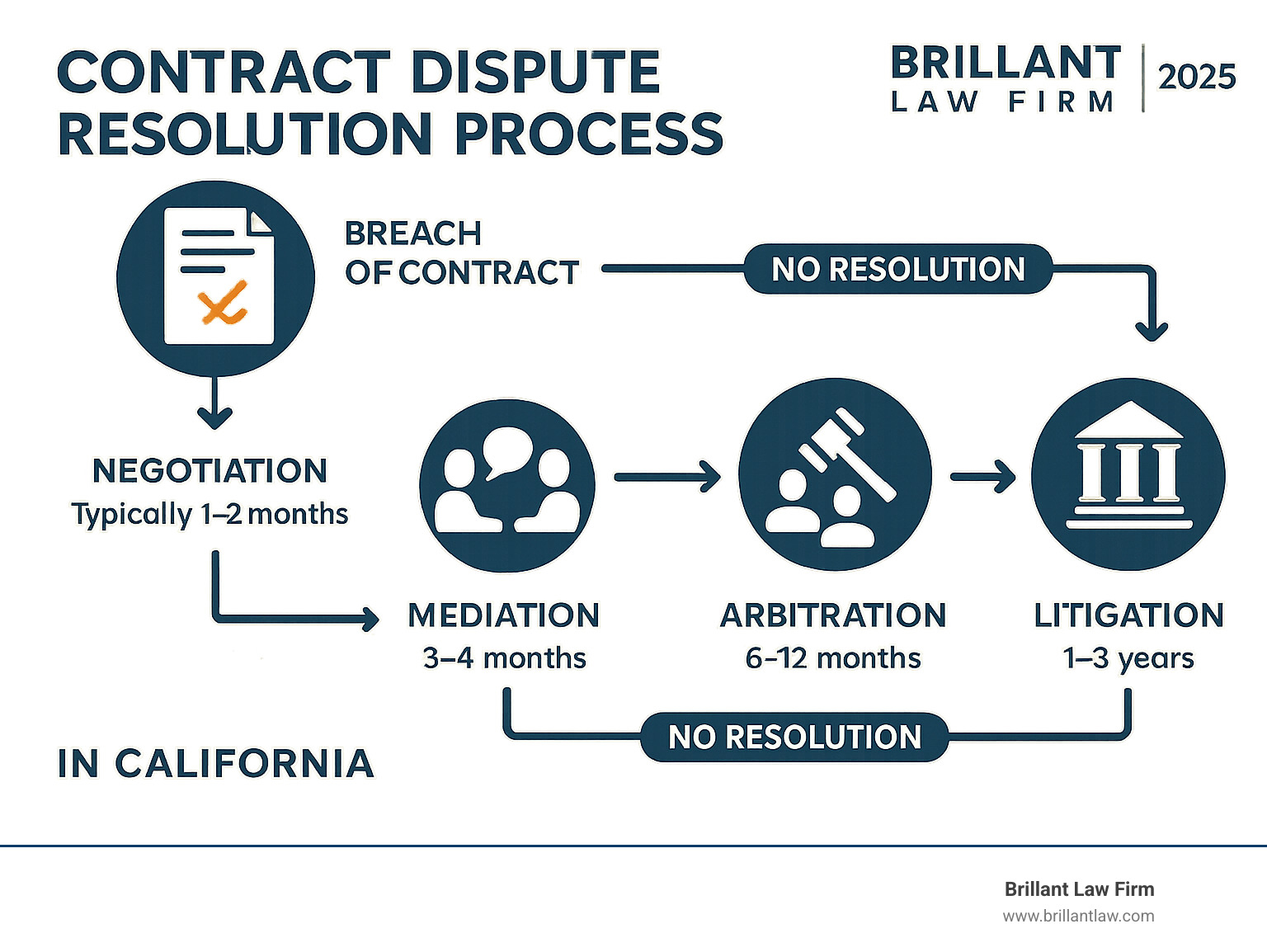
- Negotiate settlements: Most business disputes are resolved out of court. A skilled lawyer acts as your negotiator, leveraging the facts and the law to argue for a settlement that meets your objectives, saving you the time, stress, and expense of litigation.
- Represent you in mediation or arbitration: In these alternative dispute resolution (ADR) forums, your lawyer presents your case to a neutral third party. They build a compelling argument to persuade a mediator or arbitrator of the merits of your claim.
- File lawsuits: When negotiation or ADR fails to produce a satisfactory result, litigation may be necessary. Your attorney will handle every aspect of the lawsuit, from drafting the initial complaint to representing you at trial.
- Recover damages: The ultimate goal is often to make you whole again. Lawyers work to recover all available damages, which can include not only direct financial losses but also lost profits, incidental expenses, and other forms of compensation.
Contract disputes arise whenever one party fails to fulfill its legal obligations under an agreement. This can happen in any business relationship, from straightforward purchase orders to highly complex partnership deals. In California, these disputes are governed by a specific body of state laws that dictate what makes a contract valid, what constitutes a breach, and what remedies are available when things go wrong.
The stakes in contract disputes can be enormous. A single breach can trigger a cascade of negative consequences, costing your business thousands or even millions in lost revenue. Beyond the direct financial hit, disputes can cause significant operational disruptions, damage your professional reputation, and sever crucial business relationships. That’s why having the right legal strategy from the very beginning is not just an advantage—it’s a necessity.
As Brillant Law Firm, we’ve spent years handling complex contract disputes and business litigation matters for clients across California. Our experience as a full-service firm gives us a unique and powerful insight. We understand both the transactional side of creating ironclad agreements and the aggressive litigation strategies required when those agreements fall apart. This dual perspective allows us to protect our clients’ interests at every stage of the business lifecycle.
Understanding the Battlefield: What is a Contract Dispute?

Think of a contract dispute as a broken promise with legal consequences. When you enter into a legally binding agreement, you’re making a formal commitment—whether it’s to deliver specific goods, provide professional services, or meet clearly defined performance standards. A contract dispute erupts when one party fails to hold up their end of the bargain, creating a conflict that requires resolution.
At Brillant Law Firm, we see these situations play out daily. The core of the issue is often a fundamental disagreement in perception. One party believes they’ve fulfilled their obligations perfectly, while the other feels shortchanged, misled, or completely abandoned. It’s like ordering a custom-designed piece of machinery for your factory and receiving a standard model that doesn’t fit your production line. The breach of contract is clear, but the path to getting the right machine or your money back isn’t always straightforward.
Common dispute areas we encounter in California are vast and varied, touching every corner of the economy. Businesses often feel blindsided by poor performance, hidden defects, or unexpected costs that weren’t part of the original deal.
- Vendor and Supplier Agreements frequently go sideways when suppliers deliver substandard products, miss crucial deadlines that halt your operations, or unilaterally change pricing terms.
- Business Purchase Agreements can spark intense disputes when buyers find the company they acquired has undisclosed liabilities or its financial health was misrepresented in the sale documents.
- Construction Contracts are notoriously prone to conflict. We’ve handled cases involving everything from contractors who vanished mid-project to disputes over ambiguous blueprints and change orders that caused budgets to spiral out of control.
- Employment Contracts create their own unique challenges, especially around issues like wrongful termination, the enforcement of non-compete or non-solicitation clauses, and disagreements over severance packages.
- Partnership Disagreements can be especially painful, as they often involve friends or family members whose business relationship has soured, leading to disputes over profit distribution, management responsibilities, or buyout terms.
- Shareholder Disputes add another layer of complexity, particularly when minority shareholders feel their rights are being ignored or oppressed by the majority owners.
Under California contract law, these disputes are governed by specific rules about what makes an agreement enforceable and what remedies are available when a breach occurs. The good news is that not every disagreement requires a full-blown courtroom battle. Many disputes can be effectively resolved through strategic negotiation or alternative dispute resolution (ADR) methods, guided by experienced legal counsel.
Common Types of Contract Breaches
Not all breaches are created equal; they don’t all carry the same legal weight. Understanding the different types of breaches is critical because it determines your strategic options and potential for recovery. Think of it as the difference between a minor fender-bender and a total-loss collision—both are accidents, but the consequences and the required responses vary dramatically.
| Type of Breach | Definition | Examples | Potential Consequences |
|---|---|---|---|
| Material Breach | A serious violation that undermines or defeats the fundamental purpose of the contract. | A contractor abandoning a half-finished construction project; a software developer delivering a completely non-functional application. | The non-breaching party can terminate the contract, is excused from performing their own obligations, and can sue for full damages. |
| Minor Breach | A partial or less serious violation where the core purpose of the contract is still largely met, despite the failure. | A vendor delivering goods a few days late; a painter using a slightly different shade of the agreed-upon color. | The non-breaching party must still perform their obligations (e.g., pay) but can sue for damages caused by the minor breach. |
| Anticipatory Breach | Occurs when one party clearly and unequivocally states, through words or actions, that they will not perform their contractual duties before the performance is due. | A supplier informing you they won’t be able to fulfill your large order next month; an employee resigning ahead of their contract’s end date. | The non-breaching party can immediately sue for breach of contract without waiting for the performance deadline and can seek alternative arrangements. |
Failure to perform entirely, such as a complete non-delivery of goods, is almost always a material breach. In contrast, substandard performance might be a minor or material breach depending on how significantly it deviates from the contract’s requirements. Repudiation of contract—where one party flat-out refuses to honor their commitments—is a form of anticipatory breach and is always treated as a serious violation.
The type of breach you’re dealing with is a crucial factor that dictates whether you can legally walk away from the contract entirely or if you must continue to perform your side of the deal while pursuing damages.
What Makes a Contract Valid in California?
Before you can have a dispute over a breach, you must first have a valid, enforceable contract. A handshake and a promise might feel like a deal, but California law requires several key ingredients to form an agreement that a court will uphold. Think of them as the essential recipe for a legally binding contract, as defined in the California Civil Code.
- Offer: One party must make a clear, definite proposal to another, expressing a willingness to enter into a bargain. For example, “I will sell you my business equipment for $10,000.”
- Acceptance: The other party must agree to the exact terms of the offer without modification. This is the “mirror image rule.” If they propose changes, it’s considered a counter-offer, not an acceptance.
- Consideration: This is the legal term for what each party gives up in the exchange. It must be a “bargained-for” exchange of value. This can be money, goods, services, or even a promise to do or not do something. Both sides must provide consideration for the contract to be valid.
- Mutual Consent: Often called a “meeting of the minds,” this means both parties genuinely understood and agreed to the basic substance and terms of the contract. A contract can be voided if consent was obtained through fraud, duress, or a significant mutual mistake.
- Legal Purpose: The contract’s objective must be legal. A court will not enforce an agreement to perform an illegal act. For example, a contract to sell stolen goods is void from the start.
- Competent Parties: All parties entering into the contract must have the legal capacity to do so. This generally means they are of legal age (18 in California) and are of sound mind, not mentally incapacitated or under the influence of drugs or alcohol when signing.
Proper business agreement drafting that carefully addresses these elements is the first line of defense against future conflicts. This is why many of our clients at Brillant Law Firm work with us not only to resolve disputes but also to create solid, unambiguous contracts designed to prevent them from ever happening.


