

Conservatorship Walnut Creek CA: 7 Essential Facts 2025
Why Understanding Conservatorship in Walnut Creek Matters
Conservatorship walnut creek ca proceedings provide court-supervised protection for adults who cannot manage their personal care or finances due to incapacity. When someone you care about can no longer make safe decisions about their health, housing, or money, a conservatorship may be the legal solution that protects them from harm.
Quick Answer for Conservatorship Walnut Creek CA:
• What it is: Court appointment of a responsible person to manage an incapacitated adult’s affairs
• Where to file: Contra Costa County Superior Court Probate Department
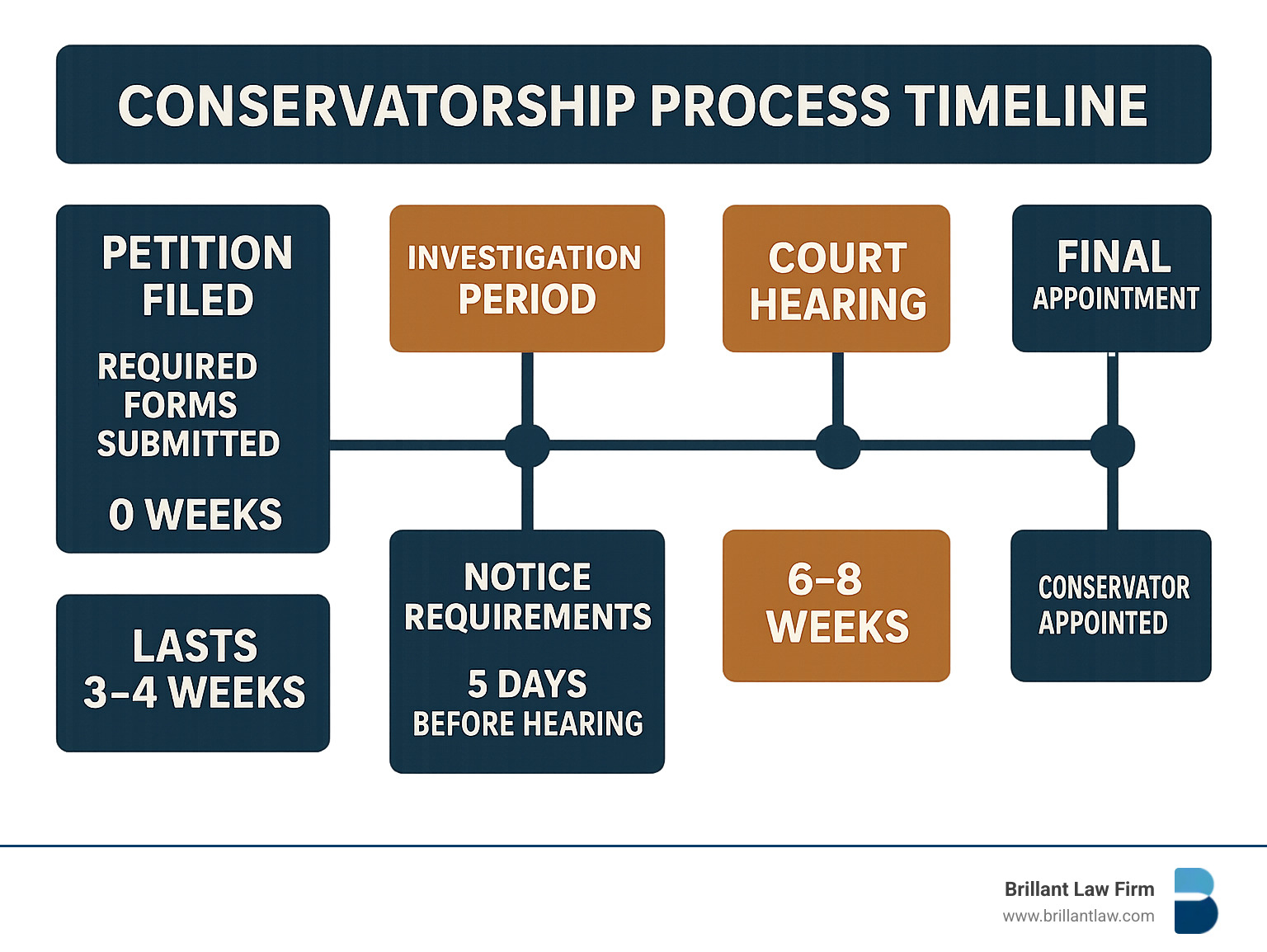
• Timeline: 6-8 weeks for general conservatorship, ~1 week for emergency temporary orders
• Types: Person (health/daily care), Estate (finances), or both combined
• Requirements: Medical evidence of incapacity, court investigation, mandatory workshop
• Cost: $465+ filing fees, attorney rates $400-$650/hour in California
The process involves filing a petition, court investigation, and a hearing where a judge determines if conservatorship serves the proposed conservatee’s best interests. Temporary conservatorships can be obtained within about a week for emergencies like financial abuse or urgent medical needs.
As someone who has guided families through complex conservatorship proceedings throughout California for many years, I understand how overwhelming this process can feel when you’re trying to protect a loved one. My experience as a Certified Specialist in Estate Planning, Trust and Probate Law has shown me that each conservatorship walnut creek ca case requires careful attention to both legal requirements and family dynamics.
Conservatorship Walnut Creek CA: Core Essentials
When families in Walnut Creek face the difficult reality that a loved one can no longer safely manage their own affairs, conservatorship walnut creek ca proceedings offer a court-supervised solution. Think of conservatorship as a legal safety net – it’s designed to protect adults who’ve lost the mental capacity to make sound decisions about their health, finances, or daily care.
The heart of any conservatorship case lies in proving incapacity under California law. This isn’t about someone making questionable choices (we’ve all bought things we didn’t need or trusted the wrong person). Rather, the incapacity standard requires clear evidence that the proposed conservatee cannot understand the consequences of their decisions or communicate reasoned choices about basic needs like food, shelter, clothing, or medical care.
In a conservatorship, we have two key players: the conservator (the person appointed to help) and the conservatee (the person who needs protection). The conservator becomes legally responsible for making decisions the conservatee can no longer make safely on their own.
Here in Contra Costa County, the local Probate Department takes conservatorship seriously. Before any non-professional conservator can begin their duties, they must complete a court-mandated workshop. This educational requirement ensures that family members and friends understand the significant responsibilities they’re taking on – because conservatorship isn’t just about good intentions, it involves real legal duties and potential personal liability.
One of the most important things families need to understand is that conservatorship doesn’t erase a person’s dignity or rights retained. The conservatee keeps many fundamental rights, including the right to legal counsel, the right to request termination of the conservatorship, and the right to have visitors. California courts favor the least restrictive arrangement possible, meaning the conservator only gets the specific powers truly necessary to protect the conservatee.
Difference Between Conservator of the Person & Conservator of the Estate
When I explain conservatorship to families, I often compare it to being a caring parent for an adult who can no longer parent themselves. But unlike parenting, conservatorship comes in two distinct flavors – and understanding the difference is crucial.
A conservator of the person focuses on health-care decisions and daily-living needs. They become the decision-maker for medical and dental care, choosing where the conservatee lives, and ensuring proper nutrition, clothing, and personal hygiene. This role extends to arranging transportation, managing social activities, and making countless daily decisions that most of us take for granted.
Meanwhile, a conservator of the estate handles asset management and financial protection. They must manage investments prudently, pay bills, collect income, and prepare detailed budgets. Perhaps most importantly, they must submit comprehensive annual accounting reports to the court, documenting every dollar spent and every financial decision made.
TABLE: Conservator Powers Comparison
| Conservator of the Person | Conservator of the Estate |
|---|---|
| Medical/dental care decisions | Asset and investment management |
| Housing arrangements | Bill paying and budgeting |
| Food, clothing, personal care | Income collection |
| Transportation coordination | Tax return preparation |
| Social activities oversight | Annual court accountings |
Many conservatorship walnut creek ca cases involve appointing the same person as conservator of both the person and estate. However, families sometimes choose different conservators for each role – perhaps one sibling is better with financial matters while another excels at healthcare coordination.
The annual accounting requirement deserves special attention because it’s where many well-meaning conservators stumble. California courts don’t accept rough estimates or “trust me, I spent it wisely” explanations. Every expense needs documentation, every investment decision requires justification, and every penny must be accounted for in court-approved formats.
When Is a Temporary Conservatorship Needed?
Sometimes life doesn’t wait for the standard 6-8 week conservatorship timeline. When emergency medical situations arise, financial abuse is finded, or immediate safety concerns demand action, temporary conservatorship provides a crucial lifeline.
I recently worked with a family who finded their father’s new “friend” had convinced him to withdraw $30,000 from his retirement account for a “guaranteed investment opportunity.” With a temporary conservatorship petition, we were able to stop further financial bleeding within days through an ex-parte hearing – a special court session where the judge reviews urgent situations without waiting for the full process.
The 1-week timeline for temporary conservatorships can literally save lives and life savings. Whether it’s authorizing emergency surgery for someone who can’t understand the medical situation, stopping ongoing financial exploitation, or removing someone from an unsafe living situation, temporary conservatorship bridges the gap between crisis and comprehensive protection.
Emergency situations that commonly warrant temporary conservatorship include medical crises where treatment consent is needed immediately, ongoing financial abuse by caregivers or strangers, and dangerous living conditions that require immediate intervention. The key is demonstrating to the court that waiting for a regular conservatorship hearing would cause irreparable harm to the proposed conservatee’s health, safety, or financial well-being.
Types of Conservatorships & Protective Alternatives
When facing the difficult decision about whether conservatorship is right for your loved one, it helps to understand that California offers different types of protection depending on the person’s specific needs and circumstances.
General probate conservatorship is what most people think of when they hear the term. This comprehensive approach works for adults who cannot manage their personal care or finances due to conditions like dementia, brain injury, or severe mental illness. It’s the most common type we see in our practice, and it provides broad authority to help someone who truly cannot care for themselves.
Limited conservatorship takes a completely different approach, and it’s one of my favorite areas of law because it’s built around empowerment rather than restriction. These are specifically designed for adults with developmental disabilities like autism or Down Syndrome. Instead of taking away rights, limited conservatorships provide only the custom assistance needed while maximizing the person’s independence.
The third type, LPS (Lanterman-Petris-Short) conservatorship, applies to individuals who are gravely disabled due to mental illness or chronic alcoholism and cannot provide for their basic needs. These cases often involve coordination with mental health professionals and require specialized expertise.
Sometimes no family member or friend is available to serve as conservator. In these situations, the Public Guardian’s Office | Contra Costa County, CA Official Website may step in. The Public Guardian is part of Contra Costa County Health Services and serves as conservator of last resort when no one else is qualified and willing to act.
But here’s something important I always tell families: conservatorship walnut creek ca proceedings aren’t always the answer. In fact, less restrictive alternatives often work better and should be considered first.
A durable power of attorney allows someone to make financial and legal decisions without court involvement. Revocable trusts can provide asset management and protection without ongoing court oversight. An advance health-care directive enables someone to make medical decisions when the person cannot.
These alternatives can often prevent the need for conservatorship entirely when implemented properly. For comprehensive guidance on these planning tools, I encourage exploring More info about Estate Planning Guidance to understand how thoughtful advance planning can protect your family.

Spotlight on Limited Conservatorship for Adults with Developmental Disabilities
Limited conservatorships hold a special place in my practice because they’re built on such a positive philosophy: provide only the support needed while preserving as much independence as possible.
These conservatorships typically help adults with autism, Down Syndrome, or other developmental disabilities steer the transition to adulthood. When a child with special needs turns 18, parents suddenly find themselves locked out due to HIPAA and adult privacy laws. They can no longer access medical records, make healthcare decisions, or help with financial matters – even though their child still needs support.
Limited conservatorships solve this problem neatly by granting specific, custom powers rather than broad authority. The court might grant power to make medical decisions, choose where the person lives, access confidential records, make educational decisions, or consent to marriage.
What makes this approach beautiful is that the conservatee retains all rights not specifically granted to the conservator. This fosters independence while providing necessary protection and support. I’ve seen young adults with developmental disabilities thrive under limited conservatorships because they maintain dignity and autonomy while getting the help they need.
Are There Situations Where Conservatorship Is NOT Appropriate?
Absolutely, and this is a conversation I have with families regularly. Conservatorship is designed to be the least restrictive alternative necessary to protect someone. In many cases, other approaches work better and cause less disruption to the person’s life.
Supported decision-making allows individuals to maintain autonomy while receiving help understanding and making decisions. This works wonderfully for people who can understand information when it’s presented clearly but need assistance processing complex choices. Think of it as having a trusted advisor rather than someone making decisions for you.
Joint bank accounts can solve many financial management issues without any court involvement. Adding a trusted family member as a joint account holder provides oversight and assistance without the expense and complexity of conservatorship proceedings.
An authorized representative for benefits allows someone to help manage Social Security, Medicare, or other government benefits without requiring broader conservatorship powers. This targeted approach often provides exactly the help needed without unnecessary restrictions.
The key question I always ask families is: “What’s the least restrictive way to provide the protection and assistance this person needs?” Sometimes the answer is conservatorship, but often it’s one of these simpler alternatives that preserves more independence while still providing necessary support.
Step-by-Step Process to Obtain a Conservatorship in Walnut Creek
Filing for conservatorship walnut creek ca can feel overwhelming when you’re already worried about a loved one’s safety and wellbeing. I’ve walked many families through this process, and while it involves several important steps, understanding what to expect can make the journey much more manageable.
The first step involves filing a petition using Form GC-310 with the Contra Costa County Superior Court. This document becomes the foundation of your case, explaining why conservatorship is necessary and requesting specific powers for the proposed conservator. Think of it as telling the court your loved one’s story – why they need protection and how you plan to help them.
Once you file the petition, the court appoints an investigator who serves as the judge’s eyes and ears. This neutral professional will interview the proposed conservatee, visit their living situation, and prepare a detailed report. I always tell families not to worry about this step – the investigator isn’t there to judge you, but to ensure the conservatorship truly serves your loved one’s best interests.
The capacity declaration using Form MC-339 requires a physician or psychologist to examine the proposed conservatee. This medical professional explains their functional limitations and why they need assistance. While this can feel uncomfortable for families, it provides the court with objective evidence about your loved one’s condition.
Service and notice requirements ensure all interested parties receive proper legal notice of the conservatorship petition. This includes family members who might want to participate or raise concerns. California law takes these notice requirements seriously because conservatorship affects fundamental rights.
The hearing typically occurs 6-8 weeks after filing, giving everyone time to prepare. During this hearing, the judge reviews all evidence and testimony to determine whether conservatorship is necessary and appropriate. If the petition is granted, the court issues Letters of Conservatorship, which provide legal authority to act as conservator.
Depending on the conservatee’s assets, the court may require the conservator to post a bond – essentially insurance that protects the conservatee’s assets from mismanagement. Bond requirements vary based on the value of assets involved.
For specific local procedures and current forms, the Conservatorships: Contra Costa Superior Court website provides detailed guidance custom to our local court’s requirements.
Who Can File & What Must Be Shown?
California law recognizes that different people may step forward to protect a vulnerable adult. Spouses and adult children most commonly file conservatorship petitions, but the law also allows other relatives, close friends with sufficient interest in the person’s welfare, Adult Protective Services, or even the proposed conservatee themselves to initiate proceedings.
The key isn’t your relationship to the person – it’s whether you can demonstrate genuine concern for their wellbeing and ability to serve their best interests.
When filing, you must provide medical evidence showing the proposed conservatee cannot provide for their personal needs like food, clothing, shelter, and healthcare. For estate conservatorships, you must also show they cannot manage financial resources or resist fraud and undue influence.
The court applies a best interest standard, meaning conservatorship must genuinely serve the proposed conservatee’s welfare. This isn’t about family convenience or resolving disputes about inheritance – it’s about protecting someone who truly cannot protect themselves.
I’ve seen cases where family members disagreed about whether conservatorship was needed. The court’s focus always remains on what’s best for the person who needs protection, not what’s easiest for the family.
Contesting or Objecting to a Petition
Not every conservatorship petition proceeds smoothly to approval, and that’s actually a good thing. California’s system includes multiple safeguards to ensure conservatorships are truly necessary and appropriate.
Any interested party can file written objections explaining why conservatorship shouldn’t be granted or suggesting a different person should serve as conservator. These objections force the court to look more carefully at the situation and consider alternatives.
Many courts encourage mediation to resolve family disputes before proceeding to trial. I’ve seen mediation save families both money and relationships by helping them find solutions everyone can live with. Sometimes these discussions reveal that conservatorship isn’t necessary, or that a different family member would be better suited to serve.
The proposed conservatee has the absolute right to legal representation, and the court will appoint an attorney if they cannot afford one. This attorney’s job is to advocate for their client’s wishes and ensure their rights are protected throughout the process.
When there are contested issues, the court holds an evidentiary hearing where all parties can present evidence and testimony. These hearings can become complex, but they ensure that conservatorships are only granted when truly necessary.
Throughout this entire process, the proposed conservatee retains significant rights, including the right to attend hearings, cross-examine witnesses, and appeal the court’s decision. These protections exist because conservatorship affects fundamental freedoms, and California takes those rights seriously.

Conservator Duties, Court Oversight & Expected Costs
Taking on the role of conservator means accepting serious responsibilities that can feel overwhelming at first. I often tell families that being a conservator is like being entrusted with someone’s entire life – their safety, their comfort, and their financial security all rest in your hands.
When you’re appointed as a conservator of the person, you become responsible for all aspects of your loved one’s daily care. This means arranging suitable housing that meets their needs, whether that’s helping them stay in their own home with support services or finding an appropriate care facility. You’ll be making medical and healthcare choices, from routine doctor visits to major surgery decisions. The responsibility extends to ensuring proper nutrition, appropriate clothing, and personal hygiene needs are met.
Don’t forget about the social and emotional aspects either. Providing transportation so they can maintain relationships, arranging recreational activities that bring joy to their life, and most critically, protecting them from abuse or exploitation – these are all part of your duty as conservator.
Financial management duties require even more detailed attention. California’s Prudent Investor Rule governs how you must handle investments, meaning you can’t just guess or follow hot stock tips. You need to make thoughtful, conservative decisions that protect and preserve the conservatee’s assets. Every penny that comes in or goes out must be documented with receipts and detailed records.
The annual accounting requirement often surprises new conservators. This isn’t a simple bank statement – it’s a comprehensive report showing every financial transaction during the year. The court reviews these accountings carefully, and judges will ask questions if something doesn’t make sense. Major financial decisions, like selling real estate or making large investments, typically require court approval before you can proceed.
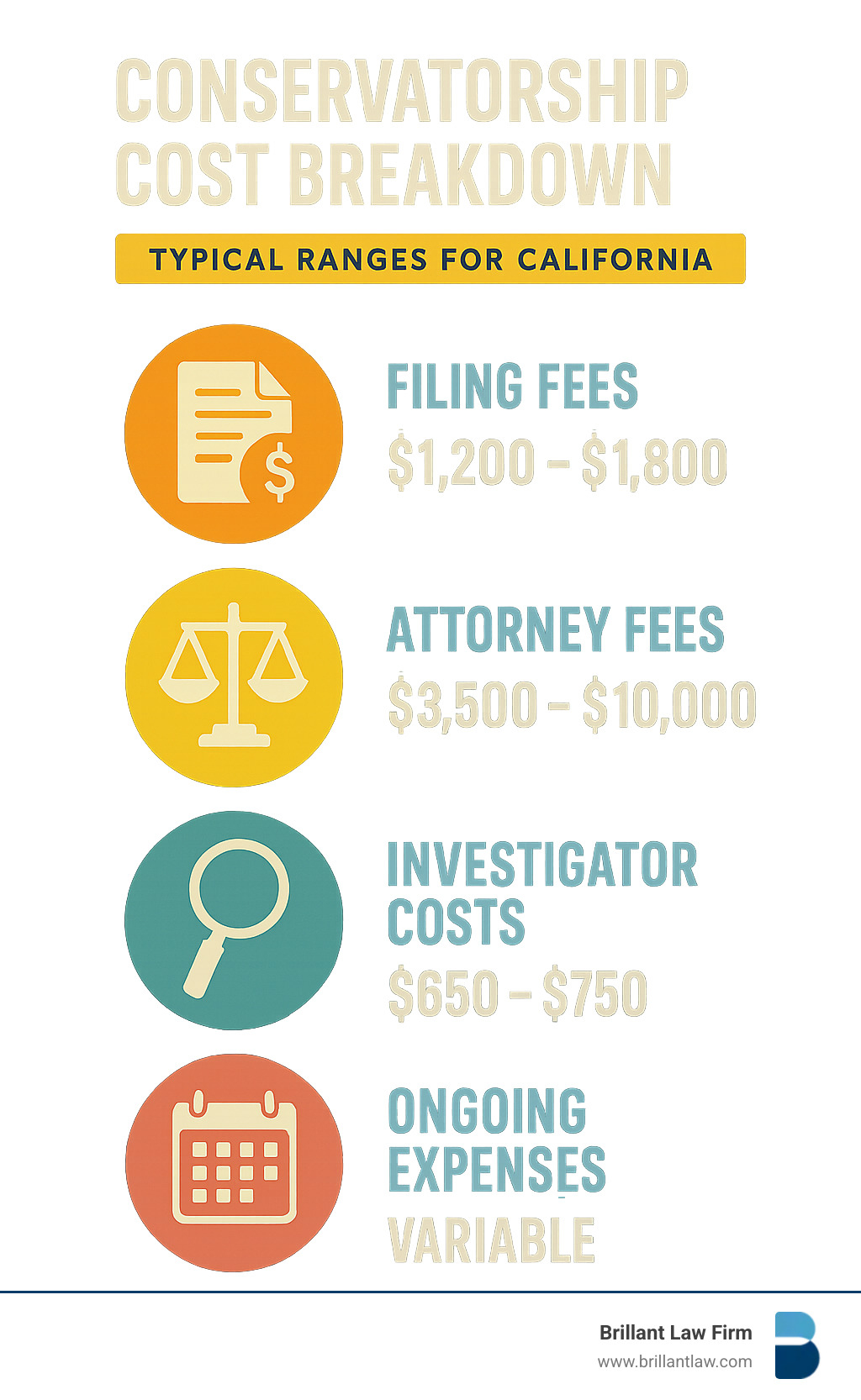
Let’s talk honestly about costs, because conservatorship walnut creek ca proceedings involve significant expenses that families need to understand upfront. Filing fees start at approximately $465 for the initial petition, but that’s just the beginning. Attorney fees in California typically range from $400 to $650 per hour, and conservatorship cases often require substantial legal work.
Court investigator fees usually run several hundred dollars, and if the court requires a bond to protect the conservatee’s assets, you’ll pay annual premiums for that protection. The ongoing costs for accounting preparation, court filings, and legal consultations can add up quickly. Fortunately, these expenses are usually paid from the conservatee’s estate, but every fee request must be approved by the court to ensure it’s reasonable and necessary.

Monitoring & Enforcement in Contra Costa County
California courts don’t just appoint conservators and walk away – they maintain active oversight to protect vulnerable adults. In Contra Costa County, this supervision involves multiple layers of monitoring that ensure conservators fulfill their duties properly.
Judge reviews happen annually when you submit your accounting. The assigned judge doesn’t just rubber-stamp these reports – they examine expenses, question unusual transactions, and may require additional documentation or explanations. I’ve seen judges call conservators into court to explain why they spent money on certain items or why they made particular investment decisions.
Court investigator visits provide another layer of protection. These trained professionals may visit the conservatee periodically to assess their living conditions, health, and overall well-being. They’re looking for signs that the conservatorship is working properly or identifying problems that need attention.
The mandatory workshop requirement for non-professional conservators serves an important educational purpose. This training covers everything from basic duties to warning signs of problems. It’s not just a formality – it’s designed to help you succeed in this challenging role.
Sanctions for breach of conservator duties are taken seriously. Conservators who fail to fulfill their responsibilities face potential removal from their position. In cases involving financial mismanagement, you could face personal liability for losses. Cases of abuse or neglect can even result in criminal charges.
For families considering this path, our comprehensive guide at Conservatorships provides additional insights into what to expect throughout the process.
Common Litigation Pitfalls
Even well-intentioned families can find themselves caught in conservatorship disputes that nobody saw coming. Understanding these common pitfalls helps families prepare for potential challenges and hopefully avoid them altogether.
Sibling conflict represents one of the most heartbreaking aspects of conservatorship proceedings. Adult children who got along reasonably well for decades suddenly find themselves in heated disagreements about Mom or Dad’s care. One sibling thinks conservatorship is necessary while another believes their parent is fine. Or everyone agrees conservatorship is needed, but they can’t agree on who should serve as conservator. These disputes drain family resources and damage relationships that may never fully recover.
Asset misuse allegations create immediate crises requiring swift court intervention. Sometimes these accusations are justified – a conservator really is stealing money or making inappropriate financial decisions. Other times, family members misunderstand legitimate expenses or disagree about spending priorities. Either way, these situations require careful investigation and often result in emergency court hearings.
Contested capacity cases arise when family members fundamentally disagree about whether their loved one truly lacks the ability to make decisions. Maybe one sibling sees clear signs of dementia while another insists their parent is just having a bad day. These disputes often require additional medical evaluations and can delay the entire process while a vulnerable person remains unprotected.
Removal motions become necessary when a conservator isn’t fulfilling their duties properly. Perhaps they’re not visiting the conservatee regularly, failing to submit required reports, or making poor financial decisions. Removing a conservator and appointing a successor involves court proceedings that can be expensive and time-consuming.
Settlement options often provide better outcomes than fighting these battles in court. Mediation allows families to work through their differences with professional guidance, often preserving relationships while finding solutions that work for everyone. Many conservatorship disputes can be resolved through thoughtful negotiation rather than costly litigation.
Frequently Asked Questions about Conservatorship Walnut Creek CA
When families consider conservatorship walnut creek ca proceedings, they naturally have many questions about how this legal protection works. These are the most common concerns I hear from clients who are trying to understand what conservatorship means for their loved one.
What rights does the proposed conservatee keep?
This question often surprises people because many assume conservatorship removes all decision-making power. That’s simply not true under California law. The conservatee actually retains substantial rights, and the court works hard to ensure the least restrictive arrangement possible.
Legal representation remains a fundamental right. Every proposed conservatee has the right to an attorney, and if they can’t afford one, the court will appoint counsel at no cost. This ensures someone is always advocating specifically for their interests.
The right to attend court hearings means the conservatee can participate in decisions about their own life. They can speak to the judge, ask questions, and express their preferences about living arrangements or who they’d prefer as their conservator.
Perhaps most importantly, the right to request termination means conservatorship isn’t permanent if circumstances change. If someone regains capacity or if less restrictive alternatives become viable, they can petition the court to end the conservatorship.
Other retained rights include the right to marry (unless the court specifically finds this inappropriate), the right to vote (unless declared incompetent to vote), and the right to make a will. The conservatee also keeps the right to have visitors, receive mail, and maintain social relationships.
California’s approach emphasizes that conservatorship should improve, not eliminate, a person’s dignity and autonomy. The goal is protection and assistance, not control.
How long does a temporary conservatorship last?
Temporary conservatorships serve as a legal bridge during emergencies, typically lasting 30 to 60 days initially. However, they’re not set in stone – the court can extend them if the emergency situation continues or if a general conservatorship petition is still pending.
The temporary conservator receives limited powers focused specifically on addressing whatever emergency prompted the filing. For example, if financial abuse triggered the temporary conservatorship, the temporary conservator might only have authority to secure bank accounts and review financial transactions, not broad power over all personal decisions.
I’ve seen families relieved to learn that temporary conservatorship doesn’t automatically lead to permanent conservatorship. The court treats these as separate proceedings, and the family has time during the temporary period to explore whether ongoing protection is truly necessary or if other solutions might work better.
The one-week timeline for emergency hearings can literally be life-saving when someone is being financially exploited or needs immediate medical decisions. However, this expedited process also means less time for investigation, which is why temporary conservatorships have limited scope and duration.
Can a conservatorship be ended if capacity returns?
Absolutely, and this happens more often than people realize. Conservatorships automatically terminate in several situations, and they can also be ended voluntarily when circumstances change.
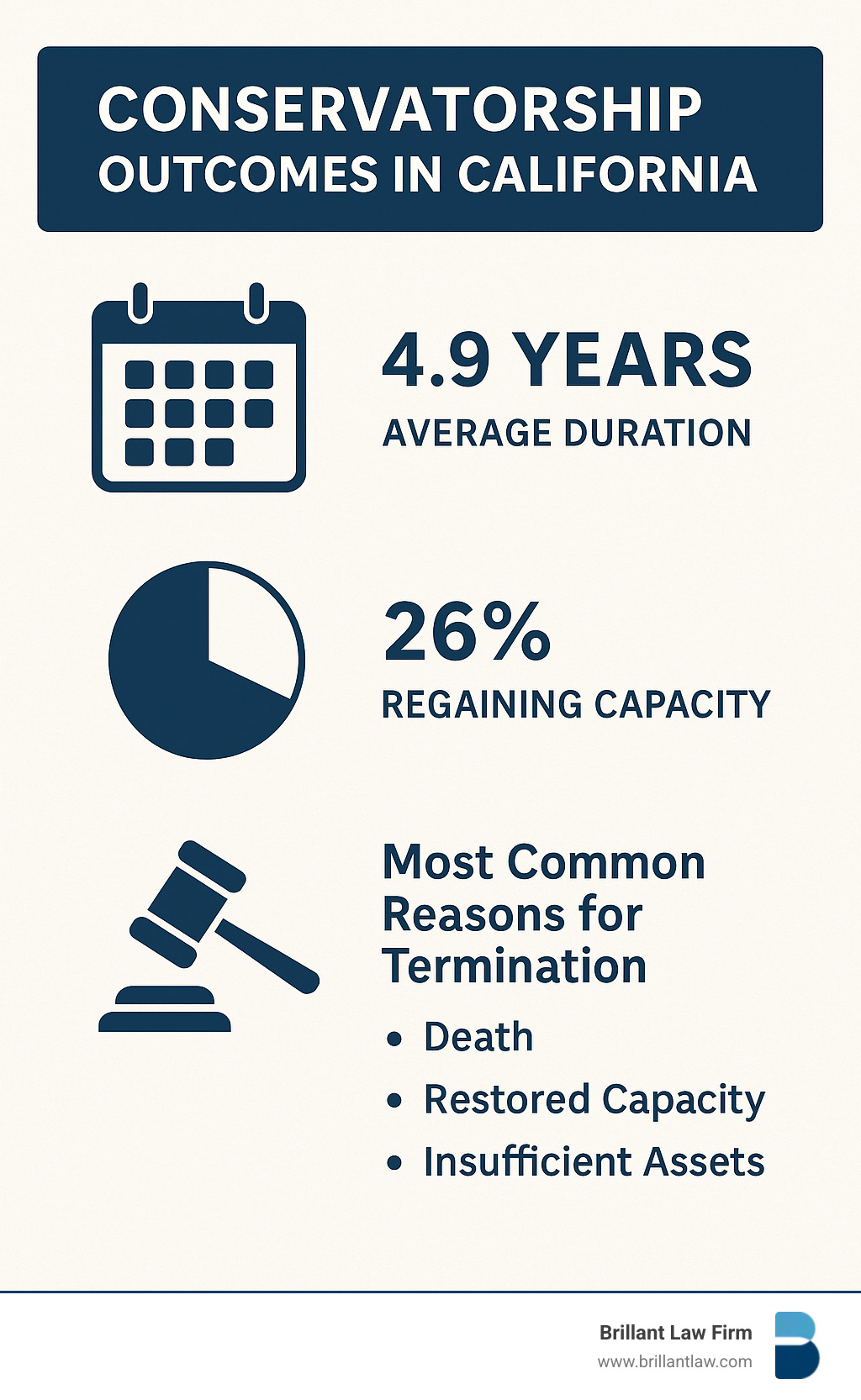
Automatic termination occurs when the conservatee dies or when an estate conservatorship runs out of assets to manage. But more encouraging is that conservatorships also end when capacity returns.
Sometimes people recover from conditions that initially required conservatorship. I’ve worked with families where someone regained cognitive function after a brain injury, or where proper medication management helped someone with mental illness return to independent functioning.
Anyone can petition for termination – the conservatee, their attorney, family members, or other interested parties. The court will require medical evidence showing that the person can now manage their personal care or finances independently, but the burden isn’t impossibly high.
The process involves filing a petition, obtaining updated medical evaluations, and presenting evidence to the court. If the judge agrees that conservatorship is no longer necessary, it ends immediately. The former conservatee regains full legal rights and decision-making authority.
This possibility of restoration gives hope to families facing conservatorship. It’s not a one-way street – it’s a protective measure that can be removed when protection is no longer needed.
Conclusion & Next Steps
Making decisions about conservatorship walnut creek ca can feel overwhelming when you’re trying to protect someone you love. The legal requirements are complex, family emotions run high, and the stakes couldn’t be more important. While conservatorship provides crucial protection for vulnerable adults, it represents a significant commitment that deserves careful consideration.
Every family’s situation tells a different story. What works for one family may not be right for another, which is why cookie-cutter approaches simply don’t work in conservatorship matters. At Brillant Law Firm, we take the time to understand your unique circumstances, family dynamics, and goals before recommending any course of action.
Whether you’re exploring conservatorship options, investigating less restrictive alternatives, or managing an existing conservatorship that’s become challenging, we’re here to provide the guidance you need. Our deep experience with California Probate rules and familiarity with Contra Costa County procedures means we can help you steer this process efficiently while protecting your loved one’s interests.
Scheduling a consultation gives us the opportunity to discuss your specific situation in detail. We’ll help you understand all available options, explain the likely timeline and costs, and develop a strategy that truly serves your loved one’s best interests. There’s no question too small or concern too complex when it comes to protecting someone you care about.
Prevention often beats intervention. Many families find that proper estate planning could have avoided the need for conservatorship entirely. If your loved one still has capacity to make decisions, exploring our More info about living-trust services might provide the protection and assistance they need without court oversight.
The path forward doesn’t have to feel uncertain. With personalized counsel custom to your family’s needs and comprehensive compliance with California Probate rules, you can make informed decisions with confidence. We understand this is often one of the most difficult times in a family’s life, and we’re committed to helping you steer it with both legal expertise and genuine compassion.
Your loved one deserves protection that preserves their dignity while providing the assistance they need. Together, we can find the right solution for your family’s unique situation.


