

California franchise tax board power of attorney form: Top 1
Why the California Franchise Tax Board Power of Attorney Form is Essential for Tax Representation
The California Franchise Tax Board power of attorney form is a legal document that grants a trusted individual the authority to handle your tax matters with the Franchise Tax Board (FTB). This form is your gateway to authorized tax representation in California, whether you need someone to access your records, speak with the FTB, or represent you in an audit.
Quick Reference: California FTB Power of Attorney
- Forms: FTB 3520-PIT (Individuals) and FTB 3520-BE (Businesses).
- Duration: Valid for 6 years from the signature date.
- Submission: Online via MyFTB or by mail.
- Key Rule for Joint Filers: Each spouse must file a separate form.
Properly completing this form is crucial for avoiding delays and costly mistakes. The FTB has specific requirements that differ from federal forms, and even small errors can lead to rejection.
I’m David Brillant, a California Certified Specialist in Estate Planning, Trust and Probate Law with a Masters in Taxation. I’ve guided countless clients through complex California Franchise Tax Board power of attorney form submissions and tax representation matters. My experience has shown me how critical proper POA documentation is for protecting your interests with the FTB.
What is an FTB Power of Attorney and What Powers Does It Grant?
The California Franchise Tax Board power of attorney form is a legal document that authorizes a trusted person to handle your tax matters with the FTB. By signing it, you give your representative the power to act on your behalf.
Key powers granted to your representative include:
- Accessing Confidential Information: They can review your account details, payment history, and correspondence.
- Communicating with the FTB: They can legally speak with the FTB for you, answering questions and providing documents.
- Representing You: They can represent you in various dealings, from routine inquiries to complex audits and collection issues.
- Signing Tax Returns: This is allowed only under specific circumstances, such as incapacitation or continuous absence from the U.S. for at least 60 days.
- Receiving Refund Checks: They can receive checks on your behalf but generally cannot endorse or cash them.
- Waiving Statute of Limitations: They can agree to extend deadlines for the FTB to assess taxes, which can be a strategic move during negotiations.
For more details, visit the official Power of Attorney | FTB.ca.gov page.
Power of Attorney (POA) vs. Tax Information Authorization (TIA)
A Power of Attorney (POA) grants broad authority to represent you, while a Tax Information Authorization (TIA) only allows someone to review your tax information. A TIA is useful for a new tax preparer to see your history, whereas a POA is essential for active representation in audits or disputes.
| Feature | Power of Attorney (POA) | Tax Information Authorization (TIA) |
|---|---|---|
| Primary Purpose | Grants broad representation and communication rights | Grants limited authorization to review tax information |
| Scope of Authority | Can represent you in all FTB matters, negotiate, sign forms, receive notices, make decisions, and receive refund checks | Can only review and receive copies of your tax information—cannot represent you or make decisions |
| Communication | Can actively communicate with the FTB on your behalf | Can receive information but cannot engage in substantive discussions or negotiations |
| Use Case | When you need someone to act for you during audits, disputes, or when you’re unable to manage tax affairs | When someone only needs to gather information to prepare returns or understand your tax history |
| FTB Form | FTB 3520-PIT (Individuals) or FTB 3520-BE (Businesses) | No specific FTB TIA form; often handled through MyFTB or modified IRS Form 8821 |
Who Can Be a Representative?
You must name an individual person as your representative, not a company or firm. While many people choose professionals like Certified Public Accountants (CPAs), Enrolled Agents, or Attorneys, you can also appoint a trusted family member or friend. The most important factor is choosing someone responsible who will act in your best interests.
When naming a professional, you will need to provide their professional identification number, such as a PTIN, CTEC number, California State Bar number, or California CPA license number, to help the FTB verify their credentials.
Choosing the Right California Franchise Tax Board Power of Attorney Form
Selecting the correct California Franchise Tax Board power of attorney form is the first critical step. Using the wrong one can delay the representation you need. The FTB uses specific forms for individuals and businesses but also accepts certain other forms if they meet California’s requirements.

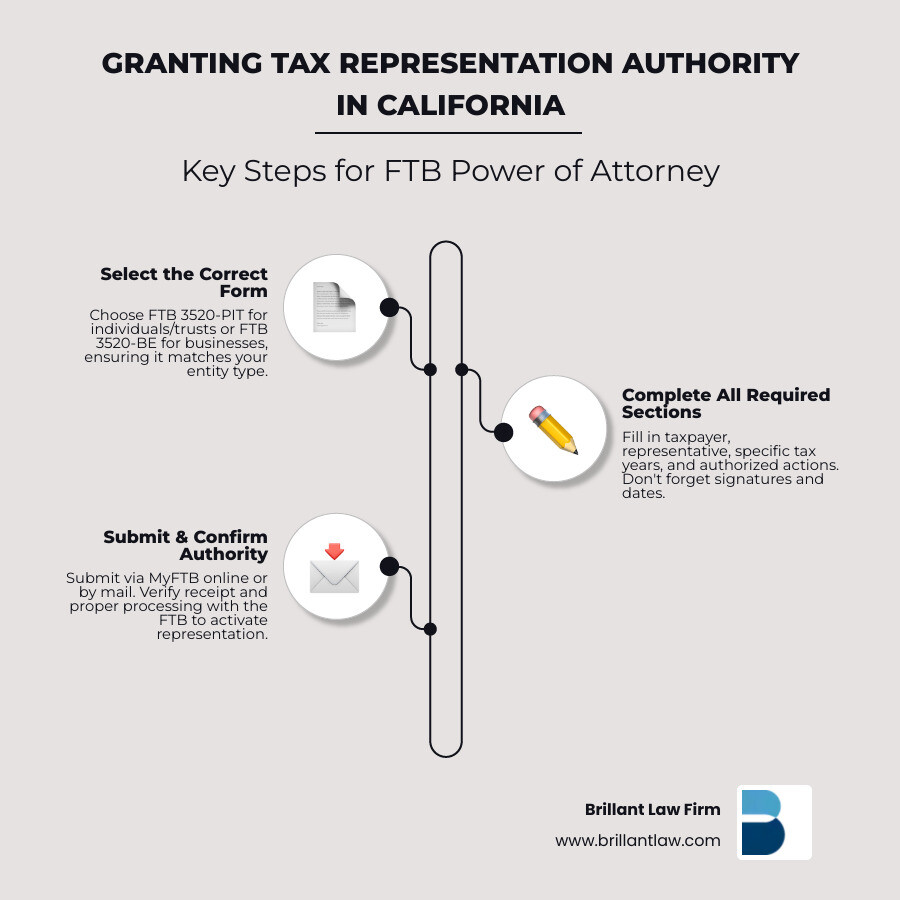
For Individuals, Estates, and Trusts: Form FTB 3520-PIT
Form FTB 3520-PIT is for personal income tax, estate, and trust matters. A critical rule that many overlook: for joint tax returns, each spouse must complete their own separate POA form. One form does not cover both spouses. This form provides the comprehensive authority your representative needs to act on your behalf as an individual taxpayer, executor, or trustee.
You can Download the latest FTB 3520-PIT form from the FTB website.
For Businesses and Group Nonresident Returns: Form FTB 3520-BE
Form FTB 3520-BE is designed for business entities like corporations, partnerships, and LLCs. It also covers group nonresident returns. If your business needs representation for both its regular business return and a group nonresident return, you must file two separate POA declarations. The FTB requires this separation to maintain clarity.
You can Download the latest FTB 3520-BE form for your business representation needs.
Other Accepted Forms
The FTB offers flexibility by accepting other forms if they are properly modified for California use:
- Modified Federal Forms: IRS Form 2848 or 8821 can be used if they clearly state they apply to FTB matters and specify California tax forms and years.
- Joint Form CDTFA-392: This multi-agency form can be used if the FTB box is checked.
- General or Durable Power of Attorney: These documents are acceptable if they specifically grant tax authority and include all information required by the FTB.
- Handwritten Documents: While not recommended, a handwritten document can work in an emergency if it contains all required taxpayer and representative information, a clear grant of authority, the specific tax matters covered, and your original signature and date.
A Step-by-Step Guide to Filling Out the FTB POA Form
Completing the California Franchise Tax Board power of attorney form requires careful attention to detail. Whether using Form FTB 3520-PIT for personal matters or FTB 3520-BE for a business, accuracy is key to avoiding rejection.

Step-by-Step: Filling Out the California Franchise Tax Board Power of Attorney Form (FTB 3520-PIT)
The FTB 3520-PIT is for individuals, estates, and trusts. Here is a breakdown of its sections:
- Part I – Taxpayer Information: Enter your full legal name, SSN or ITIN, and current mailing address exactly as they appear on your tax returns. For estates or trusts, provide the entity’s name and FEIN, along with the fiduciary’s name and title.
- Part II – Representative(s): Name the individual(s) who will represent you. Include their full name, contact information, and email address. You cannot name a company.
- Part III – Authorization Scope: Specify the tax years your representative is authorized to handle. You can choose “all years” or list specific years. Be precise to avoid rejection.
- Part IV – Additional Authorizations: Grant special powers by checking the appropriate boxes. These include signing tax returns (in rare cases), receiving refund checks, waiving statutes of limitations, and executing settlement agreements. Consider these carefully.
- Part V – MyFTB Full Online Account Access: Decide if your representative will have full or limited online access to your FTB account. Full access allows them to see more information and take action on your behalf.
- Part VI – Signature and Date: You must provide an original “wet” signature. The FTB does not accept electronic signatures, stamps, or photocopies on this form.
Key Considerations for the Business California Franchise Tax Board Power of Attorney Form (FTB 3520-BE)
When completing the FTB 3520-BE for a business, pay close attention to these areas:
- Business Identification: Accurately check your entity type (corporation, partnership, etc.) and provide the correct FEIN and California Corporation or Secretary of State Number.
- Authorized Signatories: The form must be signed by a person with legal authority to bind the entity, such as a corporate officer, general partner, or managing member. Their title must be clearly stated.
- Income Periods: Be specific about the tax periods, especially for fiscal year filers.
- Separate Forms: Remember to file separate POA forms for regular entity returns and group nonresident returns if both apply.
Common Mistakes to Avoid
- Missing Signatures or Dates: Forms must have an original signature and be dated.
- Vague Language: Be specific about tax years; avoid ambiguous terms.
- Naming Entities: You must name an individual representative, not a firm.
- Incomplete Information: Double-check all taxpayer and representative details.
- Joint Filer Error: Both spouses must file separate POA forms for a joint return.
- Information Mismatches: Ensure your name, SSN, and address match FTB records exactly.
The Lifecycle of Your FTB Power of Attorney
Your California Franchise Tax Board power of attorney form has a defined lifecycle. Understanding its duration, renewal, and revocation process helps you maintain control over who can access your confidential tax information.
How Long a POA Lasts and How to Renew It
An FTB POA is not permanent. It automatically expires six years from the date you sign it. The FTB does not send reminders, and there is no automatic renewal process. To continue the representation, you must submit a completely new POA form, which will start a new six-year period. Any POA filed on or before January 1, 2018, expired on December 31, 2023. If you had an older POA, you must file a new one to maintain representation.
How to End or Revoke a Power of Attorney
You can end a POA at any time. Here are the primary methods for revocation:
- File a New POA: Submitting a new POA for the same tax years automatically revokes any prior ones unless you specifically attach the old POA and check a box to retain it.
- Use Form FTB 3520-RVK: This is the official form for revoking a POA declaration.
- Send a Written Statement: You can mail a signed and dated letter to the FTB requesting revocation.
- Revoke Online via MyFTB: This is the fastest method and takes effect immediately, but it is not available for all filer types (e.g., fiduciaries).
- Representative Withdrawal: Your representative can also withdraw by sending a signed statement to the FTB.
A POA also terminates automatically upon the FTB being notified of the taxpayer’s death or, in some cases, incapacity.
POA and MyFTB Online Access for Tax Professionals
When you authorize a tax professional, you can grant them online access to your MyFTB account. There are two levels:
- Limited Access: Allows the representative to view notices and correspondence issued in the last 12 months.
- Full Access: Allows the representative to view information for all authorized tax years, see payment history, and take action on your behalf through the portal.
You grant full access in Part V of the POA form. Revoking a POA immediately terminates any associated MyFTB online access.
Frequently Asked Questions about the FTB POA
Here are answers to some of the most common questions we receive about the California Franchise Tax Board power of attorney form.
How do I submit the completed FTB Power of Attorney form?
You have two main options for submission:
- Online: Submitting through your MyFTB account is the fastest and most efficient method.
- Mail: You can mail the form to the address listed in the instructions. Crucially, mail your POA separately from your tax return or any other correspondence to avoid processing delays. Paper filing exceptions exist for certain situations, like for fiduciaries or those in declared disaster areas.
Can my representative sign my tax return?
Yes, but only in very specific situations and only if you grant this authority in Part IV of the form. The FTB permits a representative to sign your return if you are:
- Incapacitated due to illness or injury.
- Continuously absent from the United States for at least 60 days.
This is not a standard authorization and is reserved for exceptional circumstances.
What happens if I file a new POA declaration?
Filing a new California Franchise Tax Board power of attorney form automatically revokes any previous POA declarations you have on file with the FTB for the same tax years. This default action prevents confusion over who has the authority to represent you.
If you want to keep a previous POA active alongside a new one (for example, if you have multiple representatives), you must check the retention box on the new form and attach a copy of the prior POA you wish to keep. Without these steps, the old POA will be cancelled.
Navigating Complex Tax Matters with Professional Guidance
The California Franchise Tax Board power of attorney form is the first step in securing professional tax representation. However, the real challenge lies in navigating California’s complex tax laws. A simple FTB inquiry can quickly escalate into an audit or collection action with significant financial consequences.
Having skilled legal counsel is about more than just filling out forms. It’s about having a strategic advocate who understands the FTB’s procedures and can protect your rights. At Brillant Law Firm, we provide comprehensive representation that includes analyzing your tax position, developing audit defense strategies, and negotiating settlements.
The investment in professional legal help for California tax matters, which can range from $400 to $800 per hour, is often minimal compared to the potential taxes, penalties, and interest at stake. We have helped clients save substantial amounts through effective negotiation and strategic representation, providing peace of mind in the process.
If you are facing an FTB challenge or need help with compliance, don’t steer it alone. Our team is ready to help protect your financial security.


