

California estate administration: 5 Powerful Steps for 2025 Success
Navigating the California Estate Administration Process
California estate administration is the court-supervised process of gathering assets, paying debts, and distributing property after someone dies. For those facing this responsibility, here’s what you need to know:
California Estate Administration at a Glance:
1. Threshold: Estates valued over $184,500 typically require formal probate
2. Timeline: Usually takes 9-18 months to complete
3. Initial Steps: File petition with court, secure Letters Testamentary/Administration
4. Key Duties: Inventory assets, notify creditors, pay debts, file taxes, distribute property
5. Alternatives: Small estate procedures, living trusts, joint tenancy, TOD designations
Losing a loved one is difficult enough without the added complexity of legal procedures. Whether you’ve been named as an executor or find yourself responsible for administering a loved one’s estate, the process can feel overwhelming.
The good news? You don’t have to steer this journey alone.
With the right guidance, California estate administration can be straightforward and manageable. This guide breaks down the complex process into clear, actionable steps.
I’m David Brillant, a Certified Specialist in Estate Planning, Trust and Probate Law by the State Bar of California Board of Legal Specialization with extensive experience handling California estate administration matters ranging from simple estates to complex, high-value cases.
What Is Estate Administration in California?
When someone passes away in California, their worldly possessions don’t automatically transfer to their loved ones. Instead, a structured process called estate administration takes place to ensure everything gets handled properly.
Think of California estate administration as the entire journey of managing someone’s affairs after they’ve passed away. It’s the process of gathering their assets, paying off any lingering debts, filing final tax returns, and ultimately distributing what remains to the rightful beneficiaries.
This process is governed by the California Probate Code, which provides a detailed roadmap for personal representatives to follow. For estates valued above $184,500 (as of 2024), court supervision typically becomes necessary. The Judicial Branch of California provides resources to help steer this process.
California estate administration vs probate: what’s the real difference?
Many people use these terms interchangeably, but there’s an important distinction:
Estate administration is the umbrella term covering everything involved in settling someone’s affairs after death.
Probate, on the other hand, specifically refers to the court-supervised portion of estate administration. Not all assets need to go through probate.
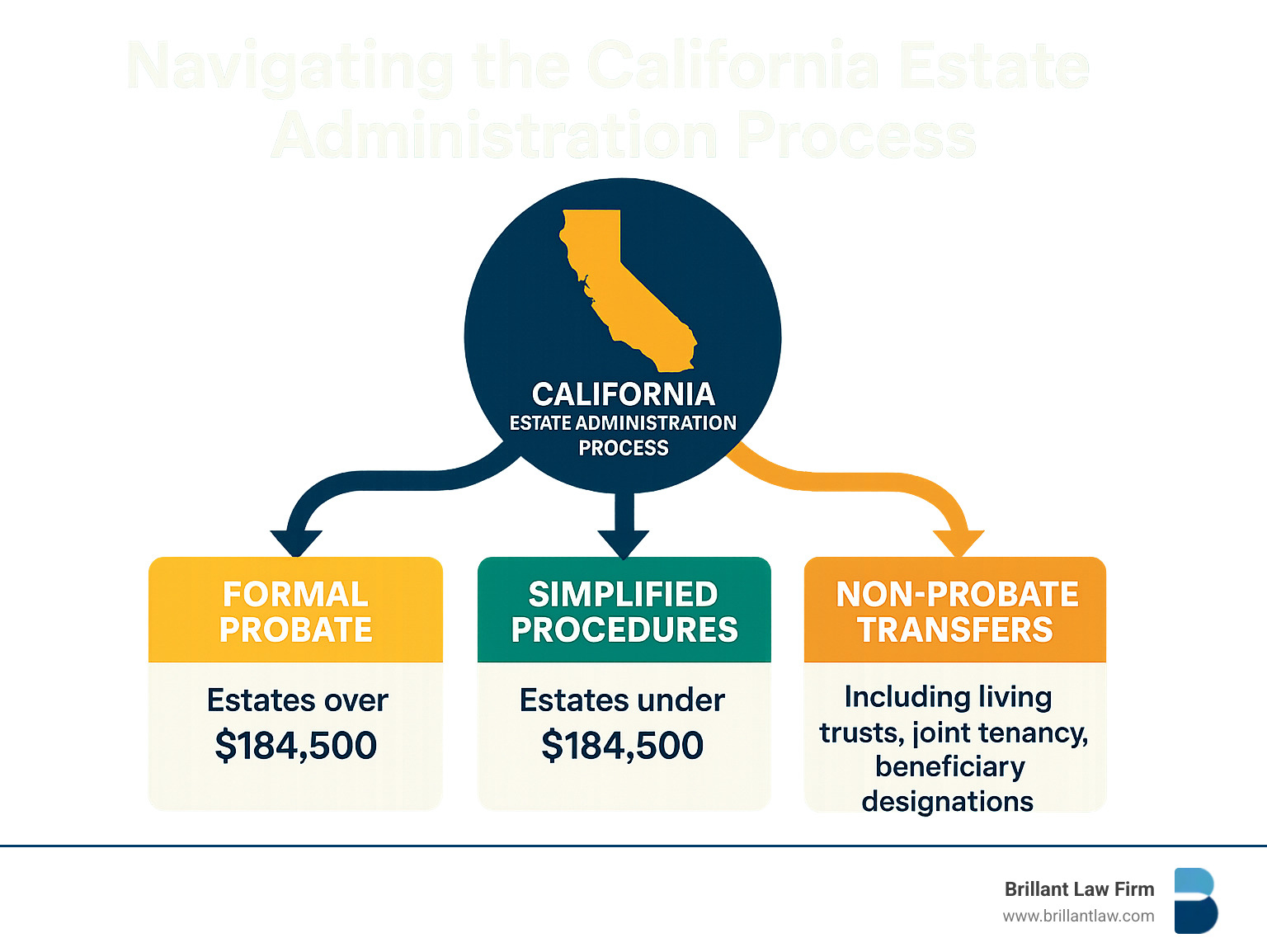
In California, property transfers after death generally follow one of three paths:
Formal probate is required for estates valued over $184,500 that don’t have alternative transfer arrangements in place.
Simplified procedures are available for smaller estates valued at $184,500 or less, offering a streamlined approach with less court involvement.
Non-probate assets bypass the court process entirely. These include assets held in living trusts, property owned in joint tenancy, accounts with designated beneficiaries, and certain small estates that qualify for transfer by affidavit.
Key terms every personal representative must know
If you’ve been named to handle someone’s estate, you’ll want to familiarize yourself with these essential terms:
An executor is specifically the person named in a will to handle the estate administration. If there’s no will, or if the named person cannot serve, the court appoints an administrator instead. Both roles fall under the broader term personal representative.
To gain legal authority to act on behalf of the estate, you’ll need official court documentation. For executors, this comes in the form of Letters Testamentary. Administrators receive Letters of Administration.
The Independent Administration of Estates Act (IAEA) allows personal representatives to handle many aspects of estate administration without needing court approval for every action.
All personal representatives have a fiduciary duty to the estate and its beneficiaries. This means you must act with honesty, good faith, and in the best interests of the estate—not your own personal interests.
Step-by-Step California Estate Administration Process

Navigating the California estate administration journey might feel like following a complicated roadmap, but don’t worry—I’ll guide you through each turn. Most estates follow these five key steps:
Step 1 – Open the case & secure authority
Your journey begins with filing a Petition for Probate (form DE-111) with the Superior Court in the county where your loved one lived or owned property. Along with your petition, you’ll need to lodge the original will (if one exists), pay the filing fee (typically $435), and notify all interested parties.
The court will schedule a hearing about 4-6 weeks after filing. Assuming no one objects to your appointment, the judge will issue your Letters Testamentary or Letters of Administration—your official authority that allows you to access accounts and handle estate matters.
Tip: Request several certified copies of your Letters right away. Banks, investment companies, and property transactions will each require their own original copy.
Step 2 – Marshal, inventory, appraise assets
With your authority in hand, it’s time to gather the estate’s assets. This means tracking down and securing everything from real estate and vehicles to bank accounts and personal possessions.
You’ll need to open an estate bank account using your newly-issued Letters and an Estate Identification Number (EIN) from the IRS.
Within four months of your appointment, you’ll need to file an Inventory and Appraisal (form DE-160) with the court. The court will assign a probate referee to appraise non-cash assets like real estate and personal property.
Don’t forget about digital assets! For guidance on managing digital assets, check our Living Trust Administration Checklist.
Step 3 – Manage debts, taxes, & ongoing expenses
As the estate’s caretaker, you’ll need to settle its financial obligations before distributing inheritances. Start by sending a Notice to Creditors (form DE-157) to known creditors and publishing a notice in a local newspaper. This starts the four-month clock during which creditors must submit their claims.
You’ll also need to:
– Obtain an EIN from the IRS
– File the decedent’s final personal income tax return
– Submit estate income tax returns (Form 1041) if the estate generates income
– File an estate tax return (Form 706) for larger estates
While all this is happening, you’ll also need to maintain insurance coverage, pay mortgage payments, and handle utility bills.
Step 4 – Use IAEA powers to operate or sell property
The Independent Administration of Estates Act (IAEA) lets you handle many aspects of the estate without returning to court for permission each time.
With “full authority” under IAEA, you can sell real estate, make investments, operate businesses, and even borrow money if necessary—all without specific court approval for each action.
For major actions like selling real estate, you’ll still need to notify beneficiaries through a Notice of Proposed Action, giving them 15 days to object.
Step 5 – Distribute inheritances & close the estate
After paying debts, taxes, and expenses, you’ll prepare a final accounting that shows everything that came into the estate, everything that went out, and what remains for distribution.
Filing a Petition for Final Distribution asks the court to review your administration and authorize the distribution of remaining assets. After a final hearing, you’ll transfer assets to beneficiaries according to the will or intestate succession laws.
Always obtain signed receipts from beneficiaries acknowledging they’ve received their inheritances. Once you submit these receipts to the court and request a formal discharge, your legal responsibilities end.
Duties, Risks & Protections for California Executors

Taking on the role of a personal representative in California estate administration isn’t just an honor—it’s a serious responsibility with real legal implications. As a fiduciary, you’re legally obligated to act in the best interests of others, putting the estate and its beneficiaries first.
Personal representatives who fail to fulfill these duties may find themselves personally liable for losses to the estate. That’s why knowing the guardrails and protections available to you is so important.
How the Independent Administration of Estates Act shields you
California’s Independent Administration of Estates Act (IAEA) gives you breathing room to handle estate matters efficiently without constantly running back to court for permission.
With full IAEA authority, you can sell property, make investments, and handle most administrative tasks independently—though you’ll still need to notify beneficiaries of major actions. This autonomy not only speeds up the administration process but also provides you with legal protection when you follow the proper procedures.
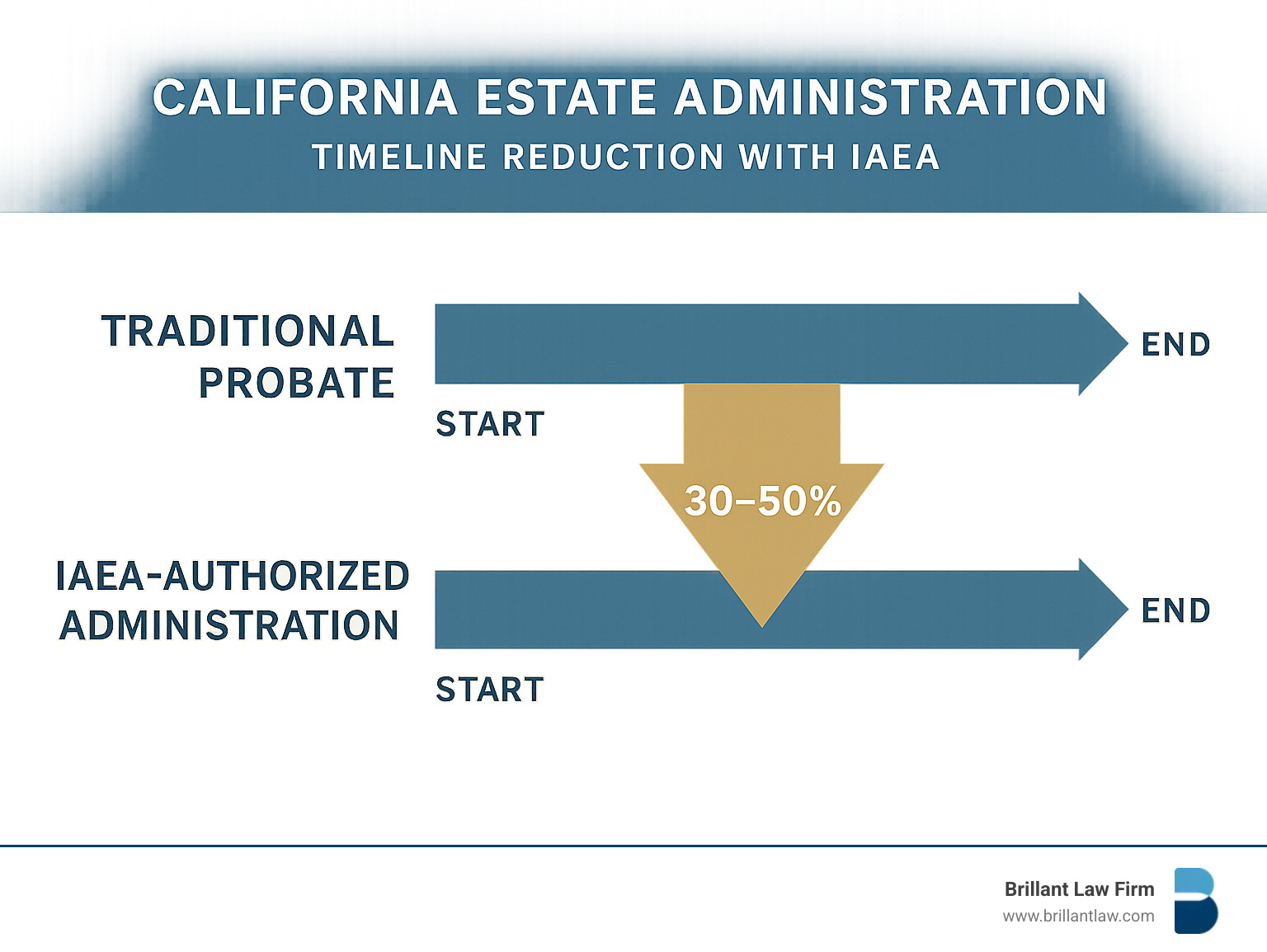
When it comes to IAEA authority, you have two options:
Full authority gives you maximum independence, including the ability to sell real estate without court confirmation (though you must notify beneficiaries).
Limited authority requires court confirmation for real property transactions but still allows independence in other matters.
To secure full authority, you may need to post a bond or have beneficiaries waive this requirement.
Insurance, bonds, and fee allowances for representatives
California law recognizes the significant work involved in administering an estate and provides both protections and compensation.
Executor’s bonds function as insurance policies that protect beneficiaries against potential mismanagement. The estate pays these premiums (typically $200-$800 depending on estate size).
For your time and effort, you’re entitled to statutory fees based on the estate’s value. The fee structure works on a sliding scale: 4% on the first $100,000, 3% on the next $100,000, 2% on the next $800,000, and continues downward as the estate value increases.
When extraordinary circumstances arise—like selling property or handling litigation—you can petition the court for extraordinary fees beyond the standard amount. You’re also entitled to reimbursement for reasonable expenses incurred while administering the estate.
For professional guidance through the complexities of California estate administration, our team at Brillant Law Firm provides personalized support at every stage. Our hourly rates typically range from $300-$750, reflecting our specialized expertise in this nuanced area of California law.
Probate vs Alternatives: Keeping Your Estate Out of Court
While navigating California estate administration through probate is sometimes necessary, many people prefer to spare their loved ones this process entirely. With thoughtful planning, you can create a roadmap that guides your assets around the probate courthouse altogether.
Toolbox for avoiding formal probate in future
Think of probate avoidance as assembling a custom toolkit—different tools work for different situations, and the best plans often use several in combination.
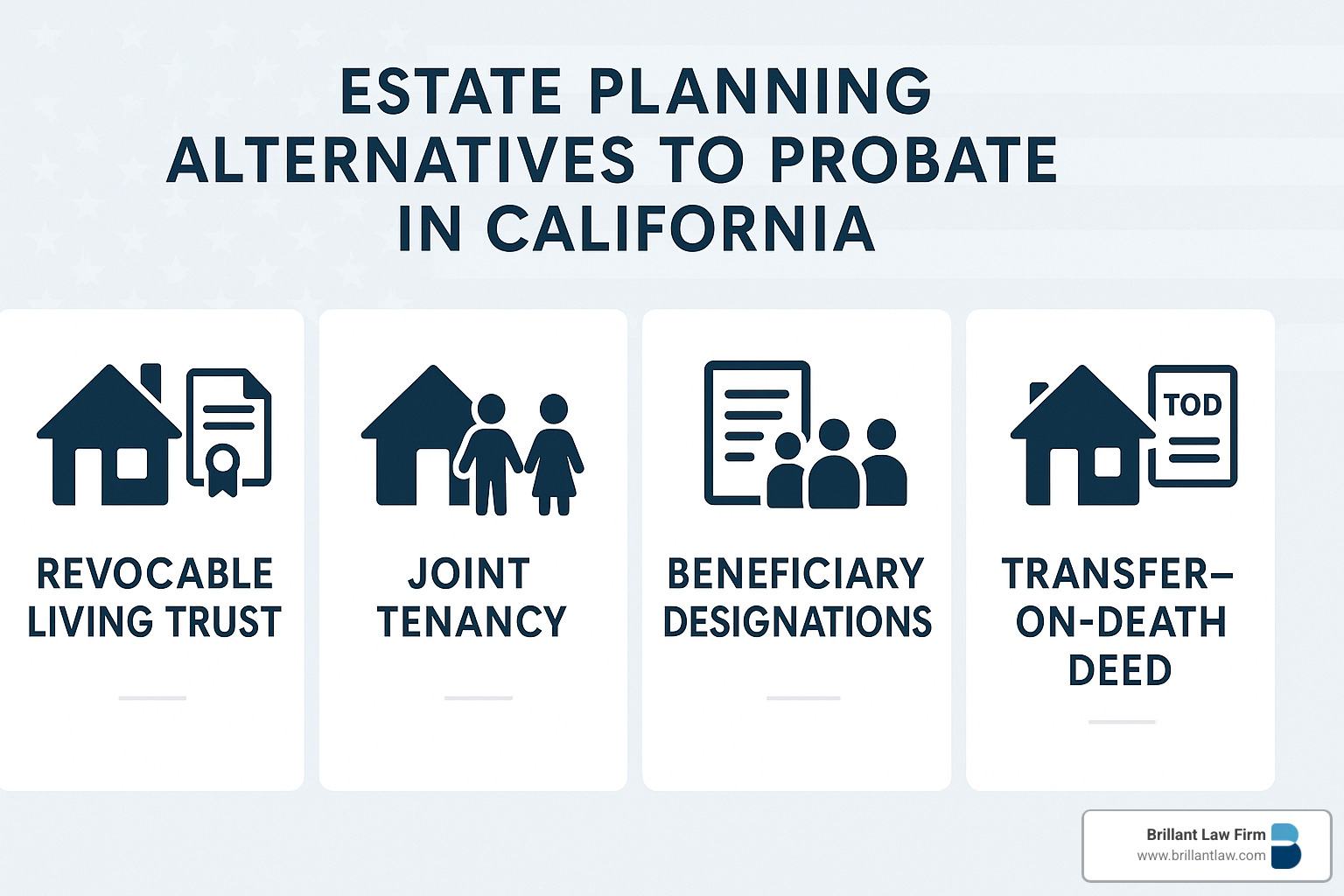
Revocable living trusts remain the gold standard for probate avoidance in California. When properly funded during your lifetime, these powerful planning tools allow your assets to flow directly to beneficiaries without court involvement.
For married couples, holding property as joint tenants with right of survivorship or as community property with right of survivorship creates an automatic transfer upon the first spouse’s death.
Beneficiary designations offer another straightforward path around probate. Your retirement accounts, life insurance policies, and investment accounts can all include beneficiary designations that supersede even your will. Many banks and financial institutions also offer transfer-on-death (TOD) or pay-on-death (POD) options for accounts.
For real estate, California offers transfer-on-death deeds. These special deeds allow property to pass directly to named beneficiaries without probate, while maintaining your complete ownership and control during your lifetime.
Even without advance planning, smaller estates may qualify for simplified procedures if they’re valued at $184,500 or less. Similarly, surviving spouses can often use a spousal property petition to transfer assets more efficiently than through standard probate.
Don’t overlook your digital footprint when planning to avoid probate. Providing instructions and access information for digital assets is just as important as planning for your physical property.
I often remind clients that these strategies only work when implemented before death. Once someone has passed away with probate-subject assets, trying to avoid probate is simply too late.
At Brillant Law Firm, we take a warm, personal approach to helping clients implement these strategies. Our comprehensive estate planning services are designed to minimize or eliminate the need for probate administration, saving your family time, money, and unnecessary stress during an already difficult time.
For more information about creating a comprehensive plan that keeps your estate out of court, visit our Estate Planning Solutions page.
Costs, Timelines & Common Roadblocks
Let’s face it – one of the first questions most people ask about California estate administration is “How much will this cost me?” The second question is usually “How long will this take?” These are perfectly reasonable concerns, and I’d like to give you an honest look at what to expect.
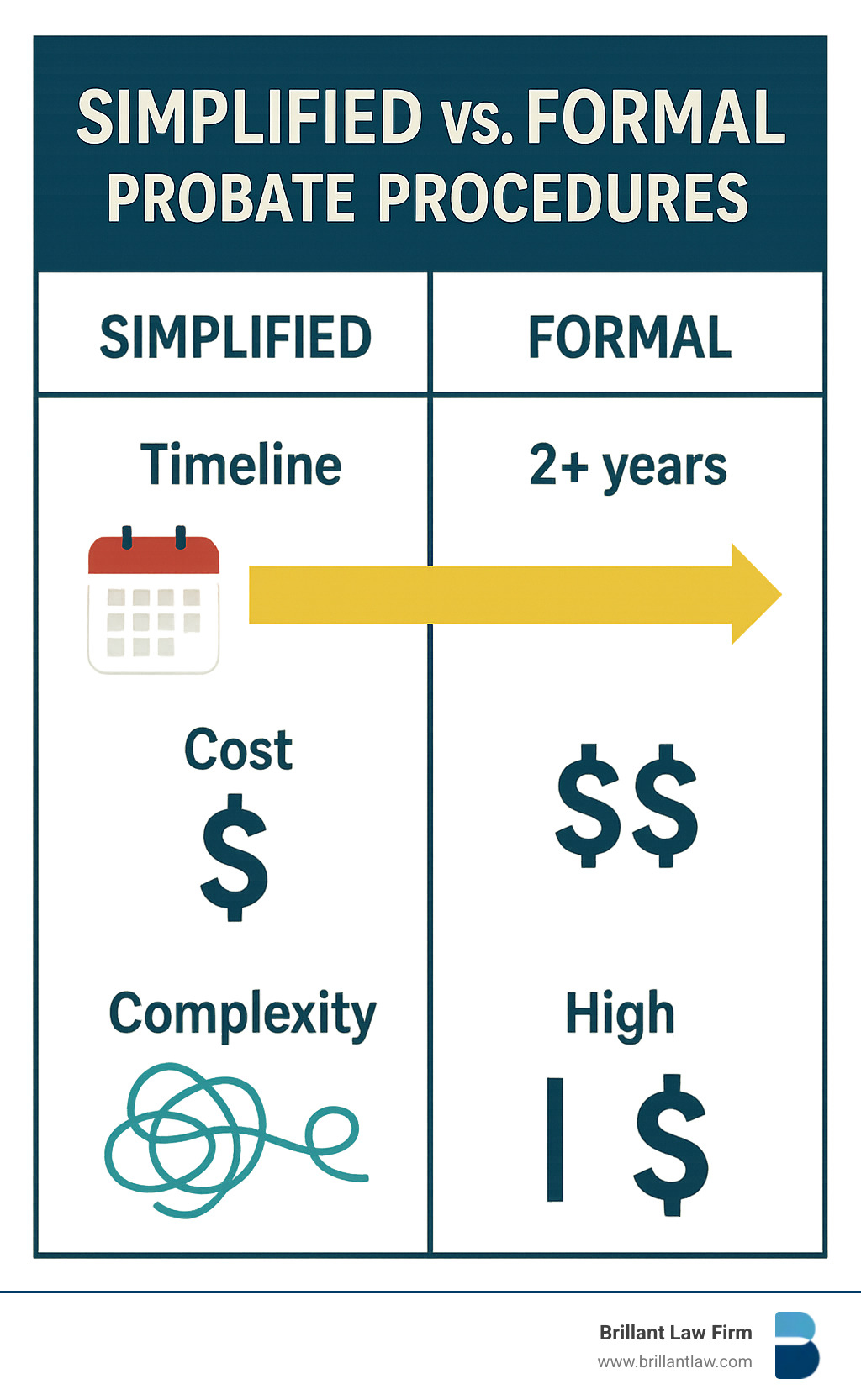
When it comes to costs, California estate administration involves several predictable expenses. The initial court filing fee is $435. You’ll also need to budget $100-$400 for publishing legal notices in local newspapers.
The probate referee who helps appraise non-cash assets charges $1 per $1,000 of asset value, with a minimum fee of $75. If the court requires a bond, expect to pay $200-$800 depending on the estate’s size.
The largest expenses are typically attorney and executor fees. California law establishes statutory fees based on the estate’s value:
- 4% on the first $100,000
- 3% on the next $100,000
- 2% on the next $800,000
- 1% on the next $9,000,000
- 0.5% on the next $15,000,000
These percentages apply to both the attorney and the executor, though family members serving as executors often waive their fee.
For a modest $500,000 estate with no complications, you might expect around $13,000 in attorney fees, $13,000 in executor fees (if not waived), and about $1,000 in other costs – totaling approximately $27,000, or about 5.4% of the estate’s value.
How long does California estate administration usually take?
The standard timeline runs 9-18 months for typical estates, broken down into several phases:
- Initial filing and appointment: 4-8 weeks
- Inventory preparation and creditor claims period: 4 months
- Administration tasks and tax filings: 3-6 months
- Final accounting and distribution: 2-4 months
Some estates move more quickly. When there are no creditor disputes, straightforward tax matters, and minimal assets to liquidate, the process might wrap up in 6-9 months.
Complex estates can stretch to 2+ years. This happens when the estate includes businesses or unusual investments, when beneficiaries contest the will, when tax issues require IRS negotiation, or when creditors file disputed claims.
California law sets a deadline – probate should be completed within one year from the personal representative’s appointment. However, if a federal estate tax return is required, you get an extra six months. Courts also routinely grant extensions when necessary.
Common roadblocks include family disagreements, missing assets, creditor disputes requiring litigation, real estate transactions facing market delays or title issues, and tax complications requiring extensive professional assistance.
At Brillant Law Firm, we’ve guided countless families through this process. While we can’t eliminate all the paperwork or waiting periods required by California law, we can help you anticipate and steer potential roadblocks, often reducing the overall timeline through proactive management.
Frequently Asked Questions about California Estate Administration
Do I need an attorney or can I DIY?
While California law doesn’t technically require legal representation, there are compelling reasons to consider professional help:
An attorney serves as your navigation system through the complex legal landscape. California estate administration involves numerous forms, deadlines, and procedural requirements that can quickly become overwhelming.
Protection from personal liability is another significant benefit. As executor, you have fiduciary responsibilities to beneficiaries and creditors. Mistakes can lead to personal financial liability. An attorney helps ensure you’re fulfilling all your duties properly.
The efficiency factor shouldn’t be overlooked either. What might take you weeks to research and understand, an experienced probate attorney has already mastered.
There’s also the emotional aspect to consider. Handling a loved one’s estate while grieving is challenging. Having someone else manage the legal complexities can provide valuable emotional space during a difficult time.
If you’re dealing with a very simple estate, cooperative beneficiaries, and straightforward assets, the DIY approach might be feasible. Even then, I recommend at least an initial consultation with an estate attorney.
What assets avoid probate automatically?
Not everything a person owns must go through probate. Several types of assets transfer automatically in California:
Trust-held assets bypass probate entirely. Property properly transferred to a revocable living trust during the decedent’s lifetime passes directly to beneficiaries according to the trust terms.
Joint ownership provides another probate bypass. Property held in joint tenancy with right of survivorship automatically passes to the surviving owner(s).
Beneficiary designations create direct transfers for many financial assets. Life insurance proceeds, retirement accounts, and transfer-on-death accounts pass straight to named beneficiaries without court involvement.
California also allows transfer-on-death vehicle registrations and transfer-on-death deeds for real property.
Small estates valued at $184,500 or less may qualify for simplified procedures that avoid formal probate.
These probate-avoidance methods must be set up before death. Once someone has passed away, it’s too late to implement most of these strategies.
When should I reject or accept the executor role?
Being named executor in someone’s will reflects their trust in you, but it’s not a responsibility to take lightly. Before accepting, consider both the honor and the workload involved.

Accept the role if you want to honor the decedent’s wishes and have the time and organizational skills required. Being familiar with the decedent’s affairs and beneficiaries is helpful, as is having some financial literacy. The statutory compensation can also be a consideration.
Consider declining if you live far from the decedent’s property or the probate court, as physical presence is often required. Significant time constraints, health issues, or lack of organizational skills might make the role challenging. Complex estates involving businesses, contested wills, or difficult beneficiaries require extra time and emotional resilience.
If you decide not to serve, it’s important to formally decline rather than simply ignoring the responsibility. This allows the probate process to move forward with an alternate representative.
At Brillant Law Firm, we often counsel potential executors on this important decision. Sometimes the wisest choice is to partner with experienced professionals who can handle the legal complexities while you maintain oversight of the process.
Conclusion & Next Steps
Stepping into the role of managing a loved one’s estate isn’t easy, but with the right approach, California estate administration can be a manageable journey that honors their legacy while fulfilling your legal responsibilities.
Remember these essential points as you move forward:
Estate administration is about more than just paperwork – it’s about carefully stewarding someone’s life’s work and ensuring their final wishes are honored.
Your role as a personal representative carries significant responsibilities. The fiduciary duty you’ve accepted means always acting in the best interests of the estate and its beneficiaries.
Organization is your greatest ally in this process. Maintain detailed records of all assets, debts, expenses, and communications.
Clear, consistent communication with beneficiaries often prevents misunderstandings before they escalate into disputes.
Don’t hesitate to seek professional guidance when needed. The complexities of California estate administration often benefit from the expertise of attorneys, accountants, and appraisers.
At Brillant Law Firm, we understand that you’re often navigating estate administration during one of life’s most challenging emotional periods. Our team of experienced California estate attorneys provides compassionate guidance custom to your unique situation, whether you need comprehensive representation throughout the entire probate process or targeted advice on specific issues.
Our approach combines technical expertise with a human touch, offering practical solutions that make the administration process as smooth as possible. With offices serving clients throughout California, we specialize in all aspects of estate administration, from straightforward cases to complex, high-value estates.
Don’t face the complexities of California estate administration alone. Contact our Trusts & Estates services team today to schedule a consultation and learn how we can help you steer this journey with confidence.
The path through estate administration may have its challenges, but with the right support, you can fulfill your duties efficiently and effectively. At Brillant Law Firm, we’re ready to help you steer every phase of the process with the expertise and care your loved one’s legacy deserves.


