

California Department of Tax and Fee Administration Power of Attorney 1 Pro
What is a CDTFA Power of Attorney?
California department of tax and fee administration power of attorney is a legal document allowing you to authorize someone to handle your tax matters with the CDTFA. Here’s what you need to know:
Quick Answer for CDTFA Power of Attorney:
- Form: Use CDTFA-392 (Power of Attorney form)
- Purpose: Authorize someone to represent you for sales tax, use tax, and special fees
- Submission: Online at onlineservices.cdtfa.ca.gov or mail to local field office
- Required Info: Your business details, representative’s credentials, specific tax types/periods
- Validity: Remains active until revoked or final resolution of tax matters
- Cost: Free to file (no notarization required)
The California Department of Tax and Fee Administration (CDTFA), established in 2017, took over responsibilities from the Board of Equalization (BOE). It now handles sales and use tax, plus other special taxes and fees in California.
Using Form CDTFA-392, you grant a representative legal authority to discuss your account, receive confidential information, and act on your behalf. This includes conferring on assessments, receiving refunds, executing petitions, and extending statutory periods.
Why might you need this? Business owners dealing with sales tax audits, complex multi-location operations, or those who want an accountant to handle routine CDTFA communications can streamline the process with a power of attorney, ensuring their representative can act effectively.
As a Certified Specialist in Estate Planning, Trust and Probate Law with a Masters in Taxation, I’ve helped many California clients steer complex california department of tax and fee administration power of attorney situations, especially those involving estate planning and business succession. My experience includes resolving difficult cases, including those requiring multi-agency tax representation.
Common california department of tax and fee administration power of attorney vocab:
Your Step-by-Step Guide to the California Department of Tax and Fee Administration Power of Attorney (CDTFA-392)
Government forms can be overwhelming, but Form CDTFA-392 is straightforward. It’s your official way to authorize someone to handle your tax matters when you can’t.
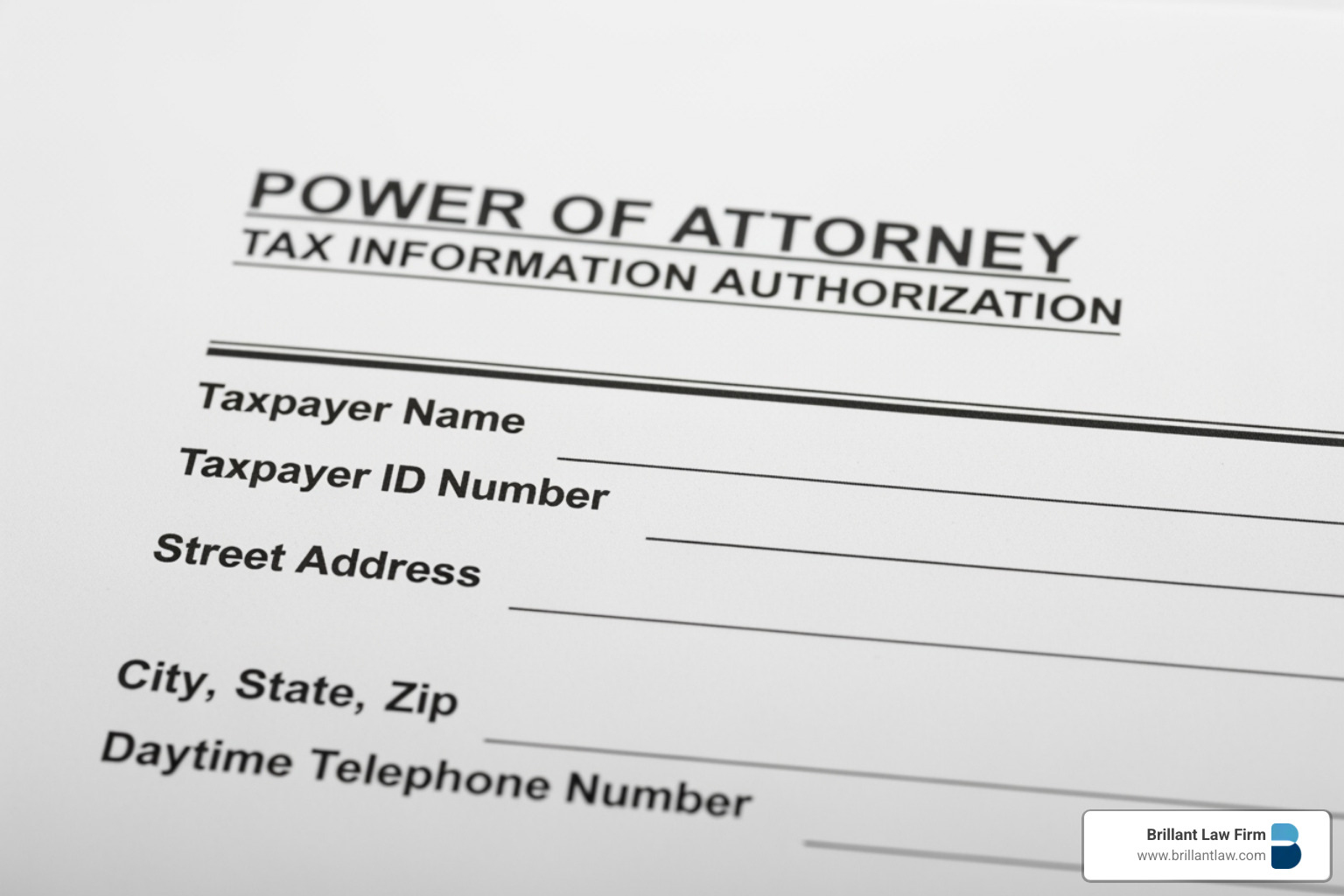
Whether for a small business or a large corporation, this form is your gateway to getting professional help with CDTFA matters. Once set up, your representative can handle everything from routine questions to complex audits.
Form CDTFA-392 is specifically for the California Department of Tax and Fee Administration. It covers sales and use tax, fuel taxes, cannabis taxes, and other special taxes and fees. Using an outdated or incorrect form will lead to rejection. Attention to detail is crucial to avoid rejection and delays.
What Information is Required for a California Department of Tax and Fee Administration Power of Attorney?
Completing your California Department of Tax and Fee Administration Power of Attorney requires specific details to introduce your representative to the CDTFA.
Gather your taxpayer identification details first. This includes your legal name or business name as it appears in CDTFA records, plus your SSN, FEIN, or CDTFA account number. The information must match CDTFA records perfectly.
For businesses, provide complete business information, including the official name, address, and all relevant CDTFA account or permit numbers. This ensures the POA applies to the correct entities and tax programs.
Next is your representative’s information: their full legal name, mailing address, phone number, and email. You must name a specific person, not just a firm.
The CDTFA also requires professional identifiers for your representative, such as their California Bar number, CPA number, Preparer Tax Identification Number (PTIN), or Enrolled Agent number. These identifiers help the CDTFA verify their identity.
A critical section involves specifying tax types and periods. Be clear about which taxes the POA covers (e.g., sales and use tax, fuel tax) and the exact time periods (e.g., “Sales and Use Tax for periods 2020-2023”). While you can authorize for “all years,” specificity is often better.
The form also asks about specific acts authorized. You can grant general authorization for your representative to do anything you could do, or limit their authority to actions like discussing assessments, receiving refunds, or filing petitions.
Finally, the form requires proper signatures and titles. A corporate officer, partner, or owner must sign for a business. For a joint return with joint representation, both individuals must sign. The signatory must also include their title. Missing or improper signatures are a common reason for rejection.
How to Submit Your Completed Form CDTFA-392
Once your California Department of Tax and Fee Administration Power of Attorney form is complete, you have several submission options.
The online submission option via the CDTFA’s online services portal at https://onlineservices.cdtfa.ca.gov/_/ is often the fastest. After logging in, select the account and look for “Request Power of Attorney.” The system guides you through the process, and you can track its status online.
If you prefer, mail submission is also available. Send the completed Form CDTFA-392 to a local field office or the central processing unit. Mailing to a local office can be useful if you’re already working with someone there. Always keep a copy for your records.
You can find your nearest office on the CDTFA website: Office Locations & Addresses.
Electronic Data Transmission (Form CDTFA-82) allows you or your representative to receive confidential CDTFA information via email once the POA is active. This email transmission is not considered secure, so consider the privacy implications.
Accuracy matters more than speed. Rushing can lead to rejected forms and missed deadlines, especially during audits. Double-check everything before submitting.
Understanding the Power You’re Granting
Signing a california department of tax and fee administration power of attorney is a significant legal decision. You are granting your representative authority to access confidential information and make decisions that impact your finances.

The Authorized Acts you grant can be extensive. Your representative can access Confidential Information, discuss assessments, negotiate on your behalf, and handle Receiving Refunds. They can also take formal actions like Signing Petitions for redeterminations or refund claims and agree to Extending Statutes of limitations, which can be crucial during an audit.
The Validity Period of your POA is not indefinite, and understanding the Revocation Process is vital. You always retain the right to revoke the authority you’ve granted.
This authorization is specific to the CDTFA. For broader legal powers, you might explore a Durable Power of Attorney California, which covers different types of decision-making.
How Long is a CDTFA POA Valid and What Can Your Representative Do?
Your california department of tax and fee administration power of attorney is not eternal. The Six-Year Validity rule means a POA declaration generally lasts for six years from its filing date. After that, you must submit a new CDTFA-392 form via the Renewal Process to continue the representation.
Expiration often occurs naturally upon the Final Resolution of the specified tax matters. If the issues for the authorized periods are resolved, the POA has served its purpose.
When completing the form, you can choose between General Authorization, which allows your representative to perform any act you could, or Specific Acts authorization. General authorization is common for complex situations like audits.
Specific Acts lets you be more selective. You can authorize them to confer on assessments, receive refunds, execute petitions, or extend statutory periods. This gives you more control, but be careful not to be overly restrictive, as it could cause delays if an unexpected issue arises.
Revoking a California Department of Tax and Fee Administration Power of Attorney
If your representative is no longer the right choice, you can revoke your california department of tax and fee administration power of attorney. This requires specific steps to ensure the CDTFA is properly notified.
Written Revocation: Submit a clear written statement identifying yourself, the representative whose authority is being revoked, and the specific tax types and periods affected. Ambiguity can cause issues.
Submitting a New POA: The CDTFA-392 form asks if the new POA should revoke previous ones for the same matters. Checking “Yes” cancels the old authorization while establishing the new one.
Notifying Your Former Agent: While not legally required by the CDTFA, it is professional courtesy to inform your former representative in writing that their authority has ended.
Providing Revocation to CDTFA: Your written revocation must be sent to the CDTFA through their online portal or by mail. Consider using certified mail for proof of receipt. A POA remains active until you formally revoke it, so proper revocation is crucial for protecting your confidential tax information.
CDTFA POA vs. Other California Tax Authorizations
California has multiple tax agencies, each with its own power of attorney form and procedures. Using the correct form for the right agency is crucial to avoid delays and compliance issues.
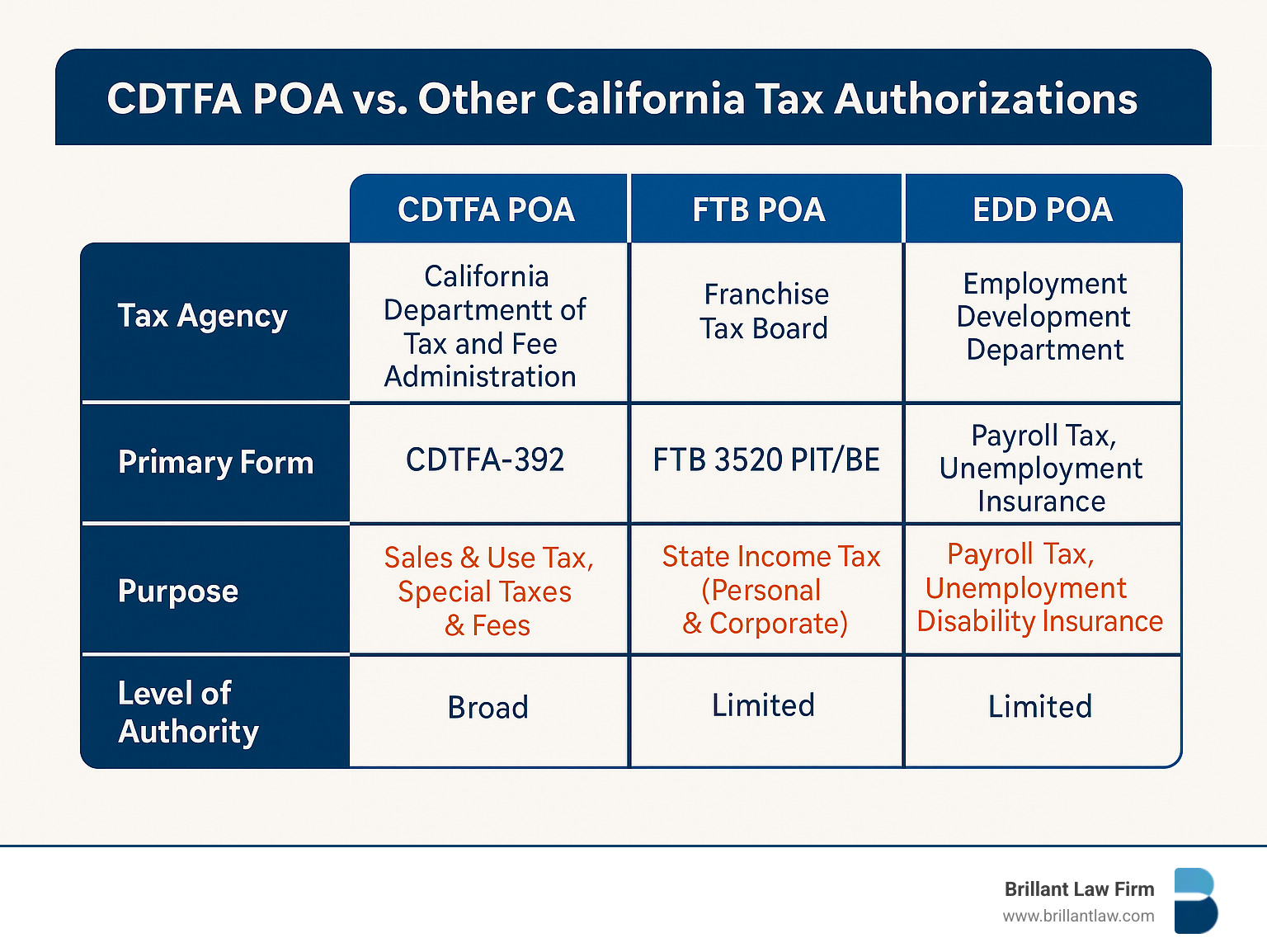
| Feature | CDTFA POA (CDTFA-392) | FTB POA (FTB 3520 PIT/BE) | EDD POA (DE 48) |
|---|---|---|---|
| Tax Agency | California Department of Tax and Fee Administration (CDTFA) | Franchise Tax Board (FTB) | Employment Development Department (EDD) |
| Primary Form | CDTFA-392 | FTB 3520 PIT (Individual/Fiduciary) / FTB 3520 BE (Business) | DE 48 |
| Purpose | Sales & Use Tax, Special Taxes & Fees | State Income Tax (Personal & Corporate) | Payroll Tax, Unemployment Insurance, Disability Insurance |
| Level of Authority | Representation for specified tax types/periods | Representation for state income tax matters | Representation for employment tax & benefit reporting |
| Validity | Remains until revoked or matters resolved (generally 6 years) | Generally 6 years, specific expiration rules apply | Remains until revoked or new one received |
| Notarization | Not required | Not required | Not required |
The california department of tax and fee administration power of attorney (CDTFA-392) is for sales, use, and special taxes. The Franchise Tax Board (FTB) uses Form FTB 3520 for state income taxes. The Employment Development Department (EDD) uses Form DE 48 for payroll taxes.
The key takeaway is that there is no universal California tax power of attorney form. A business needing representation for sales, income, and payroll tax issues must file three separate POA forms with three different agencies.
Power of Attorney (POA) vs. Tax Information Authorization (TIA)
It’s important to understand the difference between a POA and a Tax Information Authorization (TIA).
A Power of Attorney (POA) grants comprehensive authority. Your representative can access confidential information, negotiate on your behalf, and make binding decisions.
A Tax Information Authorization (TIA) only allows access to review your confidential tax records. The representative cannot act on your behalf or make decisions. The FTB, for example, accepts a modified IRS Form 8821 (TIA) for state tax matters.
Choose a POA for active representation during audits, appeals, or collections. Use a TIA when you only need to grant someone access to review records for tax preparation or basic inquiries.
CDTFA-392 vs. FTB 3520 and EDD DE 48
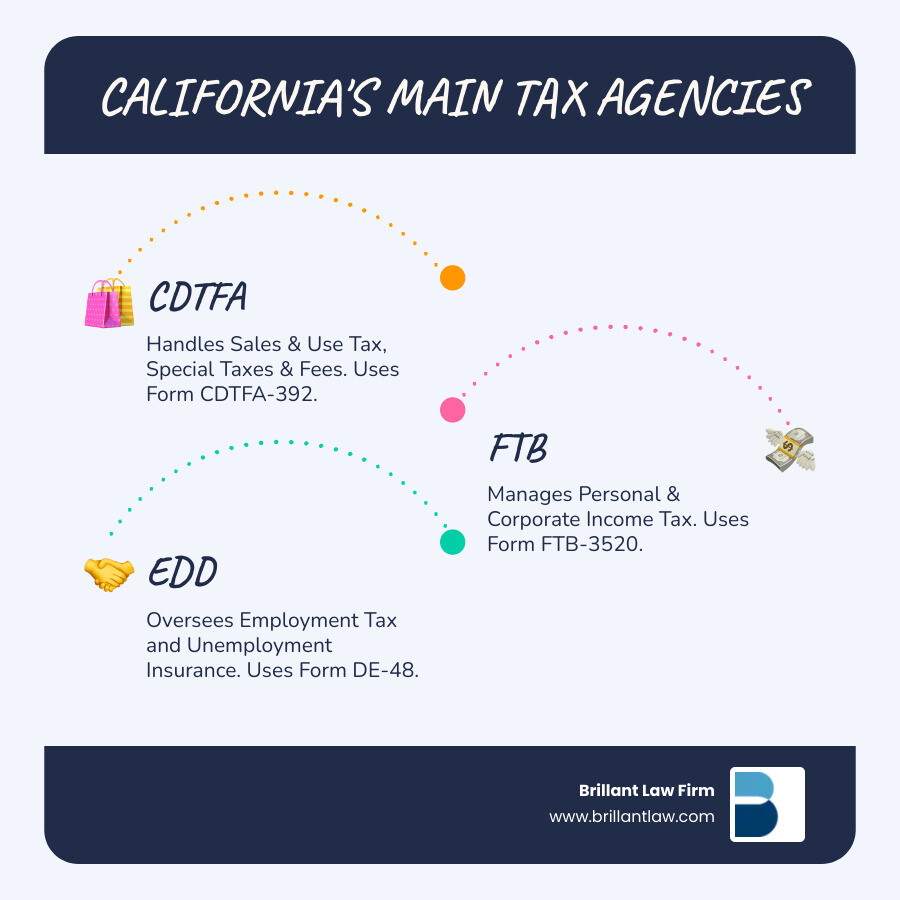
California’s three main tax agencies operate independently and require their own specific POA forms.
- The CDTFA-392 covers sales, use, and special taxes with the California Department of Tax and Fee Administration.
- The FTB 3520 (PIT for individuals, BE for businesses) handles state income tax matters with the Franchise Tax Board. The FTB also accepts modified IRS Forms 2848 and 8821. More information is available at Power of Attorney | FTB.ca.gov.
- The EDD DE 48 manages employment-related tax issues with the Employment Development Department.
Each form is generally valid for six years or until revoked. None require notarization but must be signed by an authorized individual. If your business deals with multiple tax types, you will likely need multiple POA forms to ensure proper representation with each agency.
Frequently Asked Questions about the CDTFA Power of Attorney
Here are answers to common questions about the california department of tax and fee administration power of attorney (CDTFA-392).
Do I need a lawyer to file a CDTFA Power of Attorney?
No, you can file a CDTFA Power of Attorney yourself. The form is designed for self-completion.
However, for complex tax situations, audits, or disputes with the CDTFA, consulting a Taxation Lawyer is invaluable. A qualified tax attorney ensures your POA is correctly prepared for your specific situation and can represent you effectively during audits or appeals.
Attorney fees in California can range from $350 to over $1,000 per hour, depending on the case’s complexity. The potential savings in tax liabilities, penalties, and peace of mind often justify the investment. At Brillant Law Firm, we provide bespoke strategies custom to our clients’ unique situations.
Does the CDTFA-392 form need to be notarized?
No, notarization is not required for the CDTFA-392 form. The CDTFA relies on the legal declaration you make under penalty of perjury when you sign. Only a valid signature from an authorized individual is necessary, which simplifies the process.
Can I authorize more than one person on a single CDTFA POA?
Yes. Form CDTFA-392 allows you to appoint multiple representatives. This is helpful for businesses or complex tax situations. You can specify if they can act independently or must act together, giving you control over how your team operates.
If you don’t specify, they generally have the authority to act independently. We often recommend clients clearly define roles and responsibilities when appointing multiple representatives to prevent confusion and protect their interests.
Navigating Your California Tax Obligations

Navigating California tax obligations can be complex. While this guide covers the california department of tax and fee administration power of attorney, real-world tax situations often present challenges that a form alone cannot solve.
A simple sales tax question can evolve into a matter involving multiple jurisdictions or audit triggers. That’s where professional guidance becomes essential.
Tax compliance in California involves an intricate web of sales, use, special, and district taxes. When facing an audit, significant liabilities, or appeals, the stakes are much higher than a simple form. Complex cases require an expert who understands the forms and the agency processes behind them. An experienced IRS Audit Attorney brings that same level of expertise to state-level challenges.
While you can complete a california department of tax and fee administration power of attorney on your own, complex issues often require professional guidance. At Brillant Law Firm, we’ve seen clients get into deeper trouble by trying to handle sophisticated CDTFA matters themselves.
Our team provides bespoke strategies for California taxpayers. We understand every client’s situation is unique and don’t use one-size-fits-all solutions. Whether you’re dealing with multi-state sales tax compliance, a CDTFA audit, or an appeal, our expertise can handle the most complex scenarios.
For a comprehensive review of your case and to ensure your rights are protected, contact a California Tax Attorney. We are located in California and understand the nuances of state tax law that can make or break your case.


