

The Tax Debt Burden: Finding Relief in 2025
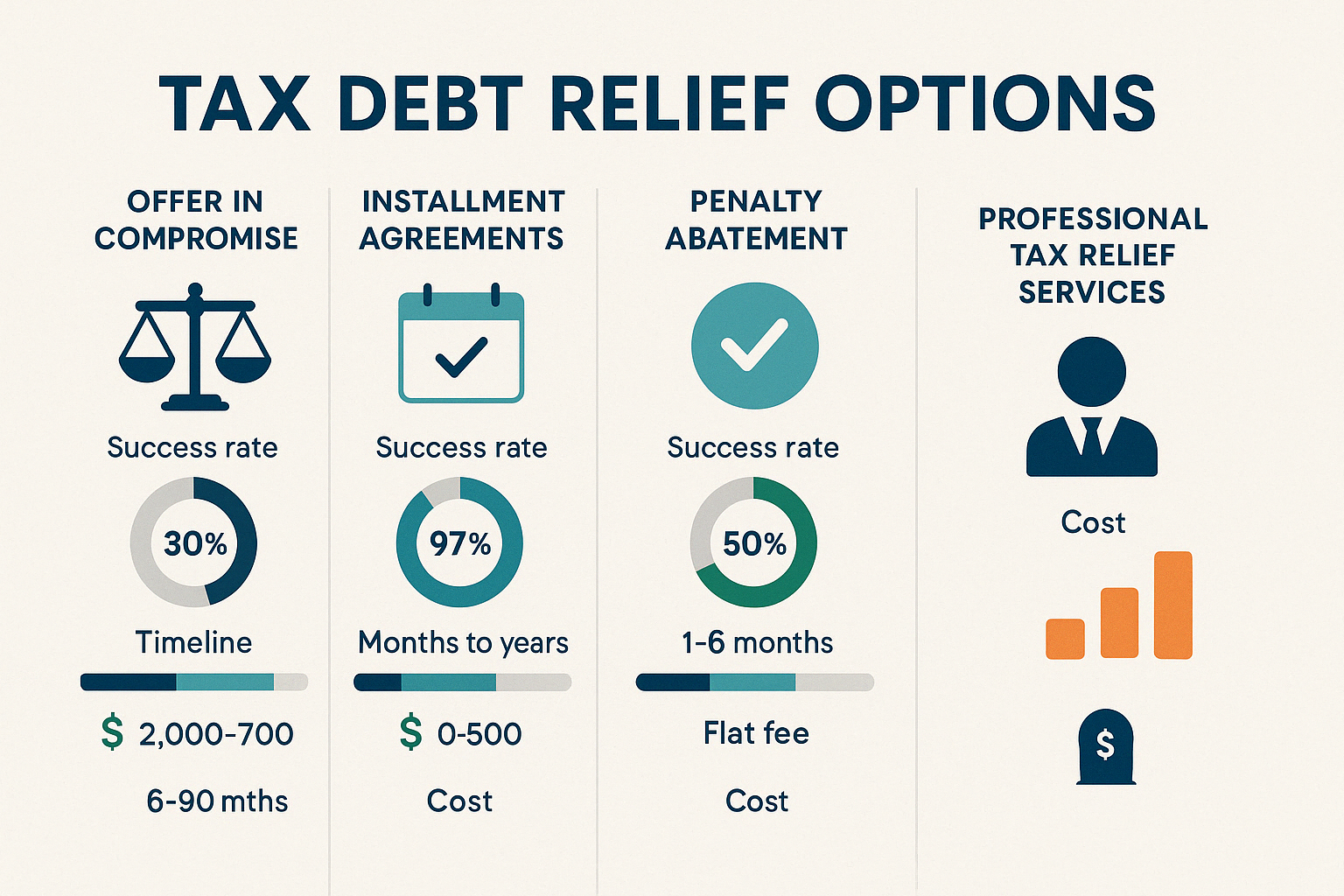
If you’re searching for the best tax debt relief options, here’s a quick overview of top solutions:
- Offer in Compromise – Settle your tax debt for less than the full amount (success rates vary)
- Installment Agreements – Set up monthly payment plans with the IRS
- Penalty Abatement – Request removal of penalties based on reasonable cause
- Currently Not Collectible Status – Temporary relief during financial hardship
- Professional Tax Relief Services – Expert representation for complex cases
More than 11.3 million Americans were behind on their federal taxes at the end of 2024, facing mounting interest, penalties, and the stress of IRS collection actions. The good news? Several legitimate tax relief options exist that can help reduce or manage your tax debt.
The IRS offers multiple programs designed to help taxpayers resolve their outstanding liabilities, from payment plans that spread your debt over time to settlement options that may reduce what you owe. Understanding which option best fits your situation is crucial for effectively addressing tax debt.
While you can attempt to negotiate with the IRS directly, many taxpayers find that professional representation significantly improves their outcomes, especially for complex cases or larger debts. However, it’s important to be cautious of predatory tax relief companies that charge excessive fees and make unrealistic promises.
I’m David Brillant, a Certified Specialist in Estate Planning, Trust and Probate Law with a Masters in Taxation who has helped numerous clients achieve the best tax debt relief outcomes through strategic negotiation with tax authorities throughout California. My experience includes successfully resolving complex tax debt cases and securing favorable settlements with the IRS and state tax agencies.
Exploring the Best Tax Debt Relief Options for Californians
If you’re a California taxpayer struggling with tax debt, you’re facing a unique challenge. Unlike residents of other states, you’re navigating not just the IRS maze but also the California Franchise Tax Board (FTB), Employment Development Department (EDD), and California Department of Tax and Fee Administration (CDTFA). This multi-layered tax system makes finding the best tax debt relief solutions especially critical for Californians.
Let’s walk through your most effective options to help you breathe easier and regain financial control:
Offer in Compromise: Settling Your Tax Debt for Less
Think of an Offer in Compromise (OIC) as the crown jewel of tax relief programs. It allows qualifying taxpayers to settle their tax debt for significantly less than what they actually owe – sometimes pennies on the dollar.
When you submit an OIC, you’re essentially saying to the IRS, “Here’s what I can realistically pay based on my financial situation.” The IRS then evaluates your ability to pay by looking at your income, expenses, assets, and future earning potential.
To qualify, you’ll need to demonstrate one of these situations:
– You truly cannot pay the full amount (Doubt as to Collectibility)
– You have legitimate reasons to believe you don’t actually owe the tax (Doubt as to Liability)
– Paying would create extreme economic hardship or would be fundamentally unfair (Effective Tax Administration)
As Greg Hudgins, CPA, wisely cautions: “What I’ve seen with some of these companies that talk about, oh, we’ll settle your debt for pennies on the dollar, is that they’re charging someone who’s already in a bit of a predicament.” This highlights why working with a reputable California tax professional matters.
The application process requires careful preparation:
1. Complete Form 656 and Form 433-A (individuals) or 433-B (businesses)
2. Pay the $205 application fee (waived for qualifying low-income taxpayers)
3. Make your initial payment
4. Provide comprehensive documentation of your finances
“The IRS generally approves an offer in compromise when the amount offered represents the most they can expect to collect within a reasonable period.” With approval rates around 40%, success largely depends on how thoroughly you prepare your application.
Before diving in, check your eligibility using the Offer in Compromise Pre-Qualifier Tool.

Installment Agreements: Spreading Out Your Payments
Installment Agreements are the workhorses of tax relief – straightforward, accessible, and practical. They allow you to break down your tax mountain into manageable monthly molehills.
For smaller debts under $100,000 that you can pay within 180 days, a Short-term Payment Plan might be perfect. There’s no setup fee if you pay electronically, though penalties and interest continue until you’re paid up.
For larger debts requiring more time, you have two Long-term Payment Plan options. The Direct Debit version costs $31 to set up online ($107 by phone or mail) and automatically withdraws payments from your bank account. The Non-Direct Debit option costs $149 online ($225 by phone or mail) but gives you control over making manual payments.
Good news for Californians facing financial hardship: setup fees can be reduced to $43 if you qualify as low-income.
Your monthly payment typically equals your total tax debt divided by the number of months in your agreement (maximum 72 months). But be aware – the IRS might require higher payments based on your disposable income.
“Installment agreements are often the most accessible form of tax debt relief,” I explain to my California clients. “They don’t require proving financial hardship like an OIC does, making them a reliable option for most taxpayers who simply need more time to pay.”
Penalty Abatement: Reducing Penalties and Interest
Those IRS penalties for late filing and payment can inflate your tax debt by 25% or more. Penalty Abatement offers a way to potentially wipe these penalties away.
If you’ve been a good taxpayer for the past three years with no penalties, you might qualify for First-Time Penalty Abatement. You’ll need to have filed all required returns (or extensions) and paid or arranged to pay any tax due.
For situations beyond your control, Reasonable Cause Abatement might help. Perhaps a natural disaster struck California, you suffered a serious illness, or you couldn’t obtain essential records. If you can show you exercised “ordinary business care and prudence” but still couldn’t meet tax obligations, the IRS may waive penalties.
In some cases, Statutory Exception Abatement applies based on specific tax code provisions or IRS administrative waivers.
One of my recent California clients illustrates penalty abatement’s power: A small business owner in Walnut Creek faced over $18,000 in penalties after a medical emergency prevented timely filing. Through a reasonable cause abatement request, we eliminated all penalties, reducing their tax debt by nearly 30%.
Currently Not Collectible Status: Temporary Financial Hardship Relief
When you’re truly struggling to keep the lights on, Currently Not Collectible (CNC) status offers breathing room. This designation tells the IRS to temporarily pause collection activities while you get back on your feet.
To qualify, you must prove paying your tax debt would prevent you from covering basic living expenses. The IRS will review your situation periodically (usually yearly) to see if your finances have improved.
While collection activities pause, a few things continue: the 10-year statute of limitations clock keeps ticking, penalties and interest keep accumulating, and the IRS may file a Notice of Federal Tax Lien to protect its interests.
The process requires completing Form 433-A or 433-F with detailed documentation of your income and expenses. You’ll need to demonstrate that after paying necessary living expenses, there’s simply nothing left to pay your tax debt.
“CNC status can provide critical breathing room for taxpayers in genuine financial distress,” I often tell my California clients. “It’s not forgiveness, but it can prevent aggressive collection actions while you work to improve your financial situation.”
Choosing the Best Tax Debt Relief Strategy
Figuring out how to tackle your tax debt can feel like standing at a crossroads without a map. What works beautifully for your neighbor might be completely wrong for you. That’s why finding the best tax debt relief strategy isn’t about following a generic formula—it’s about matching the solution to your unique situation.

When I sit down with clients at our California offices, we always start by examining the complete picture of their financial life. How much do you owe? What’s your monthly income? Do you own a home with equity? Are you approaching that 10-year collection statute deadline? Have you had tax troubles before?
These questions aren’t just formalities—they’re the foundation for building your escape route from tax debt. A $5,000 tax bill requires a very different approach than a $50,000 debt. Similarly, a stable income opens doors that might remain closed if you’re between jobs.
Handling Tax Debt Independently: Pros and Cons
Many Californians initially try the DIY approach to tax debt. For straightforward situations with modest amounts owed, this path can work well.
The advantages are clear: you’ll save on professional fees, communicate directly with the IRS, and maintain complete control over your case. If you owe a relatively small amount and qualify for a streamlined installment agreement, the process can be surprisingly straightforward.
However, going it alone comes with significant risks. Tax law is notoriously complex, and what seems like a simple form can contain pitfalls for the uninitiated. I’ve seen well-intentioned people accidentally disclose information that weakened their negotiating position or agree to payment terms that were financially unsustainable.
“The system isn’t designed to help you pay the least amount possible,” a former IRS collection officer once told me. “It’s designed to collect as much as possible.”
If you’re determined to handle things yourself, resources like How to Settle Your Debt with the IRS on Your Own can provide valuable guidance. Just be prepared for a steep learning curve and be meticulous about deadlines and documentation.
Engaging Tax Relief Professionals: Maximizing Your Outcome
For many Californians—especially those with complex financial situations or substantial tax debts—professional representation can be a game-changer. Think of it as the difference between representing yourself in court versus having an experienced attorney by your side.
Tax attorneys bring several powerful advantages to the table. First, we understand the nuances of tax law and relief programs that aren’t obvious from reading the IRS website. We know which arguments resonate with tax authorities and which fall flat. And perhaps most importantly, we provide attorney-client privilege—a level of confidentiality that other tax professionals simply cannot offer.
I remember working with a restaurant owner from San Francisco who had tried negotiating with the IRS for months without success. After reviewing his case, I identified a reasonable cause argument for penalty abatement that hadn’t been presented properly. We resubmitted with the right documentation and eliminated over $32,000 in penalties.
Professional representation becomes particularly valuable when:
- Your tax debt exceeds $25,000
- You own a business with payroll tax issues
- You haven’t filed returns for multiple years
- You’re facing an audit or collection action
- You need protection from aggressive collection tactics
- You’re seeking an Offer in Compromise
“I spent two years trying to resolve my tax problems on my own,” shared one client from San Jose. “After bringing in Brillant Law Firm, we reached a settlement in three months for less than I thought possible.”
The right professional doesn’t just fill out forms—they develop a comprehensive strategy custom to your specific circumstances and advocate fiercely on your behalf. For more details about professional tax debt representation in California, visit our Tax Debt Attorney California page.
When it comes to tax debt, the best tax debt relief strategy isn’t about quick fixes or magic solutions—it’s about making informed decisions based on your complete financial picture with an eye toward long-term stability.
Safeguarding Against Tax Relief Scams
Unfortunately, the tax relief industry has attracted numerous scam operators who prey on vulnerable taxpayers. The Federal Trade Commission warns people to be wary of any tax relief company charging high upfront fees and making false promises.

When you’re already stressed about tax debt, the last thing you need is to fall victim to a scam that leaves you in worse financial shape. I’ve seen too many California taxpayers lose thousands of dollars to predatory companies making outlandish promises they can never fulfill.
Spotting the warning signs of tax relief scams isn’t always easy when you’re desperate for help. The most common red flags include companies that guarantee specific results with the IRS (nobody can promise this), demand large upfront payments before doing any work, or use aggressive telemarketing tactics to pressure you into quick decisions.
Be especially wary of anyone claiming to have “insider connections” at the IRS. The truth is that the IRS evaluates all cases according to established guidelines, not personal relationships. And those too-good-to-be-true promises about settling for “pennies on the dollar”? While legitimate Offers in Compromise can significantly reduce tax debt, no ethical professional can guarantee a specific percentage reduction before thoroughly analyzing your situation.
“The Federal Trade Commission warns people to be wary of any tax relief company charging high upfront fees and making false promises.”
I recently worked with a San Francisco family who had previously paid $8,500 to a national tax relief company that promised to reduce their $65,000 tax debt by 90%. After taking their money, the company simply filed basic forms and disappeared when the IRS rejected their application. This scenario plays out all too often across California.
Legitimate tax professionals will always be transparent about their process and fees. We’ll explain what we’re doing, why we’re doing it, and what realistic outcomes you might expect based on your specific circumstances. There’s no secret formula – just knowledge of tax law and experience navigating the system.
If you believe you’ve encountered a tax relief scam, don’t stay silent. Report it to the Federal Trade Commission, the California Attorney General’s office, or the Taxpayer Advocate Service. Your report could help protect other vulnerable taxpayers from falling into the same trap.
The best tax debt relief comes from working with established professionals who have verifiable credentials and a local presence in your community. At Brillant Law Firm, we’ve built our reputation throughout California on transparency, ethical practices, and delivering real results for our clients. We don’t need flashy promises – our work speaks for itself.
Why Brillant Law Firm is the Best Choice for Tax Debt Relief in California
When you’re drowning in tax debt, finding the right lifeline can make all the difference. Here in California, where tax issues can be particularly complex due to our multi-layered state and federal tax systems, having knowledgeable representation isn’t just helpful—it’s essential.

At Brillant Law Firm, we understand the sleepless nights, the unopened mail, and the constant worry that comes with tax debt. That’s why we’ve built our practice around providing Californians with relief that’s not just temporary, but transformative.
What makes us different? It starts with our deep roots in California tax law. While many firms spread themselves thin across multiple states, we focus exclusively on helping California taxpayers steer both federal and state tax systems. This specialized focus means we understand the unique challenges faced by residents in Walnut Creek, Saranap, San Miguel, Castle Hill, and throughout the Golden State.
Our founder, David Brillant, brings exceptional credentials to your tax issues. With a Master’s in Taxation and certification as a Specialist in Estate Planning, Trust and Probate Law, he approaches tax problems with a level of expertise that general practitioners simply can’t match. This advanced training allows us to identify opportunities and solutions that others might miss.
Personalized strategies are at the heart of our approach. We know that cookie-cutter solutions don’t work when it comes to tax debt. That’s why we begin with a thorough analysis of your specific financial situation, identifying the unique factors that will influence your case. Whether you’re a small business owner facing payroll tax issues or an individual dealing with years of unfiled returns, we tailor our approach to your circumstances.
“After working with three different tax resolution companies, I finally found Brillant Law Firm,” shares Maria, a small business owner from San Miguel. “The difference was night and day. Instead of vague promises, they gave me a clear roadmap for resolving my $160,000 tax debt—which we ultimately settled for less than $30,000. Their expertise was truly the best tax debt relief I could have hoped for.”
When you work with us, you gain a shield between yourself and aggressive tax collectors. We handle all communications with the IRS and state tax authorities, giving you breathing room to focus on your life and business while we work toward resolution. Our clients repeatedly tell us that this relief from constant tax authority pressure is invaluable.
We believe in transparency, especially when it comes to fees. Unlike firms that lure clients with unrealistic promises only to hit them with hidden charges, we explain our fee structure clearly from the start. We understand that if you’re facing tax debt, the last thing you need is financial surprises.
Our process begins with a comprehensive consultation where we listen to your story and evaluate your options. From there, we develop a customized strategy that might include analyzing relief program eligibility, preparing documentation, negotiating with authorities, representing you in appeals, and providing ongoing compliance guidance.
The results speak for themselves. One recent client came to us with over $200,000 in combined IRS and California Franchise Tax Board debt accumulated over a decade. Through careful analysis and negotiation, we secured an Offer in Compromise that reduced his total obligation by more than 75%. More importantly, we helped him implement systems to prevent future tax problems.
For Californians seeking the best tax debt relief options, Brillant Law Firm offers the rare combination of specialized expertise, personal attention, and proven results needed to resolve even the most challenging tax situations. Learn more about our approach at California IRS Tax Attorney.
Tax debt doesn’t have to define your financial future. With the right guidance, even the most overwhelming tax problems can be resolved—often more favorably than you might expect. That’s not just what we believe; it’s what we prove, case after case, for clients throughout California.
Frequently Asked Questions about Best Tax Debt Relief
What is the best tax debt relief option for my situation?
Finding the best tax debt relief option feels a bit like trying to find the perfect pair of shoes – what works beautifully for one person might be completely wrong for another. Your ideal solution depends entirely on your unique financial circumstances.
If you’re struggling with a tax debt that seems impossible to pay in full and have limited assets or income, an Offer in Compromise might be your best path forward. This option allows you to settle your debt for less than the full amount – sometimes significantly less.
For many Californians, an Installment Agreement provides the breathing room needed to address tax debt over time. These payment plans are particularly helpful when you can manage regular payments but need them spread out to make them affordable.
If penalties make up a substantial portion of your tax bill, don’t overlook Penalty Abatement. This often-underused option can eliminate or reduce penalties if you qualify based on reasonable cause or first-time status. I’ve seen cases where this approach alone reduced a client’s tax debt by 25% or more.
And for those experiencing genuine financial hardship, Currently Not Collectible Status can provide temporary relief while you get back on your feet. This status pauses collection activities while you’re unable to pay.
At Brillant Law Firm, we don’t believe in one-size-fits-all solutions. We carefully analyze your complete financial picture to determine which option – or often, which combination of options – will provide the most favorable outcome for your specific situation.
How can I determine if I am eligible for an Offer in Compromise?
Eligibility for an Offer in Compromise (OIC) involves several important factors that the IRS considers carefully. Think of it as applying for a particularly demanding scholarship – there are specific requirements you must meet before your application even gets considered.
First, you need to be current with your tax filing obligations – all required tax returns must be filed. The IRS won’t consider an OIC if you haven’t filed all required returns. Similarly, you must be current with estimated tax payments if you’re self-employed, or your tax withholding if you’re an employee.
The heart of the OIC process is the financial evaluation. The IRS takes a deep dive into your finances, examining your income, expenses, asset equity, and future earning potential. They use this information to calculate your “Reasonable Collection Potential” (RCP) – essentially determining how much they believe you can reasonably pay.
This calculation includes your monthly disposable income (multiplied by either 12 or 24 months, depending on your payment plan) plus the value of your assets after applicable deductions. The result becomes the minimum acceptable offer amount.
For a quick initial assessment, the Offer in Compromise Pre-Qualifier Tool can be helpful. But I always caution clients that this tool provides only a basic evaluation – it’s like trying to diagnose a medical condition with an online symptom checker. For an accurate determination, you really need a tax attorney who can analyze your complete financial picture.
“One key mistake we often see is taxpayers underestimating the complexity of the OIC process,” I tell clients. “The IRS scrutinizes these applications with remarkable attention to detail, and even small errors or omissions can lead to rejection.”
How does working with Brillant Law Firm provide the best tax debt relief solution?
When you’re facing tax debt in California, working with Brillant Law Firm is like having a skilled navigator when you’re lost at sea. We don’t just help you find your way – we chart the optimal course to get you safely to shore as quickly as possible.
Our approach begins with a comprehensive evaluation of your case. We thoroughly analyze your financial situation and tax history to identify all available relief options. This isn’t a cursory glance – we dig deep to understand the full picture of your finances and tax situation.
We also know exactly what documentation the IRS requires and how to present it most effectively. This might sound simple, but it’s actually where many taxpayers stumble. The IRS has specific expectations for how information should be presented, and meeting these expectations can significantly improve your chances of success.
Our experience with thousands of tax cases gives us valuable insight into what arguments and approaches work best with tax authorities. We’ve seen what works and what doesn’t, and we apply these lessons to every case we handle.
Once you retain our services, we can request holds on collection activities while we work toward resolution. This alone provides immediate relief from the stress of IRS notices and collection attempts.
Beyond immediate relief, we help you implement strategies to prevent future tax problems. We view our role not just as solving your current problem, but helping ensure you don’t face similar issues down the road.
Our fees typically range from $3,500 to $7,500 for tax debt resolution cases, depending on complexity. While this represents an investment, our clients typically save many times this amount through reduced tax liabilities, eliminated penalties, and favorable payment terms.
“What distinguishes our approach is that we don’t just file paperwork—we build comprehensive cases that address the specific concerns the IRS will have about your situation,” I often explain to clients. “This strategic approach significantly increases approval rates for relief programs.”

Conclusion
Facing tax debt can feel like carrying a mountain on your shoulders, but I’ve seen how the right approach can transform this burden into manageable steps toward financial freedom. The best tax debt relief solution isn’t a one-size-fits-all answer—it’s the strategy that addresses your unique financial situation while shielding you from aggressive collection actions.
For California taxpayers especially, navigating the complex web of both federal and state tax issues requires specialized knowledge. The dual layers of IRS requirements plus California’s FTB, EDD, and CDTFA regulations create a particularly challenging landscape that benefits from local expertise.
As you consider your next steps, remember these crucial points:
Time is truly of the essence when dealing with tax debt. Every day that passes typically means more penalties and interest adding to your balance. What starts as a manageable amount can quickly snowball into something much more daunting.
Before diving into any solution, take the time to understand all available relief options. An Offer in Compromise might seem appealing, but an Installment Agreement or Currently Not Collectible status might actually serve you better depending on your circumstances.
Please be careful about those late-night TV commercials promising to settle your tax debt for “pennies on the dollar.” If something sounds too good to be true in the tax relief world, it usually is. Legitimate professionals will be transparent about what’s possible for your situation.
For complex cases or substantial tax debts over $10,000, professional representation often pays for itself many times over. Not just in the money saved, but in the stress avoided and time reclaimed that would otherwise be spent navigating bureaucratic mazes.
And once your tax debt is successfully resolved, implementing proper tax planning is like installing a good security system—it helps prevent you from finding yourself in the same situation again.
Taking that first step toward resolving tax debt often feels like the hardest part. Whether you choose to handle your case independently or seek professional guidance, addressing the situation head-on is infinitely better than hoping it will magically disappear (trust me, the IRS has a very long memory).
For California taxpayers looking for expert guidance with tax debt relief, I invite you to learn more about our approach at IRS Tax Relief Attorneys. We’ve helped countless clients throughout California transform their tax nightmares into manageable solutions.
By taking action today, you begin a journey toward reclaiming your financial peace of mind. Tax debt doesn’t have to define your future—with the right strategy and support, you can move beyond these challenges and look forward with genuine confidence. The path to tax relief starts with a single step, and you don’t have to walk it alone.


