

Attorney Negligence: 4 Pillars to Justice
Why Attorney Negligence Matters More Than You Think
Attorney negligence occurs when a lawyer fails to meet the professional standard of care, causing financial harm to their client. It’s crucial to understand this concept, as a disappointing legal result is not the same as actual professional negligence.
To prove negligence, you must establish four key elements:
- Duty: An attorney-client relationship existed.
- Breach: The lawyer failed to meet professional standards.
- Causation: The breach directly caused your financial loss.
- Damages: You suffered a quantifiable loss.
Common examples include missing critical deadlines, failing to investigate key evidence, representing conflicting interests, or misappropriating client funds. When an attorney’s negligence violates the trust a client places in them, the consequences—lost cases, missed opportunities, and significant financial damages—can be devastating.
As David Brillant, a California Certified Specialist in Estate Planning, Trust and Probate Law with a Masters in Taxation, I’ve seen how attorney negligence can undermine a client’s financial future. My experience in complex litigation shows that understanding these concepts is essential for protecting your interests.
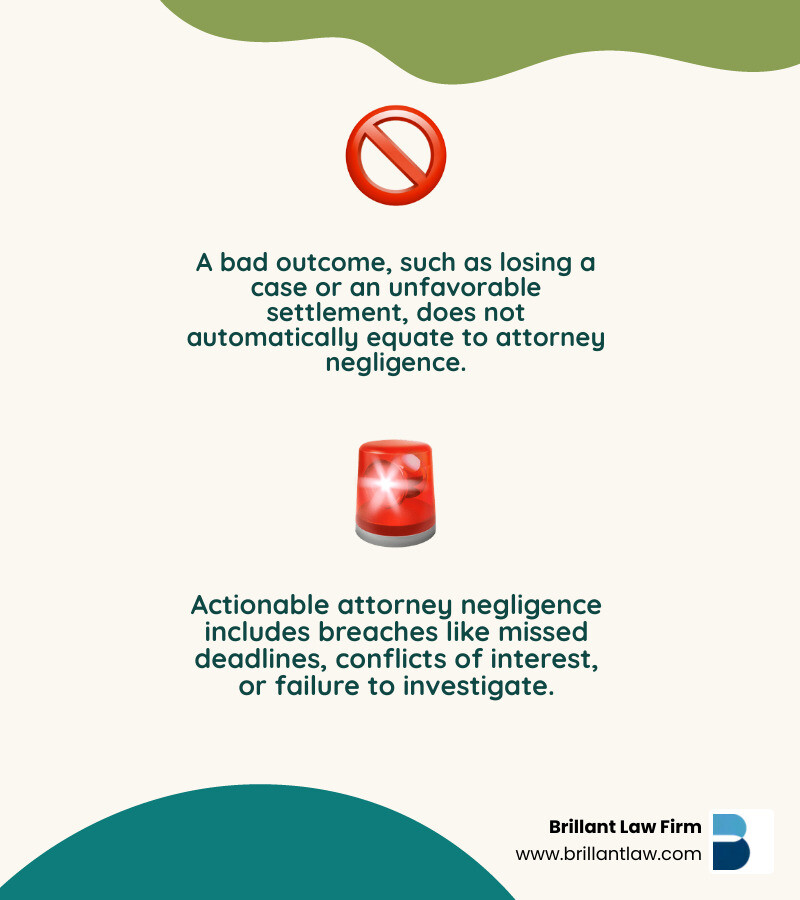
Quick look at attorney negligence:
What is Attorney Negligence? (Defining the Core Concept)
When you hire an attorney, you trust them to handle your case with competence. Attorney negligence, or legal malpractice, occurs when a lawyer fails to provide the level of service that a reasonably competent attorney would under similar circumstances. It’s not just any mistake, but an error so significant that it falls below the accepted professional standard and causes real harm.
Legal malpractice can involve a breach of fiduciary duty (acting in their own interest), a breach of contract (failing to perform agreed-upon services), or, most commonly, falling below the professional standard of care. The concept of attorney liability has evolved, as detailed in works like The Attorney’s Liability for Negligence from the Vanderbilt Law Review.
The “Standard of Care” in California
In California, the standard of care is the backbone of a negligence claim. Attorneys must use the knowledge, skill, and diligence that other reasonably competent lawyers would in similar situations. This standard is higher for those who present themselves as specialists in a field like estate planning or tax law.
The California Rules of Professional Conduct provide guidance on professional behavior, and while a violation doesn’t automatically prove malpractice, it can be strong evidence of a breach. This standard does not, however, guarantee a specific result. Competent attorneys can make reasonable errors in judgment without being negligent.
Distinguishing Negligence from a Bad Outcome
Losing a case or getting an unfavorable settlement does not automatically mean your attorney was negligent. Legal outcomes depend on many factors. The key difference is whether your attorney’s conduct fell below professional standards.
If your lawyer made fundamental errors that a competent attorney would not have—like missing deadlines or failing to investigate key evidence—that may be negligence. The question isn’t whether you won or lost, but whether your attorney’s substandard performance caused preventable harm. Client dissatisfaction alone is not enough; you must prove a breach of duty based on professional standards.
Understanding this distinction is essential because attorney negligence claims require proving not just that something went wrong, but that your lawyer’s substandard performance directly caused your damages.
The Four Pillars of a Legal Malpractice Claim
A successful legal malpractice claim in California rests on four essential pillars. If you cannot firmly establish all four, your case will fail. Understanding these elements is crucial before pursuing a claim.

The first pillar is Duty: you must prove an attorney-client relationship existed.
The second is Breach: you must show your attorney fell below the professional standard of care.
The third, Causation, is often the most difficult. You must demonstrate a direct link between the attorney’s error and your harm, typically using the “but-for” test.
The final pillar is Damages. You must prove you suffered an actual, quantifiable financial loss.
All four elements are interconnected and must be supported by credible evidence. At Brillant Law Firm, we often see cases where a client was wronged, but the attorney’s mistake didn’t legally cause the financial loss. Evaluating these four pillars upfront helps determine if an attorney negligence claim is viable.
1. Attorney-Client Relationship (Duty)
The first pillar of an attorney negligence claim is proving an attorney-client relationship existed, which creates a legal duty of care.
This relationship is most often established with a formal retainer agreement or engagement letter, which outlines the lawyer’s responsibilities. However, a signed contract isn’t always necessary. In California, a duty can arise implicitly if a person reasonably believes an attorney is representing them and the attorney provides specific legal advice or acts on their behalf.
The scope of representation is also critical. An attorney’s duty is limited to the matters they agreed to handle. If you hired a lawyer for a will, they are not liable for a separate legal issue they were not retained for. Clear communication about professional obligations is essential to define the boundaries of the relationship and ensure accountability.
2. Breach of the Standard of Care (Negligence)
Once an attorney-client relationship exists, the lawyer must represent you competently. The second pillar of a malpractice claim is proving the attorney breached this duty by falling below the professional standard of care.
This isn’t about perfection; minor mistakes are not malpractice. A breach of duty involves a significant failure, such as failing to act when required (e.g., missing a deadline) or making significant errors in legal work (e.g., misinterpreting a key statute). The core question is whether a reasonably prudent attorney in the same situation would have acted differently and prevented the harm.
Incompetence can include failing to understand basic legal principles or not conducting adequate research. If you’re curious about what proper representation in a lawsuit looks like, our guide on the litigation process offers valuable insights. More info about the litigation process. The standard is not whether you won or lost, but whether your attorney provided competent professional service.
3. Causation (The “But-For” Test)
Proving your lawyer made a mistake isn’t enough; you must also prove their error caused your harm. This is the third pillar, causation, and it’s often the most challenging part of an attorney negligence case.
The standard used is the “but-for” test: But for your attorney’s negligence, would you have achieved a better outcome? This requires you to essentially re-litigate your original case within the malpractice lawsuit, a process known as a “trial-within-a-trial.”
For example, if your attorney missed a filing deadline that led to your case being dismissed, you must prove that the original case was strong and you likely would have won a favorable settlement or verdict. You have to prove the underlying case had merit to show the missed deadline actually cost you something. This concept is complex, as discussed in legal scholarship. Legal Malpractice Damages in a Trial Within a Trial
You must also prove the error was a proximate cause of your loss, meaning the harm was a reasonably foreseeable result of the negligence. This high standard is why many potential malpractice cases fail, even when an attorney’s error seems obvious.
4. Actual Damages (Harm)
The final pillar of an attorney negligence case is proving you suffered actual, measurable harm. Without quantifiable damages, you may have a complaint for the State Bar, but not a viable malpractice lawsuit. The goal of a lawsuit is to compensate you for your losses.
- Financial losses are the core of most claims. This includes money you would have recovered, such as a lost settlement or judgment.
- Lost opportunities, like a business deal that fell through due to an attorney’s delay, can also be valid damages, though they may require expert testimony to value.
- Attorney’s fees paid to the negligent lawyer for the mishandled work are often recoverable.
In California, emotional distress damages are rarely available in legal malpractice cases unless the attorney’s conduct was egregious or caused physical harm. Similarly, punitive damages, meant to punish the wrongdoer, are reserved for cases of fraud or malice, not simple negligence. Proving damages often requires reconstructing your original case to show what you would have gained with competent representation.
Common Scenarios of Attorney Negligence
Attorney negligence often falls into predictable patterns. Recognizing these common scenarios can help you identify when your legal representation has gone wrong. Most cases involve procedural blunders, substantive legal mistakes, or ethical violations.
Procedural and Administrative Errors
These are often the most frustrating errors because they are typically preventable. Missed deadlines are a dominant cause of malpractice claims. Failing to file a lawsuit before the statute of limitations expires can be catastrophic. In California, the attorney malpractice statute of limitations is very strict, typically just one year from findy.
Filing errors, such as using incorrect forms or filing in the wrong court, can also lead to dismissals. Even simple clerical mistakes can have major consequences, ranking as a leading cause of malpractice claims according to industry surveys. Ames & Gough’s 12th annual survey results
Substantive Legal Errors
These errors go to the heart of legal competence. They include an attorney’s failure to know or apply the law correctly, presenting flawed legal arguments, or conducting an inadequate investigation. A competent attorney should gather evidence, interview witnesses, and know when to hire necessary experts for complex issues.
Ethical and Fiduciary Breaches
These violations break the fundamental trust in the attorney-client relationship. An attorney owes you a “fiduciary duty” to act in your best interest.
- Conflicts of interest: Representing clients with opposing interests without proper consent is a serious ethical breach. California Rules of Professional Conduct on Conflicts
- Breach of confidentiality: Revealing your private information without permission.
- Misappropriation of client funds: Improperly handling money in trust accounts is one of the most severe violations.
- Failure to communicate: Not keeping you informed about settlement offers or major case developments is a violation of professional duties. California Rules on Client Communication
The Complexities of Proving Your Case
Proving attorney negligence is complex because you must demonstrate what would have happened if your attorney had acted competently. The burden of proof is on you, and strong documentation of every communication and error is your lifeline.

The “Trial-Within-a-Trial” Explained
Most malpractice cases require a “trial-within-a-trial.” You must recreate your original case to prove you would have won and show how much you would have recovered. This means presenting the original evidence and witnesses, often years later when memories have faded and evidence may be lost. California courts have consistently upheld this high standard, as seen in cases like Viner v. Sweet. Viner v. Sweet. It ensures claims are based on actual losses, not just disappointment.
The Crucial Role of Expert Testimony
Expert testimony is typically essential in attorney negligence cases. A qualified legal expert is needed to:
- Establish the professional standard of care for your specific situation.
- Explain to the jury how your former attorney’s actions breached that standard.
- Connect the attorney’s mistake to your financial loss, guiding the jury through the “trial-within-a-trial.”
Choosing the right expert with deep experience in the relevant area of law is critical. What a litigation lawyer does.
Special Rules for Criminal Defense Malpractice
In California, suing a criminal defense attorney for malpractice is exceptionally difficult. You must first prove your actual innocence of the crime. This generally requires getting your conviction overturned or receiving an official pardon, as established in cases like Wiley v. County of San Diego. Wiley v. County of San Diego. Without first proving your innocence in the criminal justice system, a malpractice claim against your defense attorney will almost certainly fail, regardless of how poorly they performed.
Navigating the Aftermath and Seeking Justice
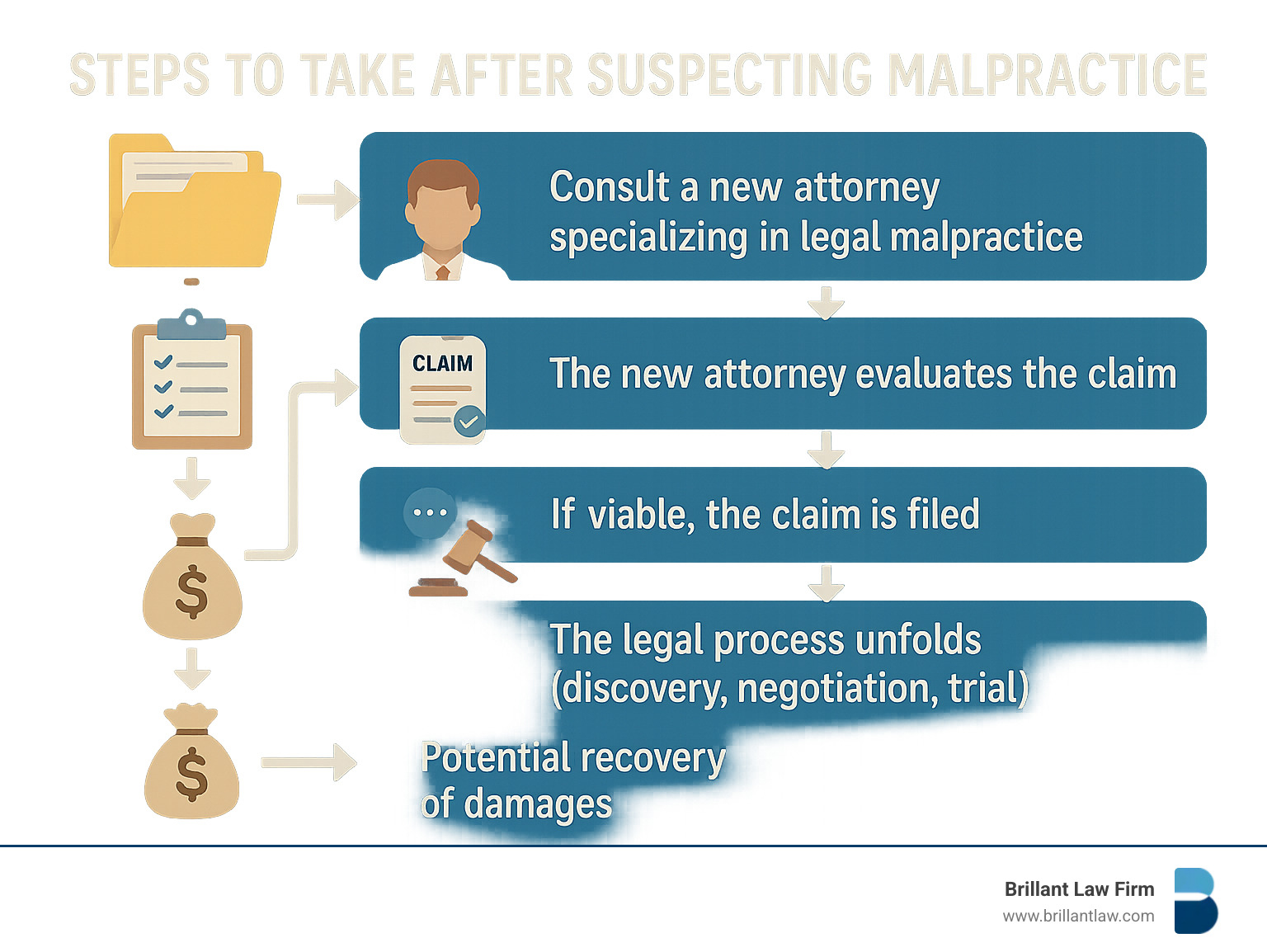
Finding your attorney may have been negligent is a frustrating betrayal of trust. While the situation is difficult, you have options for seeking justice, but you must act swiftly due to strict deadlines for attorney negligence claims.
What Damages Can You Recover?
The goal of a malpractice lawsuit is to recover your financial losses and make you whole. Recoverable damages in California primarily include:
- The value of your lost claim or defense (e.g., a lost settlement or judgment).
- Attorney’s fees you paid to the negligent lawyer.
- Consequential damages, such as penalties or interest incurred due to the error.
Emotional distress and punitive damages are rarely awarded in standard negligence cases.
Filing an Attorney Malpractice Suit
Filing a lawsuit is often the best path to recover financial losses.
- Statute of Limitations: In California, you generally have only one year from when you find the malpractice (or four years from the date of the act, whichever is first). Missing this deadline will bar your claim.
- Hiring the Right Attorney: You need a lawyer who specializes in legal malpractice. These are complex cases requiring specific expertise. Our team at Brillant Law Firm understands the intricacies of these claims. civil litigation attorney
- Costs and Fees: Malpractice cases can be expensive. Many attorneys handle them on a contingency fee basis (a percentage of your recovery). Others may bill hourly, with California attorney fees often ranging from $500 to $1,200+ per hour.
Alternatives to a Lawsuit
A lawsuit isn’t your only option.
- Reporting to the State Bar of California: This can lead to disciplinary action against the attorney but will not result in financial compensation for you. Its purpose is to protect the public.
- Fee Arbitration: A process to resolve disputes over excessive legal fees.
- Mediation: A neutral mediator can help you and your former attorney negotiate a settlement out of court, which is often faster and less costly than litigation.
Conclusion
When you hire a lawyer, you entrust them with your financial security and future. When that trust is broken by attorney negligence, the impact can be severe.
A valid malpractice claim is more than just a bad outcome; it requires proving four pillars: duty, breach, causation, and damages. Common forms of negligence include missed deadlines, inadequate investigation, conflicts of interest, and poor communication. Proving your case is complex, often requiring a “trial-within-a-trial” and expert testimony.
At Brillant Law Firm, we believe excellence is essential. Our bespoke strategies in Trusts, Estates, Taxation, Business, and Civil Litigation are built on a foundation of unwavering dedication. David Brillant’s credentials as a California Certified Specialist in Estate Planning, Trust and Probate Law, and his Masters in Taxation, exemplify the expertise needed to prevent the errors that lead to malpractice.
If you believe you are a victim of attorney negligence, time is critical. California’s statute of limitations is strict. Don’t let a lawyer’s mistake compound the harm you’ve already suffered. You deserve justice and representation that meets the highest professional standards.


