

The Importance of Understanding Business Litigation
Business Litigation can feel overwhelming, but it’s crucial for any business owner to understand. At its core, business litigation involves legal disputes that arise in a business context. These disputes can cover a wide range of issues such as contracts, employment, fraud, and more.
Here’s what you need to know about Business Litigation:
- Definition: Legal process to resolve business-related disputes.
- Common Issues: Breach of contract, employment claims, intellectual property disputes.
- Process: Includes filing complaints, findy, motions, trial, and possibly appeal.
Business disputes can heavily impact your company, both financially and operationally. They can drain resources, damage reputations, and distract from day-to-day operations.
Navigating these turbulent waters requires a clear understanding of the litigation process. Not only does it help in mitigating risks, but it also ensures a smoother handling of inevitable disputes.
I’m David Brillant, a seasoned attorney with experience in Business Litigation. I specialize in offering custom solutions that protect and advance my clients’ interests.
What is Business Litigation?
Business litigation refers to the legal process used to resolve disputes that arise in the business world. These disputes can involve a wide range of issues, from internal conflicts within a company to external disagreements with other businesses or individuals. Understanding business litigation is crucial for any business owner, as it helps in navigating conflicts and protecting the company’s interests.
Types of Business Litigation
Business litigation covers a broad spectrum of legal issues. Here are some of the most common types:
- Internal Issues: These include disputes among shareholders, partners, or employees. Examples are shareholder oppression, breach of fiduciary duty, and partnership disputes.
- External Issues: These involve conflicts with other businesses or third parties. Common cases include breach of contract, fraud, and tortious interference with business relationships.
- Employment Law Disputes: These involve issues between employers and employees, such as wage disputes, harassment claims, and wrongful termination.
- Compliance: Businesses must adhere to various laws and regulations. Non-compliance can lead to litigation involving regulatory agencies or other entities.
- Shareholder Disputes: These occur when there are conflicts among a company’s shareholders, often related to management decisions or financial distributions.
Common Business Litigation Cases
Let’s dive deeper into some of the most frequently encountered business litigation cases:
Breach of Contract
A breach of contract occurs when one party fails to fulfill their obligations as outlined in a contract. This can involve anything from not delivering goods on time to failing to pay for services rendered. Contracts are the backbone of most business relationships, so breaches can have serious repercussions.
Business Fraud
Business fraud involves deceptive practices that result in financial or other harm. Examples include falsifying financial statements, misrepresenting products or services, and embezzlement. Fraud can damage a company’s reputation and financial standing.
Wrongful Termination
Wrongful termination claims arise when an employee believes they were fired for illegal reasons, such as discrimination or retaliation. These cases often involve complex employment laws and can lead to significant financial penalties for businesses.
Insurance Disputes
Insurance disputes occur when there is a disagreement over the coverage provided by an insurance policy. This can involve claims being denied, delays in payment, or disagreements over the interpretation of policy terms. Resolving these disputes often requires a detailed understanding of the policy and relevant laws.
Whistleblower Cases
Whistleblower cases involve employees reporting illegal or unethical practices within their company. Whistleblowers are protected under various laws, and businesses can face significant penalties if found guilty of retaliation or other illegal actions.
Understanding the types of business litigation and common cases can help you better prepare for potential disputes. In the next section, we’ll explore the Business Litigation Process and outline the steps involved in resolving these conflicts.
The Business Litigation Process
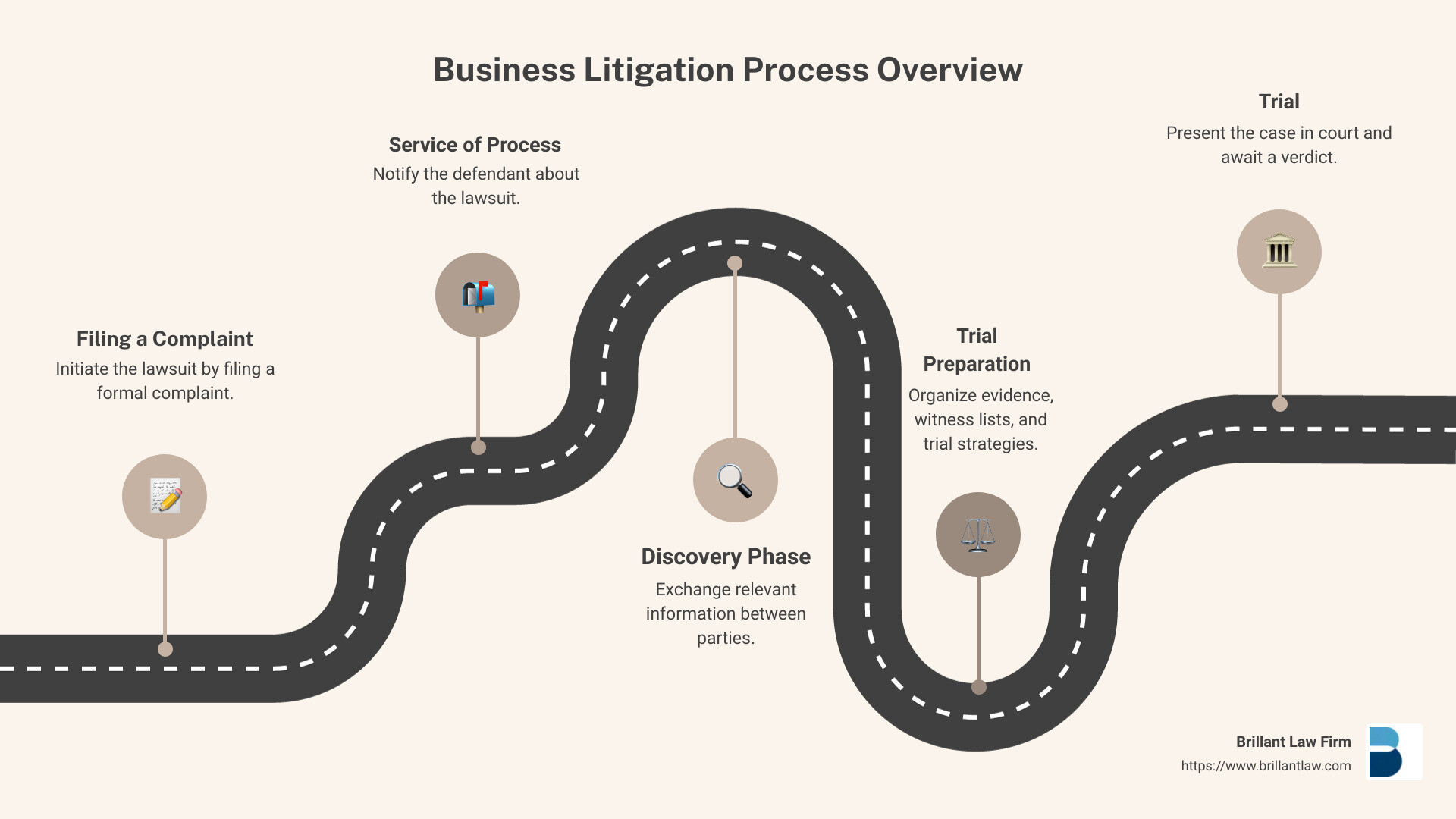
Navigating the business litigation process can feel overwhelming, but breaking it down into clear steps can help. Here’s a simplified guide to the key stages involved:
Pre-Litigation Steps
Initial Consultation and Case Evaluation: The journey begins with a consultation where you discuss your case with a lawyer. The lawyer evaluates the merits of your case, identifies potential risks, and advises on the best course of action.
Demand Letters: Before filing a lawsuit, a demand letter is often sent to the opposing party. This letter outlines the dispute and the desired resolution. It’s a formal attempt to resolve the issue without going to court.
Negotiation: If the demand letter does not resolve the issue, negotiation can be the next step. Both parties try to reach an agreement to avoid litigation. Successful negotiations can save time and money.
Filing a Lawsuit
Complaint: If pre-litigation steps fail, the next step is to file a complaint. This legal document outlines the plaintiff’s case, including the facts, legal reasons for the lawsuit, and the relief sought.
Summons and Service of Process: Once the complaint is filed, a summons is issued. The summons, along with the complaint, must be served to the defendant to notify them of the legal action and the need to respond.
Findy Phase
The findy phase is like gathering all the puzzle pieces to see the full picture of the case.
Document Requests: Both parties can request documents from each other that are relevant to the case. This can include emails, contracts, and other records.
Depositions: Depositions involve in-person questioning of witnesses under oath. Lawyers from both sides ask questions to gather detailed information.
Interrogatories: These are written questions that one party sends to the other. The receiving party must respond in writing, under oath.
Trial Preparation
Preparing for trial involves several critical steps.
Pre-Trial Motions: These are requests made to the court before the trial begins. For example, a motion to dismiss might argue that the case should not proceed due to lack of legal merit.
Settlement Discussions: Even at this stage, parties might continue to negotiate a settlement to avoid the uncertainties of a trial.
Trial Strategy: Lawyers develop a strategy based on the gathered evidence and legal arguments. This includes deciding which witnesses to call and what evidence to present.
The Trial
The trial is the final step where both sides present their case in court.
Opening Statements: Each side makes an opening statement to outline their case to the judge or jury.
Witness Testimony: Witnesses are called to testify. They provide evidence and are cross-examined by the opposing side.
Closing Arguments: After all evidence is presented, each side makes a closing argument to summarize their case and persuade the judge or jury.
Verdict: Finally, the judge or jury delivers a verdict, deciding the outcome based on the presented evidence and arguments.
Understanding these steps can help explain the business litigation process and prepare you for what lies ahead. Next, we’ll explore alternative ways to resolve disputes without going to trial.
Alternative Dispute Resolution (ADR)
When it comes to resolving business disputes, going to trial isn’t the only option. Alternative Dispute Resolution (ADR) offers other pathways like mediation and arbitration. These methods can save time, money, and stress, making them attractive alternatives to traditional litigation.
Mediation
Mediation is like having a guided conversation to resolve a dispute. In this process, a neutral mediator helps both parties discuss their issues and find a mutually acceptable solution. The mediator doesn’t make decisions but facilitates dialogue and offers potential solutions.
Benefits of Mediation
- Collaborative Negotiation: Mediation encourages both parties to work together to find a solution, which can help preserve business relationships.
- Cost-Effective: It’s generally cheaper than going to court because it involves fewer legal fees and quicker resolutions.
- Confidential: Unlike court cases, mediation is private, so sensitive business information stays under wraps.
- Flexibility: Parties have more control over the outcome and can tailor the resolution to fit their specific needs.
Drawbacks of Mediation
- Non-Binding: If the parties can’t reach an agreement, they may still end up in court.
- Voluntary: Both parties must agree to participate, which isn’t always possible.
Arbitration
Arbitration is more formal than mediation but still less so than a court trial. In this process, a neutral arbitrator (or a panel) hears both sides and makes a decision, which can be either binding or non-binding.
Benefits of Arbitration
- Less Formal: The rules of evidence and procedure are more relaxed than in court, making the process quicker and less intimidating.
- Neutral Arbitrator: Both parties agree on who will serve as the arbitrator, ensuring an impartial decision-maker.
- Binding Decisions: If the arbitration is binding, the decision is final and enforceable, reducing the chances of prolonged legal battles.
- Speed: Arbitration can often be scheduled more quickly than a court trial, leading to faster resolutions.
Drawbacks of Arbitration
- Limited Appeal: If the decision is binding, there are very few opportunities to appeal, even if you think the arbitrator made a mistake.
- Cost: While generally cheaper than litigation, arbitration can still be costly, especially if a panel of arbitrators is used.
- Imbalance of Power: If one party has significantly more resources, they may have an advantage in arbitration.
Choosing Between Mediation and Arbitration
Deciding whether to opt for mediation or arbitration depends on your specific needs and circumstances. Mediation is ideal for maintaining relationships and finding flexible solutions, while arbitration is better for obtaining a definitive and enforceable decision.
With ADR, you can often resolve disputes more amicably and efficiently. In the next section, we’ll dig into the common remedies available in business litigation, exploring what you can expect to achieve through these processes.
Common Remedies in Business Litigation
When you’re involved in business litigation, understanding the remedies available can help you know what to expect and how to proceed. Here are the common remedies you might encounter:
Compensatory Damages
Compensatory damages are designed to reimburse the aggrieved party for actual losses. Think of it as getting paid back for what you lost due to the other party’s actions. For example, if a supplier fails to deliver goods, the buyer might recover the amount paid for those goods.
Consequential Damages
Consequential damages cover losses that occur as a foreseeable result of a breach. Imagine a scenario where a delayed shipment causes you to miss a big sales opportunity. The lost profits from that missed opportunity could be claimed as consequential damages.
Punitive Damages
Punitive damages are not just about compensation; they aim to punish the wrongdoer. If the breach involved fraud or was particularly egregious, the court might award punitive damages to make an example out of the offender. These damages go beyond the actual loss suffered and are less common.
Liquidated Damages
Some contracts include a liquidated damages clause, specifying a predetermined amount to be paid if a breach occurs. This can simplify things because the amount is agreed upon in advance, avoiding lengthy disputes over the extent of the damages.
Attorneys’ Fees and Costs
In some cases, especially if the contract specifies it, the losing party might be required to pay the attorneys’ fees and costs of the winning party. This can make a big difference in deciding whether to pursue or settle a case.
Rescission
Rescission allows the parties to cancel the contract and return to their pre-contract positions. If a contract was entered into based on fraud or misrepresentation, rescission can effectively nullify the agreement, freeing both parties from their obligations.
Reformation
Reformation modifies the terms of a contract to reflect what the parties originally intended. This remedy is useful when there’s a mistake in the contract that doesn’t match the actual agreement between the parties.
Specific Performance
Sometimes, monetary damages aren’t enough. Specific performance is a remedy where the court orders the breaching party to fulfill their contractual obligations. For instance, if a rare piece of art was sold but not delivered, the court might order the seller to deliver the art rather than just pay damages.
Understanding these remedies can help you steer the complicated landscape of business litigation. Up next, we’ll address some frequently asked questions to further clarify the process and what you can expect.
Frequently Asked Questions about Business Litigation
What is the meaning of business litigation?
Business litigation refers to the legal process used to resolve disputes in the business world. These disputes can involve anything from breach of contract to intellectual property issues. When negotiation or arbitration fails, business litigation steps in to protect a company’s rights and interests through the court system.
Example: Imagine a scenario where a supplier fails to deliver goods on time, causing significant losses. Here, business litigation can help the affected company recover those losses by enforcing the contract through legal action.
What is general business litigation?
General business litigation covers a wide array of disputes that arise within a business context. These can be internal issues like shareholder disputes or external issues such as compliance violations.
Internal Issues: These often involve conflicts between shareholders or partners. For example, if one partner misappropriates funds, the other partners may need to take legal action to protect their interests.
Operations and Compliance: Businesses must comply with various laws and regulations. Failure to do so can lead to litigation. For instance, if a company violates environmental laws, it could face lawsuits from regulatory bodies or affected communities.
What is litigation risk?
Litigation risk is the potential threat of facing legal action due to a company’s actions, products, or services. This risk can come from various sources, including customers, vendors, or even shareholders.
Key Factors:
- Product/Service Issues: If a product is defective and causes harm, the company could face lawsuits from affected customers.
- Operational Risks: Mismanagement or financial discrepancies can lead to shareholder lawsuits.
- Compliance Risks: Failure to adhere to laws and regulations can result in legal action from regulatory bodies.
Risk Management: Companies often employ litigation risk analysis to identify and mitigate these risks. For example, they may conduct regular audits to ensure compliance with laws and regulations, reducing the likelihood of facing legal action.
Understanding these aspects can help you better steer the complexities of business litigation and protect your company’s interests. Next, we’ll explore alternative dispute resolution methods like mediation and arbitration to see how they can offer quicker and less costly solutions.

Conclusion
Summary
Business litigation is a complex area of law that involves resolving disputes related to business operations, contracts, and other commercial matters. Understanding the process—from pre-litigation steps to trial and potential alternative dispute resolution methods—can help you steer these challenges more effectively.
Whether dealing with breach of contract, business fraud, or shareholder disputes, knowing what to expect can make a significant difference. From initial consultations and case evaluations to the findy phase and trial preparation, each step requires careful attention and strategic planning.
Brillant Law Firm
At Brillant Law Firm, we specialize in business litigation and offer comprehensive services to address a wide range of legal issues. Our team of skilled attorneys is experienced in handling everything from internal disputes and compliance issues to complex shareholder disagreements and employment law disputes.
We pride ourselves on providing pragmatic and straightforward solutions custom to your specific needs. Our goal is to protect your business interests and achieve the best possible outcomes, whether through negotiation, mediation, arbitration, or trial.
Contact Information
If you have a business dispute and need expert legal advice, don’t hesitate to reach out to us. Contact Brillant Law Firm for a consultation and let us help you steer the complexities of business litigation.
Email: contact@brillantlaw.com
Address: 123 Main Street, Atlanta, GA 30303
Website: Brillant Law Firm
We’re here to help you protect your business and achieve the justice you deserve.


