

What Happens During the Administration of a Living Trust
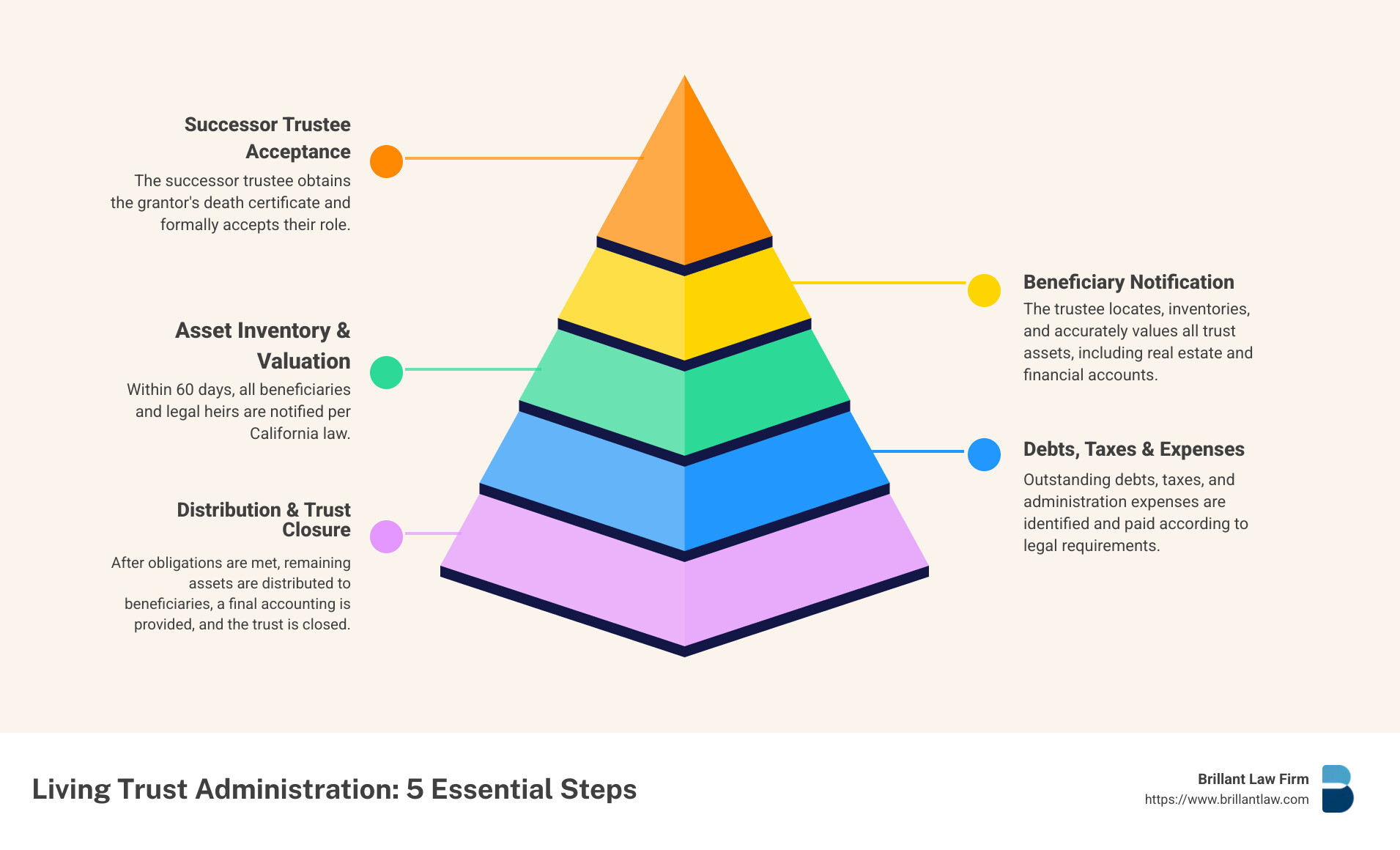
The administration of a living trust is the process of managing and distributing trust assets according to the trust’s terms, typically after the grantor’s death or incapacity. Here’s what you need to know:
- Step 1: Successor trustee obtains death certificate and accepts trustee role
- Step 2: Notify beneficiaries and heirs within 60 days (California requirement)
- Step 3: Inventory and value all trust assets
- Step 4: Pay debts, taxes, and expenses
- Step 5: Distribute remaining assets to beneficiaries
- Step 6: Provide accounting and close the trust
When someone creates a living trust, they’re planning for two scenarios: incapacity during life and the transfer of assets after death. The administration of a living trust begins in earnest when the trust creator (grantor) either becomes incapacitated or passes away. At this point, the successor trustee steps in to carry out the grantor’s wishes as documented in the trust.
Unlike probate, which can take 9-24 months and consume up to 7% of an estate’s value, trust administration generally provides a faster, more private, and often less expensive way to transfer assets to beneficiaries. However, the process still requires careful attention to legal requirements, fiduciary responsibilities, and proper accounting.
In California, trustees must follow specific procedures including providing statutory notices within 60 days, properly inventorying assets, and potentially filing tax returns. Failure to properly administer the trust can result in personal liability for the trustee.
I’m David Brillant, a Certified Specialist in Estate Planning, Trust and Probate Law by the State Bar of California Board of Legal Specialization with extensive experience guiding trustees through the administration of a living trust from simple to complex matters. As both a tax attorney and trust specialist, I understand the challenges trustees face when navigating their fiduciary duties.
Understanding Living Trust Fundamentals
Estate planning might seem overwhelming, but at its heart, a living trust is simply a legal arrangement that lets you (the grantor) place your assets into a trust during your lifetime. These assets are managed by a trustee (often yourself initially) for the benefit of your chosen beneficiaries.
Why do so many Californians choose living trusts? The primary benefits are threefold: avoiding probate, maintaining privacy, and ensuring a smooth transition of assets when you pass away or become incapacitated. Unlike a will that only activates after death and must go through public probate proceedings, a properly funded living trust works both during your life and continues seamlessly after you’re gone.
As the California Courts simply put it: “A trust manages the distribution of your assets.” This straightforward definition barely scratches the surface of the protection and flexibility a well-established trust provides during the administration of a living trust.
Living Trust vs Will—The Key Differences
While both wills and living trusts help distribute your assets after death, they function quite differently in practice:
| Feature | Living Trust | Will |
|---|---|---|
| Probate | Avoids probate | Requires probate |
| Privacy | Private document | Public record |
| Effective | During life and after death | Only after death |
| Incapacity Planning | Provides for management | Requires separate document |
| Cost to Create | Generally higher | Generally lower |
| Cost to Administer | Often lower | Often higher (probate fees) |
| Amendment Process | Relatively simple | Requires codicil or new will |
| Court Supervision | Minimal to none | Court-supervised |
One of my clients recently shared, “I watched my neighbor’s family wait almost two years for probate to complete while paying thousands in attorney fees. I don’t want to put my children through that.” This sentiment resonates with many Californians seeking alternatives to probate.
The numbers tell a compelling story. California probate can drag on for 9-24 months and consume up to 7% of your estate’s value. By contrast, the administration of a living trust typically costs significantly less and completes within 6-12 months, depending on your estate’s complexity.
Beyond cost savings, a living trust offers privacy protection. Unlike probate, which creates public records anyone can access, your trust affairs remain private—something many families greatly value during difficult times.
Revocable vs Irrevocable Living Trusts
Living trusts come in two main varieties, each serving different needs:
Revocable Living Trusts:
These offer flexibility during your lifetime. You maintain control over your assets and can change or even cancel the trust entirely as your circumstances change. One client described it perfectly: “A revocable trust is like a safety box you can open, change, or cancel whenever you want.”
Revocable trusts don’t provide asset protection from your creditors during your lifetime, and they offer no immediate tax benefits. However, they automatically become irrevocable when you pass away, ensuring your final wishes are carried out.
Irrevocable Living Trusts:
Once established, these trusts can’t be easily changed or revoked. You permanently transfer assets out of your name and relinquish control—a significant trade-off that comes with potential benefits including asset protection from creditors and possible tax advantages.
As another client colorfully explained, an irrevocable trust is “a safety deposit box you lock with no key to reopen.”
Most Californians establish revocable living trusts, striking a balance between lifetime flexibility and posthumous probate avoidance. This approach allows you to maintain control of your assets while living, then provides for smooth asset transition after your passing without court intervention.

Administration of a Living Trust: Step-by-Step Checklist
When someone passes away or becomes incapacitated, the administration of a living trust transforms from a theoretical plan into a very real responsibility. If you’ve just been named as a successor trustee, you might be feeling overwhelmed—and that’s completely normal. Let’s break down this process into manageable steps that will help you steer this important responsibility.
Taking Control as Successor Trustee
Your journey begins with formally stepping into the trustee role. Think of this as picking up the baton in a relay race—the grantor has done their part, and now it’s your turn to carry their wishes forward.
First, you’ll need to obtain proof that your authority has been triggered. This typically means getting several certified copies of the death certificate or, in cases of incapacity, physician statements confirming the grantor can no longer manage their affairs.
Next comes your formal acceptance of the role. This isn’t just a formality—it’s the moment you legally take on fiduciary responsibilities. Many trustees tell us this feels like a significant moment, and rightfully so.
“I remember staring at the acceptance document for a long time before signing,” one client shared. “It felt like the weight of my mother’s wishes all came down to that moment.”
A Certificate of Trust becomes your new best friend during the administration of a living trust. This streamlined document proves your authority without revealing the trust’s private details. Banks, investment firms, and government agencies will request this repeatedly, so keep several copies handy.
Serving Statutory Notices & Gathering Documents
California law doesn’t leave notification requirements to chance. Within 60 days of the trust becoming irrevocable (typically after the grantor’s death), you must send formal notices to all beneficiaries and legal heirs. The California Probate Code Section 16061.7 outlines exactly what these notices must contain.
These notices serve a crucial purpose: they start the clock on the 120-day period during which someone could contest the trust. While sending these notices might feel uncomfortable—especially if family relationships are strained—they protect you as trustee by limiting the window for potential challenges.
Beyond notifications, this is your document-gathering phase. You’ll need:
- The original trust document and all amendments
- Multiple certified death certificates
- Property deeds and vehicle titles
- Recent financial statements
- Previous tax returns
- Insurance policies
- A comprehensive list of assets and debts
“Organizing these documents early saves countless headaches later,” explains David Brillant. “Consider creating a dedicated filing system—physical or digital—to keep everything accessible and organized.”
Inventorying, Valuing & Protecting Trust Assets
Now comes the detective work: creating a thorough inventory of everything in the trust. This step is absolutely critical to the administration of a living trust and deserves your careful attention.
Start by listing all assets: real estate, bank accounts, investment portfolios, business interests, vehicles, valuable collections, and digital assets. For significant items like real estate or business interests, professional appraisals establish accurate values for tax purposes and ensure fair distributions later.
Don’t forget to secure physical assets immediately. This might mean changing locks on properties, updating insurance policies, or safely storing valuable collections. For financial accounts, contact each institution to notify them of the grantor’s passing and your role as trustee.
Digital assets require special consideration in our modern world. These might include cryptocurrency, online banking, email accounts, social media profiles, and digital photos or documents. Password managers, digital estate planning tools, or written instructions from the grantor can be invaluable here.

One often overlooked aspect is checking for assets that should be in the trust but weren’t properly transferred during the grantor’s lifetime. These “unfunded” assets might require additional legal steps like a Heggstad petition to bring them into the trust post-death.
Paying Debts, Taxes & Expenses
Before beneficiaries receive their inheritances, the trust must settle its obligations. This includes the grantor’s final expenses, outstanding debts, and various tax liabilities.
Start with immediate expenses like funeral costs and final medical bills. Then address ongoing obligations such as mortgage payments, utilities, and insurance premiums for trust properties. Credit card debts, personal loans, and other unsecured obligations follow according to California’s priority rules for creditors.
The tax landscape can be particularly complex during the administration of a living trust. You’ll likely need to:
- File the grantor’s final personal income tax return
- Obtain a new Taxpayer Identification Number (TIN) for the trust
- File federal trust income tax returns (Form 1041)
- File California trust tax returns (Form 541)
- Consider potential estate tax returns if the estate exceeds exemption thresholds
- Handle property tax reassessments under California law
“Most trustees are surprised by the complexity of tax obligations,” notes David Brillant. “This is one area where professional guidance often pays for itself by avoiding penalties and identifying potential tax savings.”
Keep meticulous records of all payments made from trust assets. Each expense should be documented with receipts and noted in your accounting records—beneficiaries have the right to review these details, and clear documentation protects you from potential questions or challenges.
Distributing Assets & Closing the Trust
The moment most beneficiaries are waiting for—distribution—comes only after debts and taxes are settled. The trust document serves as your roadmap here, dictating exactly who receives what and when.
Some trusts specify outright distributions: “I leave my home to my daughter Jane.” Others create ongoing sub-trusts with specific rules: “Hold my son’s inheritance until he reaches age 30, with distributions for education and healthcare in the meantime.”
For each distribution, prepare appropriate transfer documents (like deeds for real estate or stock transfers for investments) and obtain signed receipts from beneficiaries acknowledging what they’ve received. These receipts protect you by documenting that you’ve fulfilled your obligations.
Before making final distributions, experienced trustees typically:
- Retain a reasonable reserve for final expenses and contingencies
- Prepare a final accounting showing all trust transactions
- Request beneficiary releases that acknowledge receipt of their inheritance and release you from further liability
- Consult with legal counsel to ensure all bases are covered
“Closing a trust isn’t just about emptying bank accounts,” says David Brillant. “It’s about honoring the grantor’s legacy by executing their plan exactly as they intended, while maintaining family harmony wherever possible.”
The administration of a living trust concludes with final paperwork formally closing the trust or transitioning remaining assets to any continuing sub-trusts. This provides clean closure for everyone involved and marks the successful completion of your trustee responsibilities.
Trustee Duties: Fiduciary, Tax, and Distribution Obligations
When you step into the role of trustee during the administration of a living trust, you’re accepting a position of significant responsibility. As a trustee, you become what the law calls a fiduciary – someone who must act with the highest standards of care, loyalty, and integrity.
Think of being a trustee like being entrusted with someone else’s most precious possessions. Your job isn’t just to keep them safe, but to manage them wisely and distribute them exactly as the trust creator intended. This role comes with specific legal duties that can’t be taken lightly.
Your fiduciary duties include putting the beneficiaries’ interests ahead of your own (duty of loyalty), managing assets prudently (duty of care), treating all beneficiaries fairly (duty of impartiality), keeping everyone informed (duty to report), maintaining meticulous records (duty to account), avoiding conflicts of interest, and following the trust terms to the letter.
“Being a trustee isn’t just about following instructions,” says David Brillant. “It’s about embodying the trust the grantor placed in you to carry out their wishes with integrity and care.”
In California, trustees must follow the Prudent Investor Rule – investing trust assets as a thoughtful, careful investor would. This doesn’t mean you need to achieve perfect investment results, but you do need to diversify investments, balance income production with growth, keep costs low, and regularly review your strategy. Most importantly, you need to document your decision-making process to show you’re acting prudently.
Accounting & Recordkeeping Best Practices
Good recordkeeping isn’t just a nice-to-have – it’s essential for successful trust administration. California law requires you to keep beneficiaries reasonably informed, and proper accounting is how you demonstrate you’re managing the trust appropriately.
First and foremost, keep trust assets completely separate from your personal finances. This clear separation protects both you and the beneficiaries from confusion or potential allegations of impropriety. As one client put it, “Mixing personal and trust funds is like mixing oil and water – eventually, you’ll have a mess on your hands.”
Document everything carefully. Every penny that comes in or goes out should be recorded. Every asset sale, purchase, or distribution needs documentation. This might seem tedious, but these records are your protection if questions arise later.
Consider using specialized trust accounting software or working with a professional accountant familiar with trust administration. The modest expense is well worth the peace of mind and protection it provides.
Regular accountings should be provided at least annually, whenever a beneficiary reasonably requests one, when trustees change, and before final distributions. These accountings should tell the complete financial story of the trust – beginning balance, all transactions, ending balance, and any changes in asset values.
“A thorough trust accounting is like a clear financial photograph,” explains David Brillant. “When done right, it gives beneficiaries confidence that their interests are being properly managed and protected.”
Federal & California Tax Filings
Tax compliance represents one of the most technical aspects of the administration of a living trust. After the grantor passes away, several tax filings may be necessary, and missing deadlines can result in penalties that could have been easily avoided.
For federal taxes, you’ll likely need to file the grantor’s final personal income tax return, a trust income tax return (Form 1041) if the trust earns more than $600 in a year, and possibly a federal estate tax return (Form 706) for larger estates.
California has its own set of requirements, including the grantor’s final state income tax return, a California fiduciary income tax return (Form 541), and property tax reassessment notifications.
One significant tax benefit that comes into play during trust administration is the “step-up in basis.” This provision essentially resets the tax basis of inherited assets to their fair market value as of the date of death.
For example, imagine the grantor purchased stock decades ago for $10,000, and it’s worth $100,000 when they pass away. Without the step-up, if beneficiaries sold the stock, they’d owe capital gains tax on $90,000 of appreciation. With the step-up, the new basis becomes $100,000, and they’d only pay tax on gains above that amount.
“The step-up in basis is like hitting the tax reset button,” says David Brillant. “It can save beneficiaries thousands in capital gains taxes, but only if you properly document the assets’ values at the time of death.”
Managing Beneficiary Expectations & Distribution Schedules
Perhaps the most human aspect of the administration of a living trust is managing relationships with beneficiaries. Clear, compassionate communication can prevent misunderstandings and potential conflicts.
Beneficiaries often don’t understand the time and legal requirements involved in trust administration. Taking time early in the process to explain what will happen, approximately how long it will take, and what you need from them can prevent frustration later.
“I always tell new trustees to communicate more than they think is necessary,” advises David Brillant. “Even a simple monthly update saying ‘we’re still waiting on the appraisal’ or ‘tax returns will be filed next week’ goes a long way toward maintaining trust and patience.”
Be especially careful with trusts that include staggered distributions or conditions. When a trust specifies that beneficiaries receive assets at certain ages or upon meeting specific conditions, clearly explain these terms upfront. Sometimes beneficiaries expect immediate distributions and feel disappointed or even suspicious when told they must wait.
Transparency about fees and expenses is equally important. Beneficiaries deserve to know what costs are being paid from trust assets. While professional fees for attorneys, accountants, and even reasonable trustee compensation are legitimate expenses, unexplained charges can breed distrust.
For trusts with spendthrift provisions or other protective language, you may need to balance honoring the grantor’s wishes with maintaining positive relationships. Sometimes this means compassionately explaining why certain restrictions exist while still enforcing them as required by the trust terms.
Behind every trust are real people with real emotions. The administration of a living trust isn’t just about following legal procedures – it’s about honoring the grantor’s legacy while treating beneficiaries with respect and understanding during what is often a difficult time in their lives.
Challenges, Disputes, and Professional Guidance
Even the most carefully planned trusts can hit rough waters during the administration of a living trust. Like family gatherings during the holidays, trust administration sometimes brings underlying tensions to the surface.
Beneficiary Conflicts are perhaps the most common challenge. These aren’t just about money—they’re often about deeper family dynamics. I’ve seen siblings dispute the distribution of a family heirloom worth far less than the legal fees they spent arguing over it. Other common conflicts include disagreements about asset valuations, concerns about fairness, and questions about the trustee’s decisions or fees.
Trust documents themselves can create problems through ambiguities or outdated provisions. A trust created 20 years ago might not address digital assets or may contain language that doesn’t quite fit today’s family structures. Sometimes the language is simply unclear, leaving the trustee to interpret what the grantor really meant.
Asset-related challenges add another layer of complexity. From the vacation property that nobody can find the deed for, to the family business that’s difficult to value, to assets that were never properly titled to the trust—these situations require patience and often professional guidance.

When conflicts heat up, professional mediation often provides a cooling effect. A skilled mediator can transform accusatory “you” statements into productive conversations about shared interests. As one client told me after a successful mediation, “I finally felt heard, not just by the mediator but by my sister. That mattered more than the money.”
“In my experience,” shares David Brillant, “most trust disputes stem from emotional factors rather than purely financial ones. Beneficiaries often feel that distributions reflect the grantor’s feelings about them, making disputes as much about validation and recognition as about the assets themselves.”
Common Pitfalls in the Administration of a Living Trust
During the administration of a living trust, trustees can stumble into several common traps. Understanding these pitfalls can help trustees avoid painful (and potentially expensive) mistakes.
Missing statutory deadlines is a frequent error. California law imposes specific timeframes for notices and filings, and these aren’t merely suggestions—they’re requirements with real consequences. When a trustee fails to send the 60-day notice to beneficiaries, for example, it can extend the period during which beneficiaries can contest the trust.
Poor communication breeds suspicion. When beneficiaries are kept in the dark, they often assume the worst. As one client wisely noted, “An email a month kept the lawyers away.” Regular updates, even when there’s little progress to report, help maintain trust and prevent misunderstandings.
Commingling assets is a cardinal sin in trust administration. When a trustee deposits trust funds into their personal account—even temporarily—they’ve crossed a bright line. Similarly, self-dealing transactions where trustees benefit personally create serious liability issues.
Investment mismanagement can erode trust assets and create liability for the trustee. California’s Prudent Investor Rule requires thoughtful investment decisions, appropriate diversification, and regular monitoring—not just picking investments the trustee personally likes.
“The road to trust litigation is paved with good intentions,” cautions David Brillant. “Many trustees get into trouble not because they’re trying to do something wrong, but because they don’t understand their legal obligations or the proper procedures.”
When to Engage CPAs, Attorneys, and Fiduciaries
While some straightforward trusts can be administered without extensive professional help, knowing when to call in the experts can save time, money, and family relationships.
Consider consulting an attorney when the trust contains complex provisions or unusual assets. Legal counsel becomes particularly important when assets weren’t properly funded into the trust (requiring a Heggstad petition or other court procedure), when beneficiaries are threatening litigation, or when the trust owns business interests or intellectual property.
A client recently told me, “I thought hiring an attorney was an unnecessary expense until I realized the potential liability I faced as trustee. That attorney fee was the best insurance policy I ever bought.”
A CPA’s expertise proves invaluable when the trust has significant income, requires multiple tax returns, or involves business interests. Tax professionals can identify opportunities for tax savings and help avoid costly filing mistakes. They’re particularly helpful when beneficiaries live in different states or countries, creating multi-jurisdictional tax issues.
Professional fiduciaries shine in situations where family dynamics make it difficult for a family member to serve impartially. They’re also worth considering when the trust will continue for many years (as with provisions for minor children) or contains complex assets requiring specialized management.
“Professional assistance in trust administration isn’t an unnecessary expense—it’s an investment in doing things right the first time,” explains David Brillant. “The cost of fixing mistakes after the fact is almost always higher than the cost of getting expert guidance from the beginning.”
Terminating or Extending the Trust
Most living trusts are like good houseguests—they know when it’s time to leave. Typically, a trust terminates after completing its purpose, usually after distributing all assets to beneficiaries. However, some situations call for extending a trust or creating ongoing sub-trusts.
Formally terminating a trust involves several important steps. First, the trustee must distribute all remaining assets according to the trust terms. Next comes preparing a final accounting that documents all transactions throughout the administration period—think of it as the trust’s financial biography.
Obtaining releases from beneficiaries provides important protection for the trustee. These releases acknowledge that beneficiaries have received their distributions and release the trustee from future claims. Filing final tax returns and providing formal notice of termination complete the process.
In California, the Rule Against Perpetuities places limits on how long a trust can last. Generally, a trust must end no more than 90 years after its creation, or 21 years after the death of a beneficiary who was alive when the trust was created. This rule prevents trusts from controlling assets indefinitely.
Before terminating a trust, wise trustees set aside a reasonable reserve fund for any final expenses or contingencies. Nothing complicates a “completed” trust administration like finding an overlooked asset or unexpected tax bill after all funds have been distributed.
“Trust termination should be approached with the same care as trust administration,” advises David Brillant. “A properly documented termination protects the trustee from future claims and provides beneficiaries with closure.”
Conclusion
The journey through administration of a living trust might seem like navigating a complex maze, but with the right guidance and approach, it becomes a manageable process that honors your loved one’s final wishes. Throughout this article, we’ve walked through each critical step – from the successor trustee stepping into their role to the final distribution of assets and closing of the trust.
Trust administration isn’t just about paperwork and legal requirements. At its heart, it’s about carrying forward someone’s legacy and ensuring their careful planning benefits the people they cared about most. Each decision a trustee makes ripples through family relationships and financial futures, which is why approaching this responsibility with care matters so deeply.
I’ve seen how proper trust administration brings families peace during difficult times. One client recently shared, “Knowing my mother’s wishes were carried out exactly as she wanted gave our family closure during our grief. The process wasn’t nearly as overwhelming as we feared.”
At Brillant Law Firm, we understand that no two trusts are identical – just as no two families share the same dynamics, assets, or goals. We specialize in providing California trustees with customized guidance that addresses their specific circumstances, helping them steer their fiduciary duties with confidence while minimizing potential liability.
Administration of a living trust requires attention to detail, but it shouldn’t consume your life or create unnecessary anxiety. Our team combines deep expertise in both trust law and taxation – a powerful combination that helps protect both trustees and beneficiaries throughout the process.
Whether you’re a trustee just beginning the administration journey or someone planning your estate, we’re here to help. Our approach focuses on clear communication, practical solutions, and honoring the intentions behind the trust. After all, proper trust administration isn’t just about checking legal boxes – it’s about ensuring someone’s final wishes for their loved ones unfold exactly as they envisioned.
For more information about our trust administration services, please visit our Trust Administration page or contact our office directly. We’re ready to help you steer this important responsibility with confidence and care.


